Performance and Limitations
This page covers Task F. Performance and Limitations from the FAA-S-ACS-25 Flight Instructor for Airplane Category Airman Certification Standards.
Use of Charts, Tables, and Data to Determine Performance
- See Section 5 of aircraft POH for performance information
- Key phases of flight, performance charts to consult, and how they impact decision making
- Takeoff and climbout
- Is there enough runway to safely takeoff?
- Is climb performance sufficient to clear surrounding terrain?
- Cruise and fuel burn
- Ensure enough fuel is available to complete flight
- Determine duration of flight to know which weather forecasts to reference
- Landing
- Is there enough runway to safely land?
- Takeoff and climbout
Altitudes
- Indicated altitude
- What altimeter says
- True altitude
- Actual MSL height
- Absolute altitude
- AGL height
- Given by subtracting height of terrain from true altitude
- Pressure altitude
- Height above 29.92 inHg standard datum plane (SDP).
- The standard datum plane is the theoretical level in the atmosphere where the pressure is 29.92 inHg.
- What altimeter reads when setting altimeter to 29.92 inHg.
- Density altitude
- Pressure altitude corrected for nonstandard temperature
- Vertical distance above sea level in the standard atmosphere at which a given density is to be found.
Converting
- If the temperature is colder than that of the standard atmosphere, true altitude will be lower than indicated altitude
- First determine the standard temperature at the indicated altitude
- Recall: 15 °C at sea level and lapse rate of 2 °C per 1000 ft
- Example: at 20,000 ft the standard temperature is -25 °C, if the actual temperature is -35 °C then the ISA deviation is -10 °C.
- Note: in the formulas below, temperature is in Celcius.
- True Altitude = Indicated Altitude + ((OAT - ISA Temperature) x Indicated Altitude / 273 )
- Pressure Altitude = ((29.92 - Current Altimeter Setting) x 1,000) + True Altitude
- Density Altitude = Pressure Altitude + (120 x (OAT - ISA Temperature))
Factors Affecting Performance
Atmospheric Conditions
- High density altitude affects T/O, landing, climb rate
- Wind
Pilot Technique
- Achieving the performance calculated during preflight planning is dependent on the pilot flying the aircraft as directed
Airplane Configuration
- Achieving the performance calculated during preflight planning is dependent on the pilot configuring the aircraft as directed
Airport Environment
- Runway surface
- e.g. paved, grass
- Runway slope
Loading and Weight and Balance
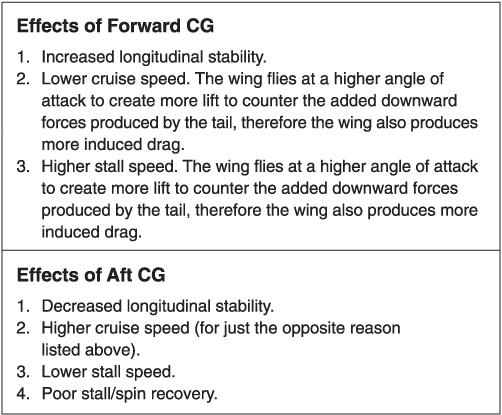
- CG too far forward
- Longer takeoff distance
- Higher stalling speed
- Reduced elevator effectiveness
- Increased stability
- Reduced fuel economy and speed
- Limit imposed by making sure enough elevator authority to hold the aircraft in normal glide with power off / aircraft's landing characteristics are suitable.
- CG too far rearward
- Worse than too far forward
- Unstable
- Reduced elevator effectiveness
- May not be able to recover from a spin
- Limit imposed by stability (making sure aircraft has correct damping) / stall recovery
Weight and Balance Terms
- Including
- Basic empty weight
- Maximum gross weight
- Arm
- Moment
- Reference datum
- Center of gravity (CG) and CG limits
- Useful load
Definitions
- Standard empty weight
- Plane and all permanently installed operating equipment
- Also includes hydraulic fluid, unusable fuel, full engine oil
- Basic empty weight
- Standard empty weight plus optional and special equipment that have been installed
- Ramp weight
- Plane loaded for flight prior to engine start (also known as taxi weight)
- Takeoff weight
- Ramp weight minus fuel burned during taxi and run-up
- Landing weight
- Greatest weight that an aircraft is normally allowed to have at landing
- Useful load
- Ramp weight or takeoff weight minus basic empty weight
- Basically stuff the pilot can choose to put in the aircraft - how much fuel, passengers, luggage
- Payload
- Weight of passengers and cargo only
- Usable fuel
- Fuel available during flight
The equipment list for an aircraft is located with the weight and balance data.
Standard Weights
- Gasoline: 6 lb/US gal
- Jet A, Jet A-1: 6.8 lb/US gal
- Jet B: 6.5 lb/US gal
- Oil: 7.5 lb/US gal
- Water: 8.35 lb/US gal
Determination of Weight and Balance
- See Section 6 of aircraft POH for weight and balance information
- Need to use actual weight and balance info kept in the airplane
- The W in S.P.A.R.(R).O.W is for weight and balance
- Weight and balance calculations are along the longitudinal direction
- Weight won't vary too much along lateral axis, but can depending on passenger configuration and assymetric fuel burn
- See below for weight and balance for N3622A
Methods for computing CG
- TBD
Aerodynamics
- TBD
Effects of Exceeding Aircraft Limitations
Understand how to determine aircraft weight and balance and performance limitations, and the importance of operating the aircraft within its limitations to remain safe and avoid damage to the aircraft.
- See Section 2 of aircraft POH for Limitations
- Placards (also in POH)
- Purpose: Mitigate risk of damage
- Generally CG affects stability and control
- Limitations include
- Weight and balance
- Airspeed
- Powerplant
- Maneuver
- For example, spins may be approved
- Also depends on loading and thus category (utility or normal)
- Flight into known icing
- Fuel
- How much fuel can be carried
- Oil
- Type of oil
- Flap
- Airspeeds flaps can be used
- Gear
- Airspeeds when retractable gear can be used
- Instrument
- Excessive pitch attitutde can tumble attitude indicator
Aircraft are certificated for weight and balance for two principal reasons:
- The effect of the weight on the aircraft's primary structure and its performance characteristics
- The effect of the location of this weight on flight characteristics, particularly in stall and spin recovery and stability
Multi-engine Performance
- Accelerate-stop / accelerate-go distances
- What will happen if an engine failure is encountered at various points during takeoff and climbout?
- See Baron-specific section below for performance charts
- All engine service ceiling
- Maximum altitude at which the plane will climb at a rate of 100 FPM in smooth air with AEI
- All engine absolute ceiling
- Maximum altitude at which the plane will no longer climb at all with AEI
- Single engine service ceiling
- Maximum altitude at which the plane will climb at a rate of 50 FPM in smooth air with OEI
- Single engine absolute ceiling
- Maximum altitude at which the plane will no longer climb at all with OEI
- Accelerate-stop distance
- Achieve maximum power prior to break release
- Reach lift-off speed
- Both throttles to idle
- Come to a complete stop
- 14 CFR § 23.55 (2017) for aircraft more than 6,000 lb
- Accelerate-go distance
- Achieve maximum power prior to break release
- Reach lift-off speed
- One engine dies
- Climb to a height of 50 feet
- Performance data in POH based on a new aircraft
- Performance data in POH is based on trained professional test pilot
- No requirements on runway length that are dependant on accelerate-stop or accelerate-go distances
- Use good ADM to determine personal minimums associated with runway use