Demonstration of Flight Characteristics at Various Configurations and Airspeeds
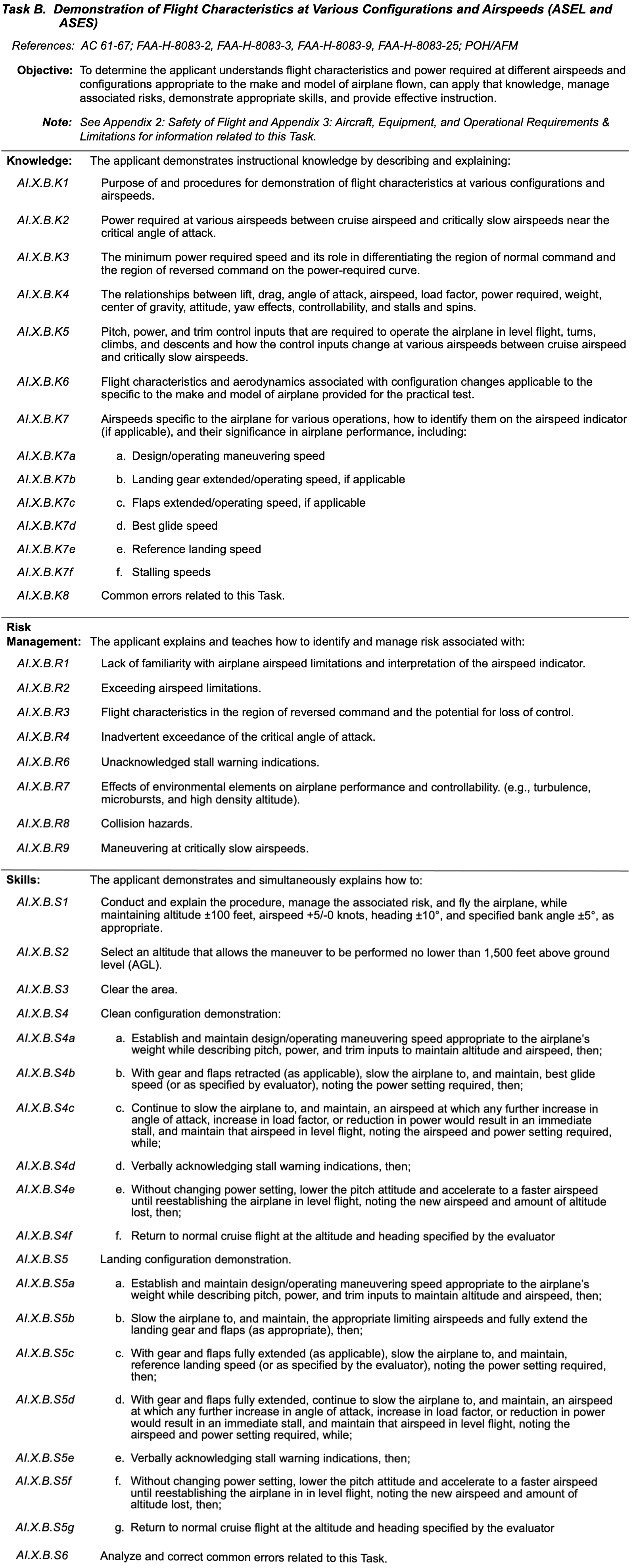
This page covers Task B. Demonstration of Flight Characteristics at Various Configurations and Airspeeds from the FAA-S-ACS-25 Flight Instructor for Airplane Category Airman Certification Standards.
- The knowledge elements for this maneuver list things that should be taught when performing this maneuver.
- There are two separate demonstrations in this task: clean configuration and landing configuration.
- The skills section of the ACS is very prescriptive when it comes to performing each of these demonstrations.
- The following notes should help couple the instruction of the various knowledge elements with the demonstration as outlined in the skills section.
- These notes apply Piper Archer PA-28-181 specific information and values.
Prerequisites
- The maneuvering speed for the Archer is
- 1917 lb - 98 KIAS
- 2550 lb - 113 KIAS
- Calculate maneuvering speed based on W&B, taking into account fuel burn.
- For example, at 2300 lb maneuvering speed is 107 KIAS.
- Perform the maneuver no lower than 1,500' AGL.
Introduction
- The purpose of this maneuver is to demonstrate many of the elements covered during the "Principls of Flight" ground lesson.
- This includes:
- The power curve
- Front and back side
- Region of normal and reversed command
- Induced drag and parasitic drag
- The effect of flaps
- The lift equation
- Trim
- And more
- The power curve
- We want to be able to understand how the aircraft behaves across the range of airspeeds and configurations.
Clean Configuration Demonstration
- Start by flying at maneuvering speed
- Depending on the speed at which the plane is at prior to commencing the maneuver, a power change may be required.
- Teach to the power change necessary along with corresponding pitch change to maintain level flight, and need to re-trim the airplane.
- The target maneuvering speed is a function the airplane's weight, and that it has been calculated given the weight and balance for the flight.
- Maneuvering speed is also not indicated on the airspeed indicator, but there is a placard.
- Note the power setting, pitch attitude, and sight picture.
- For example: 2400 RPM, 107 KIAS, 2.5° pitch.
- During this phase of flight parasitic drag is dominant.
- Slow the plane to best glide speed
- Best glide speed is not indicated on the airspeed indicator.
- Aside: the G1000 does allow airspeed references to be defined, although in the Archer with Vg and Vy being equal, I think it only shows Vy.
- Note that on the front of the power curve a power reduction is required to slow the plane.
- This is the region of normal command, and the rather intuitive part of the demonstration -- that to slow down less power is required.
- As we slow parasitic drag decreases and induced drag increases.
- Teach to the reason as to why best glide speed is chosen as the target airspeed for this step in the demonstration -- that (recalling the ground lesson and discussion on the power curve) it is where we fly "efficiently" -- specifically where the ratio of lift to drag is maximized.
- Aside: note that minimum power required speed (best endurance) and best range calculations differ between jet and propellor planes, L/D calculations are different for powered versus unpowered flight, and that nuance is beyond the scope of pilot training.
- This is the bottom of the power curve and where parasitic drag and induced drag are equal, and where total drag is minimum, and where minimum power is required to maintain level flight.
- The bottom of the power curve is the boundary between the front and back sides of the power curve.
- Speak to the lift equation and how it tells us that to maintain level flight at a slower airspeed that we need to increase our lift coefficient
. - We increase the lift coefficient by increasing angle of attack, which we control by increasing the pitch attitude of the plane via increased aft stabilator input.
- Speak to the need to re-trim the plane.
- Note the power setting, pitch attitude, and sight picture.
- For example: 2050 RPM, 76 KIAS, 7.5° pitch.
- Best glide speed is not indicated on the airspeed indicator.
- Slow the plane to just above stall speed
- Note that to slow we need to initially reduce the power to slow, but that as we slow to the back side of the power curve, or the region of reversed command, we'll need to anticipate the need to add power to maintain level flight.
- Acknowledge the stall warning horn.
- Continue to slow and acknowledge further signs of impending stall -- buffeting and "mushiness" of the controls.
- As power is added back in, teach again to lift equation, increased pitch via increased aft stabilitor input, and need to retrim.
- Note the need for additional right rudder due to increased left turning tendencies as power is added back in, and at the high angle of attack due to increase P-factor.
- Teach the importance of coordination, dangers of uncoordinated stalls resulting in spins.
- Note the power setting, pitch attitude, and sight picture.
- For example: 2000 RPM, 52 KIAS, 12.5° pitch.
- Accelerate by lowering the nose and not touching throttle
- Gently nudge the nose forward, let the plane descend a bit to accelerate, and retrim for level flight all without touching the throttle.
- Teach this back to the power curve that for a fixed power setting there are two trimmed flight conditions: one on the front and one on the back of the power curve.
- By descending a bit we are finding the flight condition on the front of the power curve that corresponds to the same power setting we just had on the back of the power curve.
- Note the power setting, pitch attitude, and sight picture.
- For example: 2100 RPM, 80 KIAS, 7.0° pitch.
- Teach that while we didn't touch the throttle the RPMs increased due to the windmilling effect.
- Note altitude lost.
- Return to normal cruise flight.
Landing Configuration Demonstration
- TBD
Other Points
- There are certainly other points that may be worth mentioning, but the notes above should hit the major ones.
Standards
- Altitude: +/- 100'
- Airspeed: +5 / -0 KIAS
- Heading: +/- 10°
- Bank: +/- 5°
Completion Standards