Night Operations
This page covers Task M. Night Operations from the FAA-S-ACS-25 Flight Instructor for Airplane Category Airman Certification Standards.
Night Vision
- Cones
- Color vision
- Concentrated toward center of field of vision
- Rods
- Running (movement)
- Provide vision in dim lighting
- Not many rods in center of field of vision
- Night Flying
- Rods are 10,000x more receptive than cones
- Use peripheral vision
- Avoid bright flashlights
- Diet and physical health have an impact on how well a pilot can see, especially in the dark.
- Anything that may affect a pilot's physical or mental condition will reduce visual acuity-illness, medication, stress, alcohol, fatigue, motion, hypoxia, etc.
- CO poisoning, smoking, alcohol, certain drugs, and a lack of oxygen can greatly decrease night vision.
- Deficiencies in Vitamin A and C have been shown to reduce night acuity.
- Close one eye when using light to preserve some degree of night vision, since any degree of dark adaptation is lost within a few seconds of viewing a bright light.
- Adaptation time from bright to dark – 30 minutes, use red lights
- Blind spots, look for traffic out of side of eyes
- Physical condition can have an effect (colds, fatigue, vitamin deficiency)
- Oxygen use above 5,000ft
- Disorientation, closest thing to instrument flying, rely on instruments, know MEF
- Hypoxia
- Without supplemental oxygen, an individual's night vision declines measurably at pressure altitudes above 4,000 feet.
- Bright lights at night
- Airport lighting before flight
- Flight deck lighting
- Dark adaptation
- Takes 30 minutes for eyes to adjust to dark conditions
- Dark adaptation of eyes impaired by lack of oxygen
- This occurs at altitudes over 5,000 ft. MSL
- Excessive illumination can produce glare-uncontrollable squinting, watering of the eyes, and even temporary blindness.
- Light reflected off canopy, surfaces inside aircraft, clouds, water, snow, and desert terrain.
- Smoke, haze, dust, rain, and flying toward the sun can reduce the ability to see other aircraft.
- Small print and colors become unreadable unless adequate lighting is available-aeronautical charts and instruments become hard to read.
Scanning
- Scanning techniques are very important in identifying objects not just at night but during the day too.
- Scan in sections about 30° wide from far to near
- Scan each section up to about 2 to 3 seconds
- Overlap each scan section by about 10°
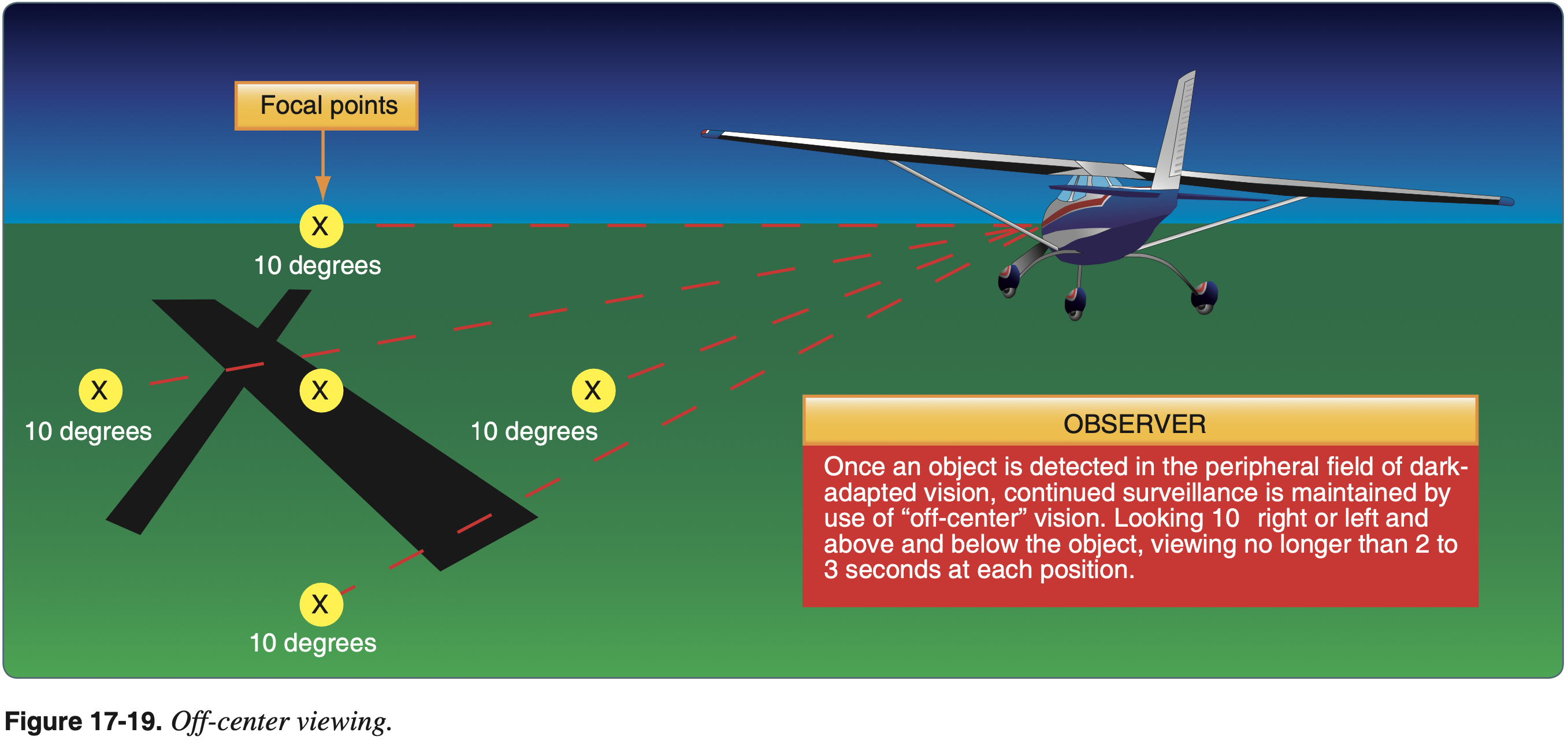
- Off-center viewing
- Type of scan that pilots can use during night flying to rely more on rods
- That's because the cones are in the center of view and the rods more peripheral and rods are used for night vision
- Look 10° above, below, or to either side of the object
- An object viewed longer than 2 to 3 seconds will seem to disappear
- Type of scan that pilots can use during night flying to rely more on rods
- Refocus eyes outside to look for targets
- Empty-Field Myopia
- Induced nearsightedness
- If there is nothing specific to focus on, eyes default to focusing at 10-30'
- Search out and focus on distant light sources, no matter how dim, to help prevent empty field myopia.
- Empty-Field Myopia
Airport Lighting
- Taxiway centerline lights - green
- Taxiway edge lights - blue
- Runway centerline lights
- White
- Last 3000 ft: alternating red and white
- Last 1000 ft: red
- Runway edge lights
- Three intensities: high, medium, low
- White
- When an instrument runway lighting is designed, the last 2,000 ft. or one-half of the runway length available (whichever is less), are yellow.
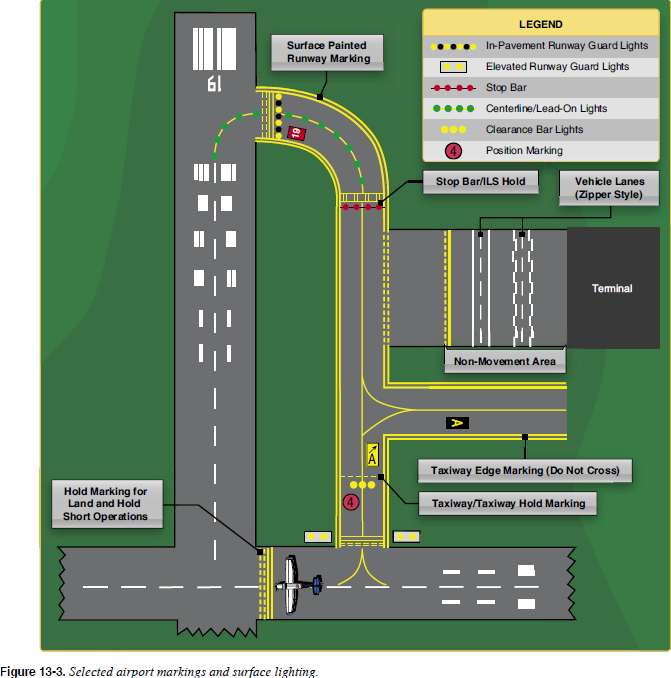
- Runway Guard Lights are installed at taxiway/runway intersections.
- They are primarily used to enhance the conspicuity of taxiway/runway intersections during low visibility conditions, but may be used in all weather conditions.
- Runway guard lights consist of either a pair of elevated flashing yellow lights installed on either side of the taxiway, or a row of in-pavement yellow lights installed across the entire taxiway, at the runway holding position marking.
- Will be flashing at all times.
- Runway Stop Bar Lights
- Red "stop sign" lights before proceeding onto runway they must not be red
- Pilots should never cross a red illuminated stop bar, even if an ATC clearance has been given to proceed onto or across the runway.
- See AIM 2-1-11 Taxiway Lights
Equipment and Lighting Requirements
- Flashlight: white light is used to preflight the aircraft; red light is used when performing cockpit operations, as it will not impair night vision as much.
- When using a red light on an aeronautical chart, the red colors will wash out.
- Aeronautical charts: if the intended course of flight is near the edge of a chart, keep the adjacent charts available.
- City lights can be seen at far distances, and charts are helpful at clearing out confusion.
- Organization eases the pilot's burden.
- Required equipment for VFR flight at night A+TOMATO FLAMES and FLAPS
- F - Fuses
- L - Landing light
- A - Anti-collision lights
- P - Position lights
- S - Source of power
- IFR-required equipment does not hurt
- Interior Lights
- Overhead light
- Pedastal light
- Instrument lights
- Panel display
- Flightdeck lighting should be kept as low as possible so that the light does not monopolize night vision.
- After reaching the desired flight altitude, pilots should allow time to adjust to the flight conditions.
- This includes readjustment of instrument lights and orientation to outside references.
- During the adjustment period, night vision should continue to improve until optimum night adaptation is achieved.
The official source of information on sun set/rise, civil twighlight, is the Air Almanac, published by the US Naval Observatory, and found here: http://aa.usno.navy.mil/publications/docs/aira.php
The Air Almanac, and tables for sun set/rise can be found online here: http://aa.usno.navy.mil/data/docs/RS_OneYear.phpNote the times here are in standard local time, and so need to be converted to daylight time when applicable.
Personal Equipment
- Red flashlight
- This no longer seems to be the case according to PHAK
- When it is necessary to read maps, charts, and checklists, use a dim white light flashlight and avoid shining it in your or any other crewmember's eyes.
Night Orientation, Navigation, and Vision
- Checkpoints - there are less of them, but it does not pose a problem.
- Light patterns of towns are easily identified. Rotating beacons are useful. Highways make good checkpoints.
- Easier to become disoriented in relation to location-continuously monitor position, time estimates, and fuel consumed.
- Use NAVAIDS whenever possible.
- Difficult to see clouds at night - exercise caution to avoid flying into MVFR/IFR weather conditions.
- The first indication will be the gradual disappearance of the ground and glowing around lights.
Use of Instruments
- Use instruments
Visual Illusions
- See Spatial Disorientation
- Lights can be mistaken for stars
- False horizon: Cloud layers or mountains can provide this illusion
- Distractions from flickering lights
- "Black Hole Approach" – when there is no visual references = use VASI/PAPI or NAV Aids
- Bright runway and ALS can give the illusion of being too low
Taxiing Operations
- Starting the engine
- Be sure the propeller area is clear.
- Turn on position and anti-collision lights prior to start, and announce "Clear prop."
- Keep all unnecessary electrical equipment off to avoid draining the battery.
- Reduce taxi speeds because of restricted vision.
- Do not taxi faster than a speed that will allow you to stop within the distance you can clearly see.
- Use the landing/taxi lights as necessary-caution overheating (no airflow).
- Do not use strobes/landing lights in the vicinity of other aircraft, as they can be distracting or blinding.
- Use an airport diagram, and understand taxiway markings, lights, and signs.
- Perform the before taxi runup with the checklist, as usual.
- Forward movement of the airplane may not be easy to detect.
- Hold the brakes and be alert that the airplane could potentially creep forward without being noticed.
Determining Traffic Position and Direction
- Use nav lights to orient other aircraft's direction in relation to your own.
- Red light on left wing
- Green light on right wing
- White light on tail
Appendix
Takeoff and Climb-out
- Clear the area for approaching traffic on the final approach.
- At non- towered airports, make a 360° turn in the direction of air traffic, to clear the area.
- After receiving clearance, align the airplane with the centerline, and check to ensure the magnetic compass and directional gyro match the intended runway.
- Perform a normal takeoff, depending more on instruments, as many visual cues are not available.
- Perception of runway width, airplane speed, and flight attitude will vary at night.
- Check flight instruments frequently.
- Adjust pitch attitude to establish a normal climb as the airspeed reaches
. - Refer to outside visual references (e.g. lights) and flight instruments.
- Check attitude indicator, vertical speed indicator, and altimeter, to ensure the airplane is climbing.
- The darkness makes it hard to tell by outside references.
- Make necessary adjustments by referencing the attitude and heading indicators.
- Don't make any turns until reaching a safe maneuvering altitude.
Emergencies
- Will be difficult to find a landing site, avoid lights since they will be houses or structures
- Lack of lights will likely be lakes or forests – but who knows...
- ABCDE Emergency Checklist
- Electrical emergency
- The greatest electrical load is placed on the system at night, resulting in the greatest chance of failure.
- In case of a suspected problem, reduce the load as much as feasible.
- If you expect a total failure, land at the nearest airport immediately.
- Engine emergency
- Don't panic-establish a normal glide and turn toward an airport, or away from congested areas.
- Check to determine the cause and correct immediately if possible, using the engine restart checklist.
- If unable to restart, maintain positive control of the airplane at all times, and orientation with the wind-do not land downwind.
- Check the landing lights and use them on landing if they work.
- Announce the emergency on the frequency with ATC or UNICOM. Don't change frequency unless instructed to.
- Consider an emergency landing area close to public access.
- Use the before landing checklist, and touch down at the lowest possible airspeed.
- After landing, turn off all switches and evacuate as quickly as possible.
Traffic Patterns
- Consider overflying the field first to get a better look at the environment
- Identify the runway/airport lights as soon as possible.
- It may be difficult to find the airport or the runways-fly towards the beacon until you identify runway lights, and compare the runway lights with your heading to ensure you are at the right place.
- Distance may be deceptive at night due to limited light conditions - lack of references on ground and inability to compare their location and size.
- Depend more on instruments, particularly the airspeed indicator and altimeter.
- Use the landing light for collision avoidance, and fly a normal traffic pattern.
- Know the location of the runway/approach threshold lights at all times.
- When entering the pattern, allow for plenty of time to complete the before landing checklist, and execute the approach in the same manner as during the day.
Landing without Landing Light
- Make a stabilized approach, in the same manner as during the day.
- Use flight instruments more often, especially altimeter/airspeed indicator, as distance may be deceptive.
- Maintain specified airspeeds on each leg, and watch the VSI to keep the approach under control.
- If there are no centerline lights, align the airplane between the edge lights.
- Note and correct any wind drift, and use power and pitch corrections to maintain a stabilized approach.
- If available, use approach lights (VASI, PAPI, etc.) to maintain glideslope.
- Make a smooth and controlled roundout and touchdown in the same manner as in day.
- Impaired judgment of height, speed, and sink rate may create a tendency to round out too high.
- Start the roundout when the landing light reflects on the tire marks on the runway, or when the runway lights at the far end appear to be rising higher than the airplane.
Go-around
- Restricted visibility makes a prompt decision even more necessary at night - be prepared in case the maneuver becomes necessary.