Chandelles
This page covers Task C. Chandelles from the FAA-S-ACS-25 Flight Instructor for Airplane Category Airman Certification Standards.
Purpose and Procedure
From FAA-H-8083-3C Airplane Flying Handbook Chapter 10: Performance Maneuvers:
Performance maneuvers serve to further develop piloting skills. Performance maneuvers enhance a pilot's proficiency in flight control application, maneuver planning, situational awareness, and division of attention. To further that intent, performance maneuver design allows for the application of flight control pressures, attitudes, airspeeds, and orientations that constantly change throughout the maneuver.
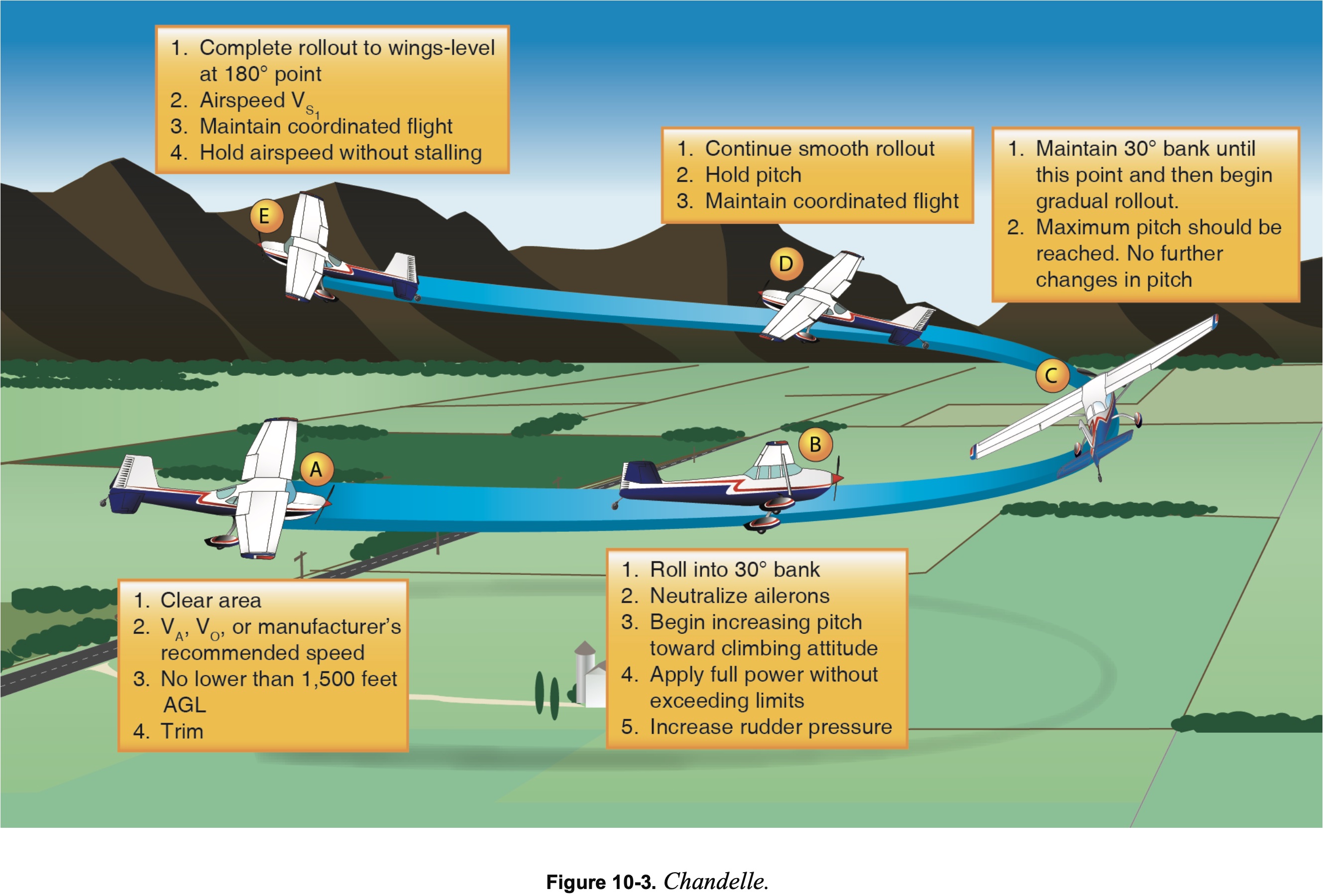
A 180° climbing turn that begins from straight-and-level flight and concludes with the airplane in a wings-level, nose-high attitude just above stall speed.
It is a maximum performance maneuver, that is, the airplane should gain the most altitude possible for a given degree of bank angle and power setting.
NOTE
Select an altitude that allows the maneuver to be performed no lower than 1,500' AGL.
- The turn can be performed either to the right or the left
- Rudder input different depending on direction
- This maneuver can be broken apart into two specific phases
- First 90°
- Second 90°
- Even though each phase involves some constant aircraft attitude, control pressures/deflections will not be constant
- As airspeed decreases, right-rudder will need to gradually increase to counteract left turning tendency
- The amount of right rudder required will differ depending on whether the chandelle is to the left or right.
- For example, when nearing completion of a left chandelle the rollout is to the right meaning adverse yaw will act to the left in addition to left turning tendency, so a lot of right rudder is required.
- When nearing completion of a right chandelle the rollout is to the left, the adverse yaw is to the right which counteracts some of the left turning tendency meaning less right rudder is required.
- So remember when rolling out of a chandelle that a left chandelle will need more right rudder.
- Be slow to increase pitch in first half or you will undershoot target heading
- Be slow to reduce bank in second half or you will undershoot target heading / stall before getting to target heading
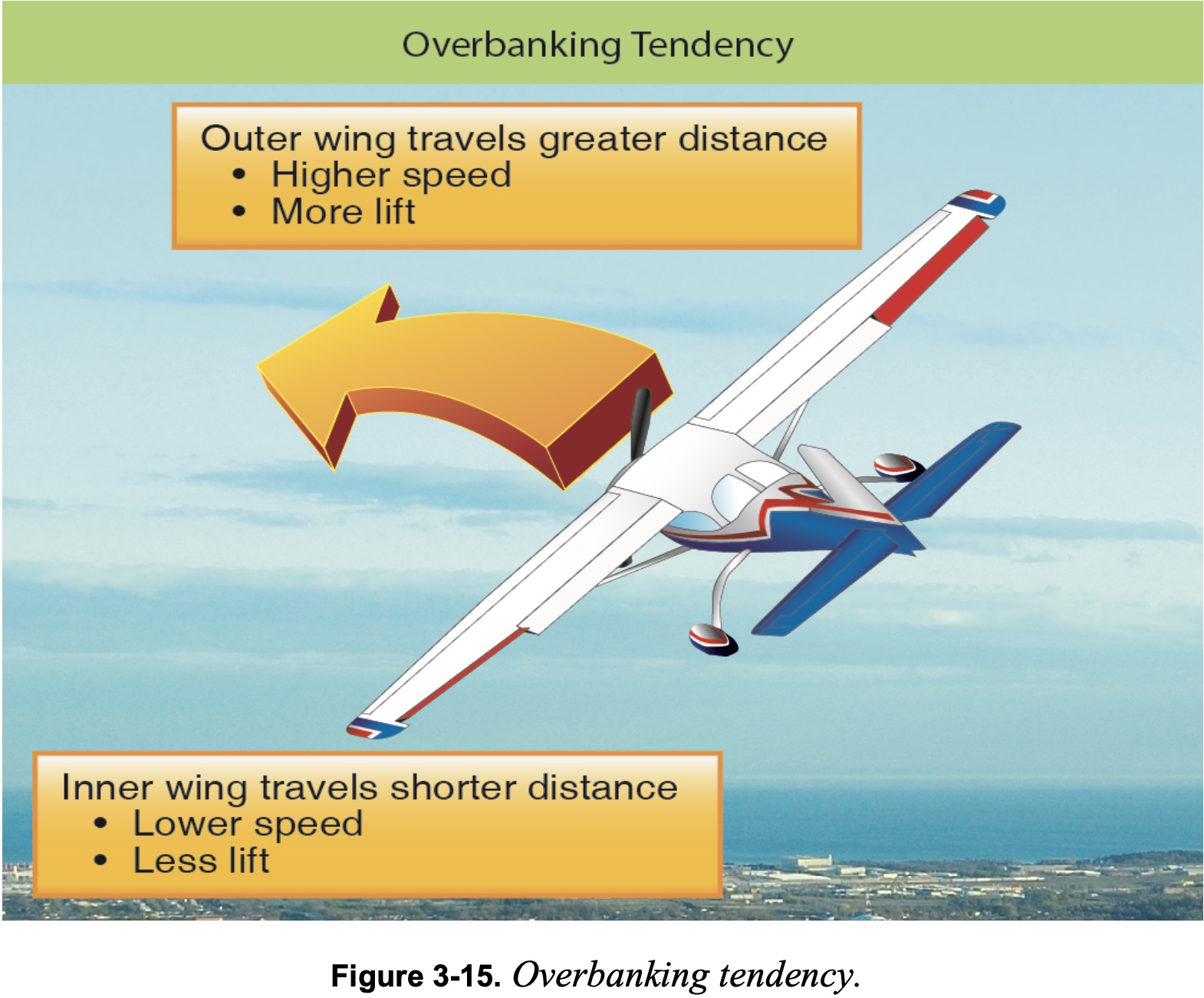
- Be aware of overbanking tendency that needs to be controlled by the use of opposite aileron when the desired bank angle is reached.
- At successful completion airspeed should be about 50-55 KIAS
- Stall speed at max weight, flaps up, and power off is 48 KIAS - with power on it will be lower
- While the maneuver requires periods of sustaining constant roll and pitch, the control pressures will not be constant. Aileron pressure will need to be adjusted to correct for overbanking tendency and elevator pressure will need to be increased during second 90° to maintain constant pitch attitude while airspeed is decreasing
Aerodynamics
- Remember the constant aircraft attitude does not mean constant control inputs, those need to change as the airspeed decreases
- Recall from the section on Turn Rate:
- Be mindful of overbanking tendency
Common Errors
See the Airplane Flying Handbook:
- Not clearing the area
- Initial bank is too shallow resulting in a stall
- Initial bank is too steep resulting in failure to gain maximum performance
- Allowing the bank angle to increase after initial establishment
- Not starting the recovery at the 90° point in the turn
- Allowing the pitch attitude to increase as the bank is rolled out during the second 90° of turn
- Leveling the wings prior to the 180° point being reached
- Pitch attitude is low on recovery resulting in airspeed well above stall speed
- Application of flight control pressures is not smooth
- Poor flight control coordination
- Stalling at any point during the maneuver
- Execution of a steep turn instead of a climbing maneuver
- Not scanning for other traffic during the maneuver
- Performing by reference to the instruments rather than visual references