14 CFR and Publications
This page covers Task J. 14 CFR and Publications from the FAA-S-ACS-25 Flight Instructor for Airplane Category Airman Certification Standards.
Overview
- Availability
- Generally everything is freely available digitally online
- Also printed copies widely available for purchase
- Purpose
- Advisory circulars - dissemination of information to aviation community
- PTS / ACS - define standards used in the certification of airmen
- POH / AFM - concise reference books that provide specific information about a particular aircraft or subject
- General content
- Also
- Handbooks - provide specific information about a particular topic that enhances training or understanding
- Aeronautical Information Manual (AIM) - official guide to basic flight information and ATC procedures for the aviation community
- Legal letters - clarifications and interpretations of regulations in response to questions from the aviation community
14 CFR: Aeronautics and Space
Code of Federal Regulations (CFR), which is the codification of the general and permanent rules published by the executive departments and agencies of the United States Government.
The regulations are divided into 50 different codes, called Titles, that represent broad areas subject to Federal regulation.
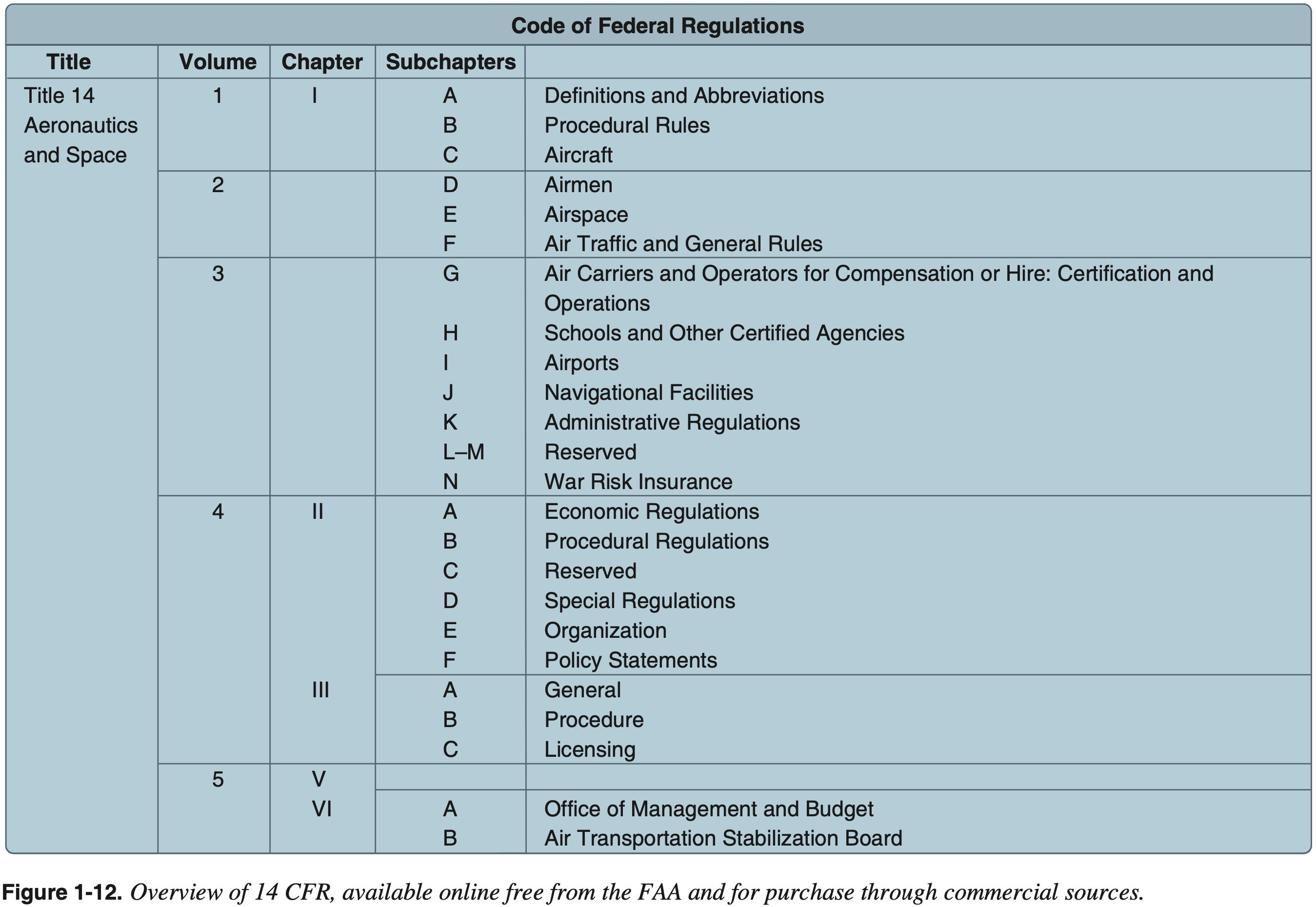
Title 14 of the Code of Federal Regulations is a collection of regulatory laws that govern aeronatics and space.
The heirarchy of Title 14 that is relevant to pilots is shown below.
While the parts listed below are some important parts for pilots to know, there are other parts which are relevant as well.
Title 14: Aeronautics and Space
- Chapter I: Federal Aviation Administration, Department of Transportation
- Subchapter A: Definitions and General Requirements
- Part 1: Definitions and Abbreviations / Section 1: General definitions
- Subchapter A: Definitions and General Requirements
- Chapter I: Federal Aviation Administration, Department of Transportation
Select Regulations
Part 43
- 14 CFR §43.3(g)
- Says that a private pilot or higher can perform preventative maintenance on an aircraft they own or operate that is not being used for part 121, 129, or 135 operations
- Appendix A to Part 43(c)
- Long list of items considered preventive maintenance
- 14 CFR §43.3(k)
- Says a pilot can update GPS databases
Part 91
- 14 CFR §91.3 - Responsibility and authority of the pilot in command
- The pilot in command is directly responsible for, and is the final authority as to, the operation of that aircraft
- Can deviate from the rules to meet an emergency
- 14 CFR §91.13 - Careless or reckless operation
- 91.205 IFR Equipment
- 91.167 Fuel Requirements
- 91.179 IFR Cruising Altitudes
- 91.173 IFR ATC Clearance and Flight Plan
- 91.187 Malfunction Reports
49 CFR: Transportation
Title 49 governs transportation.
Heirarchy for 49 CFR is different.
Select Regulations
- 49 CFR §830.2 - Definitions
- Serious injury is defined by the following
- Requires hospitalization for more than 48 hours, commencing within 7 days from the date of the injury was received
- Results in a fracture of any bone (except simple fractures of fingers, toes, or nose)
- Causes severe hemorrhages, nerve, muscle, or tendon damage
- Involves any internal organ
- Involves second- or third-degree burns, or any burns affecting more than 5 percent of the body surface
- Serious injury is defined by the following
- 49 CFR §830.5 - Immediate notification
- The aircraft operator should notify the NTSB immediately when an aircraft accident or serious incident occurs, or an aircraft is overdue and is believed to have been involved in an accident.
- The list of serious incidents is
- Flight control system malfunction or failure
- Inability of any required flight crewmember to perform normal flight duties as a result of injury or illness
- In-flight fire
- Aircraft collision in flight
- Damage to property, other than the aircraft, estimated to exceed $25,000
- Release of all or a portion of a propeller blade from an aircraft, excluding release caused solely by ground contact
- A complete loss of information, excluding flickering, from more than 50 percent of an aircraft's cockpit electronic displays
- If a landing or departure occured on a taxiway, incorrect runway, or other area not designed as a runway
- Experiences a runway incursion that requires the operator or the crew of another aircraft or vehicle to take immediate corrective action to avoid a collision.
- Failure of any internal turbine engine component that results in the escape of debris other than out the exhaust path
- Responding to an Airborne Collision and Avoidance System (ACAS) resolution advisories on an IFR flight plan to avoid a collision
- Damage to helicopter tail or main rotor blades, including ground damage, that requires major repair or replacement of the blade(s)
- For large multiengine aircraft (more than 12,500 pounds maximum certificated takeoff weight) several failures including electrical, hydraulic, multiple engine failure, or evacuation
- 49 CFR §830.15 - Reports and statements to be filed says
- The aircraft operator must file a report within 10 days after an accident, or after 7 days if an overdue aircraft is still missing
- A report on an incident for which immediate notification is required by 49 CFR §830.5(a) shall be filed only if requested by the NTSB
- Reporting requirements are also provided in AIM 7-7-2. Aircraft Accident and Incident Reporting
Advisory Circulars
- An Advisory Circular (AC) is an informational document that the FAA wants to distribute to the aviation community.
- This can be in the form of a text book used in a classroom or a one page document.
- ACs provide a single, uniform, agency-wide system that the FAA uses to deliver advisory material to FAA customers, industry, the aviation community, and the public.
- An AC may be needed to
- Provide an acceptable, clearly understood method for complying with a regulation
- Standardize implementation of a regulation or harmonize implementation for the international aviation community
- Resolve a general misunderstanding of a regulation
- Respond to a request from some government entity, such as General Accounting Office, NTSB, or the Office of the Inspector General
- Help the industry and FAA effectively implement a regulation
- Explain requirements and limits of an FAA grant program
- Expand on standards needed to promote aviation safety, including the safe operation of airports
- There are three parts to an AC number, as in 25-42C.
- The first part of the number identifies the subject matter area of the AC and corresponds to the appropriate 14 CFR part.
- For example, an Advisory Circular on "Certification: Pilots and Flight and Ground Instructors" is FAA-AC-61-65J.
- Since ACs are numbered sequentially within each subject area, the second part of the number beginning with the dash identifies this sequence.
- The third part of the number is a letter assigned by the originating office and shows the revision sequence if an AC is revised.
- The first part of the number identifies the subject matter area of the AC and corresponds to the appropriate 14 CFR part.
INFOs
Information for Operators
InFO 06001 - Introducing InFOs
Much like SAFOs, which contain critical safety information, an InFO message contains valuable information for operators that should help them meet certain administrative, regulatory, or operational requirements with relatively low urgency or impact on safety. InFOs contain information or a combination of information and recommended action to be taken by the respective operators identified in each individual InFO.
SAFOs
Safety Alerts for Operators
SAFO 05001 - Introducing SAFOs
The SAFO process re-establishes a communication channel between Flight Standards and operators. This channel permits a policy-making division such as AFS-200 to convey important safety information concurrently to FAA field offices and to operators in a timely manner, without undue delays caused by coordination among government offices. SAFOs frequently contain recommended action to be accomplished by operators.
Test / Certification Standards
- Practical Test Standards (PTS)
- Older version of testing standards.
- The PTS primarily provides metrics to define acceptable performance of the "flight proficiency" skills listed in 14 CFR part 61 for a given certificate or rating.
- Airman Certification Standards (ACS)
- The ACS is an enhanced version of the Practical Test Standards (PTS) that started replacing the PTS in 2016, and will eventually replace all PTS.
- It adds task-specific knowledge and risk management elements to each PTS Area of Operation and Task.
- The result is a comprehensive presentation that integrates the standards for what an applicant needs to know, consider, and do in order to pass both the knowledge test and the practical test for a certificate or rating.
POH and AFM
FAA Approved Pilot Operating Handbooks / AFM
Flight manuals and operating handbooks are concise reference books that provide specific information about a particular aircraft or subject.
They contain basic facts, information, and/or instructions for the pilot about the operation of an aircraft, flying techniques, etc., and are intended to be kept on hand for ready reference.
The aircraft owner/information manual is a document developed by the aircraft manufacturer and contains general information about the make and model of the aircraft.
The manual is not approved by the Federal Aviation Administration (FAA) and is not specific to an individual aircraft.
The manual provides general information about the operation of an aircraft, is not kept current, and cannot be substituted for the AFM/POH.
An AFM is a document developed by the aircraft manufacturer and approved by the FAA. This book contains the information and instructions required to operate an aircraft safely.
A pilot must comply with this information which is specific to a particular make and model of aircraft, usually by serial number.
An AFM contains the operating procedures and limitations of that aircraft.
Title 14 of the Code of Federal Regulations (14 CFR) part 91 requires that pilots comply with the operating limitations specified in the approved flight manuals, markings, and placards.
Originally, flight manuals followed whatever format and content the manufacturer felt was appropriate, but this changed with the acceptance of Specification No. 1 prepared by the General Aviation Manufacturers Association (GAMA).
Specification No. 1 established a standardized format for all general aviation airplane and helicopter flight manuals.
The POH is a document developed by the aircraft manufacturer and contains FAA-approved AFM information. If "POH" is used in the main title, a statement must be included on the title page indicating that sections of the document are FAA approved as the AFM.
The POH for most light aircraft built after 1975 is also designated as the FAA-approved flight manual. The typical AFM/POH contains the following nine sections
- General
- Limitations
- Emergency Procedures
- Normal Procedures
- Performance
- Weight and Balance/Equipment List
- Systems Description
- Handling, Service, and Maintenance
- Supplements
Manufacturers also have the option of including additional sections, such as one on Safety and Operational Tips or an alphabetical index at the end of the POH.
AFM vs POH
- Aircraft owner/information manual is not approved by the FAA and is not a substitute for the approved POH/AFM
- The POH is a document developed by the aircraft manufacturer and contains FAA-approved AFM information.
- If "POH" is used in the main title, a statement must be included on the title page indicating that sections of the document are FAA approved as the AFM.
- The POH for most light aircraft built after 1975 is also designated as the FAA-approved flight manual.
- Manuals follow standard format
- AFM vs POH/PIM
AFM regulated by FAA and specific to airplane
POH/PIM general aircraft info
POH is standardized by the General Aviation Manufacturer's Association
The title [of the document shall be] "Pilot's Operating Handbook and FAA Approved Airplane Flight Manual" for all airplanes except those for which the airplane manufacturer elected to provide a separate FAA Approved Airplane Flight Manual. In the latter case, the title shall be "Pilot's Operating Handbook".
Note: After the effective date of this revision, Pilot's Operating Handbooks for newly manufactured airplanes must be FAA Approved Airplane Flight Manuals.
Aeronautical Information Manual
- The Aeronautical Information Manual (AIM) is the official guide to basic flight information and ATC procedures for the aviation community flying in the NAS of the United States.
- Aeronautical Information Manual