Lazy Eights
This page covers Task D. Lazy Eights from the FAA-S-ACS-25 Flight Instructor for Airplane Category Airman Certification Standards.
Purpose and Procedure
- To further and develop the proper coordination of the flight controls across a wide range of airspeeds and attitudes – at no point in the maneuver are any of the flight control pressures constant, nor is the airspeed, altitude, or attitude.
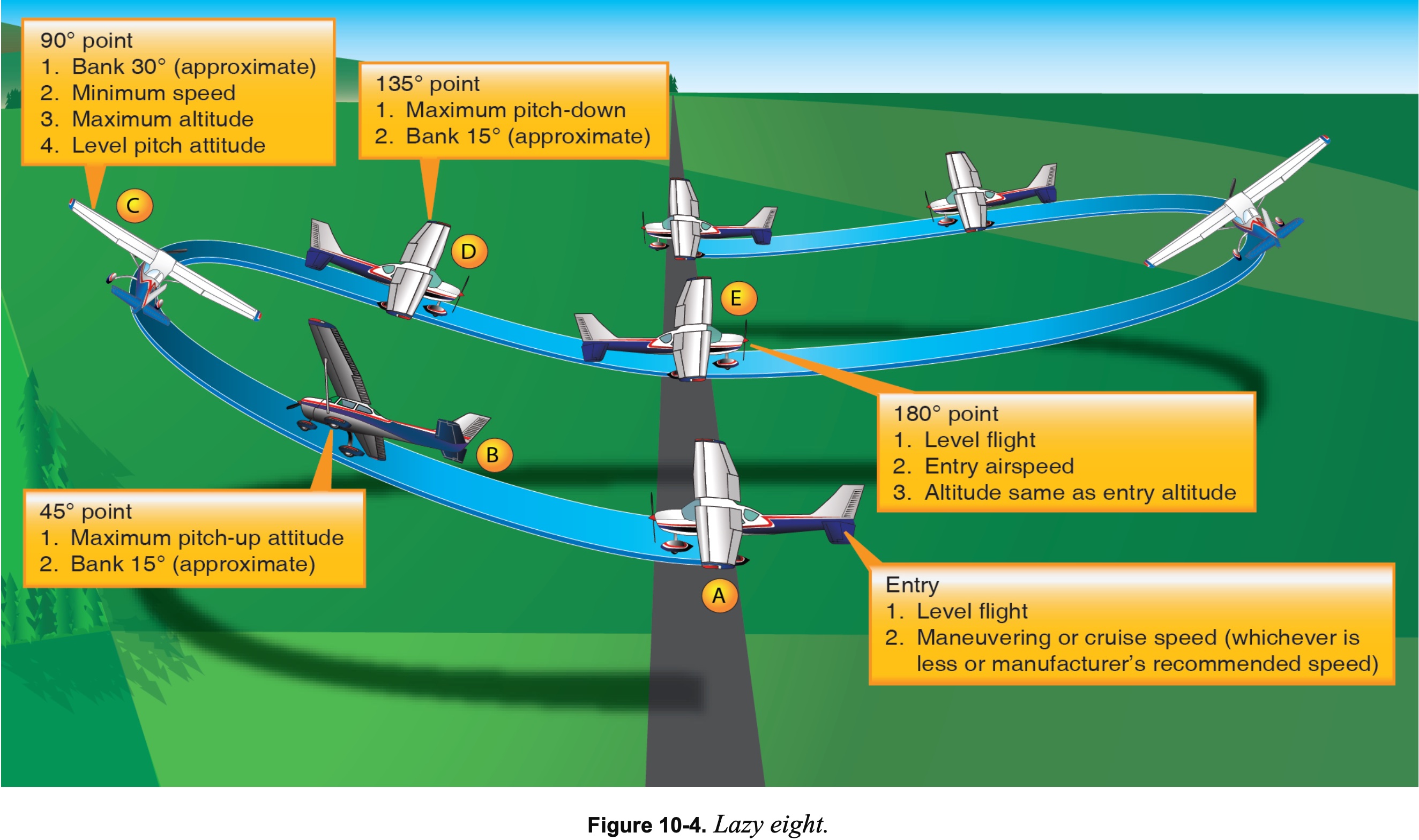
- A series of S-turns, similar to S-turn across a road, with a climb and descent added to each 180° segment. (i.e. First 90° segment is a climb, second 90° segment is a descent, and repeat)
NOTE
Select an altitude that allows the maneuver to be performed no lower than 1,500' AGL.
- Reference points
- Be sure to bug them
- The farther away the reference points, the more accurate and steady they will be
- If bank is too fast, the aircraft will increase the rate of turn too quickly and reach 45° point before highest pitch is attained
- As airspeed decreases rate-of-turn will increase, so latter half of climbing portion will happen more quickly
- Rudder pressure
- Right rudder pressure will have to be applied to counteract torque, especially as airplane is climbing, slowing, and turning to the right (adverse yaw adding to left-turning-tendency)
- Due to left turning tendency, rudder pressure to stay coordinated will be different in left versus right turns.
- Similarly, decrease in right-rudder pressure during descent, especially when turning left
- May need to use opposite aileron in turn to avoid overbanking
- Make note of altitude gain at the 90° point so this can be matched to make a symmetrical turn on the other side of the lazy eight
- Back out power slightly at 45° point
- Number targets
- 17.5° pitch up, 15° bank at 45° point with close to 300 ft. altitude gained
- 0° pitch, 30° bank, and 50-55 KIAS at top of loop (90° point) with 300 ft. altitude gained
- 10° pitch down, 15° bank at 135° point, about 100 ft. above entry altitude
- Level pitch, level bank at 180° point
- Repeat in other direction
- Consider start with a heading in a cardinal direction to help make passing of different visual reference points in the maneuver easier to cross check against heading indicator
- Good reference points may be difficult to select, and the heading bug may be the primary reference
- While using the heading indicator to identify points throughout the maneuver, make sure to keep attention outside of the cockpit
- While the lazy eight is not a ground reference maneuver, to help maintain the symmetry of the maneuver with respect to reference points (for example the road in the figure above) the maneuver should be started perpendicular to the wind and with turns made to advance the aircraft into the wind so as to reduce the ground distance covered while performing the maneuver.
- Be mindful of the difference between control pressures and deflections - with the aircraft speed varying widely throughout the maneuver, the slow portions of the maneuver may experience less control pressure, but larger control deflections.
- This maneuver should feel painfully slow - if you think you've got to 90° point in a comfortable time then slow it down.
Common Errors
See the Airplane Flying Handbook:
- Not clearing the area
- Maneuver is not symmetrical across each 180°
- Inadequate or improper selection or use of 45°, 90°, 135° references
- Ineffective planning
- Gain or loss of altitude at each 180° point
- Poor control at the top of each climb segment resulting in the pitch rapidly falling through the horizon
- Airspeed or bank angle standards not met
- Control roughness
- Poor flight control coordination
- Stalling at any point during the maneuver
- Execution of a steep turn instead of a climbing maneuver
- Not scanning for other traffic during the maneuver
- Performing by reference to the flight instruments rather than visual references