Pilot Qualifications
This page covers Task A. Pilot Qualifications from the FAA-S-ACS-25 Flight Instructor for Airplane Category Airman Certification Standards.
Objective
To determine the applicant understands pilot training and qualification requirements for different levels of pilot certificate including student pilot, sport pilot, recreational pilot, private pilot, commercial pilot, and flight instructor; can apply that knowledge, manage associated risks, demonstrate appropriate skills, and provide effective instruction.
Certification, Currency, and Recordkeeping Requirements
- There are several requirements to obtain various levels of pilot certificates described in 14 CFR Part 61
- Eligibility requirements
- e.g. age, knowledge test requirements, endorsements
- Aeronautical knowledge areas
- Flight proficiency
- Maneuvers the pilot should be able to perform
- Aeronautical experience
- The number of hourse spent on various flight training activities
- Eligibility requirements
- These are broken down by the level of pilot certificate below
- Also included in the below are the privileges and limitations of each level of pilot certificate
Student Pilot
Eligibility Requirements
- 14 CFR §61.83
- 16 years old
- Except 14 years old for glider or balloon
- Read, speak, write, and understand English
Aeronautical Experience
- No aeronautical experience required to be a student pilot
Privileges and Limitations
- 14 CFR §61.89
- A student pilot may not act as pilot in command of an aircraft
- That is carrying a passenger
- That is carrying property for compensation or hire
- For compensation or hire
- In furtherance of a business
- On an international flight
- Except that a student pilot may make solo training flights from Haines, Gustavus, or Juneau, Alaska, to White Horse, Yukon, Canada, and return over the province of British Columbia;
- With a flight or surface visibility of less than 3 statute miles during daylight hours or 5 statute miles at night
- When the flight cannot be made with visual reference to the surface
- In a manner contrary to any limitations placed in the pilot's logbook by an authorized instructor
- A student pilot may not act as a required pilot flight crewmember on any aircraft for which more than one pilot is required by the type certificate of the aircraft or regulations under which the flight is conducted, except when receiving flight training from an authorized instructor on board an airship, and no person other than a required flight crewmember is carried on the aircraft
- CFI endorses the student logbook for the specific make and model for the aircraft to be flown, good for 90 days.
- With proper documentations, as mentioned above, solo PIC flight can be completed to specific destinations or areas by the student pilot.
- Can use BasicMed
- Student pilots are required to carry their logbook on solo cross-country flights
Subparagraph (i) of 14 CFR §61.1(b) Cross-country time states the following
includes a landing at a point other than the point of departure
Subparagraph (ii) say that for the purposes of meeting aeronautical experience requirements for a private pilot certificate the cross-country flight must include a point of landing more than 50 nm from the point of departure
This seems to mean that student pilots must carry their logbook on any flight that involves a landing at a point other than the point of departure, even if such a flight cannot count towards aeronautical experience requirements for a private pilot certificate
It is probably best for student pilots to just get in the habit of keeping their logbook in their flight bag so it is always with them when they fly.
Notes
- Student pilot certificates never expire
- Have student pilot apply for student pilot certificate via IACRA right away
- Student pilot certificate is physical plastic card just like any other pilot certificate
Recreational Pilot
Eligibility
- 14 CFR §61.96
- Need to be 17 years old
Aeronautical Experience
- 14 CFR §61.99
- 30 hours total flight time
- 15 hours flight training (on Recreational Pilot areas of operation in 14 CFR §61.98(b))
- 2 hours to an airport at least 25 nm from home airport, with 3 takeoffs/landings at this airport
- 3 hours within 2 months of practical test
- 3 hours solo flight (in the aircraft for the rating sought)
- 15 hours flight training (on Recreational Pilot areas of operation in 14 CFR §61.98(b))
Privileges and Limitations
- 14 CFR §61.101
- Can carry only 1 passenger
- Need to pay pro rata share for flight operating expenses
- Need logbook endorsement both for flights within 50 nm and those that exceed 50 nm from departure airport
- Need logbook endorsement to fly in B, C, and D airspace and at airport with control tower
- Can only fly aircraft with
- 4 seats or less
- Single engine
- Up to 180 hp
- Fixed landing gear
- Can not fly
- For compensation or hire
- Between sunrise and sunset
- At an altitude of more than 10,000 feet MSL or 2,000 feet AGL, whichever is higher
- When the flight or surface visibility is less than 3 statute miles
- Without visual reference to the surface
- On a flight outside the United States, unless authorized by the country in which the flight is conducted
- To demonstrate that aircraft in flight as an aircraft salesperson to a prospective buyer
- That is used in a passenger-carrying airlift and sponsored by a charitable organization
- That is towing any object
- Recent flight experience
- If pilot has less than 400 hours and hasn't logged PIC time within previous 180 days, needs to receive flight training and endorsement from CFI before acting as PIC
- Can use BasicMed
- Can get for
- Airplanes
- Helicopters
- Gyroplanes
- Recreational pilots must always carry logbook when acting as PIC?
- Recreational pilot cannot fly where ATC communication is required
- Exception: if a recreational pilot is working on a private pilot certificate, then they can but must carry logbook with endorsement
- If less than 400 hours, cannot act as PIC unless have logged PIC time in past 180 days
Private Pilot
Eligibility
- 14 CFR §61.103
- 17 years old
- Except 16 years old for glider or balloon
- Read, speak, write, and understand English
- Receive training, endorsements, meet experience requirements, etc.
Aeronautical Experience
- 14 CFR §61.109
- 40 hours total flight time
- 20 hours flight training (on Private Pilot areas of operation in 14 CFR §61.107(b))
- 3 hours cross country
- 3 hours night
- One cross country flight of over 100 nm total distance
- 10 T/O's and 10 landings to a full stop with each involving a flight in the traffic pattern at an airport
- 3 hours by reference to instruments in a single engine airplane
- 3 hours in a single engine airplane within 2 calendar months prior to the practical test
- 10 hours solo flight (in a single engine airplane)
- 5 hours of solo cross country flying
- One solo cross country flight of at least 150 nm total distance with full stop landings at 3 points and one segment of at least 50 nm between T/O and landings
- 3 T/O's and landings to a full stop at an airport with an operating control tower
- 20 hours flight training (on Private Pilot areas of operation in 14 CFR §61.107(b))
Privileges and Limitations
- 14 CFR §61.113 - Private pilot privileges and limitations: Pilot in command
- 14 CFR §61.117 - Private pilot privileges and limitations: Second in command of aircraft requiring more than one pilot
- No person who holds a private certificate may act as a PIC of an aircraft carrying passengers or property for hire, or as PIC of an aircraft for hire/compensation.
- Only if the aircraft is in connection to any business and is only incidental to that business or employment, and the aircraft does not carry passengers of property for compensation or hire.
- Must pay at least their pro rata share of flight operating expenses
- A private pilot may act as the PIC for a charitable, nonprofit, or community event of a flight as described in 14 CFR §91.146, if the sponsor and pilot comply with 14 CFR §91.146.
- Private pilots may be reimbursed for aircraft operating expenses directly related to search and rescue operations, provided the expenses are rental fees, fuel/oil, airport expenditures.
- If a private pilot is a salesman, he/she may demonstrate a plane for a prospective buyer is he/she has more than 200 hours.
- A private pilot who meets the requirements of 14 CFR §61.69 may act as PIC of an aircraft towing a glider/un-powered trike ultra-light.
- Private pilot cannot be SIC on aircraft carrying passengers or property for compensation or hire
- Can use BasicMed
Commercial Pilot
Eligibility
- 14 CFR §61.123
- Need to be 18 years old
Aeronautical Experience
- 14 CFR §61.129
- 250 hours total flight time
- 100 hours in powered aircraft, of which 50 hours must be in airplanes
- 100 hours of a pilot-in-command flight time which includes
- 50 hours in airplanes
- 50 hours in cross-country flight of which at least 10 hours must be in airplanes
- 20 hours flight training (on Commercial Pilot areas of operation in 14 CFR §61.127(b))
- 10 Hours of instrument training (5 hours must be in a single-engine airplane)
- 14 CFR §61.195(c)(1) says this training must be done by a CFII.
- See Grayson 2010
- 10 hours of training in a complex airplane or TAA
- One 100 nm 2-hour day cross-country
- One 100 nm 2-hour night cross-country
- 3 hours of check ride preparation in a single-engine airplane within 2 calendar months of the checkride
- 10 Hours of instrument training (5 hours must be in a single-engine airplane)
- 10 hours solo flight (in a single engine airplane)
- One 300nm cross-country flight
- One leg straight-line distance of at least 250 nm from point of departure with 3 points of landing
- 5 hours in night VFR conditions with 10 takeoffs and landings at an airport with an operating control tower
- One 300nm cross-country flight
- 50 hours in simulator can be credited
- 14 CFR §61.129(i)(1)(i)
- Note the reg says FFS/FTD, but the LOA for a given sim will indicate if it can be used for this purpose
- Only need 3rd class medical to get certificate (even though 2nd class to exercise privileges)
Privileges and Limitations
14 CFR §61.133 - Commercial pilot privileges and limitations
FAA-AC-120-12A - Private carriage versus common carriage of persons or property
A commercial pilot may act as PIC of an aircraft carrying persons/property for hire or as PIC of an aircraft for hire. (As long as the pilot is qualified under 14 CFR part 61.)
Without instrument rating cannot be PIC of an aircraft for hire/compensation at night or on cross country in excess of 50 nm.
No Common Carriage or seat configurations of 20 pax / payload less than 6000lbs 14 CFR §119.1
- Exceptions
- 14 CFR §91.146
- 14 CFR §91.147
- Student instruction, non-stop air tours, ferry/training flights, crop dusting, banner towing, aerial photography, firefighting, pipeline patrol, skydivers (within 25nm of departure airport)
- Exceptions
Supervised Solo
- The 10 hours of solo flight can be performed with an instructor on board
- In the case, instructor is acting in their capacity as an instructor, and so can log PIC
- The pilot does not log dual received since they are not receiving instruction
- See Kuhn 2014
Double Dipping
TIP
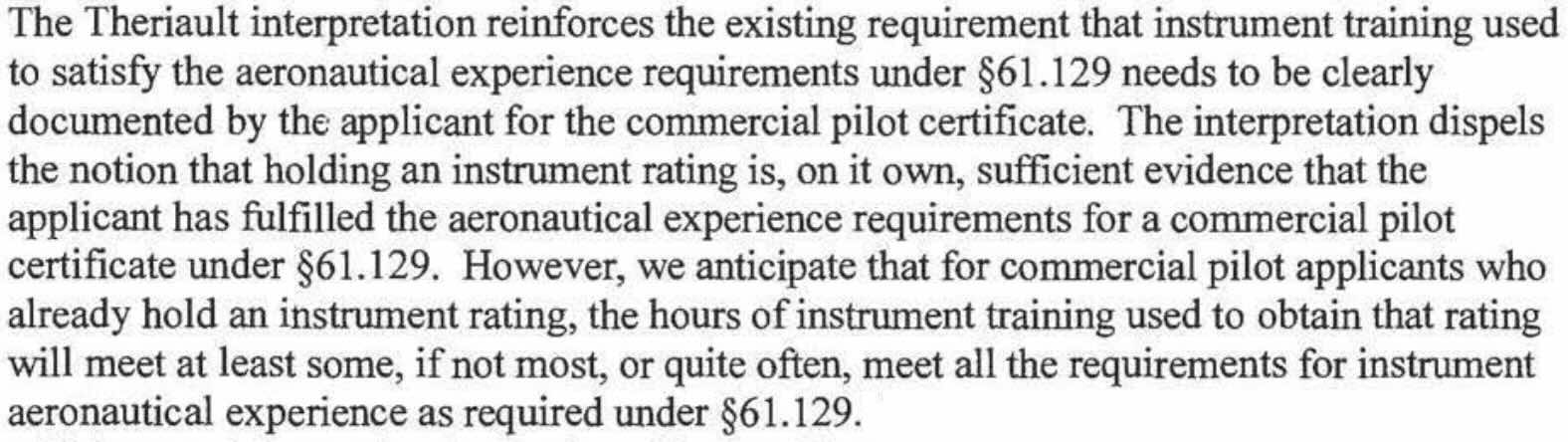
The safest way to credit instrument training received while working towards an instrument rating towards the requirements of 14 CFR §61.129 is to ensure the training satisfies the commercial requirements and note in the logbook entry that the training received was in accordance with 14 CFR §61.129.
- On counting time received during training for instrument rating towards experience requirements above
Flying for Hire
Introduction
A commercial pilot's license does not mean you can just buy a plane and start charging money to fly people around. Rather it's quite restrictive. First, you will be considered a carrier if you are willing to take payment to transport people or proerty from place to place as described in FAA-AC-120-12A Private Carriage Versus Common Carriage Of Persons or Property, with a few exceptions. The carriage of passengers may fall under common carriage or private carriage, which are discussed below, but in either case an air carrier certificate is required.
Basically, there isn't practically anything an owner of a small plane can do to charge to carry passengers. Rather, you'll get a job with a company / operator of a plane that will need to take care of the air carrier or operating certificate if needed. And really the takeaway here is that if, as a commercial pilot, you are faced with an opportunity where there is any uncertainty as to whether it is legal or not, go check out 14 CFR.
Definitions
- Operate (14 CFR §1.1)
- With respect to aircraft, means use, cause to use, or authorize to use aircraft.
- Operational control (14 CFR §1.1)
- With respect to a flight, means the exercise of authority over initiating, conducting, or terminating a flight.
- Commercial operator (14 CFR §1.1)
- Means a person who, for compensation or hire, engages in the carriage by aircraft in air commerce of persons or property, other than as an air carrier or foreign air carrier or under the authority of Part 375 of this title. Where it is doubtful that an operation is for "compensation or hire", the test applied is whether the carriage by air is merely incidental to the person's other business or is, in itself, a major enterprise for profit.
- Air Carrier (14 CFR §1.1)
- Means a person who undertakes directly by lease, or other arrangement, to engage in air transportation.
- Common carriage
- A carrier becomes a common carrier when it "holds itself out" to the public, or to a segment of the public as willing to furnish transportation within the limits of its facilities to any person who wants it.
- There are four elements in defining common carriage:
- A holding out of a willingness to
- Transport persons or property
- From place to place
- For compensation
- FAA-AC-120-12A
- Private carriage
- Carriage for hire which does not involve "holding out" is private carriage.
- FAA-AC-120-12A
Overview
A commercial pilot can carry passengers for compensation or hire
Operations that constitute common carriage are required to be conducted under
Common carriage operations are conducted under part 121 or part 135, depending on the type of aircraft, seating configuration, and payload capacity.
Private carriage may be conducted under
Air carriers and commercial operators are subject to certain rules
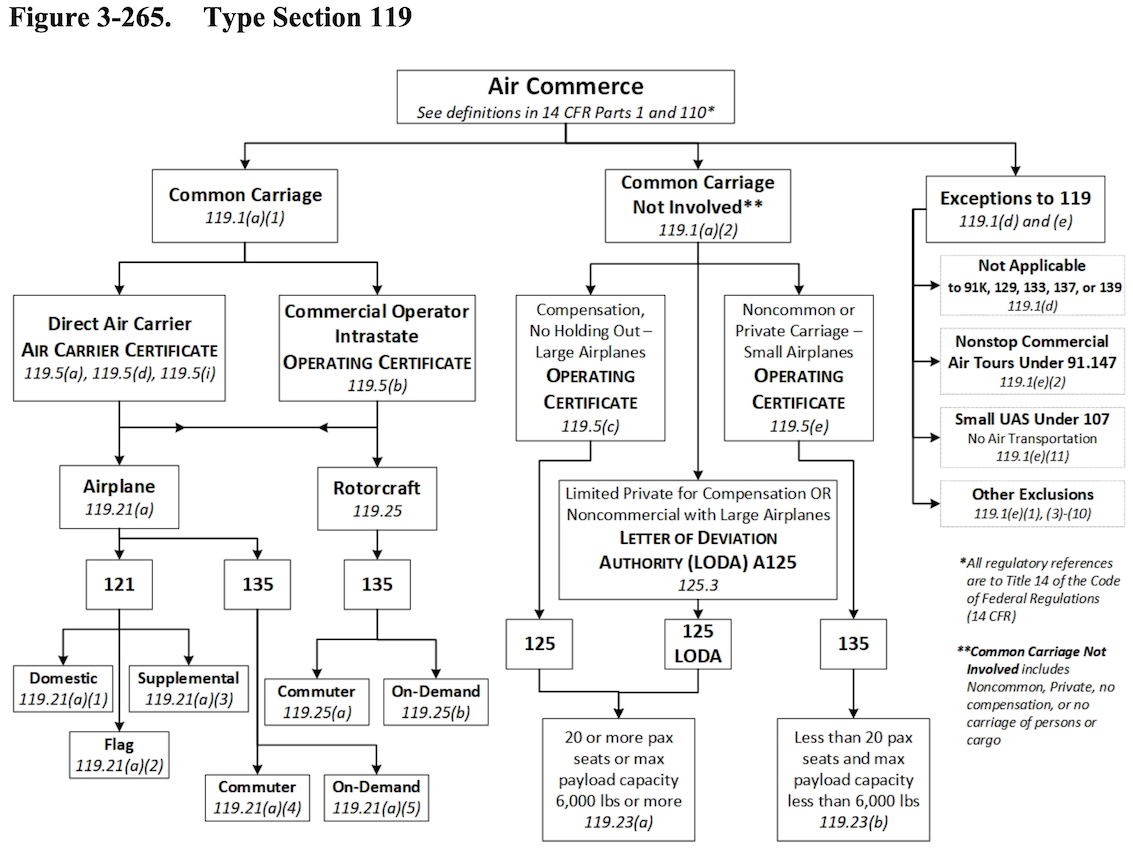
- 14 CFR §119
- 14 CFR §119.1 describes which rules are applicable to different types of operations, and certification requirements to operate under various other parts.
- This applies to each person operating or intending to operate a civil aircraft:
- As an air carrier or commercial operator or
- When common carriage is not involved but the plane is big, 20+ seats, 6000+ lb payload
- There are exceptions to these requirements
- 14 CFR §119.1(e)
- Flight instruction
- Ferry or training flights
- Aerial photography
- Banner towing
- Skydive operations
- And some others
There are certain operations that can be done under Part 91 when common carriage is not involved
- 14 CFR §91.501(b)
- Ferry or training flights
- Aerial photography
- Pipeline patrol
- Flights conducted by the operator of an airplane for personal transportation or transportation of guests if no charge is made
- And some others
- In addition, this section describes certain things that can be charged for during certain specific operations
Under certain conditions, passengers can be carried for compensation or hire under Part 91 for sightseeing or skydiving
- 14 CFR §91.147
- Start and end at the same airport
- Remain within a 25 nm radius of the airport
Under certain conditions, passengers can be carried for compensation or hire under Part 91 to benefit a charitable, community, or nonprofit event
- 14 CFR §91.146
- Start and end at the same airport
- Remain within a 25 nm radius of the airport
- VFR day only
- Maximum of 30 seats for passengers
- And some others
Wet vs dry leasing
- 14 CFR §110.2
- Wet leasing means any leasing arrangement whereby a person agrees to provide an entire aircraft and at least one crewmember.
- Dry leasing is the lease of an aircraft without any crew members.
- See FAA General Aviation Dry Leasing Guide
- Basically, a wet lease scenario must be done under Part 135, while a dry lease one can be done Part 91.
- See Huber 1990:
The line between Part 91 and Part 135 is crossed, however, if the pilot also comes from the same source as the airplane. Renting or leasing a plane and pilot constitutes a 135 operation on the part of the lessor and pilot.
There are certain requirements when an aircraft is leased to someone else
Common Scenarios
- You are hired by a skydive company to fly skydivers
- This is legal under 14 CFR §91.147
- You want to rent a plane to fly somewhere with your friends and split the rental cost and fuel equally
- This is legal under 14 CFR § 61.113(c) assuming there is a common purpose.
- An aircraft owner wants to pay you to fly them somewhere in their plane
- This is legal under 14 CFR §91.501(b)(4)
- An aircraft owner wants to pay you to fly their friends and family members somehwhere in their plane
- This is legal under 14 CFR §91.501(b)(4) as long as the aircraft owner isn't charging his friends and family for the flight
- Your friend wants to pay you to fly them somewhere in your plane and drop them off.
- This is not legal; there is no exception that allows for the charging of passengers.
- Note that 14 CFR §91.501(b)(4) allows the operator to be flown.
Resources
- FAA-AC-120-12A - Private carriage versus common carriage of persons or property
- FAA-AC-61-142 - Sharing Aircraft Operating Expenses in Accordance with 14 CFR § 61.113 (c)
- FAA-AC-91-37B - Truth in Leasing
- Order 8900.1 CHG 948
- FAA Safe Air Charter Handout
- Aviation StackExchange What do the terms 'holding out' and 'common carriage' mean?
- Midlife Flight - What are my limitations as a commercial pilot? has a good overview
Airline Transport Pilot
Eligibility
- 14 CFR §61.153
- Need to be 23 years old
- Need to be 21 years old for restricted ATP
Aeronautical Experience
- 14 CFR §61.159
- 1,500 total time
- 500 cross-country
- See 14 CFR §61.1(b) Cross-country time for the definition applicable to ATP requirements
- 100 night
Privileges and Limitations
Instrument Rating
- 14 CFR §61.65
- Pass knowledge test
Aeronautical Experience
- 14 CFR §61.65 Instrument rating requirements
- 50 hours PIC cross country
- 40 hours actual or simulated instrument time
- 15 hours from an instructor
- Max of 20 hours can be in AATD
- 3 hours within 2 calendar months of checkride
- 250 nm cross country
- Total distance along airways, not straight-line distance between points of landing
- 3 different types of approaches
- 14 CFR §61.65(d)(2)(ii)
- 14 CFR Par 141 Appendix C Instrument Rating Course
- No minimum PIC cross country
- 35 hours actual or simulated instrument time
- 15 hours from an instructor
- 40% of the time (14 hours) can be in AATD
- The first 2 of 4 stages are well suited to be done in AATD
- 3 hours within 2 calendar months of checkride
- 250 nm cross country
- Total distance along airways, not straight-line distance between points of landing
- 3 different types of approaches
- 100 nm straight line distance
Aside: Different Approaches
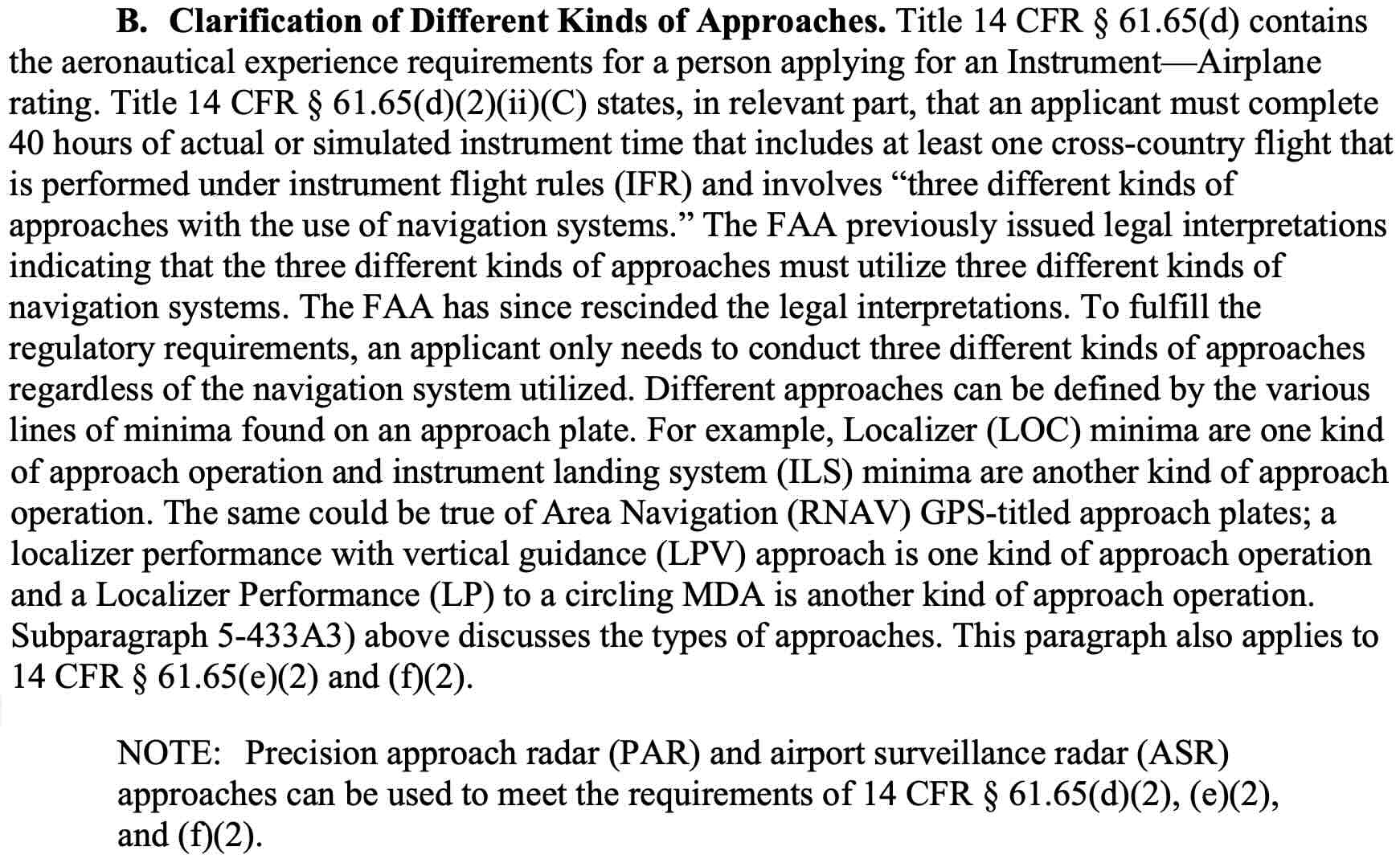
In order to satisfy the requirements of the 250 nm cross country flight above, 14 CFR §61.65(d)(2)(ii)(C) specifies the flight must involve three different types of approaches. Order 8900.1A, which provides additional guidance and is available in the Dynamic Regulatory System (DRS) here provides clarity as to what is meant by different in this context in 5-434 B.
Privileges and Limitations
- Flight under IFR or in weather less than VFR
- 14 CFR §61.3(e) Instrument rating
- "No person may act as pilot in command of a civil aircraft under IFR or in weather conditions less than the minimums prescribed for VFR flight unless that person holds ... instrument rating on that person's pilot certificate."
- Goodish 2008 letter states that even filing an IFR flight plan, even without planning to actually accept an IFR clearance in association with the flight plan, is intent to violate 14 CFR §61.3(e)
- 14 CFR §61.3(e) Instrument rating
- Flight in Class A airspace
- 14 CFR §91.135 Operations in Class A airspace
- "Each person operating an aircraft in Class A airspace must conduct that operation under instrument flight rules (IFR)."
- 14 CFR §91.135 Operations in Class A airspace
- Special VFR at night
- Technically it is between sunset and sunrise
- 14 CFR §91.157(b)(4)
- "The person being granted the ATC clearance meets the applicable requirements for instrument flight under part 61 of this chapter."
Adding Instrument Rating to Commercial Pilot Certificate
- Passengers for hire on cross countries longer than 50 nm or at night
- 14 CFR §61.133(b)(1) Commercial pilot privileges and limitations
- "The carriage of passengers for hire in airplanes on cross-country flights in excess of 50 nautical miles or at night is prohibited."
- 14 CFR §61.133(b)(1) Commercial pilot privileges and limitations
14 CFR §91.173
- 14 CFR §61.3(e) states that a pilot needs an instrument rating to operate in weather conditions less than VFR.
- 14 CFR §91.173 says that (and let's assume the pilot is instrument rated and therefor satisfies 14 CFR §61.3(e)) that the pilot only needs to be on an IFR flight plan and receive clearance in controlled airspace.
- Operations in uncontrolled airspace under IMC without a clearance or instrument rating may violate 14 CFR §91.13 Careless or reckless operation
- See FAA vs Murphy
- See Lamb 2016 letter
Flight Instructor
- 14 CFR §61.195
- Federal Register: Removal of Expiration Date on a Flight Instructor Certificate; Additional Qualification Requirements To Train Initial Flight Instructor Applicants; and Other Provisions
Medical Certificates: Class, Expiration, Privileges
- And temporary disqualifications, and operations under BasicMed.
- 14 CFR §61.23
Classes of Medical Certificate
- First Class
- Required to PIC with an ATP
- Required to be required pilot flightcrew member if 60 years old
- 40 and older: 6 months
- Under 40: 12 months
- Second Class
- Required for commercial PIC privilages
- 12 Months at any age
- Third Class
- Sufficient for the sport, recreational, student, private, and flight instructor ratings
- 40 and older: 24 months
- Under 40: 60 months
Medical Certificate Details
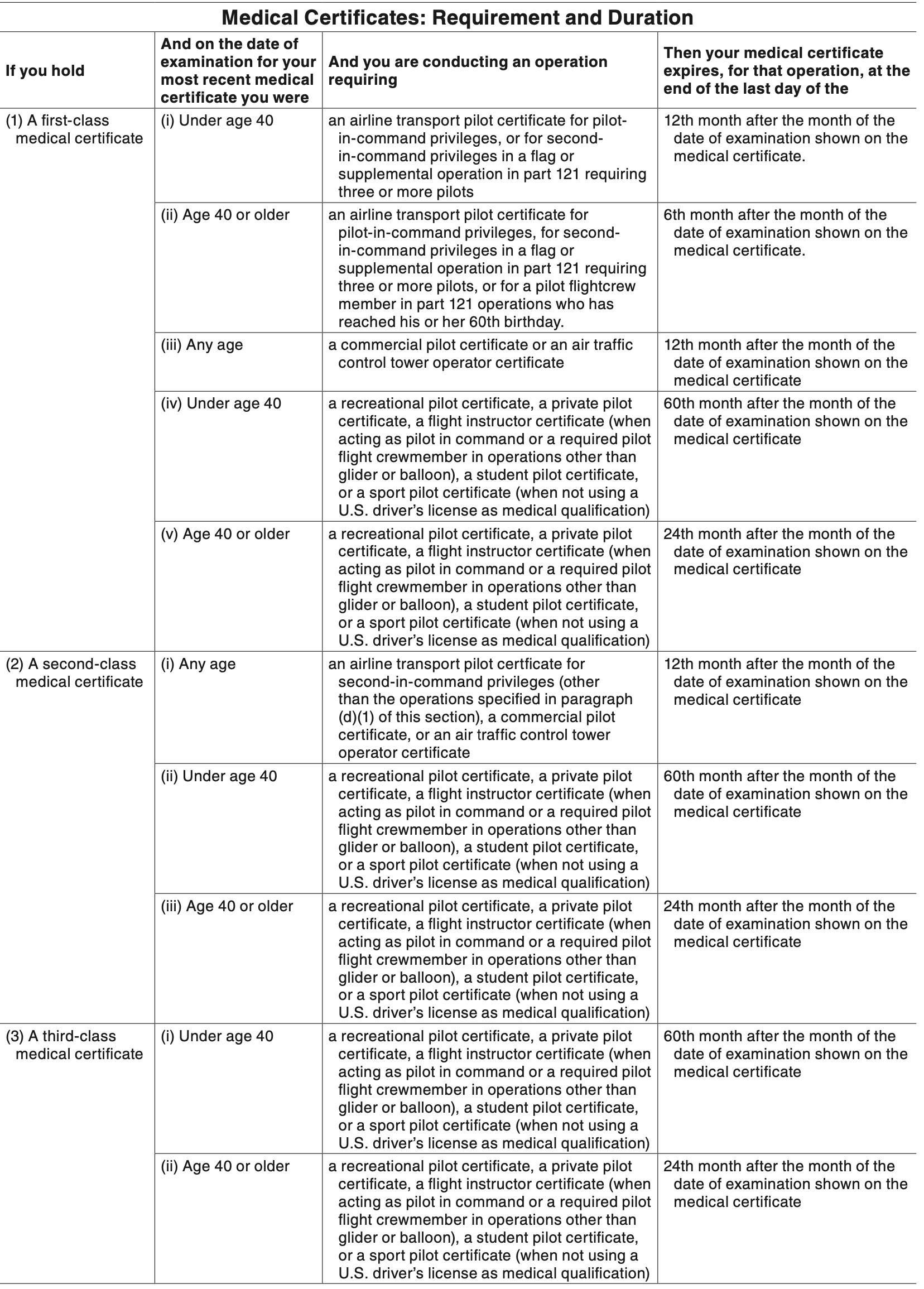
- 14 CFR §61.23 - Medical certificates: Requirement and duration
- Each of the classes of medical certificates "reverts" to the the lower class at expiration.
BasicMed
- Limitations
- 14 CFR §61.113(i)
- For Private Pilot only
- Airplane authorized to carry not more than 7 people or with max takeoff weight not more than 12,500 lb
- Carry no more than 6 passengers
- Fly no higher than 18,000 ft
- Fly no faster than 250 KIAS
- Cannot fly for compensation or hire
- These limitations were updated in November 2024
- Requirements
- 14 CFR §61.23(c)(3)
- Have held a medical at some point after 14-July-2006
- The most recent medical cannot have been suspended or revoked
- Completed medical education course in previous 24 calendar months
- Received physical exam in previous 48 calendar months
- Bring BasicMed checklist to any licensed physician
- Comply with any medical requirements or restrictions associated with their U.S. driver's license
- FAA-AC-68-1A BasicMed
- FAA Updates BasicMed Program
- FAA BasicMed
Medical Deficiencies
- 14 CFR §61.53 Prohibition on operations during medical deficiency
- If you have a medical certificate and are taking medication or have a condition which would make you no longer meet the requirements then you cannot fly
- Don't fly if you are unable to operate the aircraft in a safe manner
- Certain medical conditions are disqualifying
- Certain medical conditions will result in being issued a medical certificate with a limitation on it
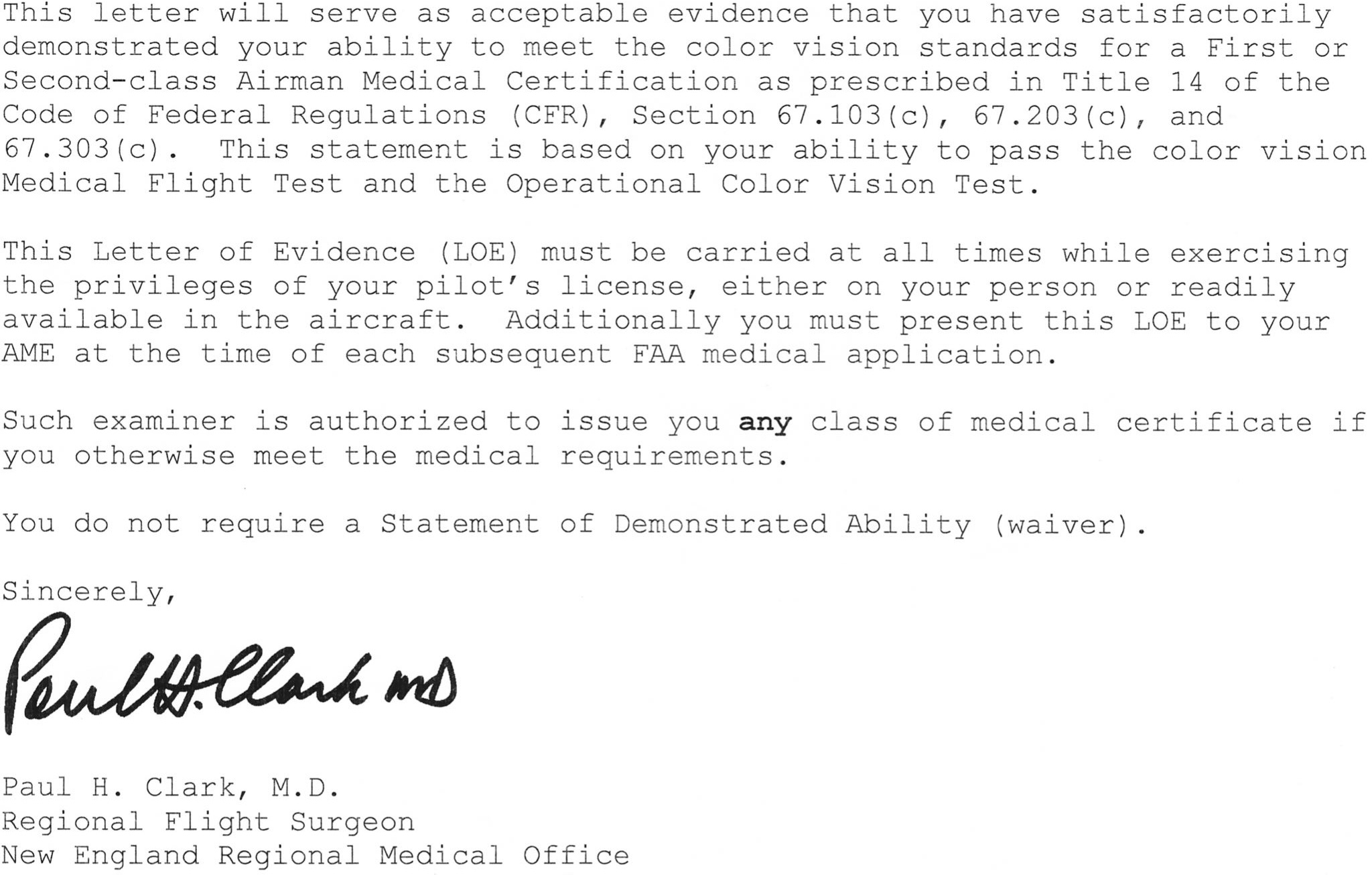
- For example if an applicant fails to meet the color vision standard as interpreted above but is otherwise qualified, the Examiner must issue a medical certificate bearing the limitation
- Not valid for night flying or by color signal control
- Guide for Aviation Medical Examiners Application Process for Medical Certification
- Guide for Aviation Medical Examiners Aerospace Medical Dispositions Item 52. Color Vision
- Another example of a limitation is for someone who is hearing impaired they would require the limitation "not valid for flight requiring the use of radio."
- Some disabilities may require special equipment to be installed in the aircraft, such as hand controls for pilots with paraplegia.
- For example if an applicant fails to meet the color vision standard as interpreted above but is otherwise qualified, the Examiner must issue a medical certificate bearing the limitation
- Statement of Demonstrated Ability (SODA)
- A statement authorizing medical certification of, at the discretion of the Federal Air Surgeon, applicants whose disqualifying condition is static or non-progressive.
- May be issued Letter of Evidence (LOE) that needs to be carried along with medical
- May involve different levels of tests (e.g. Operational Color Vision Test (OCVT), Medical Flight Test (MFT))
- If you have any concern about potential medical deficiency, good idea to get medical certificate in the early stages of flight training
- Remember, medical (and student pilot) certificate is required to solo
- No age limit to log dual received, so potentially could be paying for and receiving a lot of flight training before even being eligible to solo, only to later find out you can't get medical (or it has limitation)
Currency Requirements
Basic Currency Requirements
- 14 CFR §61.56 - Flight Review
- 14 CFR §61.57 - Recent flight experience: Pilot in command
- To act as PIC
- Flight review within previous 24 calendar months
- 1 hour flight and 1 hour ground training
- Review of Part 91
- Demonstrate safe exercise of pilot certificate
- 1 hour flight and 1 hour ground training
- Checkride counts as flight review
- Flight review within previous 24 calendar months
- To carry persons
- 3 takeoffs/landings within the preceding 90 days
- Same category, class, and type
- Full stop if in tailwheel
- 3 takeoffs/landings within the preceding 90 days
- To carry persons at night (1 hour after sunset and ending 1 hour before sunrise)
- 3 takeoffs/landings within the preceding 90 days
- Same category, class, and type
- Full stop
- 3 takeoffs/landings within the preceding 90 days
- See Kortokrax 2006 which was later rescinded and the Federal Register here.
- Basically, with this change, a non-current pilot can act as PIC with an instructor on board, only for the purposes of regaining currency.
- The update that brought the change from passengers to persons also brought a change to the definition of passenger to clarify that persons providing or receiving flight training are not passengers.
Instrument Currency Requirements
- To act as PIC under IFR or less than VFR weather minimums
- Use 66 HIT to remember instrument currency requirements
- 6 Approaches within
- 6 months including
- Holding
- Procedures and tasks
- Intercepting
- Tracking
- Courses through the use of navigational electronic systems
- 14 CFR §61.57(c) Instrument experience
- Per aircraft category
- e.g. airplane, helicopter
- After instrument currency lapses there is a 6 month "grace period" during which you are not instrument current, but can still complete the above to become curent.
- After that need to complete an IPC
- 14 CFR §61.57(d) Instrument proficiency check
- Note: can file IFR flight plan, but cannot accept the clearance and go IFR even if weather is VMC
- If instrument currency lapses, need IPC
- Use 66 HIT to remember instrument currency requirements
Documents Pilots Must Possess
- A pilot is required to have on them or readily accessible in the plane (PPM):
- P - Pilot certificate
- P - Photo ID
- M - Medical certificate
- As instructor and not acting as PIC, just need
- Instructor certificate
- Pilot certificate
- Instructor certificate it says not valid unless pilot certificate is also carried
- Don't need SFRA course completion certificate, but need to produce it within reasonable time if asked
- 14 CFR §61.3 - Requirement for certificates, ratings, and authorizations
- Student pilots are required to carry their logbook on solo cross-country flights