Steep Turns
This page covers Task A. Steep Turns from the FAA-S-ACS-25 Flight Instructor for Airplane Category Airman Certification Standards.
Elements of Steep Turns
- Relationship of bank angle, load factor, and stalling speed.
- Recall: stall is a function of angle-of-attack, and a stall can happen at any airspeed
- Dominant physics here are the same as those in single engine
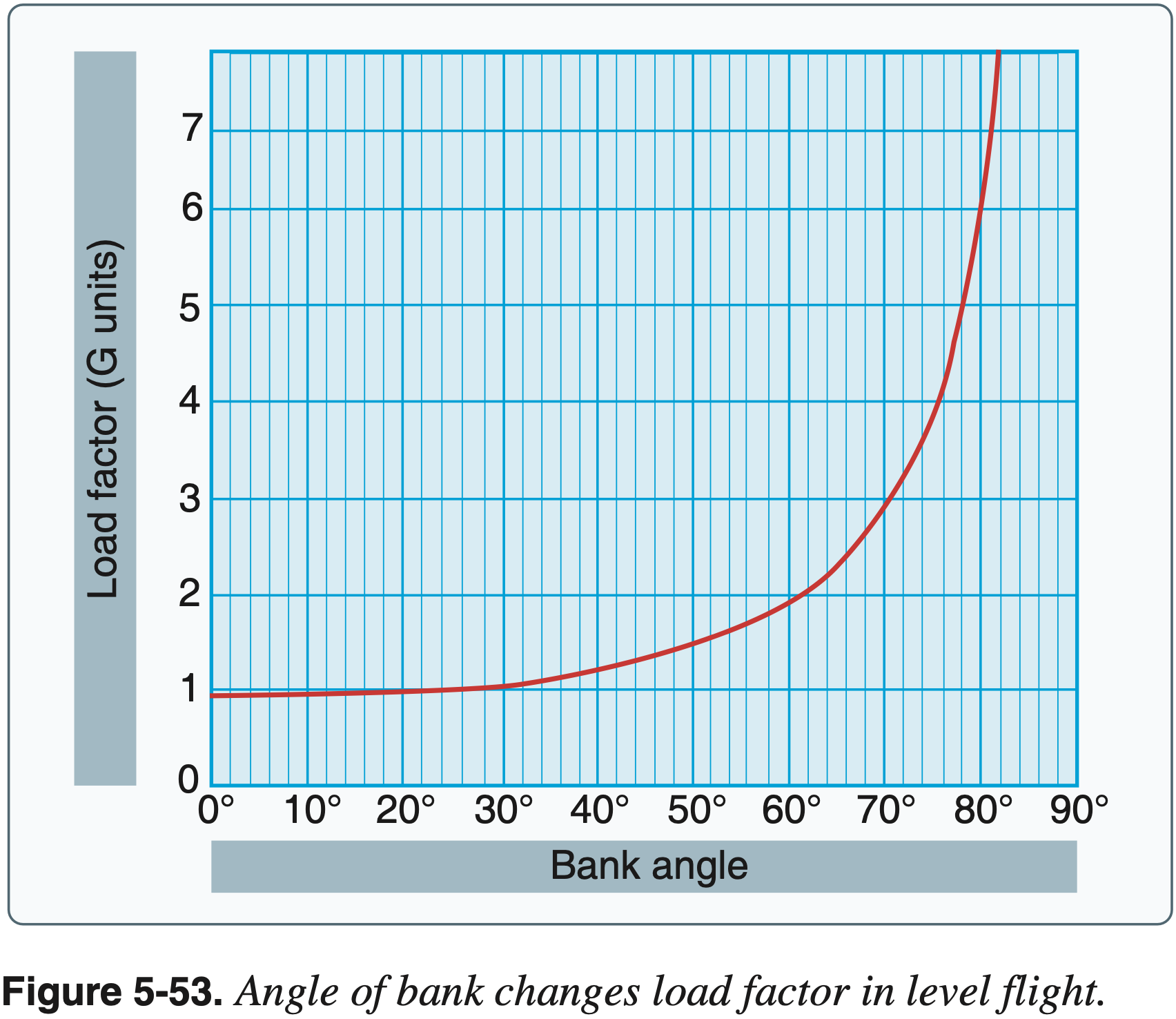
- Relationship between bank angle and load factor is not linear
- It varies like
, which is what is plotted below
- It varies like
- Note also how to calculate maneuvering speed at weight less than max gross
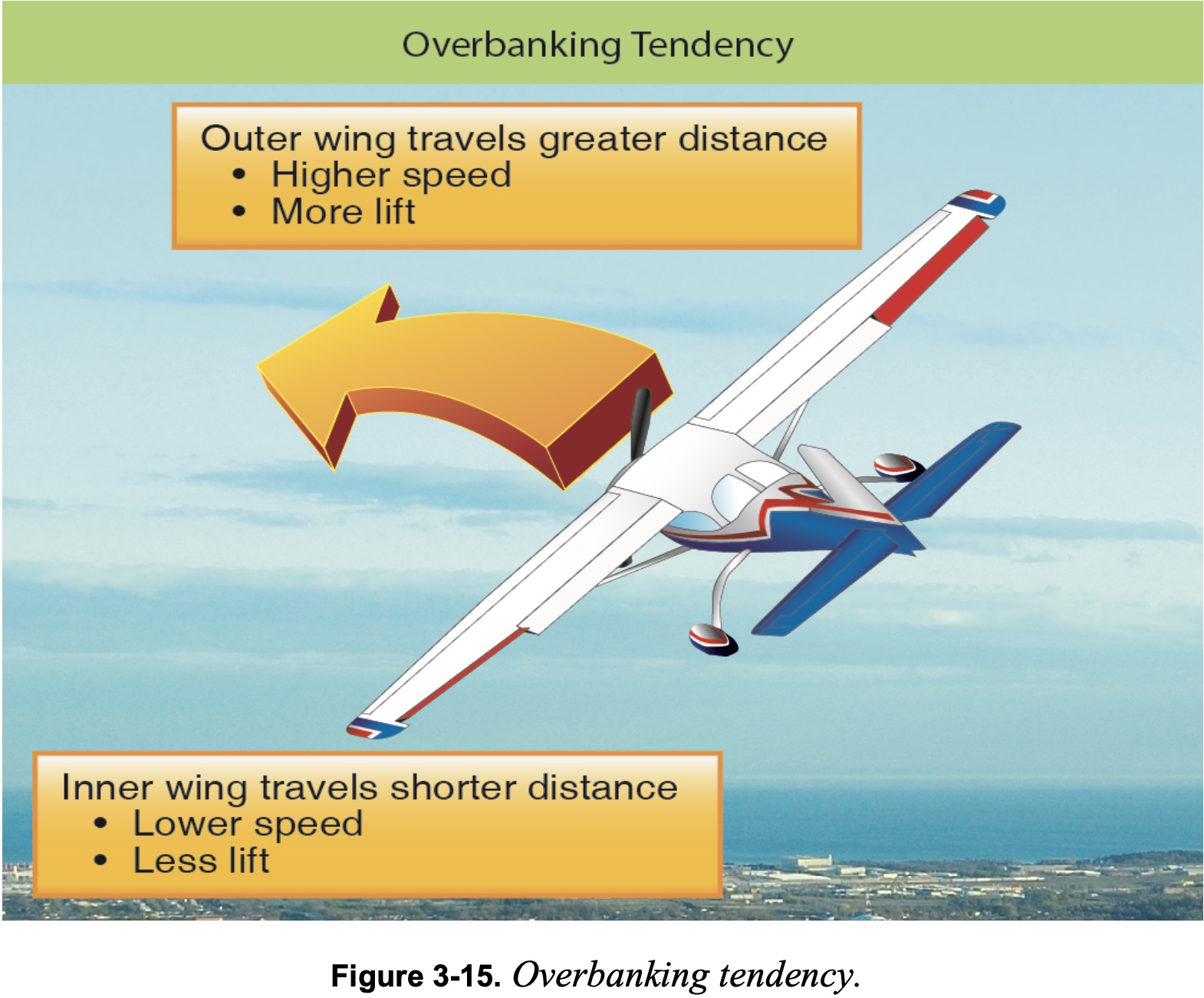
- Overbanking tendency.
- In a turn, the outside wing travels at a faster airspeed than the inside wing and, as a result, it develops more lift
- This creates an overbanking tendency that needs to be controlled by the use of opposite aileron when the desired bank angle is reached
- Torque effect in right and left turns.
- Torque effect (for planes with props that rotate clockwise from pilot's view) will tend to roll the plane to the right
- This asymmetry may be apparent during steep turns
- However, it's likely that other asymmetries will be more dominant, such as the following for example
- Sight picture
- Even throttle application
- Selection of a suitable altitude.
- Start at an altitude that ensures a minimum of 3,000' AGL will be maintaned throughout the entire maneuver
- Don't have a great reference, closest is Commercial Pilot - Airplane Airman Certification Standards (FAA-S-ACS-7A) that specifies minimum altitudes for other maneuvers
- The minimum is typically 1,500 AGL for any maneuvers, and where there is a difference in the minimums for multiengine they are increased to 3,000' AGL
- Thus a minimum of 3,000' AGL seems reasonable for steep turns
- The Baron POH, as an example, only specifies minimum 5,000' AGL for
demo, but not for any other maneuvers
- Don't have a great reference, closest is Commercial Pilot - Airplane Airman Certification Standards (FAA-S-ACS-7A) that specifies minimum altitudes for other maneuvers
- More altitude is always good
- Start at an altitude that ensures a minimum of 3,000' AGL will be maintaned throughout the entire maneuver
- Orientation, division of attention, and planning.
- Use a spot on the windshield, glarshield, or compass and keep that on the horizon
- To correct altitude deviations can use a combination of bank and pitch changes
- Entry and rollout procedure.
- Perform CHAPS
- Select a visual reference
- Two 360° turns in opposite directions at a 50° bank angle
- Add power on roll-in followed by nose-up trim
- Start rollout 20 degrees before target heading
- Coordination of flight and power controls.
- Altitude, bank, and power control during the turn.
- Proper recovery to straight-and-level flight.
- During rollout return the nose-up trim that was added on the roll-in back to where it was
- Reduce power back to where it was on entry
- Perform cruise checklist
Common Errors Related to Steep Turns
- Improper pitch, bank, and power coordination during entry and rollout.
- Uncoordinated use of flight controls.
- Improper procedure in correcting altitude deviations.
- Loss of orientation.
Additional common errors are listed in FAA-H-8083-3C Airplane Flying Handbook Chapter 10: Performance Maneuvers on page 10-3.
References
- FAA-H-8083-3C Airplane Flying Handbook
- Chapter 10: Performance Maneuvers
- Page 10-1
- Chapter 10: Performance Maneuvers
- FAA-H-8083-25B Pilot's Handbook of Aeronautical Knowledge
- Chapter 5: Aerodynamics of Flight
- Page 5-22: Forces in Turns
- Page 5-34: Load Factors in Steep Turns
- Chapter 5: Aerodynamics of Flight