Endorsements and Logbook Entries
This page covers Task K. Endorsements and Logbook Entries from the FAA-S-ACS-25 Flight Instructor for Airplane Category Airman Certification Standards.
- Different aircraft are organized according to the following definitions 14 CFR §1.1
- Category - Broad classification (airplane, rotorcraft, glider, etc.)
- Class - Classification within a category wish similar operating characteristics (single-engine land, multi-engine land, etc.)
- Type - A specific make and basic model (C-152, B-737, etc.)
- A type rating is required by 14 CFR §61.31(a) for
- Large Aircraft - those with a maximum takeoff weight of more than 12,500 lb
- Turbojet powered airplanes
- Any others specified by the FAA
- A type rating is required by 14 CFR §61.31(a) for
- Additional distinctions are
- High Performance
- An engine of 200hp or more
- 14 CFR §61.31(f)
- Complex - Retractable gear, flaps, and controllable pitch propeller
- High Altitude - 25,000 MSL or more
- Tail-wheel
- Technically Advanced Aircraft (TAA) - see here for example
- 14 CFR §61.129(j)
- PFD
- MFD
- Autopilot
- High Performance
- Aircraft certification
- Restricted - ex. former military aircraft
- Limited - historic aircraft, or could be former military
- Primary - simple, for personal use, e.g. kit planes
- These are important to know when it comes to which aircraft a pilot can fly
TIP
Generally best answer when it comes to questions about endorsements is to consult FAA-AC-61-65J.
Required Logbook Entries for Instruction Given
NOTE
Instructor must sign the logbook of each person they have given flight or ground training to.
- 14 CFR §61.189(a)
- 14 CFR §61.51 - Pilot logbooks
- This lists what the log entry must contain, all the standard items in logbook
- Date
- Aircraft info
- Duration
- Location
- This lists what the log entry must contain, all the standard items in logbook
Required Student Pilot Endorsements and Logbook Entries
- FAA-AC-61-65J
- This acknowledges that the endorsements it provides are recommended, and although it provides recommended or "sample" endorsements beyond the two above (pre-solo knowledge test and pre-solo flight training, as well as citizenship verification) it also seems to make fairly clear that only the 90 day endorsement is required, and the pre-solo knowledge test and flight training are requirements (but that need not bring an endorsement)
- 49 CFR §1552.15(c)(2)
- Describes the required citizenship verification endorsement
- This section was changed on 30-July-2024 to require a citizenship endorsement when previously it did not
- The diff is here, with the previously relevant section 49 CFR §1552.3(h) (2024-09-29)
- To solo, a student pilot technically (as far as I can tell) only needs two endorsement: citizenship verification and the initial (and then recurring) 90 day solo endorsement
- It provides endorsements and language that ensures consistency with 14 CFR Part 61, and described below is the "standard" endorsements given, even if they do include more endorsements than strictly necessary.
- In the section that follows, the endorsements required to solo are described as if all the endorsements mentioned above are required
Zero-to-Solo
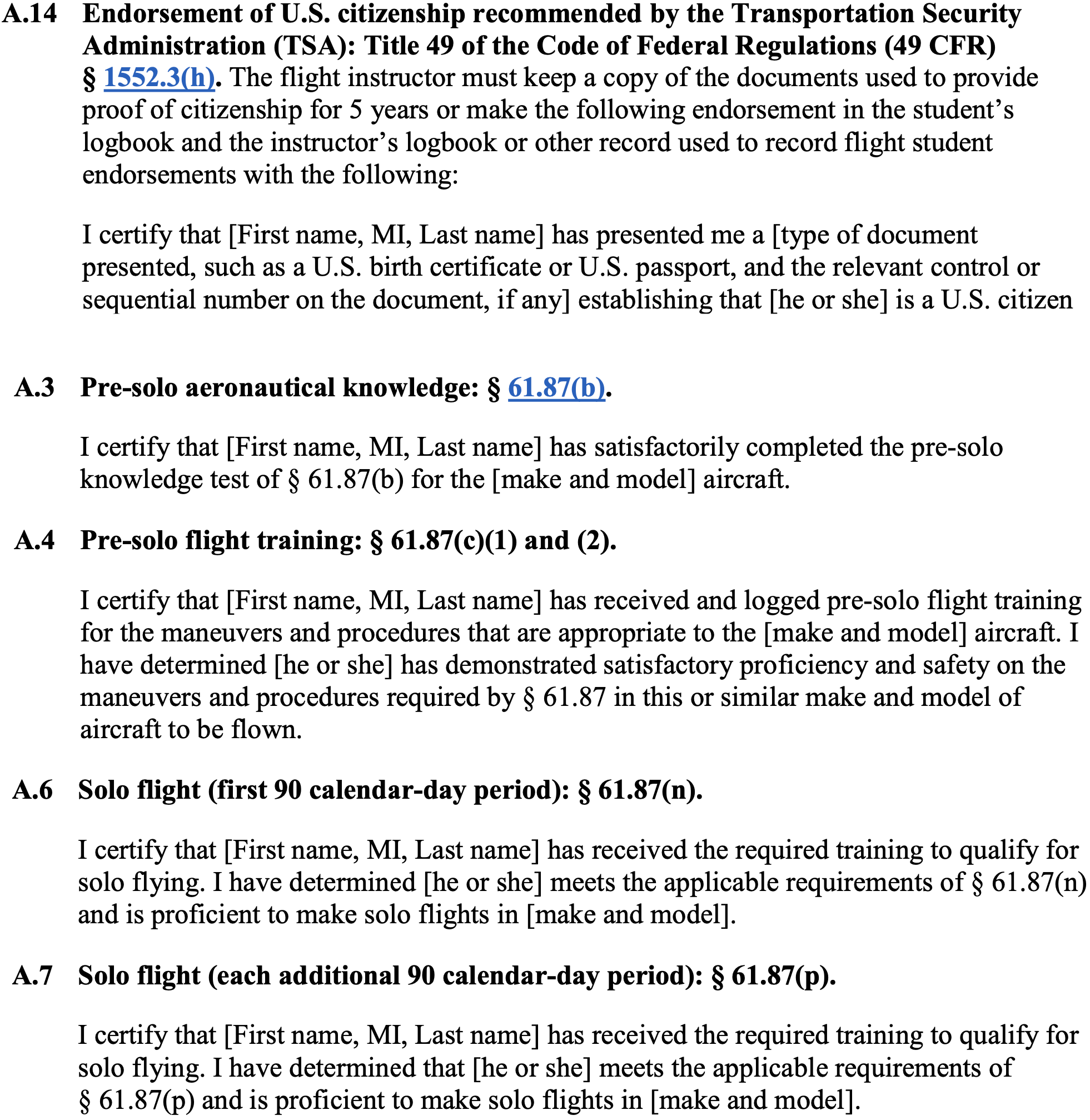
- Citizenship verification (A.14)
- Flight school must verify citizenship before flight training begins
- 49 CFR §1552.7(a)
- The wording of the CFR has changed, but previously it had said the flight school must verify citizenship, but the endorsement sample in FAA-AC-61-65J says the flight instructor needs to make the endorsement and keep a copy of the documents proving citizenship for 5 years.
- As a flight instructor, it's best to keep your own records of this, even if not strictly required.
- Can do flight training as non-US citizen, but need TSA approval
- Flight Training Security Program (FTSP)
- Getting Your Pilot's License as a Non-US Citizen
- Check if this is still correct though, as it seems the CFRs have recently changed.
- Flight school must verify citizenship before flight training begins
- Medical and student pilot certificate (No Endoresments Needed)
- 14 CFR §61.87 - Solo requirements for student pilots
- Before a student solos, they need to have a student pilot certificate and medical (or BasicMed) neither of which are required before to log training received time
- No instructor endorsement required for student to get student pilot certificate and medical.
- Pre-solo knowledge test (A.3)
- 14 CFR §61.87(b)
- This describes the pre-solo knowledge test requirement, but doesn't specifically state a separate endorsement is required
- Student's CFI must test knowledge of airspace rules and procedures, and flight characteristics and limitations of make and model of aircraft to be solo'd
- Student's CFI must administer the pre-solo knowledge test, review the answers, and will endorse their logbook.
- 14 CFR §61.87(b)
- Pre-solo flight training (A.4)
- 14 CFR §61.87(c)
- CFI must have judged student to be safe
- Student needs to have received and logged training in maneuvers specified in 14 CFR §61.87(d)
- Proper flight preparation procedures, including preflight planning and preparation, powerplant operation, and aircraft systems
- Taxiing or surface operations, including runups
- Takeoffs and landings, including normal and crosswind
- Straight and level flight, and turns in both directions
- Climbs and climbing turns
- Airport traffic patterns, including entry and departure procedures
- Collision avoidance, windshear avoidance, and wake turbulence avoidance
- Descents, with and without turns, using high and low drag configurations
- Flight at various airspeeds from cruise to slow flight
- Stall entries from various flight attitudes and power combinations with recovery initiated at the first indication of a stall, and recovery from a full stall
- Emergency procedures and equipment malfunctions
- Ground reference maneuvers
- Approaches to a landing area with simulated engine malfunctions
- Slips to a landing
- Go-arounds
- Initial 90-day solo endorsement (A.6)
- 14 CFR §61.87(n)
- By the student's instructor who gave the training
- Specific to the make and model to be flown in solo flight
- No older than 90 days
- Is the initial endorsement
- This and the above are the minimum necessary for student pilot to do first solo flight in traffic pattern
- 14 CFR §61.87(n)
- Additional 90-day solo endorsement (A.7)
- 14 CFR §61.87(p)
- This says pretty much the same thing as 14 CFR §61.87(n) above, but from the perspective of the requirements on the instructor
- This is also the recurring 90 day endorsement that needs to get re-upped periodically
- 14 CFR §61.87(p)
- There are more endorsements that are applicable to student pilots described below
- The above zero-to-solo endorsements are everything the student pilot needs to solo out of the airport where their training is conducted, e.g. KHEF. To fly solo from KHEF and practice landings at KHWY or KCJR, for example, that are within 25 NM, a cross-country endorsement isn't needed, but there is a separate endorsement described below.
Cross Country
- Practice landings at aiport within 25 nm (A.8)
- Solo takeoffs and landings at another airport within 25 nm: 14 CFR §61.93(b)(1)
- CFI needs to train the student to, from, and at other airport and endorse the student's logbook
- The endorsement is specific to each airport the student is authorized to solo to
- Solo takeoffs and landings at another airport within 25 nm: 14 CFR §61.93(b)(1)
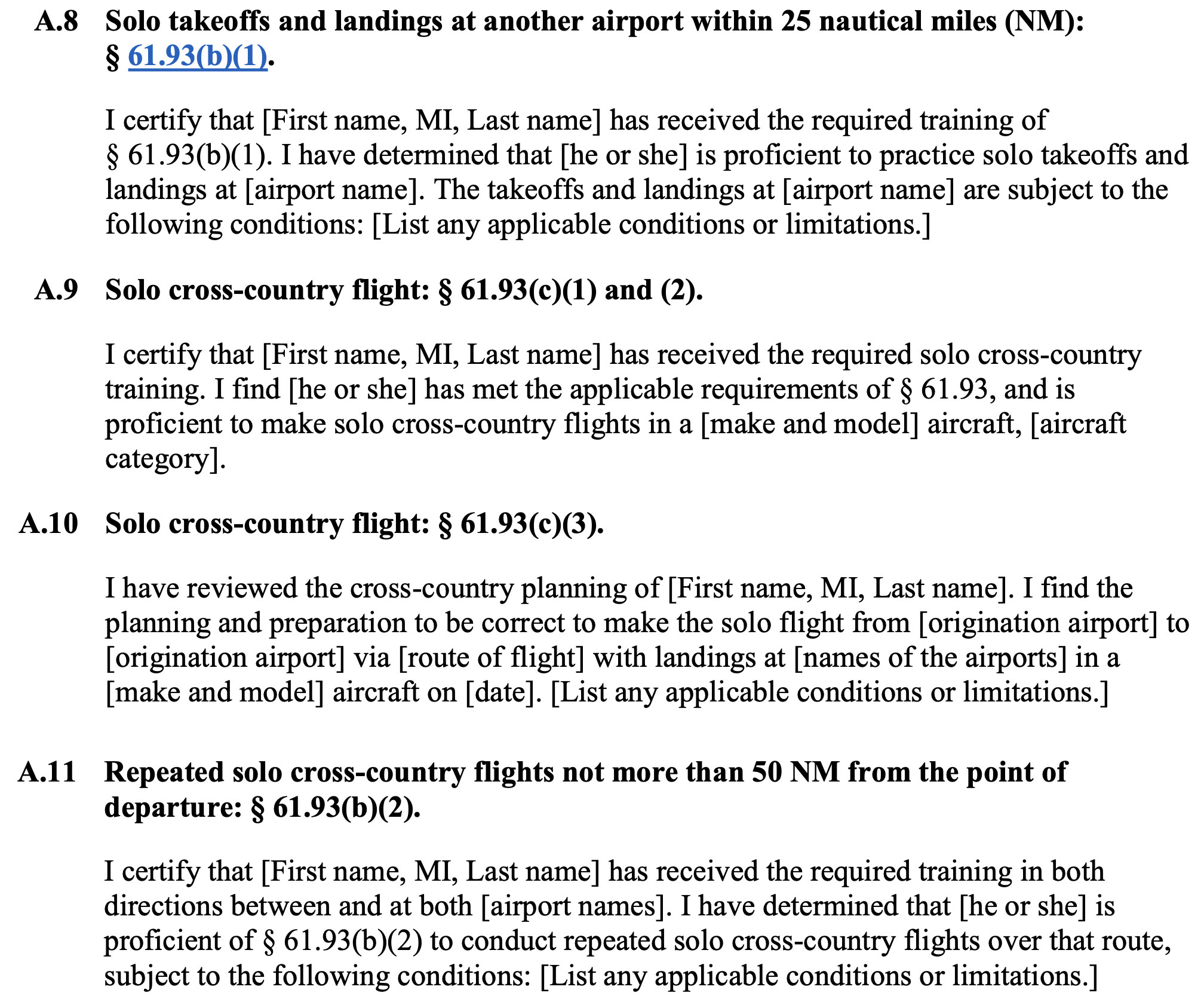
- Solo cross-country in make and model (A.9)
- 14 CFR §61.93(c)(1) and 14 CFR §61.93(c)(2) specify endorsements needed for category and make and model, respectively.
- One endorsement combines the requirements of these two sections
- Student needs to receive training in maneuvers specified in 14 CFR §61.93(e)
- This applies for any flight more than 25 nm from origin airport
- Solo cross-country flight planning (A.10)
- 14 CFR §61.93(c)(3) requires the student's instuctor verify their preflight planning and specifies origin and destination airports, route, and airports of landing along the way.
- This is the "day of" endorsement and is specific to a particular flight, of a particular route, on a particular day
- This applies for any flight more than 25 nm from origin airport
- Repeated solo cross-country flights within 50 nm (A.11)
- Repeated solo cross-country flights not more than 50 nm from the point of departure: 14 CFR §61.93(b)(2)
- This seems like an unlikely endorsement for most people who rent from a flight school
- Note: student pilots need to carry their logbook only on solo cross country flights
The Rest
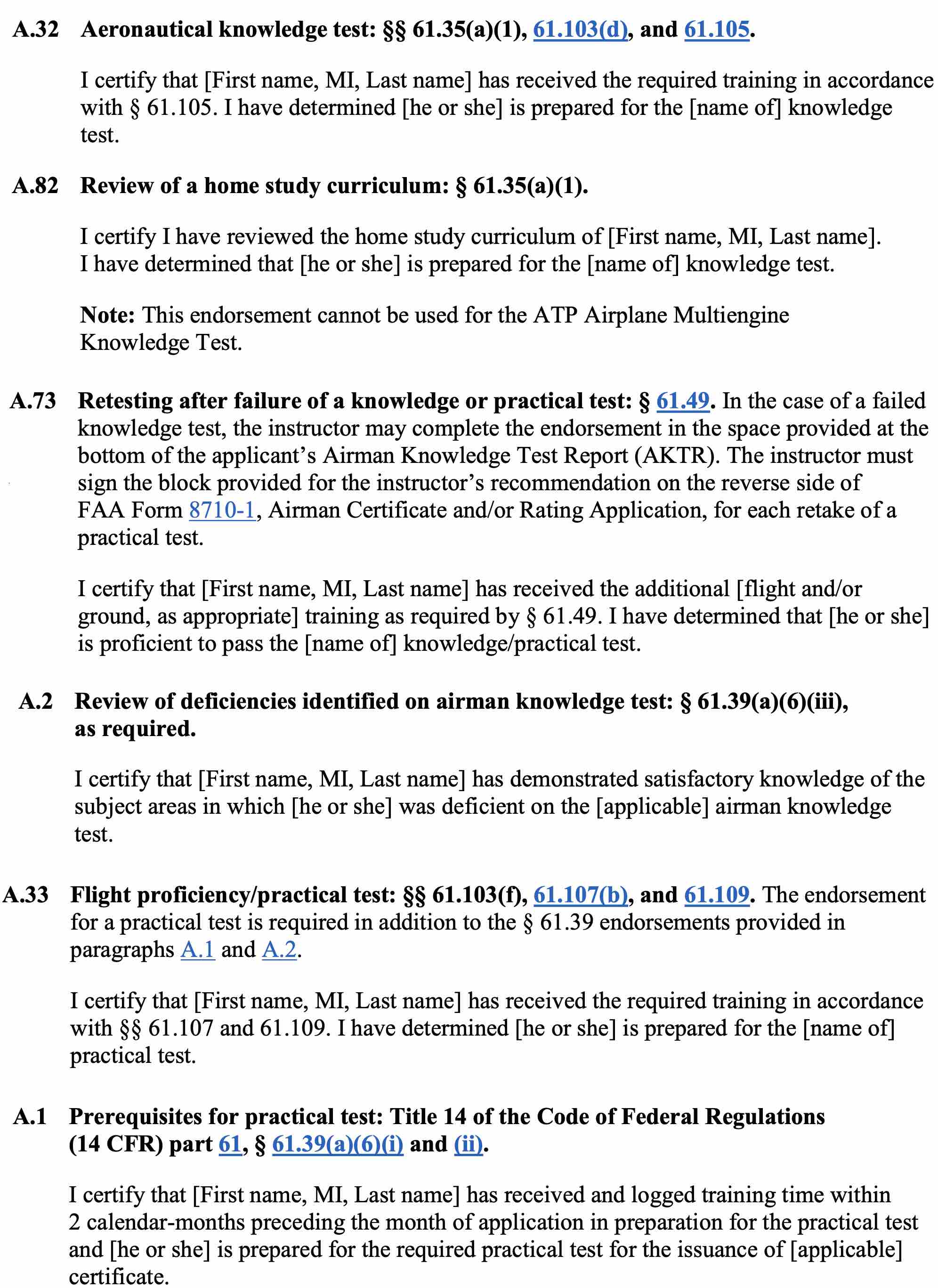
- Prepared for knowledge test (A.32)
- 14 CFR §61.35(a)(1)
- Received training and/or did home study and is prepared for knowledge test
- 14 CFR §61.103(d)
- Received training and/or reviewed home study and is prepared for knowledge test
- 14 CFR §61.105
- Describes aeronautical knowledge areas
- 14 CFR §61.35(a)(1)
- Retaking knowledge test after failure (A.73)
- Should the student fail the knowledge test, they need to get additional training and an endorsement to retake the test
- 14 CFR §61.49 - Retesting after failure
- Reviewing knowledge test deficiencies (A.2)
- Unless the student gets 100% on the private pilot knowledge test, they need an endorsement stating that they have demonstrated satisfactory knowledge in the areas they were deficient on the knowledge test before they can take the practical test
- 14 CFR §61.39(a)(6)(iii)
- Prepared for practical test (A.33)
- 14 CFR §61.103(f)
- Received training and is prepared for practical test
- 14 CFR §61.107(b)
- Areas of operation
- 14 CFR §61.109
- Meets aeronautical experience requirements
- 14 CFR §61.103(f)
- Received training within 2 months for practical test (A.1)
- Retaking practical test after failure (A.73)
- Same endorsement as for knowledge test, saying additional training was given and the student is ready to re-take the practical test
Less Common Ones
- The privileges granted by the endorsements in this section are not necessary to get a private pilot certificate
- Pre-solo flight training at night (A.5)
- Night solo not required for PPL but student pilot can solo at night if they meet requirements in 14 CFR §61.87(o)
- Solo flight in Class B airspace (A.12)
- Solo flight to, from, or at an airport located in Class B airspace (A.13)
- 14 CFR §61.95(b)
- 14 CFR §91.131(b)(1)
- This includes the primary airport as designated in JO 7400.11B and the rare cases of airports within Bravo airspace that are not primary (e.g. DAL)
- Special Federal Aviation Regulation (SFAR) 73 seems to apply to Robinson Helicopters
Recreational and Sport Pilot Endorsements
- Recreational and sport pilot certificates are heavily restricted compared to a private pilot certificate
- Restrictions include how far one can fly from origin airport, restricts to E and G airpsace, altitude restrictions, horsepower restrictions, passenger carrying restrictions
- While these certificates offer an easier path to a pilot certificate than a private pilot, I don't think the marginally easier training makes up for how restricted they are
- It is unlikely I will ever give this training or grant these endorsements, so they are not covered here
Instrument Rating Endorsements
- Aeronautical knowledge test (A.38)
- Flight proficiency/practical test (A.39)
- Received training within 2 months for practical test (A.40)
- Interesting, for the instrument rating A.40 combines the usual A.1 and A.2
Commercial Pilot Endorsements
- Aeronautical knowledge test (A.34)
- Review of deficiencies on knowledge test (A.2)
- Flight proficiency/practical test (A.35)
- Received training within 2 months for practical test (A.1)
Flight Instructor Endorsements
- Part 61 Subpart H - Flight Instructors Other than Flight Instructors With a Sport Pilot Rating
- To apply for a flight instructor certificate
- Must receive and log training on the fundamentals of instructing: 14 CFR §61.183(d)
- Pass FOI knowledge test: 14 CFR §61.183(e)
- Pass FIA aeronautical knowledge test: 14 CFR §61.183(f)
- Receive logbook endorsement on flight instructor areas of operation 14 CFR §61.183(g)
- Spin training and endorsement: 14 CFR §61.183(i)
Preparation of a Recommendation for Pilot Practical Test
- 14 CFR §61.39 - Prerequisites for practical tests
- Completed knowledge test within 24 months before the practical test and present the result
- Accomplished required training and obtained the aeronautical experience for the certificate or rating sought
- Hold at least a third-class medical certificate (or BasicMed)
- Meet age requirements
- 17 for private pilot
- 18 for commercial pilot
- 23 for ATP
- Have instructor logbook endorsement
- Review of deficiencies identified on airman knowledge test: 14 CFR §61.39(a)(6)(iii)
- Completed and signed application
- See FAA-AC-61-65J for examples of endorsements for instrument and commercial
Multi-Engine Endorsements (Added Class)
- Solo without category/class rating (A.72)
- 14 CFR §61.31(d)(2)
- Given most places in the Dallas area do not seem to rent multiengine planes, this is an unlikely endorsement to give
- Prepared for practical test to add category/class/type (A.74)
- Still give A.1 stating the applicant for a commercial multi-engine addon, for example, has received training within the preceding 2 months of practical test
- 14 CFR §61.63(c)(3)
- No time requirements for additional class rating
Additional Endorsements
- To act as pilot in command in a complex airplane (A.68)
- To act as pilot in command in a high-performance airplane (A.69)
- 14 CFR §61.31(f)
- An airplane with an engine of more than 200 horsepower
- To act as pilot in command in a pressurized aircraft capable of high-altitude operations (A.70)
- To act as pilot in command in a tailwheel airplane (A.71)
- Completion of an instrument proficiency check (IPC) (A.67)
- 14 CFR §61.57(d)
- Don't see in 14 CFR where it states the endorsement requirement
- Completion of any phase of an FAA-sponsored Pilot Proficiency Program (WINGS) (A.66)
- 14 CFR §61.56(e)
- This is in lieu of flight review
Flight Review
- Completion of a flight review (A.65)
- See 14 CFR §61.56 - Flight Review (a) and (c)
- Minimum 1 hour ground and 1 hour flight training
- Log unsatisfactory flight review as dual given
- FAA-AC-61-98E

Required Flight Instructor Records
- 14 CFR §61.189 - Flight instructor records
- Instructor must keep their own record of
- The name of each student they endorsed for solo and the date of the endorsement
- The name of each person they endorsed for a knowledge test or practical test, and which test, the date, and the results.
- These records must be kept at least 3 years
Flight instructor renewal and reinstatement requirements
- Within preceding 24 calendar months endorsed at least 5 people for practical test with 80% pass rate
- Serve as a part 121 or 135 instructor or check airman
- Complete a Flight Instructor Refresher Course (FIRC)
- Take a practical test with FAA or DPE
Special Federal Aviation Regulation (SFAR) 73
- Special requirements for Robinson R-22 and R-44 helicopters.
Logging Flight Time Without Flying
What time is loggable as flight time is defined in 14 CFR §1.1 - Flight Time:
Flight time means:
(1) Pilot time that commences when an aircraft moves under its own power for the purpose of flight and ends when the aircraft comes to rest after landing; or
(2) For a glider without self-launch capability, pilot time that commences when the glider is towed for the purpose of flight and ends when the glider comes to rest after landing.
This regulation is cited repeatedly across references where clarification is sought regarding how to apply this definition. Most of the clarification is around clarifying the "purpose of flight" such as in the Johnson 2000 which clarifies that when deicing procedures are part of an aircraft's journey from the origin gate to the final destination, the time spent deicing counts towards flight time. Other clarifications like this exist.
However, another question when applying the above definition is whether flight time can be logged if a takeoff, and therefore a landing, is never made. The arguments I have seen seem consider the first part of the definition in (1): that if an aicraft is moving for the purpose of flight that time is loggable, regardless of whether a landing was actually made.
In attempt to get a better answer to this question, there are several letters of interpretation that offer some guidance. Several excerpts are below. Notably, there isn't a single interpretation that I have been able to find that relieves the condition of "after landing." Emphasis added below.
Thus, we further conclude that flight time starts at the moment when the aircraft taxies under its own power from the gate to the de-icing pad, and flight time continues until the moment the aircraft comes to rest at the next point of landing.
In a situation in which a flight returns to the gate, for mechanical repair or other reason, such as additional freight or passengers, a critical inquiry is whether the air carrier requires the pilot to remain on board the airplane, because the mechanical repair or the on loading of passengers or cargo can be performed with all crewmembers and passengers on board. When the pilot must remain on board, this constitutes a delay that does not interrupt the accrual of flight time, because of the continuing "purpose of flight." In this situation, flight time starts when the aircraft first taxies under its own power from the gate, continues through the period of delay when the aircraft returns to the gate and in which the pilot must remain on board, and ends at the moment the aircraft comes to rest at the point of landing at the destination airport.
Another situation in which all flight time must be recorded is when a flight returns to the gate for mechanical reasons, the aircraft cannot be repaired, a replacement aircraft is used, and that aircraft does taxi, take off and make a landing at the destination airport. In this situation, flight time accrues and must be counted. The flight time that must be counted is the time the first aircraft moves under its own power from the gate to the time of the return of the first aircraft to the gate, plus flight time from the time the replacement aircraft moves under its own power from the gate to the point where the replacement aircraft comes to rest at landing at the destination airport.
Flight time ends for any helicopter operation when the helicopter comes to rest after landing.
Each of your scenarios presents a fact pattern where flight time has commenced and the aircraft has landed, but the flightcrew is still required to remain on the aircraft. Consequently, the aircraft in each of your scenarios has not come to rest after landing and flight time would continue to accrue in each scenario.
Commentary
It seems fairly obvious to me in all the letters I have been able to find, the FAA is clear that in every situation where flight time is accruing, that a landing has to have taken place. There isn't a clear response in anything I have been able to find in response to a scenario that involves never flying, regardless of intention. Much like the conversation around 14 CFR §91.126(b)(1) and circling approaches, the FAA's guidance has been consistent with the CFRs. So, it's not unexpected that the FAA hasn't provided guidance that contradicts the Flight Time definition whereby logging ends at some other point in time other than after landing as is written.
In the context of flight duty and crew rest periods (which is the context for many of the above such letters clarifying what counts as flight time) the issue of a landing never being made (whether after changing planes or other significant ground delays) is somewhat a moot point. The pilot(s) go home, and are able to rest during a time they would otherwise be flying. Now, this doesn't mean that there aren't scenarios without ambiguity, but rather that these seem not to have been come up in practice and motivating the need for clarification.
A somewhat more common, albeit still rare scenario, is in scenarios having no crew rest requirements or otherwise how time should be logged when no associated landing ever occured. One such scenario is a GA pilot who identifies an issue during the runup and aborts the flight and taxis back to the tidown whether this time counts as flight time. I think the letters on this topic, all of which are consistent with Flight Time ending after landing is no.
However, even accepting some ambiguity in this case one should consider whether logging such time when no flight ever occured is wise. Consider that in the face of this ambiguity not every DPE or potential future employer is going to share the interpretation that logging such flight time is consistent with regulation. And what might that say about someone so desperate to log time that they need to try to capture some tiny fraction of percent of time despite never having flown.