Airworthiness Requirements
This page covers Task B. Airworthiness Requirements from the FAA-S-ACS-25 Flight Instructor for Airplane Category Airman Certification Standards.
General Airworthiness Requirements and Compliance for Airplanes
Aircraft Documentation
Required Certificates and Documents
- Use the SPARROW acronym to remember certificates and documents required to be on board an aircraft.
- S - Supplements
- P - Placards
- The placards that should be on the plane are listed in the POH
- 14 CFR §91.9(a)
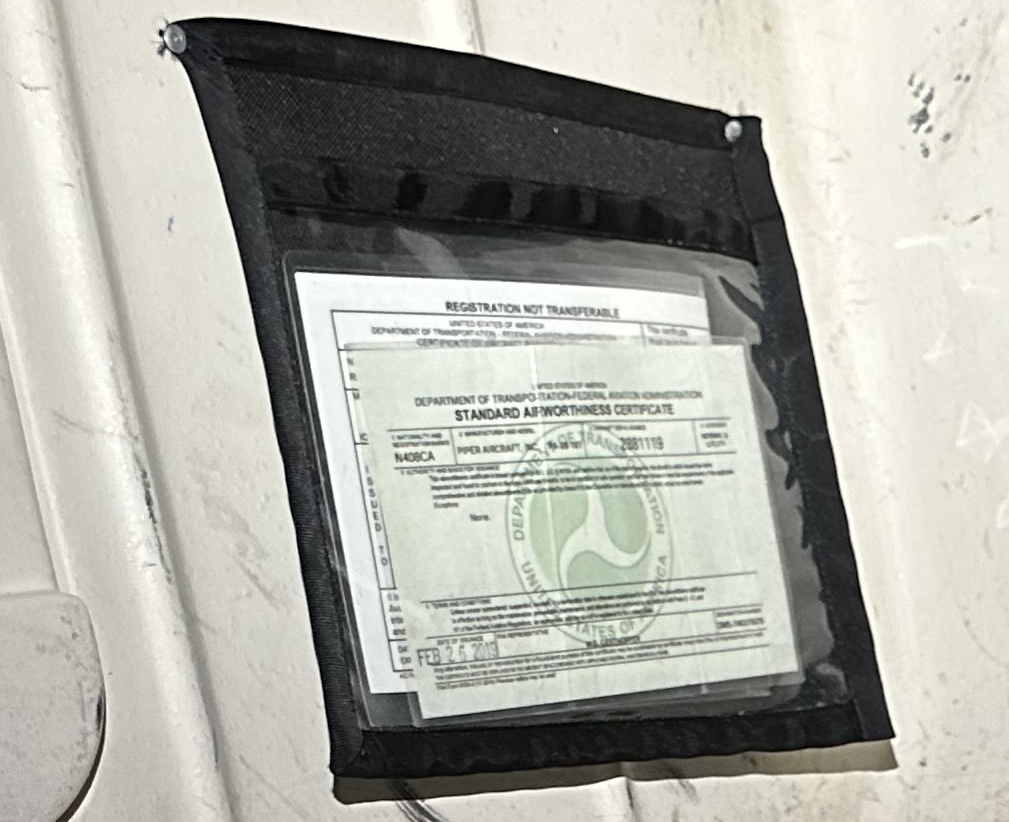
- A - Airworthiness certificate
- Means aircraft is safe for flight
- Remains valid as long as maintenance is done
- 14 CFR §91.203(a)(1)
- R - Registration
- Valid for 3 years (Now 7 years)
- Required to be visible on outside of aircraft
- Paper document required to be onboard
- 14 CFR §91.203(a)(2)
- R - Radio station license
- International only
- Good for 10 years?
- Note: the pilot may also need a radiotelephone operator permit, but that is a requirement of the pilot, not the plane as the items in this list pertain to.
- TODO@dwiese check this 47 CFR §87.89, and 47 CFR §87.18
- O - Operating limitations
- Includes but not limited to: placards, gauge markings, POH/AFM
- 14 CFR §91.9(b)(1)
- W - Weight and balance
Radio Station License / Radiotelephone Operator Permit
Regarding an additional "R" for radio station license see FCC Commercial Radio Operator License Program, Transport Canada: Flying to Canada: what you need to know - TP 15048, 47 CFR §87.89, and 47 CFR §87.18.
Basically, the plane needs a radio station license and the pilot needs a restricted radiotelephone operator permit.
A commercial operator license does not constitute or imply FCC authorization to transmit radio signals. Before you operate any radio station, make certain that the station is licensed as required by the FCC.
Another excerpt:
You need a commercial radio operator license to operate the following:
- Aircraft radio stations, except those which operate only on very high frequencies (VHF) and do not make foreign flights.
AFM vs POH
- Aircraft owner/information manual is not approved by the FAA and is not a substitute for the approved POH/AFM
- The POH is a document developed by the aircraft manufacturer and contains FAA-approved AFM information.
- If "POH" is used in the main title, a statement must be included on the title page indicating that sections of the document are FAA approved as the AFM.
- The POH for most light aircraft built after 1975 is also designated as the FAA-approved flight manual.
- Manuals follow standard format
- AFM vs POH/PIM
AFM regulated by FAA and specific to airplane
POH/PIM general aircraft info
POH is standardized by the General Aviation Manufacturer's Association
The title [of the document shall be] "Pilot's Operating Handbook and FAA Approved Airplane Flight Manual" for all airplanes except those for which the airplane manufacturer elected to provide a separate FAA Approved Airplane Flight Manual. In the latter case, the title shall be "Pilot's Operating Handbook".
Note: After the effective date of this revision, Pilot's Operating Handbooks for newly manufactured airplanes must be FAA Approved Airplane Flight Manuals.
Inspections Required
- Use the AVIATE Acronym to remember required aircraft inspections.
- A - Airworthiness Directives (AD)
- 14 CFR §39
- Need to find all applicable ones and make sure they are complied with
- Can look up FAA Airworthiness Directives (ADs)
- There are third-party services that can provide and help ensure ongoing compliance with ADs by inputting information about a plane
- Airworthiness directives cannot be overflown.
- V - VOR
- Every 30 days for IFR
- 14 CFR §91.171(a)(2)
- VOR accuracy requirements 14 CFR §91.171(b), (c)
- VOT: +/- 4 deg
- Ground checkpoint: +/- 4 deg
- Airborne checkpoint: +/- 6 deg
- Dual check: within 4 deg
- Log the results of the VOR accuracy test in the aircraft logbook or other record including the PADS acronym:
- P - Place
- A - Accuracy (bearing error)
- D - Date
- S - Signature
- I - Inspections
- Annual
- Can not be overflown.
- If annual "expires" and it needs to be flown somewhere for inspection, need a special flight permit (ferry permit).
- Annual can count as 100 hour but not vice versa.
- 100 hour if for hire
- Including flight instruction when the plane and pilot are provided.
- Or progressive
- 100 hour may be overflown to get to a place where inspection may be performed.
- 14 CFR §91.409(a)(1) and 14 CFR §91.409(b)
- Annual
- A - Altimeter/static system
- Every 24 calendar months
- 14 CFR §91.411
- T - Transponder
- Every 24 calendar months
- 14 CFR § 91.413(a)
- E - ELT
- Every 12 months
- 14 CFR §91.207(d)
- Also need to replace/recharge battery at 50% life or after 1 hour of cumulative use
- A - Airworthiness Directives (AD)
Logbook Documentation
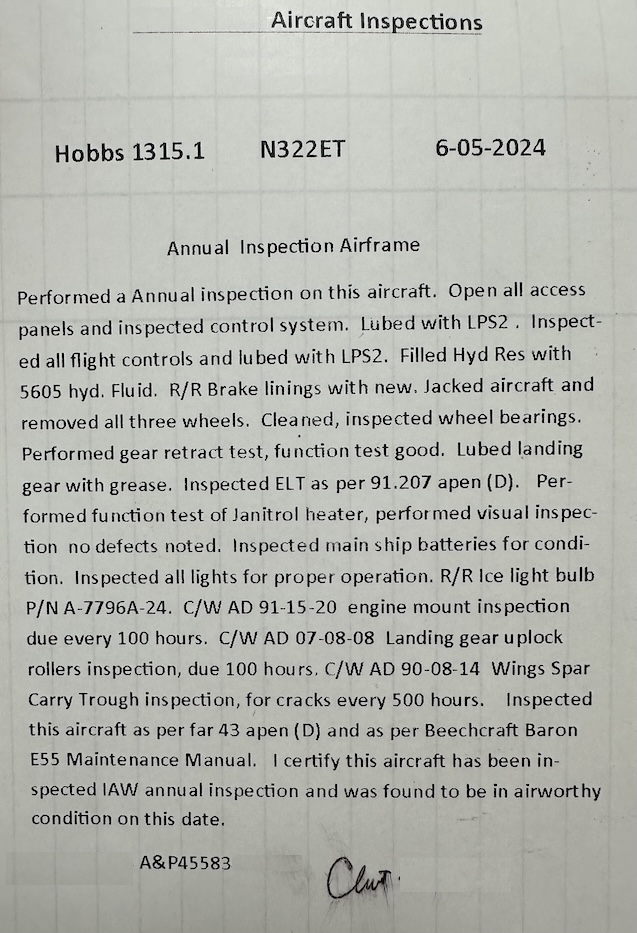
- 14 CFR §43.11
- Things required when inspections are performed
- Type and description.
- Date of inspection and aircraft total time.
- Signature, certificate type and certificate number.
- A statement certifying the aircraft was airworthy for return to service, or list of unairworthy items.
- Things required when inspections are performed
- 14 CFR §43.9
- Similarly, a similar list when maintenance is performed.
- 14 CFR §91.417
- Basically says the aircraft owner must keep these records.
- FAA-AC-43-9C
- This advisory circular provides guidance to help comply with the CFRs above.
VOR Check
- Recall from AVIATE acronym, VOR needs to be checked every 30 days for IFR
- VOR accuracy requirements 14 CFR §91.171(b), (c)
- VOT: +/- 4 deg
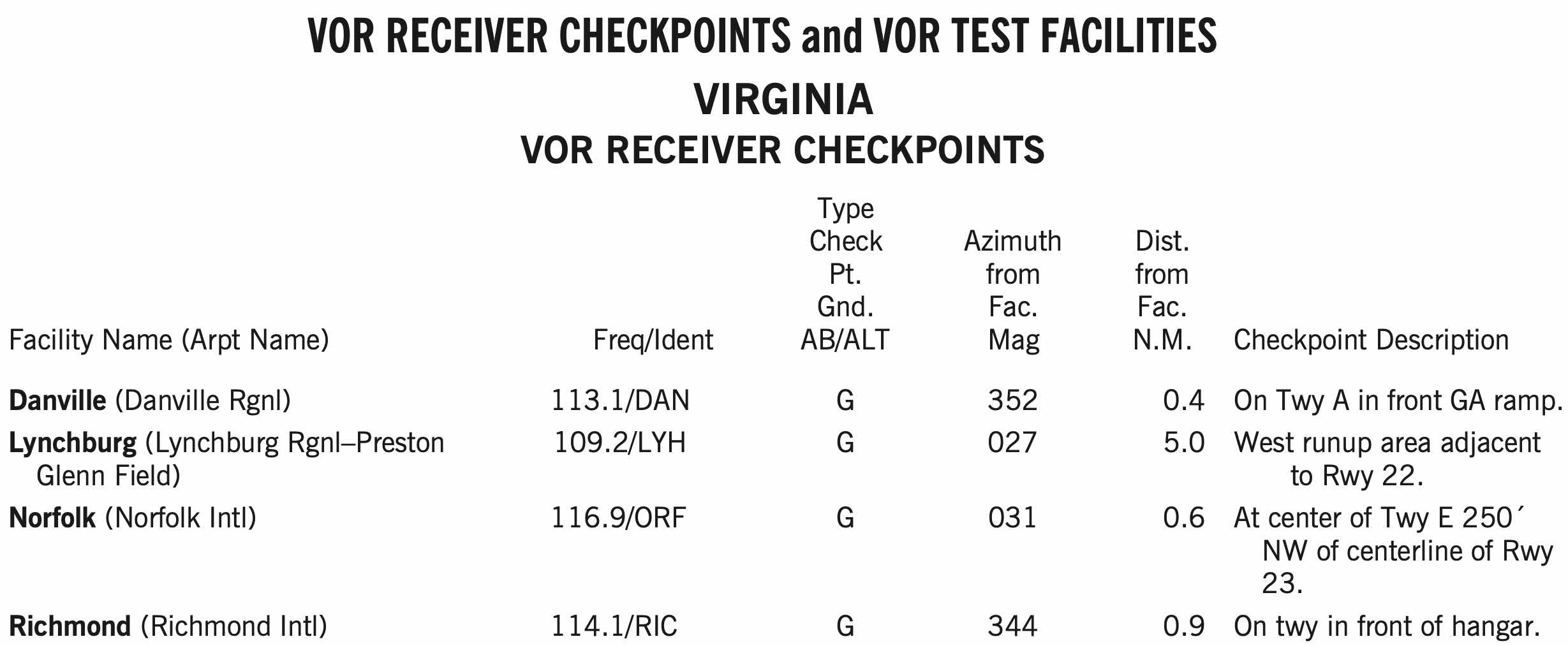
- Can be checked on the ground or in the air, as indicated in the chart supplement for that facility
- Ground checkpoint: +/- 4 deg
- Airborne checkpoint: +/- 6 deg
- Dual check: within 4 deg
- VOT: +/- 4 deg
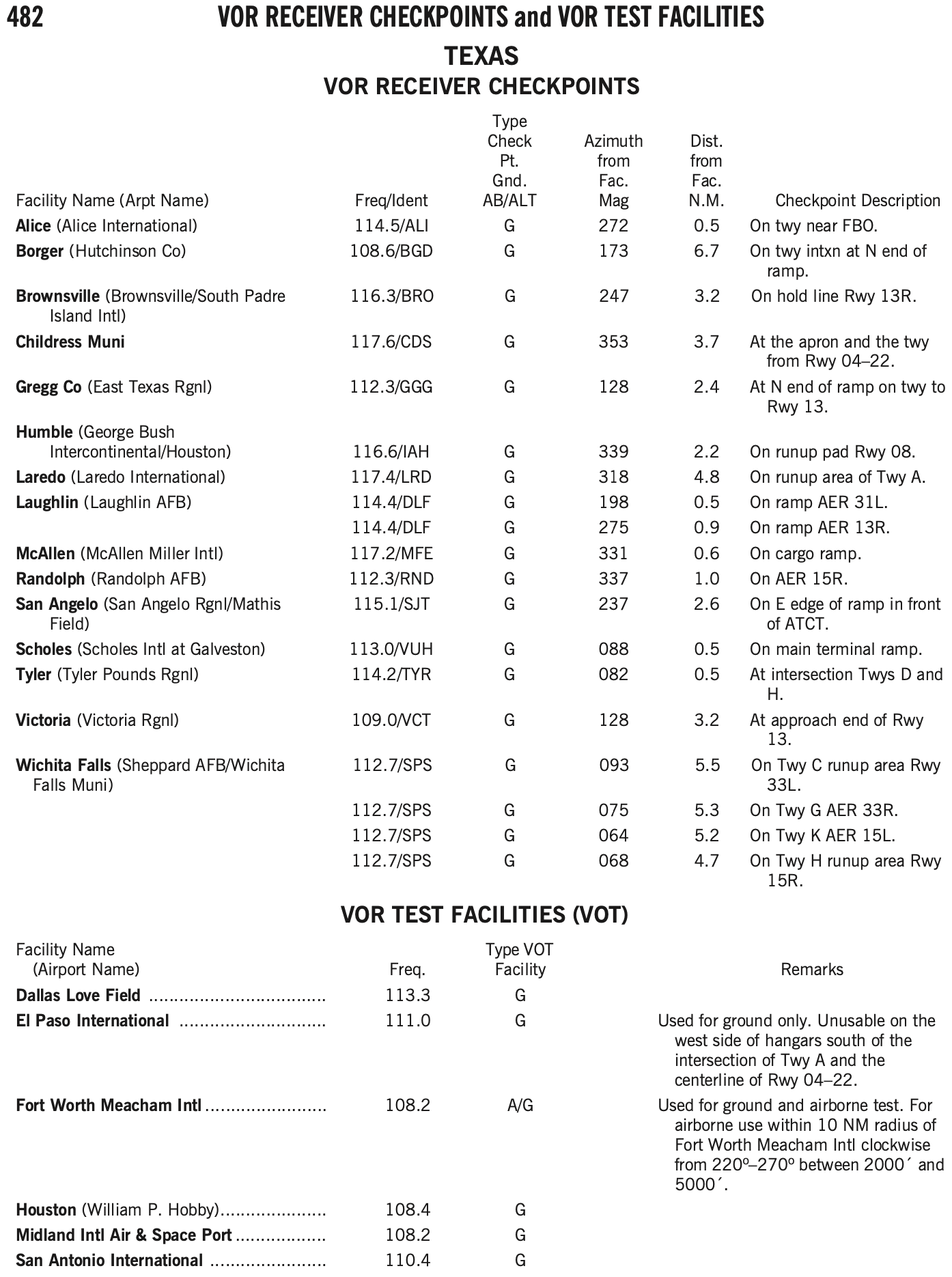
- Can find VOT facilities and VOR checkpoints in the chart supplement.
- Log the results of the VOR accuracy test in the aircraft logbook or other record including the PADS acronym:
- P - Place
- A - Accuracy (bearing error)
- D - Date
- S - Signature
- VOT is the most convenient way to perform a VOR check if your home airport happens to have one
- Similarly, ground checkpoints are also a convenient option
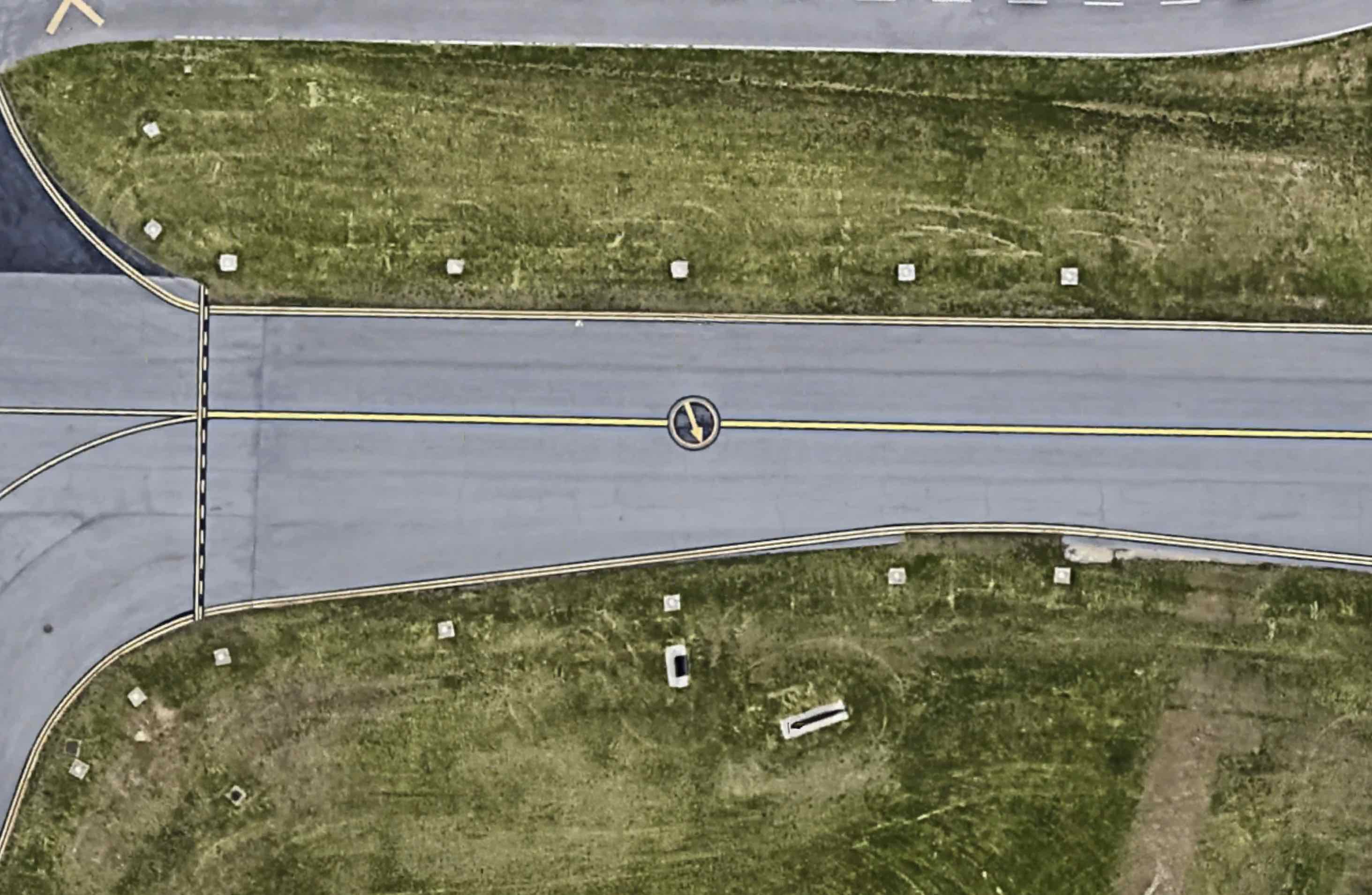
VOR Ground Checkpoint
- Has a sign in front of the arrow with the radial and frequency
VOT Check
- A VOT is a facility located at certain airports that emits a signal that can be used to test a plane's VOR receiver
- The VOT signals are generally designed to be used while on the ground, but some are designated as usable in air, with certain restrictions
- This information can be found in the chart supplement
- Dial a course of 180° in using the OBS, should see the needle center (within +/- 4 degrees) with a
TOindication.
Airworthiness Directives
- 14 CFR §39 covers Airworthiness Directives
- Need to find all applicable ones and make sure they are complied with
- Can look up FAA Airworthiness Directives (ADs)
- There are third-party services that can provide and help ensure ongoing compliance with ADs by inputting information about a plane
- Airworthiness directives are issued when
- An unsafe condition exists in the product and
- The condition is likely to exist or develop in other products of the same type design
Special Airworthiness Information Bulletins
- Special Airworthiness Information Bulletins (SAIB)
- A Special Airworthiness Information Bulletin (SAIB) is an information tool that alerts, educates, and makes recommendations to the aviation community.
- SAIBs contain non-regulatory information and guidance that does not meet the criteria for an Airworthiness Directive (AD).
Special Flight Permit
- 14 CFR §21.197
- A special flight permit is a Special Airworthiness Certificate authorizing operation of an aircraft that does not currently meet applicable airworthiness requirements but is safe for a specific flight.
- FAA may require an inspection first.
- The special flight permit is issued to allow the aircraft to be flown to a base where:
- Repairs, alterations, or maintenance can be performed.
- For delivering or exporting the aircraft.
- For evacuating an aircraft from an area of impending danger.
- Manufacturer flight tests.
- Customer demonstration.
- A special flight permit may be issued to allow the operation of an overweight aircraft for flight beyond its normal range over water or land areas where adequate landing facilities or fuel is not available.
- Also referred to as a ferry permit.
- An aircraft overdue for an annual inspection may be operated under a Special Flight Permit issued by the FAA for the purpose of flying the aircraft to a location where the annual inspection can be performed.
- However, all applicable ADs that are due must be complied with before the flight.
- To get a special flight permit, contact FSDO and use FAA Form 8130-7, Special Airworthiness Certificate.
- Valid period of a special flight permit is specified on the permit
Pilot-Performed Preventive Maintenance
- 14 CFR §43.3(g)
- Says a pilot may perform preventive maintenance under certain conditions (operated under part 91).
- 14 CFR §43 Appendix A(c)
- Gives the list of 31 items that are considered preventative maintenance.
- 14 CFR §43.7
- Says the pilot can authorize the aircraft to be returned to service after preventative maintenance.
- 14 CFR §43.9
- Says the pilot must put an entry in the logbook, and what that entry must contain.
- Hochberg 2016
Discusses things that do not rise to the level of preventative maintenance, and therefore do not require a logbook entry be made.
- Adding oil to the engine.
- Cleaning the windshield.
Some other things are a bit less clear:
- Adding air to tires.
In the case of cleaning a windshield or getting an opinion on the condition of a tire, the FAA considers these to be covered in the normal course of flight preparation and pre-flight inspection-tasks not normally considered to fall under the definitions of maintenance or preventive maintenance.
The subject of adding oil is often debated; however, we note that it is not an item included in part 43, appendix A, paragraph (c), which lists items the FAA considers to be preventive maintenance.
However, part 43 appendix A, paragraph (c) does include Lubrication in (6).
- So this seems a bit contradictory.
Others that seem benign but are listed in 14 CFR §43 Appendix A(c) and therefore require a logbook entry:
- FAA-AC-43-12A
- Coleal 2009
Equipment Requirements
Day VFR Required Equipment
- 14 CFR §91.205(b)
- A-TOMATO FLAMES
- A - Anti-collision lights
- If newer than 1996
- T - Tachometer
- For each engine
- O - Oil temperature gauge
- For each engine
- M - Manifold pressure gauge
- For altitude engine
- A - Airspeed indicator
- T - Temperature gauge
- For liquid cooled engines
- O - Oil pressure gauge
- F - Fuel level gauge
- L - Landing gear position indicator
- Retractable only
- A - Altimeter
- M - Magnetic direction indicator
- Compass
- E - ELT
- S - Seatbelts
- Shoulder harnesses in front seat if newer than 1978
- A - Anti-collision lights
- Note: Transponder required above 10,000 MSL, unless witihin 2,500 AGL. Also in A, above B mode-C veil, and in C airspace.
Note on Fuel Gauges
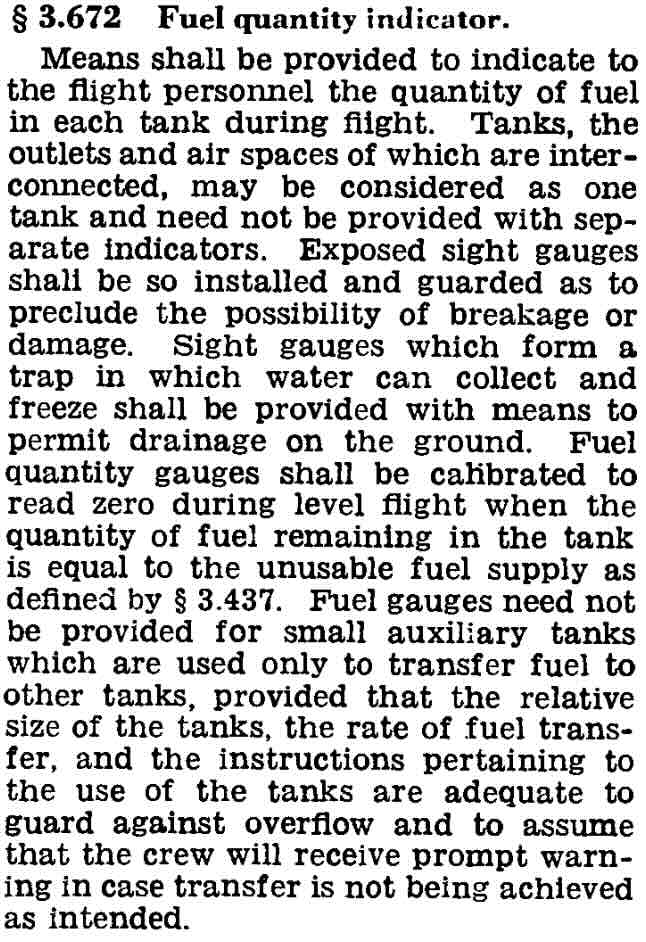
This note exists to provide some context around statements regarding the required accuracy of fuel gauges.
The below provides some excerpts of the regulations around fuel gauges depending on which set of regulations a given aircraft are certified under.
This is the most recent CFR for normal category airplanes that gives fuel gauge requirements.
Each fuel system must— Provide the flightcrew with a means to determine the total useable fuel available and provide uninterrupted supply of that fuel when the system is correctly operated, accounting for likely fuel fluctuations;
The relevant CFR prior to the Part 23 rewrite that went into effect on August 30, 2017.
Fuel quantity indication. There must be a means to indicate to the flightcrew members the quantity of usable fuel in each tank during flight. An indicator calibrated in appropriate units and clearly marked to indicate those units must be used.
Night VFR Required Equipment
- 14 CFR §91.205(c)
- FLAPS (In addition to day VFR)
- F - fuses
- L - landing light
- If for hire
- A - anti-collision lights
- P - position lights
- Nav lights
- S - source of power
IFR Required Equipment
- 14 CFR §91.205(d)
- GRABCARDD
- G - Generator
- Or alternator
- R - Radios
- Comm and navigation suitable for the route to be flown
- A - Altimeter
- Adjustable
- B - Ball
- Inclinometer, slip/skid indicator
- C - Clock
- With seconds
- A - Attitude indicator
- R - Rate of turn indicator
- D - Directional gyro
- Heading indicator
- D - DME or RNAV
- At FL240 and higher if VOR is required
- G - Generator
Additional Night Lighting Requirements
- Regarding lights see also 14 CFR §91.209 Aircraft lights
- No person may, from sunset to sunrise, park or move an aircraft in, or in dangerous proximity to, a night flight operations area of an airport unless the aircraft:
- Is clearly illuminated
- Has lighted position lights
- Or is in an area that is marked by obstruction lights
- Basically when pushing the plane around at night with the towbar, for example, unless the area is well lit, leave the nav lights on.
Note: this is a good example where there are grey areas in the definitions, for example how clear is "clearly illuminated" so the obvious thing to do if in doubt at all is just leave the nav lights on.
What is a night flight operations area? Absent any proffered definition, the plain reading of the phrase-as I read it-would be an area used, or subject to use, for flight operations at night. In other words, any public use airport with an apron or taxiway that is open to flight operations at night could and should be considered-by my reading-a night flight operations area. Whether the area is a movement or non-movement area shouldn't matter. Could someone else reasonably taxi past you (or into you!) at night? That's probably a night flight operations area.
Inoperative Equipment Overview
When thinking about what equipment is required first think of 14 CFR §91.7 - Civil aircraft airworthiness that says:
No person may operate a civil aircraft unless it is in an airworthy condition. The pilot in command of a civil aircraft is responsible for determining whether that aircraft is in condition for safe flight
So if you have any reason to think the aircraft is not safe to fly due to some inoperative equipment, don't fly it.
Regulations should be a floor for safety not a ceiling.
Minimum Equipment List (MEL)
- A minimum equipment list is a list of equipment approved by the manufacturer and the FAA, by which you may legally operate a flight with inoperative equipment.
- Requirements below are when an aircraft needs an MEL
- No aircraft can fly with inoperative equipment unless it has an approved minimum equipment list (MEL)
- Exception:
- Non-turbine planes (and some other aircraft) as long as the inoperative equipment is not required by 14 CFR §91.205
- And not required by type certificate or Airworthiness Directive (AD)
- Marked as "INOP"
- If the aircraft does not have an MEL can follow 14 CFR §91.213 which says for non-turbine planes (and some other aircraft) as long as the inoperative equipment is not required by 14 CFR §91.205 and not required by type certificate or Airworthiness Directive (AD) it can be marked as "INOP" and the aircraft can still be flown.
- If missing any items in MEL must get authorization from FSDO
Kind of Operations (Equipment) List (KOL or KOEL)
- Indicates equipment required for airworthiness during the kinds of operations (e.g. VFR/IFR, day/night)
- The Cessna 172SP, for example, which contains a KOEL in Section 2 of the POH indicates that strobes are required for all flight conditions.
- If our aircraft has a KOEL it will be in the POH?
- Indicates equipment required for airworthiness during the kinds of operations (e.g. VFR/IFR, day/night)
Comprehensive Equipment List (CEL)
- For example in the weight and balance section of C172SP POH
- It is a comprehensive list of equipment in the aircraft and identifies those items that are required by CFRs for FAA certification
- Is this actually any different than the minimum required by FAA? Or is Cessna imposing additional requirements beyond the FAA with this list?
- Is this the same as KOEL?
Supplemental Type Certificate (STC)
- FAA authorization to modify aircraft (e.g. install new avionics)
- Might come with additional requirements, e.g. keep PFD manual in plane
This has interesting discussion about what equipment needs to be working in particular on intermittently working equipment Minimum Equipment: What Has to be Working?
A good way to approach required equipment on the aircraft is to think through a hypothetical situation of preflighting an aircraft prior to a flight, finding a piece of equipment inoperative, and then determining whether or not the aircraft can still be flown with said equipment inoperative.
Determining Airworthiness
- The following flowchart captures most of the questions that need to be answered in this situation.
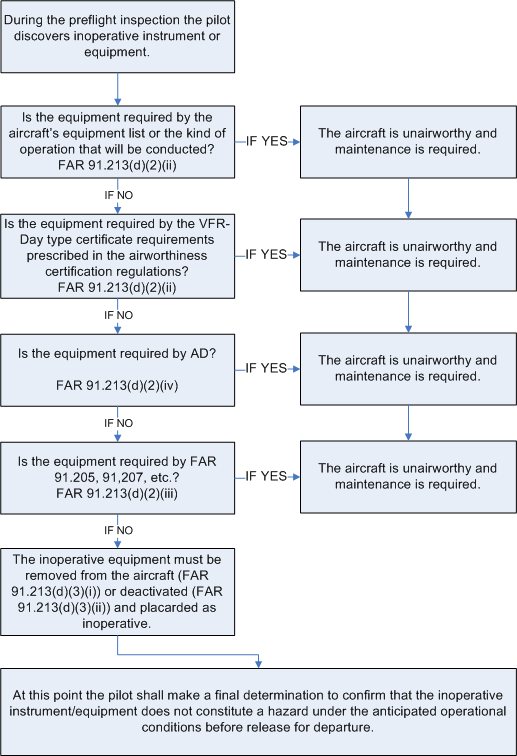
- The following list is similar to the questions in the flowchart.
- The order in which these questions are asked does not matter.
- Does the plane have an MEL?
- Minimum equipment list, approved by FAA
- General aviation planes will almost certainly not have an MEL
- Does the plane have a KOEL (kinds of equipment list)?
- G1000/nav com III POHs do, start there (section 2 POH, operating limitations)
- Does the plane have a CEL (comprehensive equipment list)?
- 172R/S/M/N/P (section 6 POH, weight and balance, R required for flight, S standard)
- Is it required by 14 CFR §91?
- 14 CFR §91.205, 14 CFR §91.207, etc.?
- A+TOMATOFLAMES, FLAPS, etc.
- Is it required by Airworthines Directive?
- Is it required by STC?
- Finally, is it required to fly safely?
- See 14 CFR §91.7
- Does the plane have an MEL?
- If it legal to fly with the inoperative equipment, it must be placarded and either removed or deactivated, if it is removed, a new weight and balance might need to be computed depending on the weight of the part.
FAA-AC-91-67A Minimum Equipment Requirements for General Aviation Operations Under FAR Part 91
Deactivation. When an item is "deactivated" or "secured," or both, the specified item must be put into an acceptable condition for safe flight. Deactivation may involve more than simply turning off a system switch, which does not remove power from the system. Deactivation may involve pulling and securing the circuit breaker and/or removing the equipment. Deactivation of an inoperative system is not preventive maintenance as described in part 43 appendix A. Regardless of the method of deactivation, a person authorized to approve the aircraft for return to service under § 43.7 must make the maintenance record entry required by § 43.9. No person may operate the aircraft without the entry required by § 43.9.
The safest interpretation of this is that deactivation is not preventative maintenance and therefore not something the pilot can do.
However, the references below may offer other interpretations that might be applied in the case of pulling and securing a circuit breaker in order to deactivate a piece of equpiment.
Specifically, that the act of pulling a circuit breaker, like adding oil to the engine, doesn't even rise to the level of preventative maintentance.
Many preventive maintenance tasks are listed in 14 C.F.R. part 43, appendix A, paragraph (c). The paragraph sets forth in 32 numbered subparagraphs items the FAA has determined to be preventive maintenance. Even though the introductory text of subparagraph (c) states that "[p]reventive maintenance is limited to the following work ...." (emphasis added), in view of the broader definition of preventive maintenance in section 1.1, we believe that such limitation is not controlling. Similarly, for the same reason, we also believe that the following sentence in Advisory Circular 43-12A, Preventive Maintenance (which was referenced in Mr. Hernandez's letter), is overly restrictive That sentence, found in Paragraph 3(b)(l), states: "If a task or maintenance function does not appear in the list, it is not preventive maintenance." As with the other paragraphs of Appendix A (i.e., on major repairs and major alterations), the lists are better viewed as examples of the tasks in each category-they cannot be considered all-inclusive. There are, no doubt, many "simple or minor preservation operations [tasks]" and many "replacement[s] of small standard parts not involving complex assembly operations" performed daily, especially on small general aviation aircraft, that the agency would consider to be preventive maintenance, though they are not included in the 32 listed items.
- Referenced above in Pilot Performed Preventative Maintenance
- In the context of pilots deactivating inoperative systems (e.g. via pulling and securing a circuit breaker) this letter offers some guidance related to things pilots can do which do not even rise to the level of preventative maintenance.
- In the context of this letter, it seems a reasonable position to take that pulling and securing a circuit breaker is the same level as adding oil, and therefore while not preventative maintenance something the pilot can legally do.
14 CFR §91.213(d)(3) also says, "if deactivation of the inoperative instrument or equipment involves maintenance" implying that deactivation may be possible that does not involve maintenance.
Finally, remember about Advisory Circulars from the AIM:
Advisory Circulars ‐ The FAA issues Advisory Circulars (AC) to inform the aviation public in a systematic way of nonregulatory material. Unless incorporated into a regulation by reference, the contents of an advisory circular are not binding on the public.
Aside: a Single Broken Strobe Light
Regarding equipment required by 14 CFR §91.205, it is interesting to note that 14 CFR §91.205(b)(11) says, regarding anticollision light system:
In the event of failure of any light of the anticollision light system, operation of the aircraft may continue to a location where repairs or replacement can be made.
So this is why according to the C172SP KOEL that Strobes are required during all flight conditions.
See also Letts 2017 Legal Interpretation.
Aside: Altimeter Accuracy
Altimeter accuracy requirements +/- 75 ft. for IFR. For VFR not explicitly stated, but it's up to PIC to determine the aircraft is in a safe condition for flight.
Accuracy requirements of altimeter AIM 7-2-3 Altimeter Errors:
If the difference from the known field elevation and the altitude read from the altimeter is plus or minus 75 feet or greater, the accuracy of the altimeter is questionable and the problem should be referred to an appropriately rated repair station for evaluation and possible correction.
From 14 CFR §91.217(a)(2):
- The difference between the automatic reporting output and the altitude displayed at the altimeter shall not exceed 125 feet.
Standard and Special Airworthiness Certificates
- Including their associated operational limitations
- Airworthiness certificates are classified as either "Standard" or "Special."
- Standard airworthiness certificates are white, and are issued for the following aircraft categories:
- Normal
- Utility
- Acrobatic
- Commuter
- Transport
- Special airworthiness certificates are pink, and are issued for the following aircraft categories:
- Primary
- Restricted
- Limited
- Light sport
- They are also issued as provisional airworthiness certificates, special flight permits (ferry permits), and for experimental aircraft.
- 14 CFR §91.325 - Primary category aircraft: Operating limitations.
- Generally treated like Standard except no passenger/cargo for hire.
- Extra limits if the owner maintains the aircraft under the “pilot-owner” program.
- 14 CFR §91.313 - Restricted category civil aircraft: Operating limitations.
- Can only be flown for the specific special-purpose listed on the certificate.
- No passenger/ cargo for hire.
- Other restrictions.
- 14 CFR §91.315 - Limited category civil aircraft: Operating limitations.
- Limitations on carrying passengers for compensation or hire.
- 14 CFR §91.327 - Aircraft having a special airworthiness certificate in the light-sport category: Operating limitations.
- Compensation or hire only for glider/ultralight towing and flight training.
- Must tell occupants that it is an LSA and does not meet standard airworthiness requirements.
- 14 CFR §91.325 - Primary category aircraft: Operating limitations.
- See also:
- 14 CFR §91.317 - Provisionally certificated civil aircraft: Operating limitations.
- Primarily for flight-test & manufacturer demonstration
- Operations outside the U.S
- Air-transport require specific FAA permission.
- 14 CFR §91.319 - Aircraft having experimental certificates: Operating limitations.
- Must be operated consistent with the purpose in the certificate.
- Restrictions on carrying passengers for compensation or hire.
- Must tell occupants that it is experimental.
- Day VFR only unless authorized otherwise.
- 14 CFR §91.317 - Provisionally certificated civil aircraft: Operating limitations.