Collision Avoidance
This page covers Task B. Visual Scanning and Collision Avoidance from the FAA-S-ACS-25 Flight Instructor for Airplane Category Airman Certification Standards.
Environmental conditions that degrade vision
- Hypoxia
- Without supplemental oxygen, an individual's night vision declines measurably at pressure altitudes above 4,000 feet.
- Bright lights at night
- Airport lighting before flight
- Flight deck lighting
- Dark adaptation
- Takes 30 minutes for eyes to adjust to dark conditions
- Excessive illumination can produce glare-uncontrollable squinting, watering of the eyes, and even temporary blindness.
- Light reflected off canopy, surfaces inside aircraft, clouds, water, snow, and desert terrain.
- Smoke, haze, dust, rain, and flying toward the sun can reduce the ability to see other aircraft.
- Small print and colors become unreadable unless adequate lighting is available-aeronautical charts and instruments become hard to read.
Vestibular and visual illusions
Spatial Disorientation
Spatial Orientation
Defines our natural ability to maintain our body orientation and/or posture in relation to the surrounding environment.
- Vestibular System (inner ear/balance) + Somatosensory System (nerves/gravity) + Visual System
- Sensory mismatch can cause illusions leading to spatial disorientation.
- Vestibular system = fluid in inner-ear makes contact with hairs, deflect
- Basically all vestibular illusions below are caused by a steady-state condition being reached in the inner ear that is not straight-and-level flight
- Return to straight-and-level flight from this condition then feels wrong causing the pilot to react incorrectly
- Posture considerations
- ICEFLAGS is an acronym that can be used to help memorize a mix of some of the more common vestibular and visual illusions below.
Vestibular Illusions
- Inversion Illusion
- An abrupt change from climb to straight-and-level flight can stimulate the otolith organs enough to create the illusion of tumbling backwards
- Pilot may compensate by pushing the aircraft nose towards the ground
- Coriolis Illusion
- Inner ear getting used to turning equilibrium
- Turning head perturbs this equilibrium and can give pilot sense of different motion
- Elevator Illusion
- An abrupt upward vertical acceleration, as can occur in an updraft, can stimulate the otolith organs to create the illusion of being in a climb.
- The Leans
- Sudden return to level flight following a gradual and prolonged turn
- When gradual turn rate is below the detection threshold of the semicircular canals
- Graveyard Spiral
- As in other illusions, a pilot in a prolonged coordinated, constant-rate turn may experience the illusion of not turning
- In recovery from the turn the pilot feels a turn the other way, so compensates back the original direction
- The turn can result in altitude loss, requiring more backpressure, which increases the rate of turn, and results in a spiral to the ground
- Somatogravic Illusion
- A rapid acceleration, such as experienced during takeoff, stimulates the otolith organs in the same way as tilting the head backwards.
- Pilot may compensate by pushing the aircraft nose towards the ground
Visual Illusions
- False Horizon
- A sloping cloud formation, an obscured horizon, an aurora borealis, a dark scene spread with ground lights and stars, and certain geometric patterns of ground lights can provide inaccurate visual information, or "false horizon," when attempting to align the aircraft with the actual horizon.
- Autokinesis
- Staring at a single point of light against a dark background for more than a few seconds the light appears to move.
- During flight a pilot may attempt to align the aircraft with this moving light and cause them to lose control.
- Reversible Perspective Illusion
- At night, an aircraft may appear to be moving away from a second aircraft when it is, in fact, approaching a second aircraft. This illusion often occurs when an aircraft is flying parallel to another's course.
- To determine the direction of flight, pilots should observe aircraft lights and their relative position to the horizon. If the intensity of the lights increases, the aircraft is approaching; if the lights dim, the aircraft is moving away.
- Size-Distance Illusion
- This illusion results from viewing a source of light that is increasing or decreasing in brightness. Pilots may interpret the light as approaching or retreating.
- Flicker Vertigo
- A light flickering at a rate between 4 and 20 cycles per second can produce unpleasant and dangerous reactions. Such conditions as nausea, vomiting, and vertigo may occur. On rare occasions, convulsions and unconsciousness may also occur.
- Proper scanning techniques at night can prevent pilots from getting flicker vertigo.
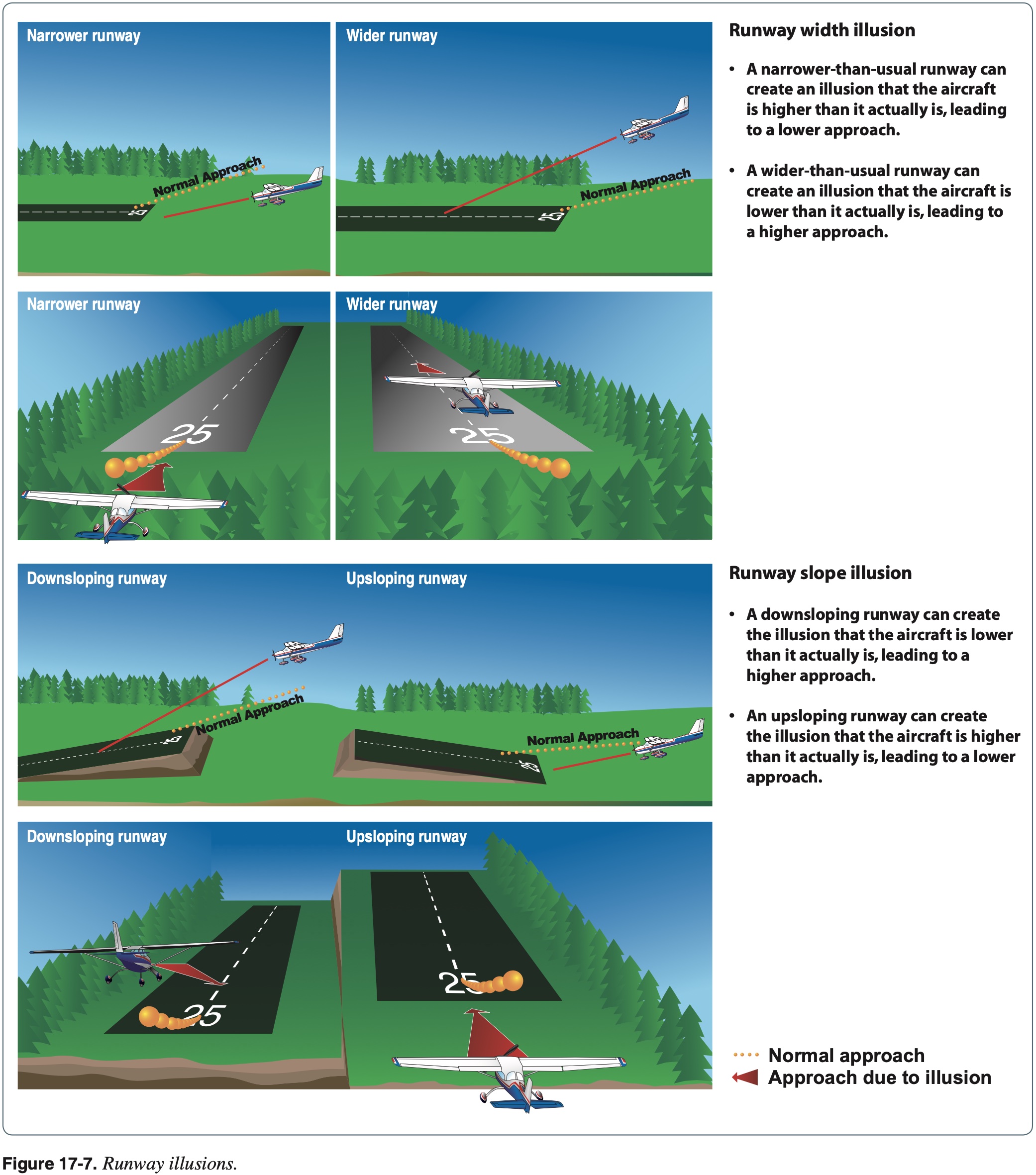
- Runway Width Illusion
- A narrower-than-usual runway can create an illusion that the aircraft is at a higher altitude than it actually is, especially when runway length-to-width relationships are comparable.
- The pilot who does not recognize this illusion will fly a lower approach
- Runway and Terrain Slopes Illusion
- An upsloping runway, upsloping terrain, or both can create an illusion that the aircraft is at a higher altitude than it actually is.
- Featureless Terrain Illusion
- An absence of surrounding ground features, as in an overwater approach over darkened areas or terrain made featureless by snow, can create an illusion that the aircraft is at a higher altitude than it actually is.
- Water Refraction
- Rain on the windscreen can create an illusion of being at a higher altitude due to the horizon appearing lower than it is.
- This can result in the pilot flying a lower approach.
- Haze
- Atmospheric haze can create an illusion of being at a greater distance and height from the runway.
- As a result, the pilot has a tendency to be low on the approach.
- Fog
- Flying into fog can create an illusion of pitching up. Pilots who do not recognize this illusion often steepen the approach abruptly.
- Ground Lighting Illusions
- Lights along a straight path, such as a road or lights on moving trains, can be mistaken for runway and approach lights.
- Bright runway and approach lighting systems, especially where few lights illuminate the surrounding terrain, may create the illusion of less distance to the runway.
- The pilot who does not recognize this illusion will often fly a higher approach.
Preventing Visual Illusions
TIP
When experiencing spatial disorientation make sure to rely on flight instruments.
- Stay proficient
- Avoid flying in conditions for which you are not rated and/or not proficient
- Rely on instruments
- Learn ahead about airport you will be landing at for information on runway slope, terrain, and lighting.
- Reference altimeter
- Overfly the field
- Use approach lighting (VASI or PAPI)
"See and avoid" responsibilities
- Vigilant Lookout
- Pilots should also keep in mind their responsibility for continuously maintaining a vigilant lookout regardless of the type of aircraft being flown.
- Remember that most midair collision accidents and reported near midair collision (NMAC) incidents occurred during good VFR weather conditions and during the hours of daylight.
- Preflight Planning
- Review all airspace, NOTAMs, Special Use Airspace, and terrain information along their route of flight during preflight planning.
- Pilots should also note the forecasted visibility and any adverse meteorological conditions that would affect their ability to see other aircraft
- Smoke
- Haze
- Haze makes objects or terrain appear to be farther away than it actually is
- Precipitation
- Sun angle and position
- Use correct scan technique
- 90% time eyes outside 10% inside
- Know and follow right-of-way rules
Right-of-Way Rules
NOTE
When aircraft of the same category are converging at approximately the same altitude (except head-on, or nearly so), the aircraft to the other's right has the right-of-way.
- See 14 CFR §91.113 - Right-of-way rules: Except water operations
- Right of way is generally granted to the less maneuverable aircraft
- If the aircraft are of different categories basically the less capable aircraft has right-of-way.
- An aircraft towing or refueling another aircraft has right-of-way over all other engine powered aircraft.
- When two aircraft of any category are approaching head-on, each should move to the right.
- Each aircraft that is being overtaken has the right-of-way and each pilot of an overtaking aircraft shall alter course to the right to pass well clear.
- Aircraft, while on final approach to land or while landing, have the right-of-way over other aircraft in flight or operating on the surface.
- When approaching an airport to land, lower aircraft has right-of-way.
- An aircraft in distress has the right-of-way over all other air traffic.
Visual scanning procedure and the importance of peripheral vision
- Scanning techniques are very important in identifying objects not just at night but during the day too.
- Scan in sections about 30° wide from far to near
- Scan each section up to about 2 to 3 seconds
- Overlap each scan section by about 10°
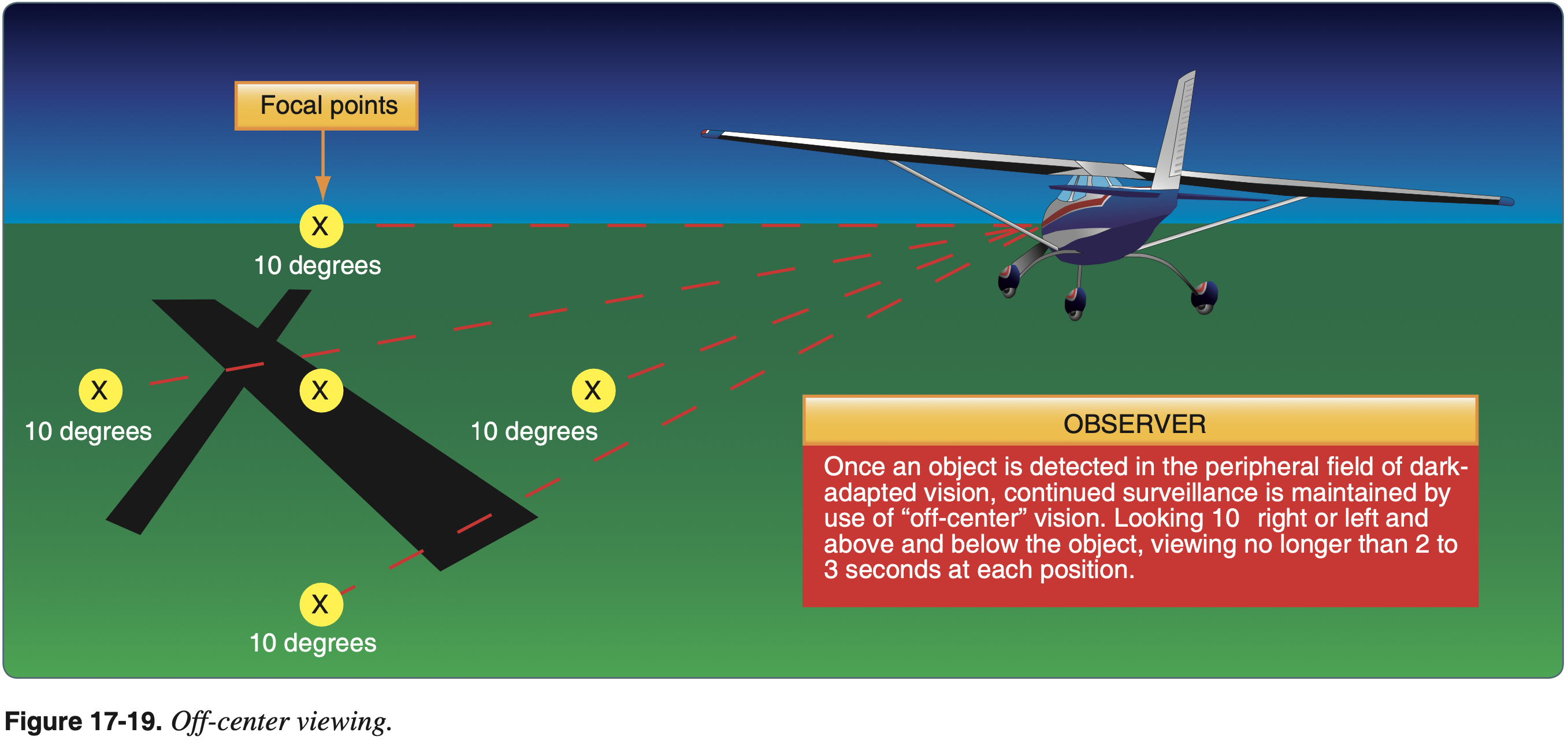
- Off-center viewing
- Type of scan that pilots can use during night flying to rely more on rods
- Look 10° above, below, or to either side of the object
- An object viewed longer than 2 to 3 seconds will seem to disappear
- Refocus eyes outside to look for targets
- Empty-Field Myopia
- Induced nearsightedness
- If there is nothing specific to focus on, eyes default to focusing at 10-30'
- Search out and focus on distant light sources, no matter how dim, to help prevent empty field myopia.
- Empty-Field Myopia
Aircraft blind spots and clearing procedures
- Blind spots could be due to wing (high or low) or other aircraft structure, much like a car
- Compensate for blind spots due to aircraft design and flight attitude by moving your head or maneuvering the aircraft.
- Keep a clean windshield-dirty or bug smeared windshields can greatly reduce vision.
- ATC will provide radar traffic advisories as long as their workload permits-use whenever possible.
- Pilots should:
- Prior to taxiing onto a runway or landing area for takeoff, scan the approach areas for possible landing traffic by maneuvering the aircraft to provide a clear view of such areas.
- It is important that this be accomplished even though a taxi or takeoff clearance has been received.
- During climbs and descents in flight conditions which permit visual detection of other traffic, execute gentle banks left and right at a frequency which permits continuous visual scanning of the airspace about them.
- Adjust pitch attitude in climb to facilitate better visibility over the cowl
- Adjust seat position to help see over cowl
- Execute appropriate clearing procedures before all turns, abnormal maneuvers, or acrobatics.
- Execute pattern entries and departures for the runway in use appropriate to the airport configuration and information depicted.
- During training operations maintain vigilance and make clearing turns prior to practicing a maneuver.
- Verbalize clearing procedures ("clear left, right, above, below")
- Prior to taxiing onto a runway or landing area for takeoff, scan the approach areas for possible landing traffic by maneuvering the aircraft to provide a clear view of such areas.
Visual cues of an impending mid-air collision
- No relative motion of another aircraft out the side window on a converging course
Situations that create the greatest collision risk
Greatest collision risk
- Clear days near navaids
- Maintain vigilance in the vicinity of VORs and intersections de to converging traffic.
- In traffic pattern
- VORs and Class B, C, D, and E surface areas are high hazard areas where aircraft tend to cluster -- exercise vigilance even when in a radar environment.
- Poor visual scanning increases the risk of midair collisions.
Aircraft speed differential and collision risk
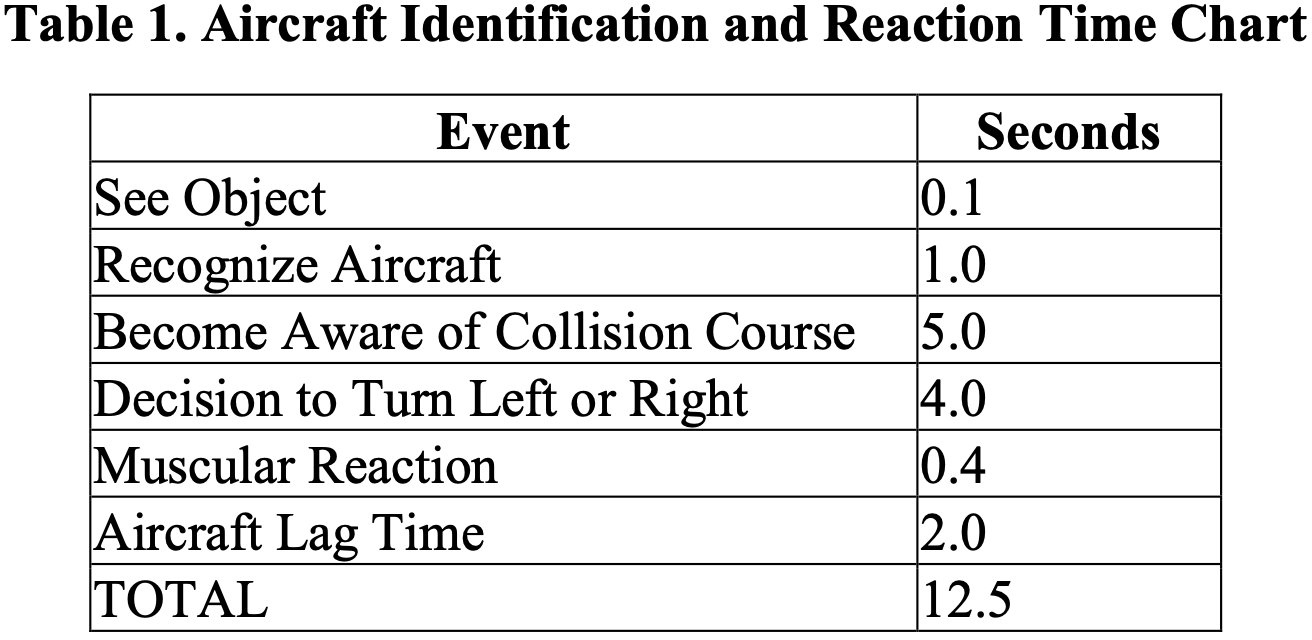
- Average person has a reaction time of 12.5 seconds
- The greater the speed differential, the less time to see and avoid
- To determine relative altitude, use the horizon as a reference point: if the aircraft is above the horizon, it is probably on a higher flight path, and if it is below the horizon, it is probably on a lower flight path.
- Any aircraft that appears to have no relative motion is likely to be on a collision course-if it shows no lateral or vertical motion, but increases in size, take evasive action.
Division of attention inside and outside the aircraft
- Do not spend too much time "heads down" inside
- Especially with glass cockpits, iPads, etc.
- ADS-B TIS traffic data is a supplement, but does not replace looking outside
- Not all aircraft even has ADS-B out