Risk Management
This page covers Task F. Elements of Effective Teaching that Include Risk Management and Accident Prevention from the FAA-S-ACS-25 Flight Instructor for Airplane Category Airman Certification Standards.
Risk Identification and Mitigation
- Principles of risk management
- The function of risk management is a decision making process designed to identify hazards systematically
- Risk management process
- Level of risk
- Assessing risk
- Mitigating risk
- IMSAFE personal checklist
- I - Illness
- M - Medication
- S - Stress
- A - Alcohol
- F - Fatigue
- E - Eating
- PAVE checklist
- Use the PAVE checklist to perceive hazards
- Identify hazards and personal minimums
- Divides risk into four fundamental risk elements or categories
- P ilot
- A ircraft
- en V ironment
- E xternal pressures (mission)
- 5P checklist
The 5P concept relies on the pilot to adopt a "scheduled" review of the critical variables at points in the flight where decisions are most likely to be effective.
Apply the 5 Ps to evaluate the pilot's current situation at key decision points during the flight or when an emergency arises.
- P lan
- P lane
- P ilot
- P assengers
- P rogramming
The 5 Ps are used to evaluate the pilot's current situation at key decision points during the flight, or when an emergency arises. These decision points include preflight, pretakeoff, hourly or at the midpoint of the flight, predescent, and just prior to the final approach fix or for visual flight rules (VFR) operations, just prior to entering the traffic pattern.
Risk Management Tools
- Three models of a structured framework for decision-making
- 5 Ps
- 3P using PAVE, CARE, and TEAM
- DECIDE
PAVE
1. 5 Ps
- Apply the 5 Ps to evaluate the pilot's current situation at key decision points during the flight or when an emergency arises.
- The 5P concept relies on the pilot to adopt a "scheduled" review of the critical variables at points in the flight where decisions are most likely to be effective.
- P lan
- P lane
- P ilot
- P assengers
- P rogramming
2. 3P using: PAVE, CARE and TEAM
PAEM sometimes used instead of PAVE where the M is for mission.
- Perceive - given circumstances
- Use the PAVE checklist to perceive hazards
- Identify hazards and personal minimums
- Divides risk into four fundamental risk elements or categories
- P ilot
- A ircraft
- en V ironment
- E xternal pressures (mission)
- Process - impact on flight safety
- Use the CARE checklist to process hazards
- Review hazards and evaluate risk
- C onsequences
- A lternatives
- R eality
- E xternal factors
- Perform - implement best course of action
- Use the TEAM checklist to choose and implement risk control
- Take action to eliminate hazards or mitigate risk
- T ransfter
- E liminate
- A ccept
- M itigate
3. DECIDE
The DECIDE Model is a continuous loop to make decisions
- D - Detect
- A change
- E - Estimate
- Need to react
- C - Choose
- Desirable outcome
- I - Identify
- Actions needed
- D - Do
- The actions
- E - Evaluate
- The effect
Key takeaways from ADM
- Decisions should be made proactively, not reactively (e.g. 5P's)
- Feedback should be used throughout the decision making process (e.g. DECIDE)
- All risk factors must be considered (e.g. PAVE)
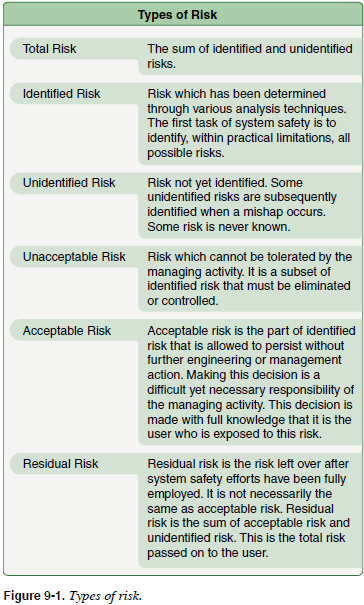
Types of Risk
- Aeronautical Decision Making (ADM)
- A systematic approach to risk assessment and stress management.
- Or, a systematic approach to mental process to determine best course of action in response to circumstances
- Risk management - identify and mitigate hazards
- Relies on situational awareness
- Problem recognition
- Exercise good judgement
- Judgement
- The mental process of recognizing and analyzing pertinent information
- Evaluation of alternative actions in response
- Timely decisions
- Single Pilot Resource Management (SRM) - the art and science of managing all the resources available to a single pilot to ensure the successful outcome of the flight.
- Risk - assessment of the single or cumulative hazard facing a pilot. Different pilots see hazards differently.
- Situational Awareness - the accurate perception of the operating and environmental factors that affect the aircraft, pilot, and passengers during a specified period of time.
- Four Factors of Risk Management
- Accept no unnecessary risk
- Decisions should be made by PIC, not ATC or passengers
- Accept risk when benefit outweighs danger
- Integrate risk management into planning at all levels
- Five Hazardous Attitudes
- Antiauthority (don't tell me)
- Follow the rules - they are usually right
- Impulsivity (do something quickly)
- Not so fast. Think first.
- Invulnerability (it won't happen to me)
- It could happen to me.
- Macho (I can do it)
- Taking chances is foolish.
- Resignation (what's the use)
- I'm not helpless. I can make a difference.
- Antiauthority (don't tell me)
- Steps for good decision making are:
- Identifying personal attitudes hazardous to safe flight
- Learning behavior modification techniques
- Learning how to recognize and cope with stress
- Developing risk assessment skills
- Using all resources in a multicrew situation
- Evaluating the effectiveness of one's ADM skills
- First step towards good ADM is recognizing hazardous attitudes
- To gain realistic perspective of your own hazardous attitudes, take a self assessment hazardous attitude inventory test.
- Stress - nonspecific generalized response to demands, whether pleasant or unpleasant
- Reduce stress in personal life first
- At first sign of stress in cockpit just relax and think rationally
FRAT
- TBD
Introducing Risk Management
- TBD
Managing Risk During Instruction
Common Risks
- TBD
Best Practices
- TBD
Takeoffs and Landings
- TBD
ADM, CRM, and SRM
- TBD