Instrument Flight Deck Check
This page covers Task C. Instrument Flight Deck Check from the FAA-S-ACS-8C Instrument Rating Airplane Airman Certification Standards.
Objective
To determine the applicant exhibits satisfactory knowledge, risk management, and skills associated with conducting a preflight check on the aircraft's instruments necessary for an IFR flight.
Flight Deck Check Overview
- During preflight check all antennas and pitot tube and static ports for blockage
- Check aircraft records
- 24-month pitot-static inspection
- 30-day VOR inspection
- Check NOTAMs for conditions of NAVAIDs to be used in flight
- When turning on the Master switch during preflight, listen to electric gyros as they spin up
- Check pitot heat
- Check lights
Communications Equipment Preflight Check
- Check integrity of antennas during preflight
- Antennas can become damaged due to ice
- Can hear clearly over COM1 and COM2
- Observe TX when depressing PTT
Navigation Equipment Preflight Check
- Two primary systems to check
- GPS
- VOR
- Check system status indication as applicable
- No annunciators
- GPS correctly shows location
- Check databases
- See table in AIM Table 1-1-6
- Databases need not be current, but during enroute you must check each point in the aircraft GPS against a source that is current, e.g. Foreflight and make sure none of the points have changed
- Same with using GPS for approach - need to make sure approach hasn't changed or been amended since your database date, even if your database is out-of-date
- "Verification of correctness"
- Check RAIM
- Will we have adequate satellite coverage
- Check databases
- Review VOR test sheet is within 30 days and in spec
- Date
- Place
- Bearing error
- Signature
Magnetic Compass Preflight Check
- Compass should
- Float freely and turn freely in turns
- Indicate correctly on known headings (e.g. when aligned with runway)
Heading Indicator / Horizontal Situation Indicator / Radio Magnetic Indicator
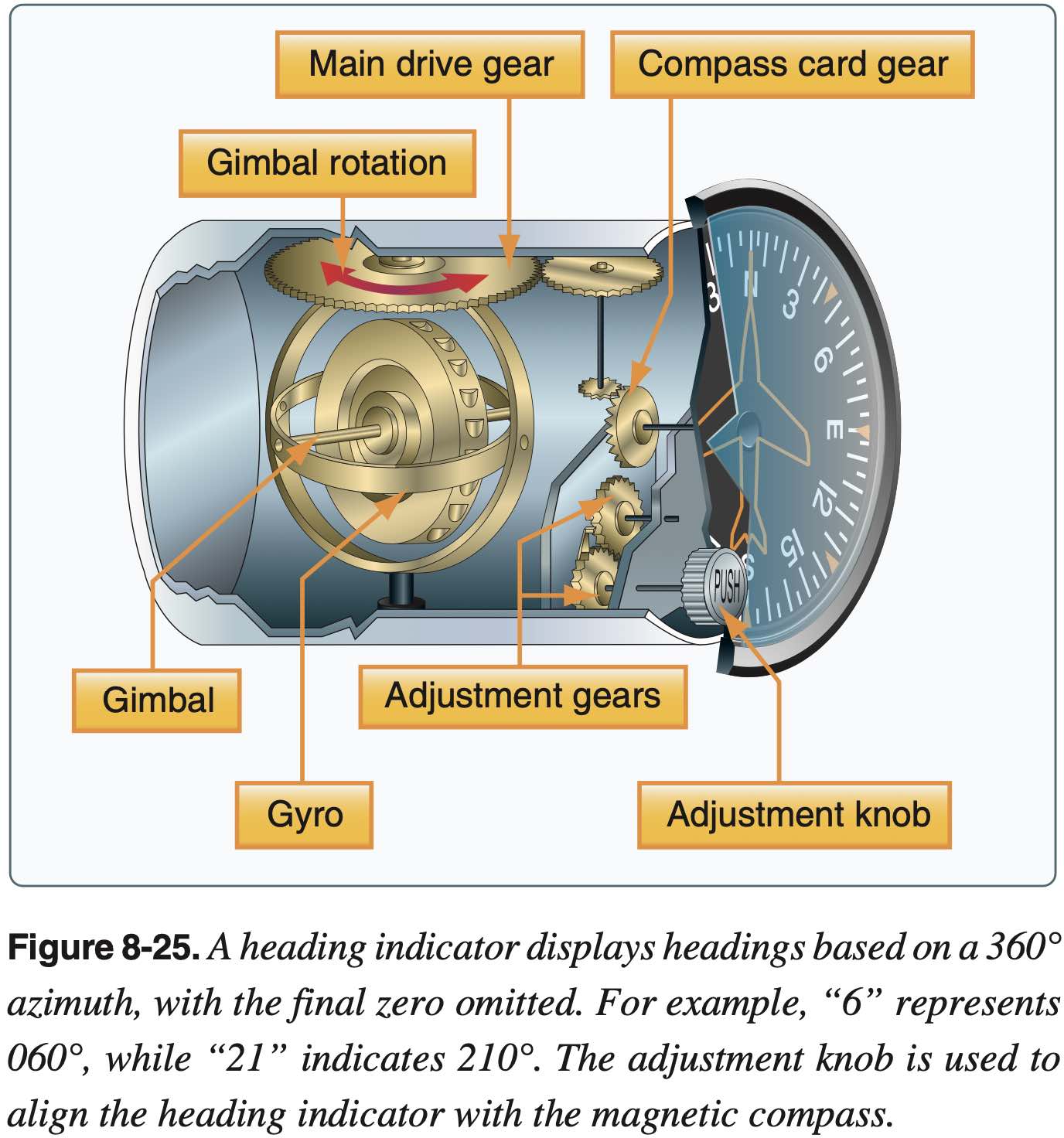
- Heading indicator
- Also known as directional gyro
- Usually powered by the aircraft vacuum system
- Gyroscopic rigidity keeps them fixed in space, but need to be periodically set to the compass
- Errors in compass make it hard to use to turn to specific headings, especially in turbulent air - heading indicator helps with this
- Some heading indicators referred to as horizontal situation indicators (HSI) receive a magnetic north reference from a magnetic slaving transmitter and generally need no adjustment.
- See also: remote indicating compass
- Radio magnetic indicator (RMI)
- Modern systems use an Altitude Heading Reference System (AHRS) to determine the aircrafts heading that incorporate a magnetometer in them
Attitude Indicator
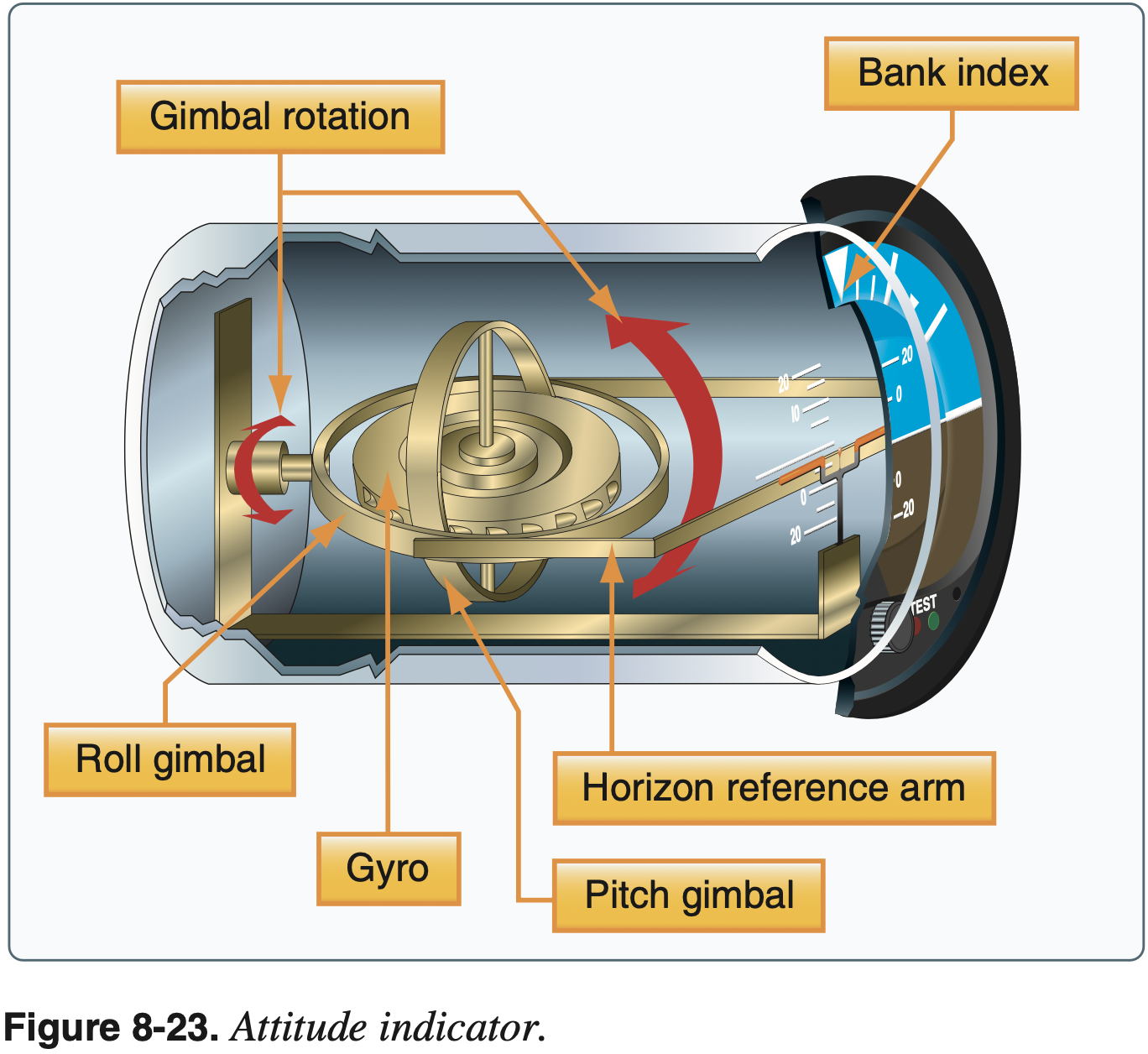
- Also known as artificial horizon
- Principles
- Rigidity in space
- Precession
- Electrically or vacuum powered
- What is in POH might have changed and need to consult supplements
- For example, the Garmin G5 attitude indicator uses solid state (electrically powered) gyro instead of vacuum powered.
- Due to friction, gyroscopic instruments can drift and need to be reset periodically (for example heading indicator to compass)
- For example, check and reset every 15 minutes
- Certain gyroscopic instruments have specific pitch and bank limits that induce a tumble of the gyro.
- Modern systems such as G5 or G1000 use solid-state devices instead of spinning gyros to determine the aircraft attitude
Preflight Check
- During taxi check
- Erect
- Less than 5 degree lean
Altimeter
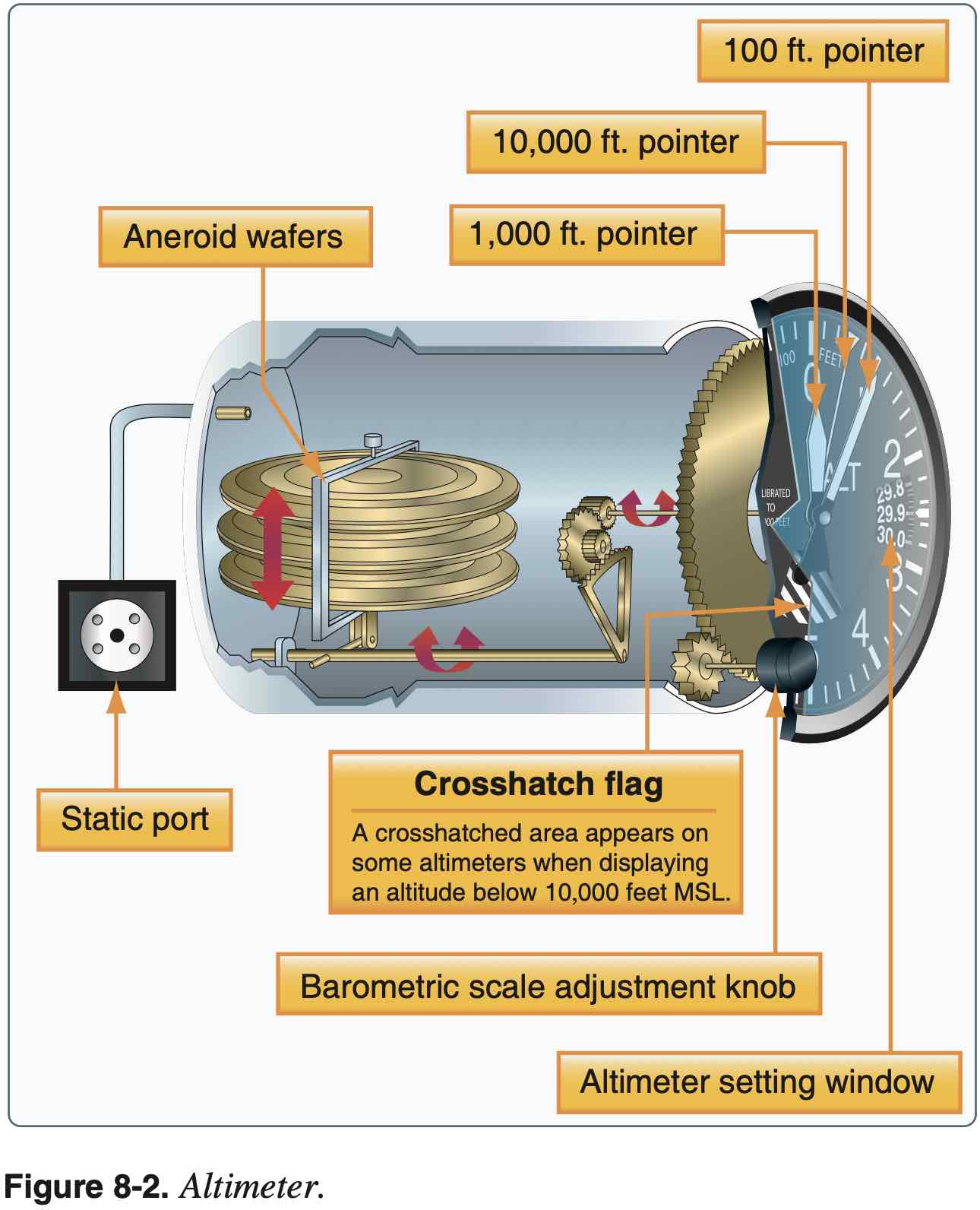
- The indicated altitude is correct, however, only when the sea level barometric pressure is standard (29.92 inHg), the sea level free air temperature is standard (15 °C or 59 °F), and the pressure and temperature decrease at a standard rate with an increase in altitude.
- Can adjust the altimeter for nonstandard pressure but not temperature
- True altitude thus varies with temperature
- Higher temps means true altitude is higher than indicated and lower temps means true altitude is lower than indicated
- Recall "hot-to-cold look out below"
- Beware obstacle clearance especially when flying in colder temps
- Mental model: altimeter setting provides true datum at ground level of the reporting station. Then consider the pressure gradient (which decreases with altitude). Compared to the standard pressure gradient, the pressure gradient in colder more dense air will decrease more quickly, and in hot air the pressure gradient will decrease less quickly.
Preflight Check
- Reads within 75 feet of field elevation when set to local altimeter setting
Turn-and-Slip Indicator / Turn Coordinator
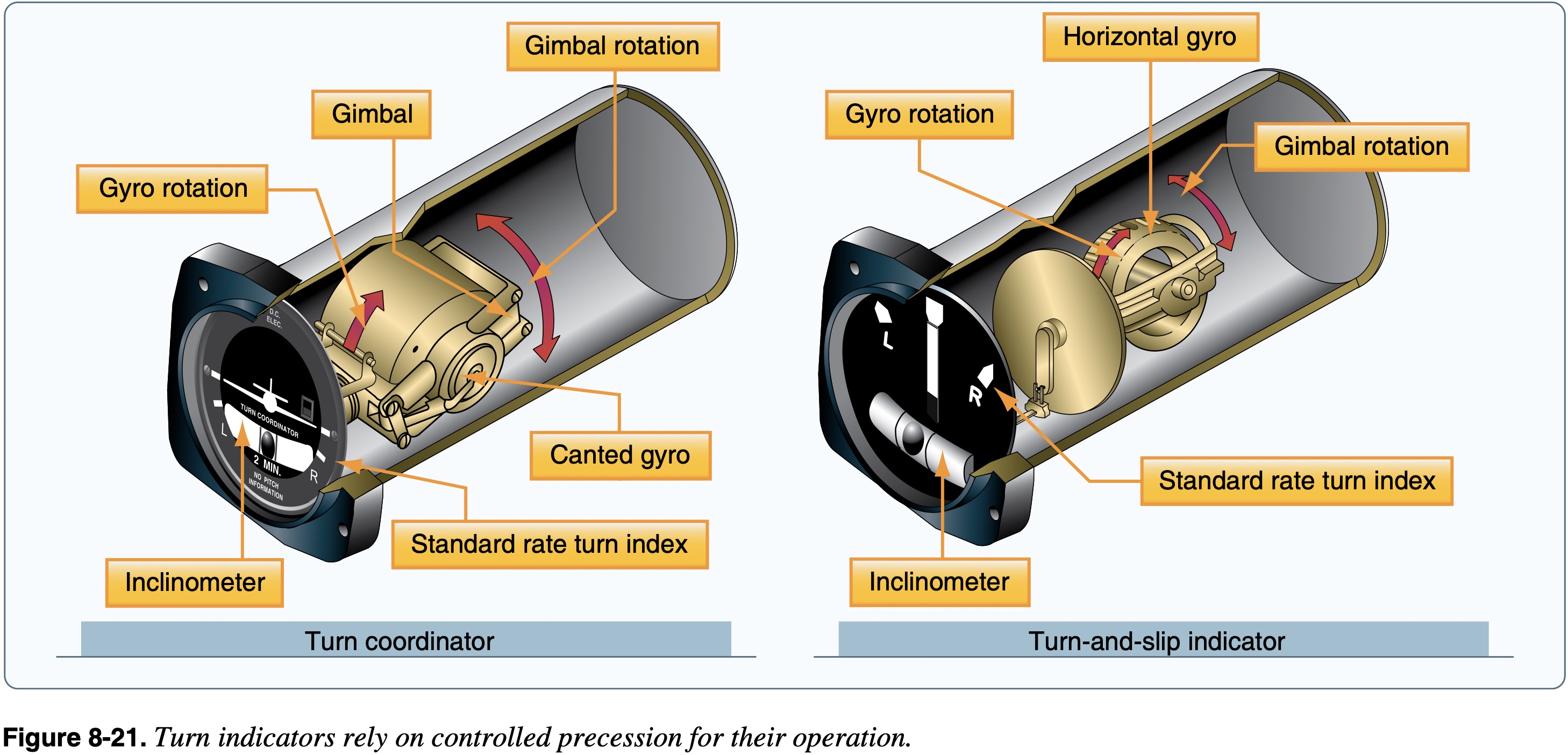
- Turn coordinator
- Roll rate (initially)
- Rate of turn (after it stabilizes)
- Quality of turn
- Contains inclinometer
- The ball
- "step on the ball" to coordinate flight
- Turn and slip indicator
- Rate of turn
- Quality of turn
- Turing taxi should indicate direction of turn and ball should go to outside of turn
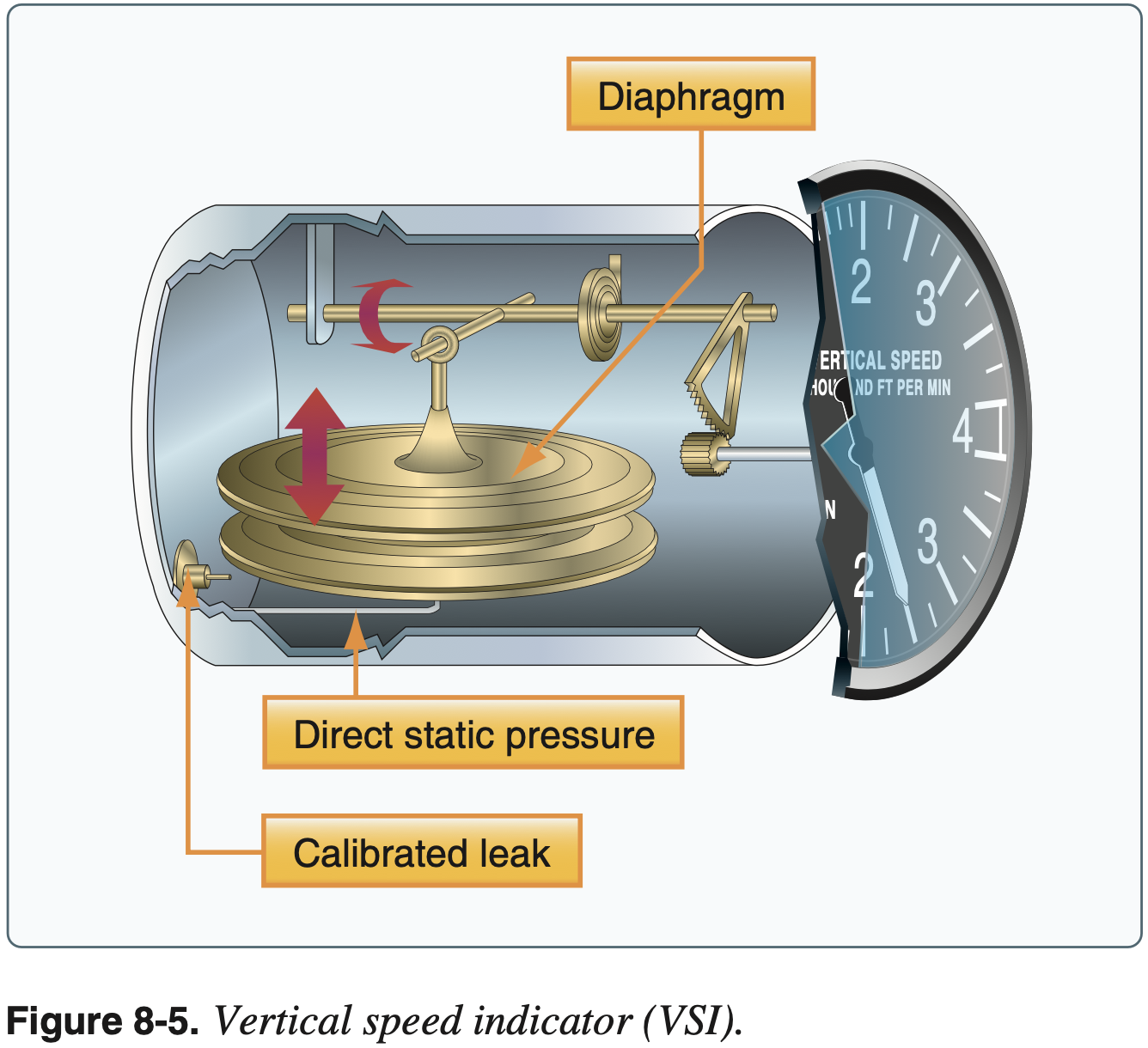
Vertical Speed Indicator (VSI)
- Not required equipment for VFR or IFR flight
- Uses static pressure only
Preflight Check
- Should indicate 0 when on the ground
- If it indicates something other than 0, this value can be used as 0 and then interpret changes from that value
- Should see a small momentary deviation from 0 when changing to alternate static source
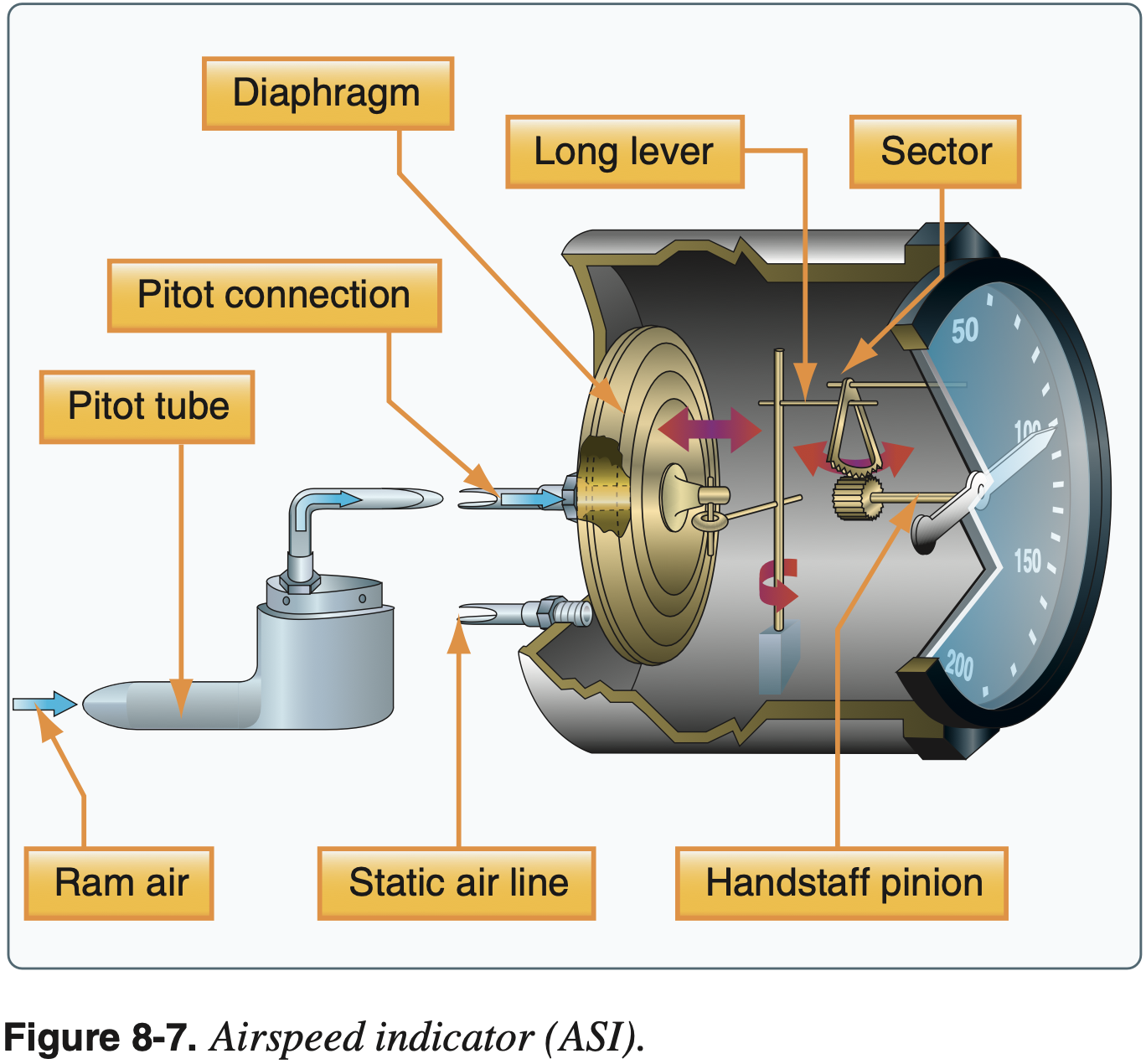
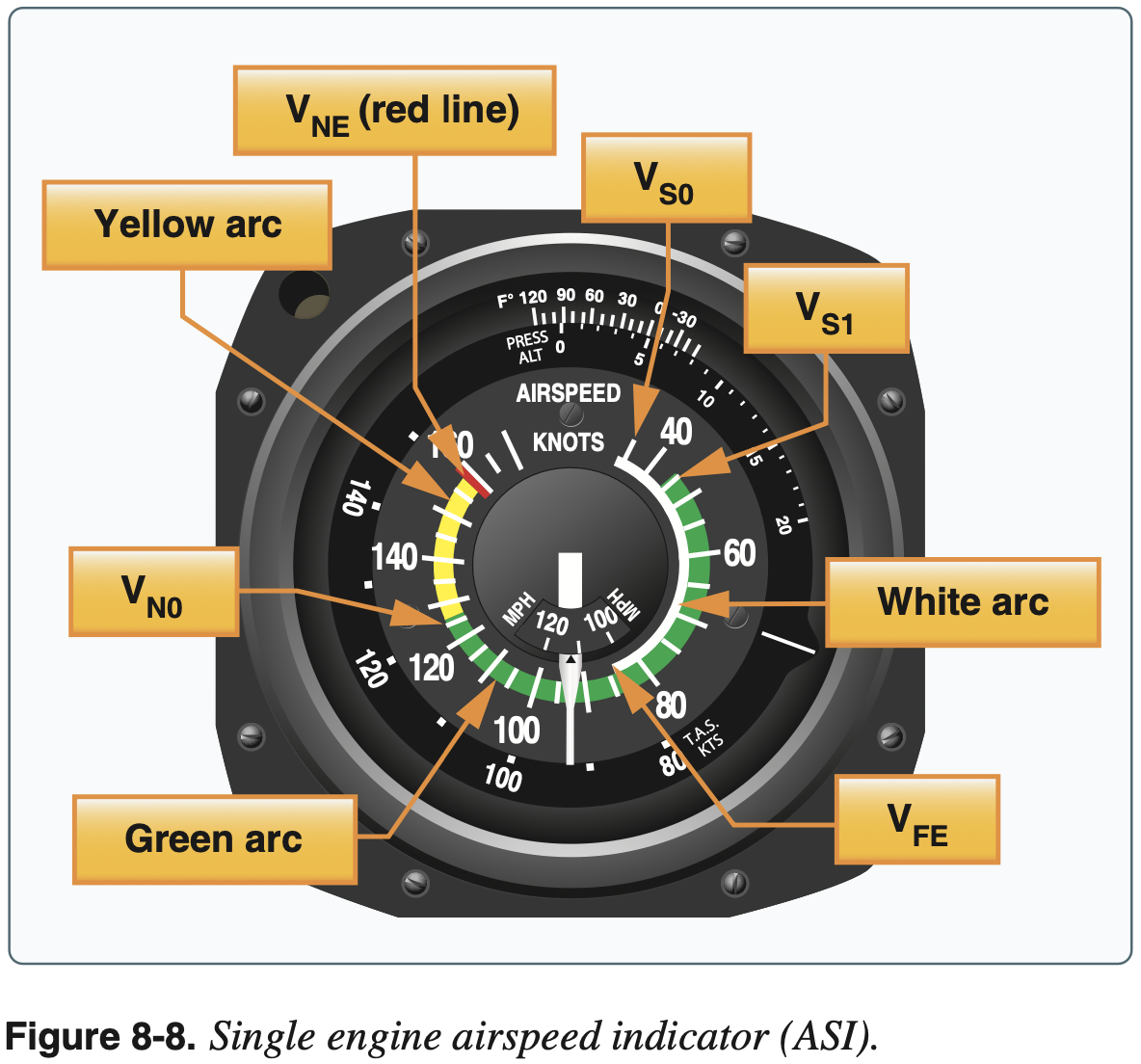
Airspeed Indicator (ASI)
- Requires pitot and static pressure
- Required for day VFR operation
- Lower limits of green and white arc are power-off stall speeds
- Other speeds not here are, for example,
, , and - The same behavior described by "hot-to-cold look out below" for the altimeter applies to the airspeed indicator as well - when flying to a warmer area, for example, true airspeed will increase (given a constant power setting and true altitude)
Preflight Check
- Should read 0 when stationary and while taxiing
Outside Air Temperature Preflight Check
- Should read ambient air temperature
Clock Preflight Check
- Check correct time and running
Cabin Heat
- In most aircraft, can pull a knob to turn on cabin heat
- Cabin heat captures waste heat from the exhaust by passing intake air through a shroud around the exhaust and then into the cabin
- Need to be especially mindful of CO poisoning when using cabin heat
PFD Preflight Check
- No annunciators
- No red X's
Autopilot Preflight Check
- Do preflight check of autopilot according to POH
- Know where the autopilot fuse is
Inspections Required
- Use the AVIATE Acronym to remember required aircraft inspections.
- A - Airworthiness Directives (AD)
- 14 CFR §39
- Need to find all applicable ones and make sure they are complied with
- Can look up FAA Airworthiness Directives (ADs)
- There are third-party services that can provide and help ensure ongoing compliance with ADs by inputting information about a plane
- Airworthiness directives cannot be overflown.
- V - VOR
- Every 30 days for IFR
- 14 CFR §91.171(a)(2)
- VOR accuracy requirements 14 CFR §91.171(b), (c)
- VOT: +/- 4 deg
- Ground checkpoint: +/- 4 deg
- Airborne checkpoint: +/- 6 deg
- Dual check: within 4 deg
- Log the results of the VOR accuracy test in the aircraft logbook or other record including the PADS acronym:
- P - Place
- A - Accuracy (bearing error)
- D - Date
- S - Signature
- I - Inspections
- Annual
- Can not be overflown.
- If annual "expires" and it needs to be flown somewhere for inspection, need a special flight permit (ferry permit).
- Annual can count as 100 hour but not vice versa.
- 100 hour if for hire
- Including flight instruction when the plane and pilot are provided.
- Or progressive
- 100 hour may be overflown to get to a place where inspection may be performed.
- 14 CFR §91.409(a)(1) and 14 CFR §91.409(b)
- Annual
- A - Altimeter/static system
- Every 24 calendar months
- 14 CFR §91.411
- T - Transponder
- Every 24 calendar months
- 14 CFR § 91.413(a)
- E - ELT
- Every 12 months
- 14 CFR §91.207(d)
- Also need to replace/recharge battery at 50% life or after 1 hour of cumulative use
- A - Airworthiness Directives (AD)
Logbook Documentation
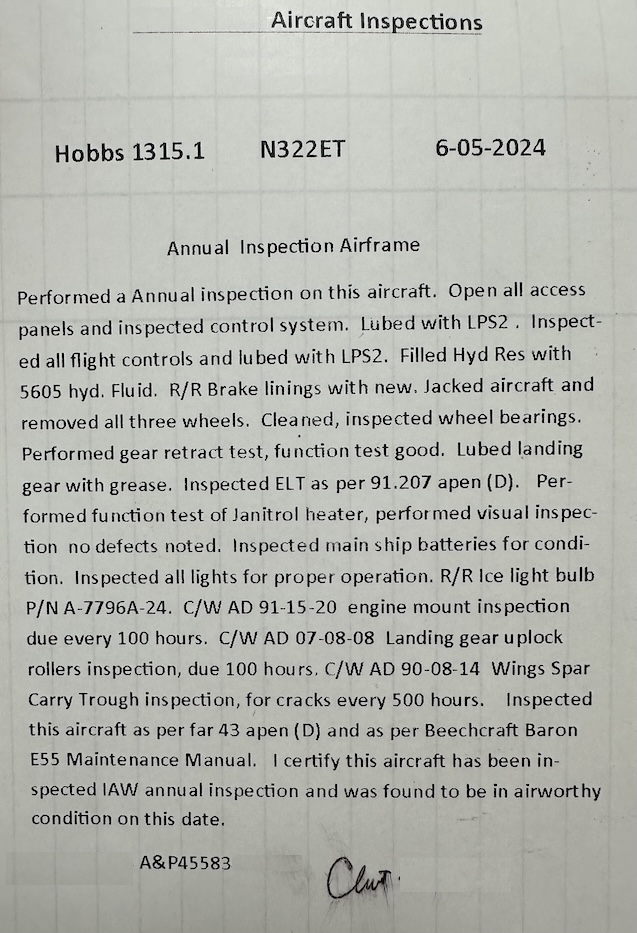
- 14 CFR §43.11
- Things required when inspections are performed
- Type and description.
- Date of inspection and aircraft total time.
- Signature, certificate type and certificate number.
- A statement certifying the aircraft was airworthy for return to service, or list of unairworthy items.
- Things required when inspections are performed
- 14 CFR §43.9
- Similarly, a similar list when maintenance is performed.
- 14 CFR §91.417
- Basically says the aircraft owner must keep these records.
- FAA-AC-43-9C
- This advisory circular provides guidance to help comply with the CFRs above.
VOR Check
- Recall from AVIATE acronym, VOR needs to be checked every 30 days for IFR
- VOR accuracy requirements 14 CFR §91.171(b), (c)
- VOT: +/- 4 deg
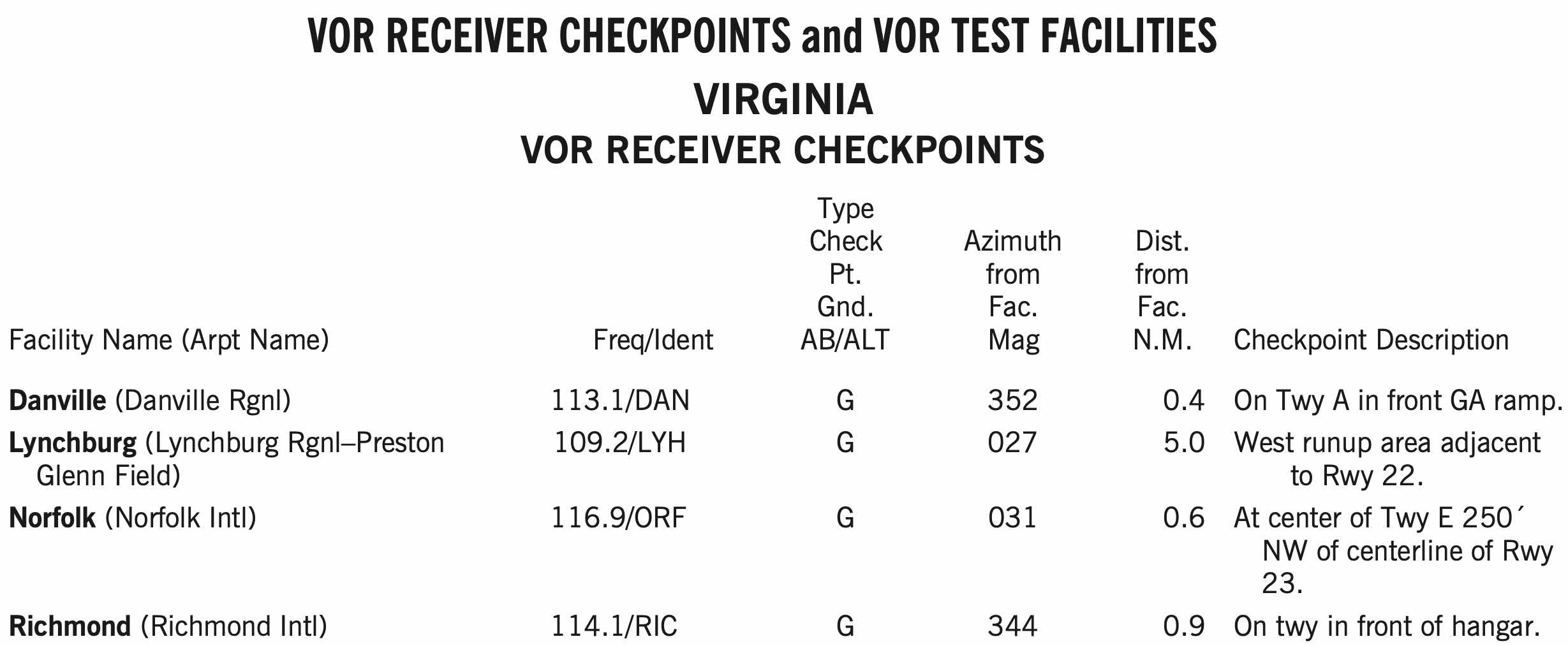
- Can be checked on the ground or in the air, as indicated in the chart supplement for that facility
- Ground checkpoint: +/- 4 deg
- Airborne checkpoint: +/- 6 deg
- Dual check: within 4 deg
- VOT: +/- 4 deg
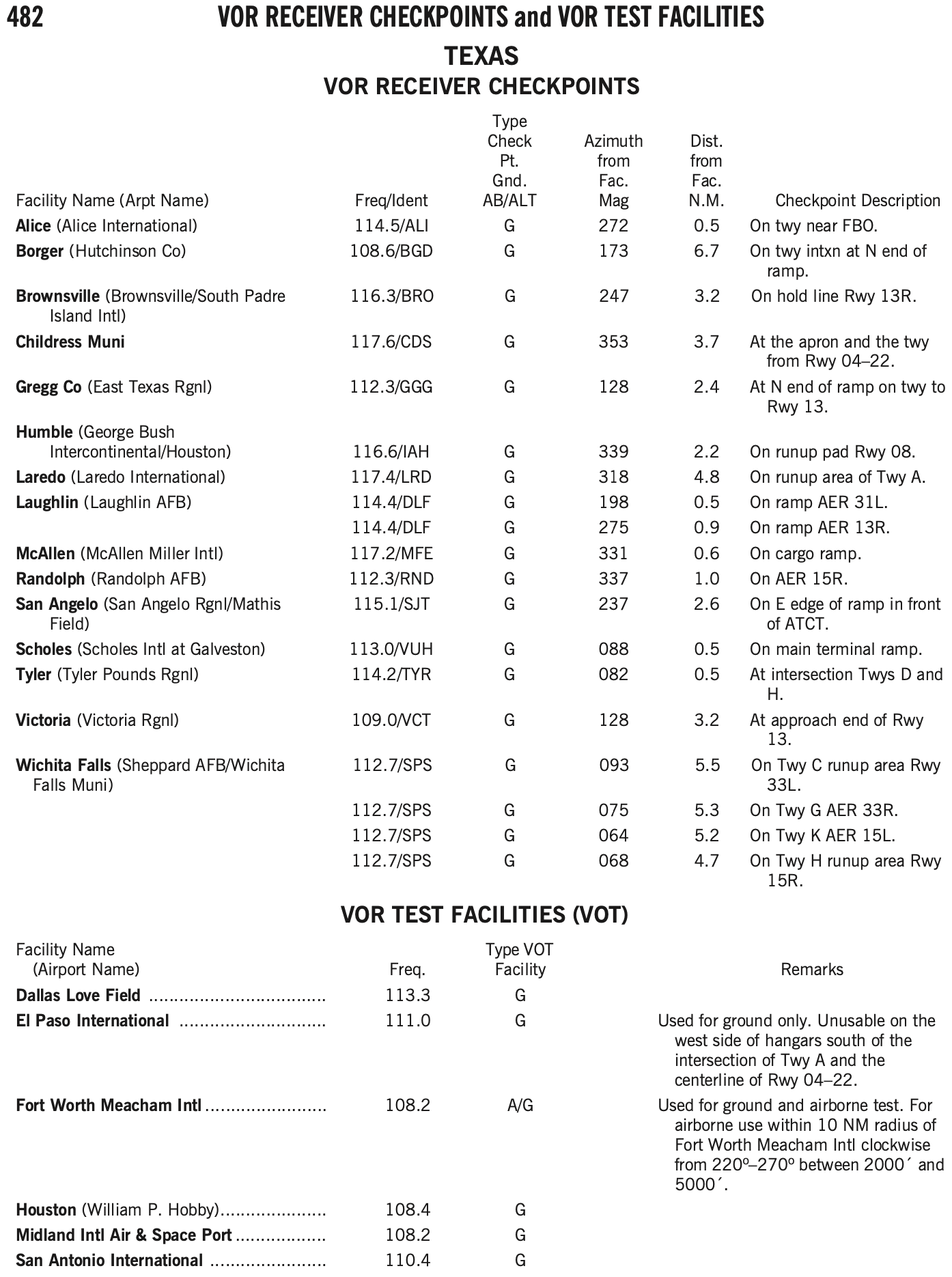
- Can find VOT facilities and VOR checkpoints in the chart supplement.
- Log the results of the VOR accuracy test in the aircraft logbook or other record including the PADS acronym:
- P - Place
- A - Accuracy (bearing error)
- D - Date
- S - Signature
- VOT is the most convenient way to perform a VOR check if your home airport happens to have one
- Similarly, ground checkpoints are also a convenient option
VOR Ground Checkpoint
- Has a sign in front of the arrow with the radial and frequency

VOT Check
- A VOT is a facility located at certain airports that emits a signal that can be used to test a plane's VOR receiver
- The VOT signals are generally designed to be used while on the ground, but some are designated as usable in air, with certain restrictions
- This information can be found in the chart supplement
- Dial a course of 180° in using the OBS, should see the needle center (within +/- 4 degrees) with a
TOindication.
Equipment Requirements
Day VFR Required Equipment
- 14 CFR §91.205(b)
- A-TOMATO FLAMES
- A - Anti-collision lights
- If newer than 1996
- T - Tachometer
- For each engine
- O - Oil temperature gauge
- For each engine
- M - Manifold pressure gauge
- For altitude engine
- A - Airspeed indicator
- T - Temperature gauge
- For liquid cooled engines
- O - Oil pressure gauge
- F - Fuel level gauge
- L - Landing gear position indicator
- Retractable only
- A - Altimeter
- M - Magnetic direction indicator
- Compass
- E - ELT
- S - Seatbelts
- Shoulder harnesses in front seat if newer than 1978
- A - Anti-collision lights
- Note: Transponder required above 10,000 MSL, unless witihin 2,500 AGL. Also in A, above B mode-C veil, and in C airspace.
Note on Fuel Gauges
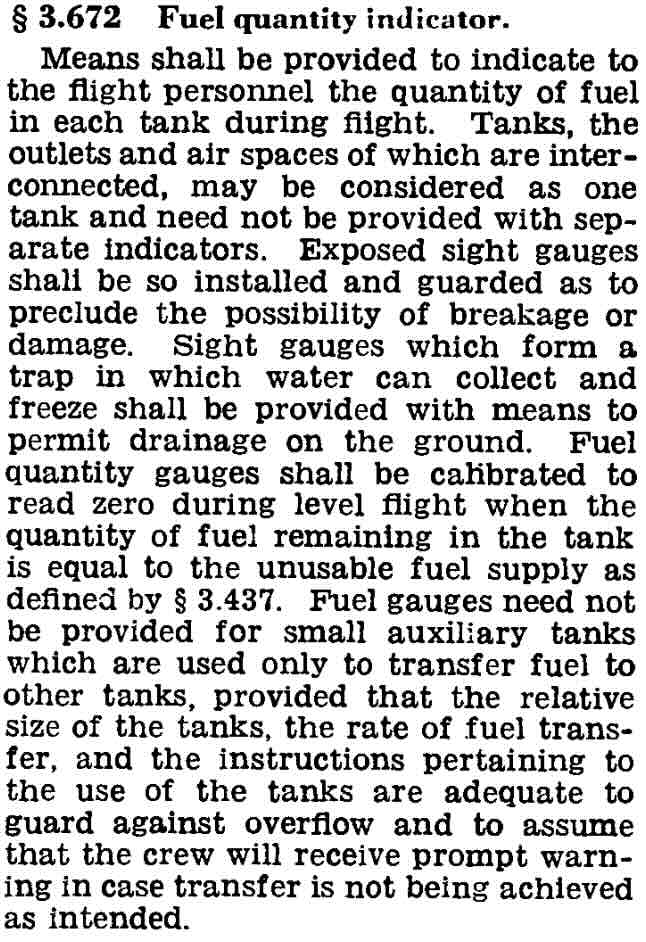
This note exists to provide some context around statements regarding the required accuracy of fuel gauges.
The below provides some excerpts of the regulations around fuel gauges depending on which set of regulations a given aircraft are certified under.
This is the most recent CFR for normal category airplanes that gives fuel gauge requirements.
Each fuel system must— Provide the flightcrew with a means to determine the total useable fuel available and provide uninterrupted supply of that fuel when the system is correctly operated, accounting for likely fuel fluctuations;
The relevant CFR prior to the Part 23 rewrite that went into effect on August 30, 2017.
Fuel quantity indication. There must be a means to indicate to the flightcrew members the quantity of usable fuel in each tank during flight. An indicator calibrated in appropriate units and clearly marked to indicate those units must be used.
Night VFR Required Equipment
- 14 CFR §91.205(c)
- FLAPS (In addition to day VFR)
- F - fuses
- L - landing light
- If for hire
- A - anti-collision lights
- P - position lights
- Nav lights
- S - source of power
IFR Required Equipment
- 14 CFR §91.205(d)
- GRABCARDD
- G - Generator
- Or alternator
- R - Radios
- Comm and navigation suitable for the route to be flown
- A - Altimeter
- Adjustable
- B - Ball
- Inclinometer, slip/skid indicator
- C - Clock
- With seconds
- A - Attitude indicator
- R - Rate of turn indicator
- D - Directional gyro
- Heading indicator
- D - DME or RNAV
- At FL240 and higher if VOR is required
- G - Generator
Additional Night Lighting Requirements
- Regarding lights see also 14 CFR §91.209 Aircraft lights
- No person may, from sunset to sunrise, park or move an aircraft in, or in dangerous proximity to, a night flight operations area of an airport unless the aircraft:
- Is clearly illuminated
- Has lighted position lights
- Or is in an area that is marked by obstruction lights
- Basically when pushing the plane around at night with the towbar, for example, unless the area is well lit, leave the nav lights on.
Note: this is a good example where there are grey areas in the definitions, for example how clear is "clearly illuminated" so the obvious thing to do if in doubt at all is just leave the nav lights on.
What is a night flight operations area? Absent any proffered definition, the plain reading of the phrase-as I read it-would be an area used, or subject to use, for flight operations at night. In other words, any public use airport with an apron or taxiway that is open to flight operations at night could and should be considered-by my reading-a night flight operations area. Whether the area is a movement or non-movement area shouldn't matter. Could someone else reasonably taxi past you (or into you!) at night? That's probably a night flight operations area.
Inoperative Equipment Overview
When thinking about what equipment is required first think of 14 CFR §91.7 - Civil aircraft airworthiness that says:
No person may operate a civil aircraft unless it is in an airworthy condition. The pilot in command of a civil aircraft is responsible for determining whether that aircraft is in condition for safe flight
So if you have any reason to think the aircraft is not safe to fly due to some inoperative equipment, don't fly it.
Regulations should be a floor for safety not a ceiling.
Minimum Equipment List (MEL)
- A minimum equipment list is a list of equipment approved by the manufacturer and the FAA, by which you may legally operate a flight with inoperative equipment.
- Requirements below are when an aircraft needs an MEL
- No aircraft can fly with inoperative equipment unless it has an approved minimum equipment list (MEL)
- Exception:
- Non-turbine planes (and some other aircraft) as long as the inoperative equipment is not required by 14 CFR §91.205
- And not required by type certificate or Airworthiness Directive (AD)
- Marked as "INOP"
- If the aircraft does not have an MEL can follow 14 CFR §91.213 which says for non-turbine planes (and some other aircraft) as long as the inoperative equipment is not required by 14 CFR §91.205 and not required by type certificate or Airworthiness Directive (AD) it can be marked as "INOP" and the aircraft can still be flown.
- If missing any items in MEL must get authorization from FSDO
Kind of Operations (Equipment) List (KOL or KOEL)
- Indicates equipment required for airworthiness during the kinds of operations (e.g. VFR/IFR, day/night)
- The Cessna 172SP, for example, which contains a KOEL in Section 2 of the POH indicates that strobes are required for all flight conditions.
- If our aircraft has a KOEL it will be in the POH?
- Indicates equipment required for airworthiness during the kinds of operations (e.g. VFR/IFR, day/night)
Comprehensive Equipment List (CEL)
- For example in the weight and balance section of C172SP POH
- It is a comprehensive list of equipment in the aircraft and identifies those items that are required by CFRs for FAA certification
- Is this actually any different than the minimum required by FAA? Or is Cessna imposing additional requirements beyond the FAA with this list?
- Is this the same as KOEL?
Supplemental Type Certificate (STC)
- FAA authorization to modify aircraft (e.g. install new avionics)
- Might come with additional requirements, e.g. keep PFD manual in plane
This has interesting discussion about what equipment needs to be working in particular on intermittently working equipment Minimum Equipment: What Has to be Working?
A good way to approach required equipment on the aircraft is to think through a hypothetical situation of preflighting an aircraft prior to a flight, finding a piece of equipment inoperative, and then determining whether or not the aircraft can still be flown with said equipment inoperative.
Determining Airworthiness
- The following flowchart captures most of the questions that need to be answered in this situation.
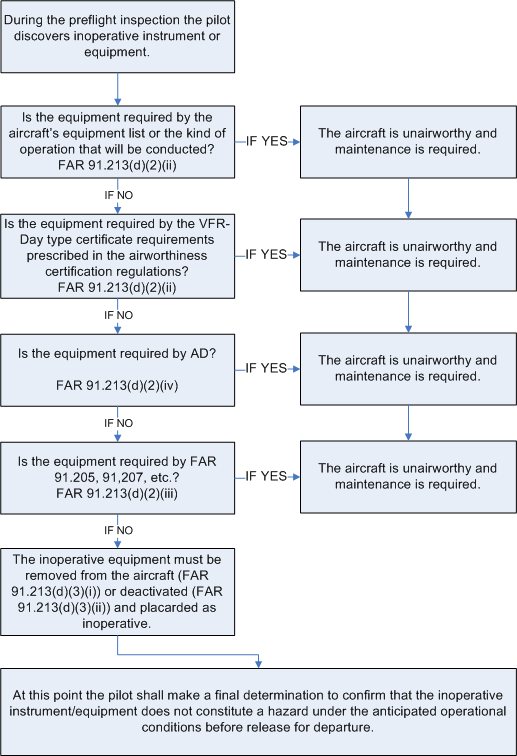
- The following list is similar to the questions in the flowchart.
- The order in which these questions are asked does not matter.
- Does the plane have an MEL?
- Minimum equipment list, approved by FAA
- General aviation planes will almost certainly not have an MEL
- Does the plane have a KOEL (kinds of equipment list)?
- G1000/nav com III POHs do, start there (section 2 POH, operating limitations)
- Does the plane have a CEL (comprehensive equipment list)?
- 172R/S/M/N/P (section 6 POH, weight and balance, R required for flight, S standard)
- Is it required by 14 CFR §91?
- 14 CFR §91.205, 14 CFR §91.207, etc.?
- A+TOMATOFLAMES, FLAPS, etc.
- Is it required by Airworthines Directive?
- Is it required by STC?
- Finally, is it required to fly safely?
- See 14 CFR §91.7
- Does the plane have an MEL?
- If it legal to fly with the inoperative equipment, it must be placarded and either removed or deactivated, if it is removed, a new weight and balance might need to be computed depending on the weight of the part.
FAA-AC-91-67A Minimum Equipment Requirements for General Aviation Operations Under FAR Part 91
Deactivation. When an item is "deactivated" or "secured," or both, the specified item must be put into an acceptable condition for safe flight. Deactivation may involve more than simply turning off a system switch, which does not remove power from the system. Deactivation may involve pulling and securing the circuit breaker and/or removing the equipment. Deactivation of an inoperative system is not preventive maintenance as described in part 43 appendix A. Regardless of the method of deactivation, a person authorized to approve the aircraft for return to service under § 43.7 must make the maintenance record entry required by § 43.9. No person may operate the aircraft without the entry required by § 43.9.
The safest interpretation of this is that deactivation is not preventative maintenance and therefore not something the pilot can do.
However, the references below may offer other interpretations that might be applied in the case of pulling and securing a circuit breaker in order to deactivate a piece of equpiment.
Specifically, that the act of pulling a circuit breaker, like adding oil to the engine, doesn't even rise to the level of preventative maintentance.
Many preventive maintenance tasks are listed in 14 C.F.R. part 43, appendix A, paragraph (c). The paragraph sets forth in 32 numbered subparagraphs items the FAA has determined to be preventive maintenance. Even though the introductory text of subparagraph (c) states that "[p]reventive maintenance is limited to the following work ...." (emphasis added), in view of the broader definition of preventive maintenance in section 1.1, we believe that such limitation is not controlling. Similarly, for the same reason, we also believe that the following sentence in Advisory Circular 43-12A, Preventive Maintenance (which was referenced in Mr. Hernandez's letter), is overly restrictive That sentence, found in Paragraph 3(b)(l), states: "If a task or maintenance function does not appear in the list, it is not preventive maintenance." As with the other paragraphs of Appendix A (i.e., on major repairs and major alterations), the lists are better viewed as examples of the tasks in each category-they cannot be considered all-inclusive. There are, no doubt, many "simple or minor preservation operations [tasks]" and many "replacement[s] of small standard parts not involving complex assembly operations" performed daily, especially on small general aviation aircraft, that the agency would consider to be preventive maintenance, though they are not included in the 32 listed items.
- Referenced above in Pilot Performed Preventative Maintenance
- In the context of pilots deactivating inoperative systems (e.g. via pulling and securing a circuit breaker) this letter offers some guidance related to things pilots can do which do not even rise to the level of preventative maintenance.
- In the context of this letter, it seems a reasonable position to take that pulling and securing a circuit breaker is the same level as adding oil, and therefore while not preventative maintenance something the pilot can legally do.
14 CFR §91.213(d)(3) also says, "if deactivation of the inoperative instrument or equipment involves maintenance" implying that deactivation may be possible that does not involve maintenance.
Finally, remember about Advisory Circulars from the AIM:
Advisory Circulars ‐ The FAA issues Advisory Circulars (AC) to inform the aviation public in a systematic way of nonregulatory material. Unless incorporated into a regulation by reference, the contents of an advisory circular are not binding on the public.
Aside: a Single Broken Strobe Light
Regarding equipment required by 14 CFR §91.205, it is interesting to note that 14 CFR §91.205(b)(11) says, regarding anticollision light system:
In the event of failure of any light of the anticollision light system, operation of the aircraft may continue to a location where repairs or replacement can be made.
So this is why according to the C172SP KOEL that Strobes are required during all flight conditions.
See also Letts 2017 Legal Interpretation.
Aside: Altimeter Accuracy
Altimeter accuracy requirements +/- 75 ft. for IFR. For VFR not explicitly stated, but it's up to PIC to determine the aircraft is in a safe condition for flight.
Accuracy requirements of altimeter AIM 7-2-3 Altimeter Errors:
If the difference from the known field elevation and the altitude read from the altimeter is plus or minus 75 feet or greater, the accuracy of the altimeter is questionable and the problem should be referred to an appropriately rated repair station for evaluation and possible correction.
From 14 CFR §91.217(a)(2):
- The difference between the automatic reporting output and the altitude displayed at the altimeter shall not exceed 125 feet.
References
- FAA-H-8083-15B Instrument Flying Handbook
- Chapter 5: Flight Instruments
- Page 5-10
- Page 5-26
- Page 5-34: Terrain Alerting Systems
- Chapter 5: Flight Instruments
- FAA-H-8083-15B Instrument Flying Handbook
- Chapter 9: Navigation Systems
- Page 9-44
- Chapter 9: Navigation Systems