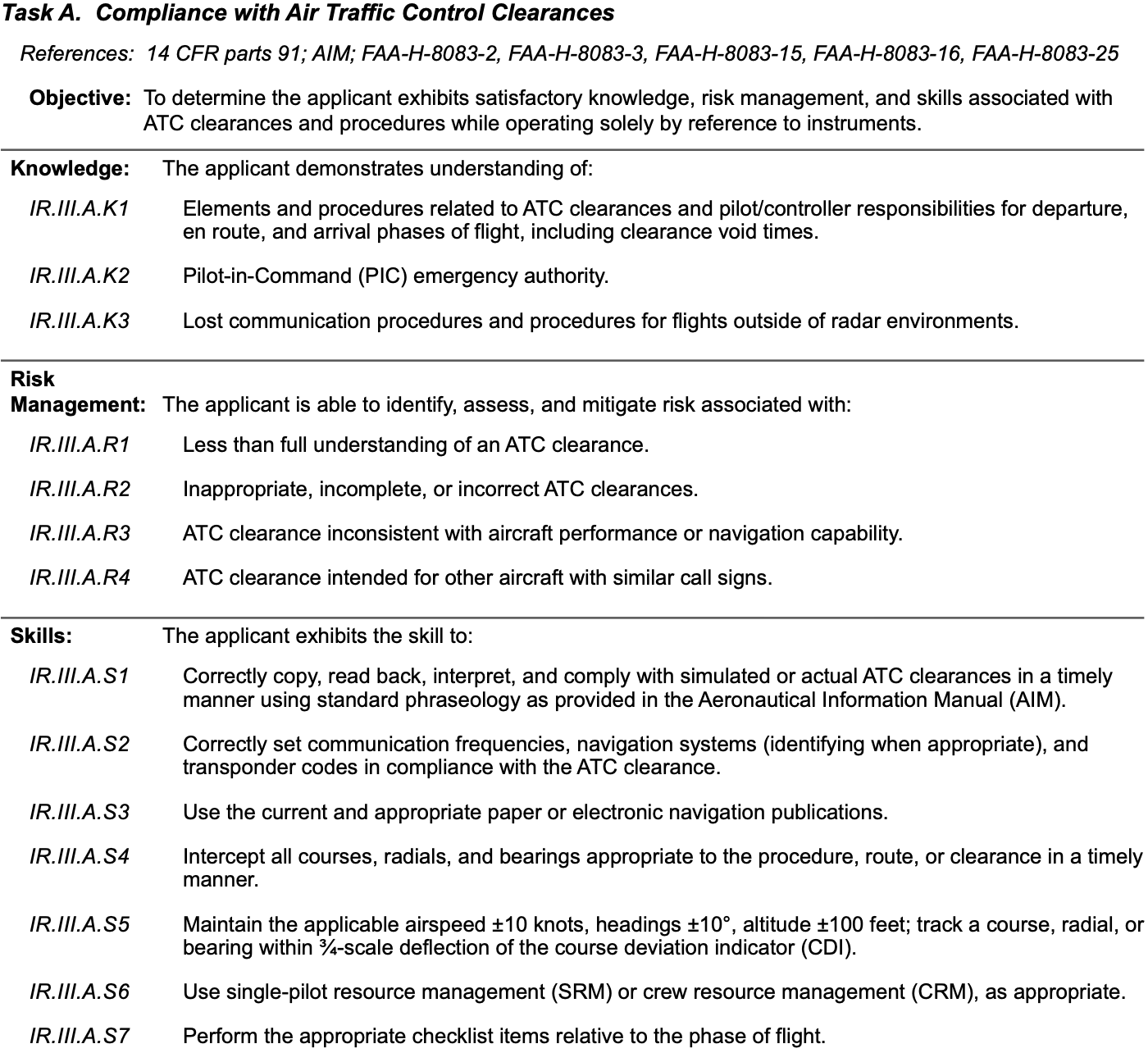
Compliance with ATC Clearances
This page covers Task A. Compliance with Air Traffic Control Clearances from the FAA-S-ACS-8C Instrument Rating Airplane Airman Certification Standards.
Objective
To determine the applicant exhibits satisfactory knowledge, risk management, and skills associated with ATC clearances and procedures while operating solely by reference to instruments.
Pilot and controller responsibilities to include tower, en route control, and clearance void times
- FAA-H-8083-15B Instrument Flying Handbook
- Chapter 10: IFR Flight
- File IFR flight plan
- IFR departure
- Release time
- May not depart prior to this time
- Clearance void time
- Clearance void if not airborne by this time
- Release time
Correct and timely copying of an ATC clearance
- Obtaining a clearance
- Clearance delivery
- The
KHEFclearance delivery frequency goes directly to Potomac Approach when the tower is closed so we can get clearances from them - When calling for clearance at an airport where ground and clearance share the same frequency, in call-up refer to them as "clearance" when calling for clearance
- This allows the person receiving the transmission to more easily switch context to clearance delivery from their ground controller duties
- The
- Ground control
- RCO/GCO
- Flight Service
- ATC
- Clearance delivery
- Use the CRAFT acronym when copying IFR clearance
- C - Clearance limit ("cleared to")
- R - Route
- A - Altitude
- F - Frequency
- T - Transponder
- If no further clearance is received, then 3 minutes prior to arriving at clearance limit slow to holding speed
- Suggest that students fill out as much of the expected CRAFT as possible before calling for clearance
- Pop-up IFR clearance
How to Receive a Clearance
- Getting IFR clearance before T/O
- Towered airport
- Specific clearance delivery frequency e.g. KBED 121.85
- Ground e.g. KOWD 121.8
- Non-towered airport
- Center/approach control (via radio)
- Center/approach control (via phone, e.g. Oakland Center/Norcal Approach 1-310-725-3300)
- Flight service (radio or telephone)
- Towered airport

Popup IFR Clearance
- Aviation StackExchange: Does a request for a Pop-Up IFR clearance constitute filing a flight plan?
- Aviation StackExchange: How do you request a "pop up" IFR clearance?
- How to obtain an abbreviated IFR flight plan? (See definition in pilot controller glossary)
Ability to comply with the clearance
- Make sure to copy the clearance correctly
- The readback should ensure this is the case
- Make sure to have information needed to adhere to the clearance
- Taxi diagram
- Departure procedure
- Set up FMS according to the clearance
Correct and timely read-back of an ATC clearance, using standard phraseology
- See above
Correct interpretation of an ATC clearance and, when necessary, request for clarification, verification, or change
- See above
Setting of communication and navigation frequencies in compliance with an ATC clearance
- Departure frequency given with CRAFT clearance
- Check frequencies before takeoff
- "No dead frequencies"
- Suggest using COM1 for "air" frequencies and COM2 for "ground" frequencies
Mandatory Reporting Points
- Required reports (MARVELOUS VFR C500)
- M - Missed approach
- A - Airspeed
- +/- 10 kts or 5% of filed TAS (whichever greater)
- ATC basically wants to know if we are making a deliberate power change
- R - Reaching a holding fix
- Time and altitude
- Crossing the holding fix outbound as part of our entry procedure
- V - VFR on-top altitude changes
- E - ETA change
- Of more than +/- 2 minutes
- In non-radar environment
- L - Leaving a holding fix
- O - Outer marker inbound
- In non-radar environment
- Outer marker indicates final approach fix for non-precision approach
- U - Unforecast weather
- Especially icing, turbulence, wind
- S - Safety of flight
- V - Vacating an altitude or flight level
- F - FAF inbound
- In non-radar environment
- R - Radio or navigation failure
- Report loss of any equipment which may impair safety and/or ability to operate under IFR
- AIM 5-3-3 a.1 (h)
- 14 CFR §91.187
- C - Compulsory reporting points
- In non-radar environment
- 500 - Failure to maintain at least 500 FPM climb or descent
Position Reports
- How to report one of the above (PTA PT P)
- P - Point
- T - Time
- A - Altitude
- P - Point
- T - Time
- P - Point
- For example
- "Potomac Approach, Skyventures 124 is over CSN at 4000 feet 30 minutes after the hour, expect BRV at 45 minutes after the hour, then FAK"
- Position reports
- Position reports are required over each compulsory reporting point along the route being flown
- Shown on the chart as a solid triangle
- Along direct routes, reports are required of all IFR flights over each point used to define the route of flight
- Position reports should include the following items:
- Identification
- Position
- Time
- Altitude
- Type of flight plan
- Estimated time of arrival (ETA) and name of next reporting point
- The name only of the next succeeding reporting point along the route of flight
- Remarks
- Position reports are required over each compulsory reporting point along the route being flown
Departure Procedures
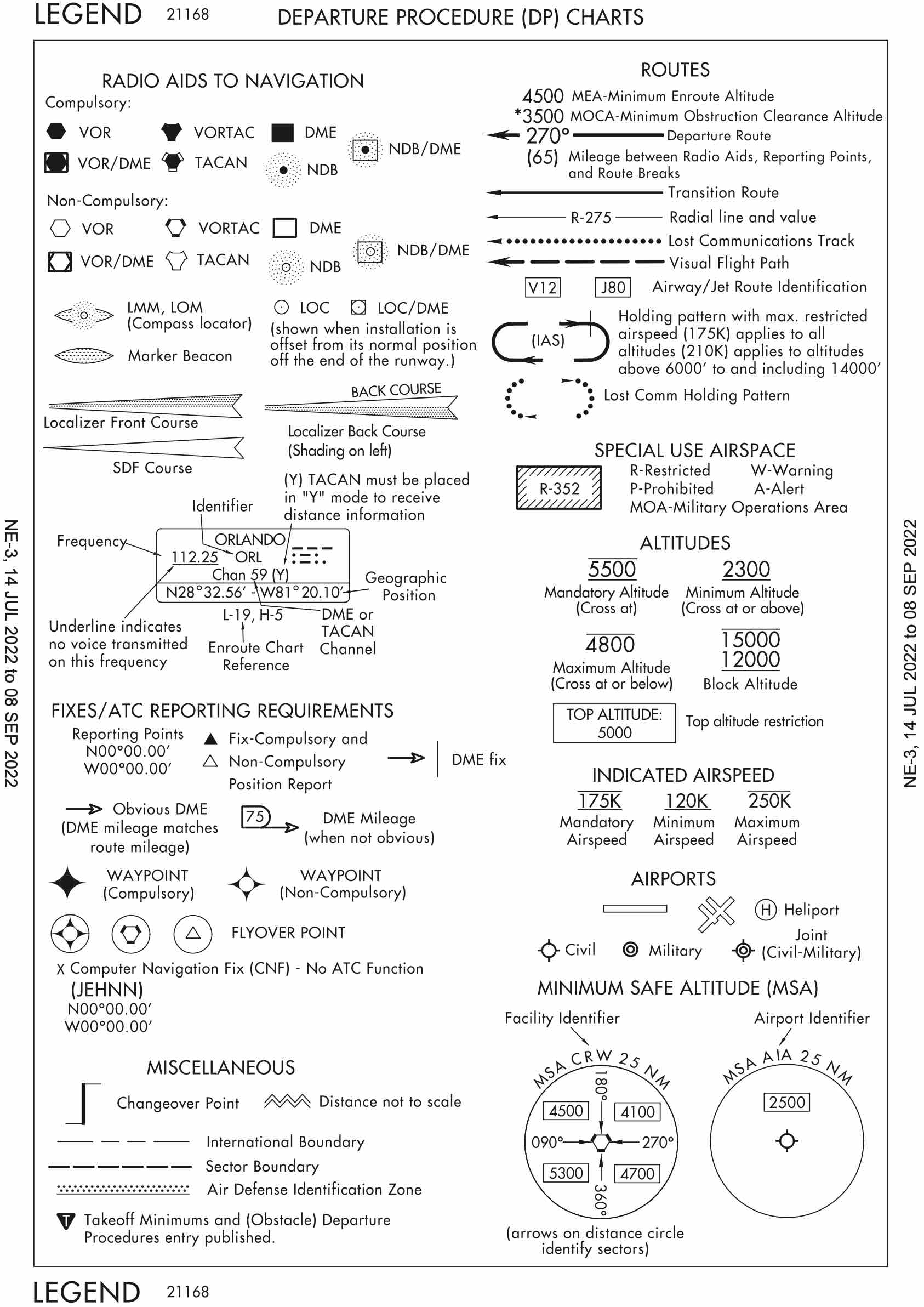
- Find Standard Terminal Arrival Routes (STAR) and Departure Procedures (DP) in the Digital Terminal Procedures Publication
- AIM Section 2. Departure Procedures
- Departure Procedures (DP)
- The generic term for any kind of departure procedure
- Then you have two basic types below, with two subtypes (graphical or textual)
- The two basic types are
- Obstacle Departure Procedures (ODP)
- Standard Instrument Departures (SID)
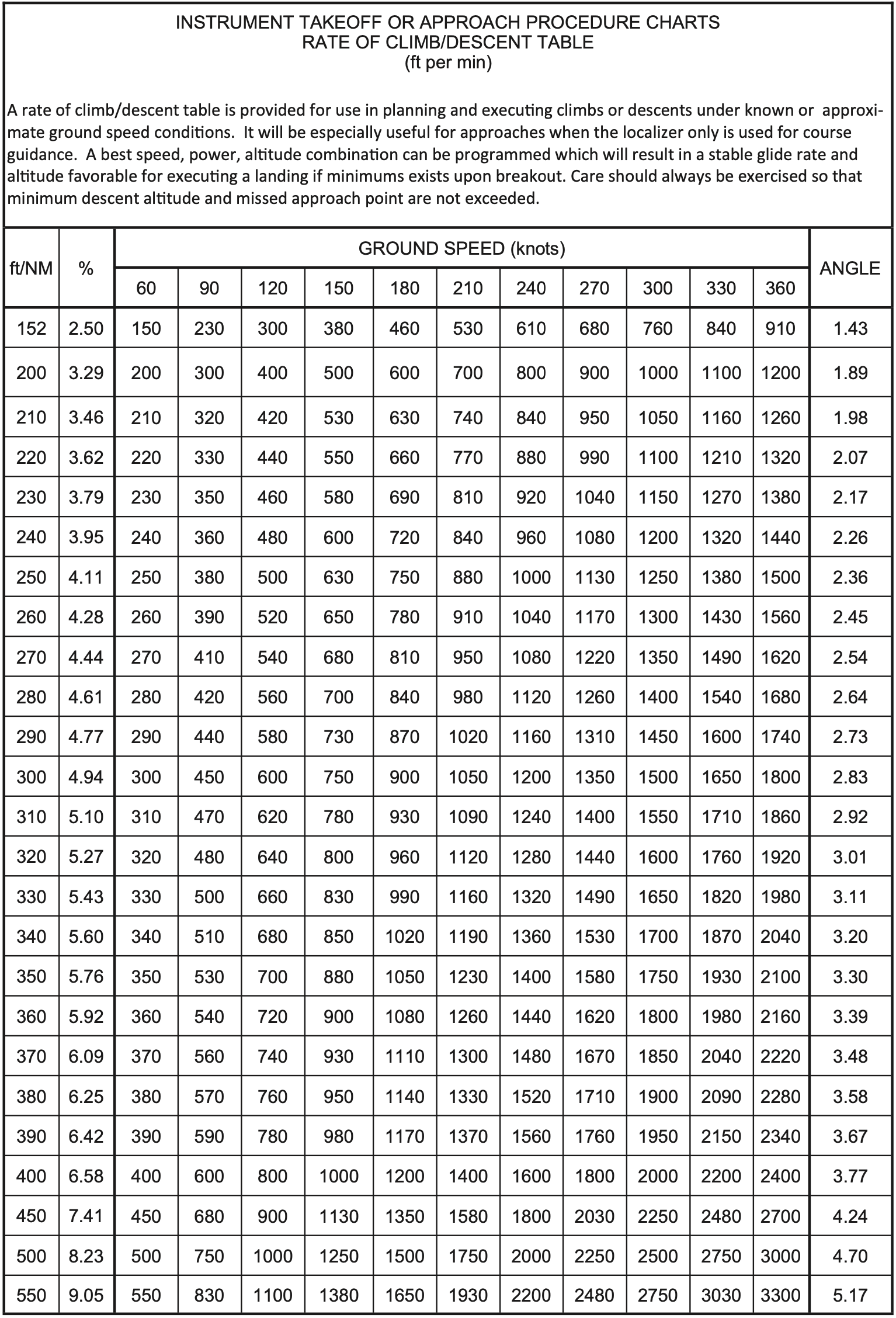
- Departure procedure performance requirements are given in terms of feet per nautical mile.
- To convert those to feet per minute, there is a chart in the back of the Digital Terminal Procedures Publication (d-TPP)/Airport Diagrams
Obstacle Departure Procedures (ODP)
- Purely for obstacle clearance
- Graphical or textual
- ODPs may be flown without clearance
- Generally designed to be available to the largest number of aircraft possible, so they might assume only a VOR receiver and low aircraft performance.
- See
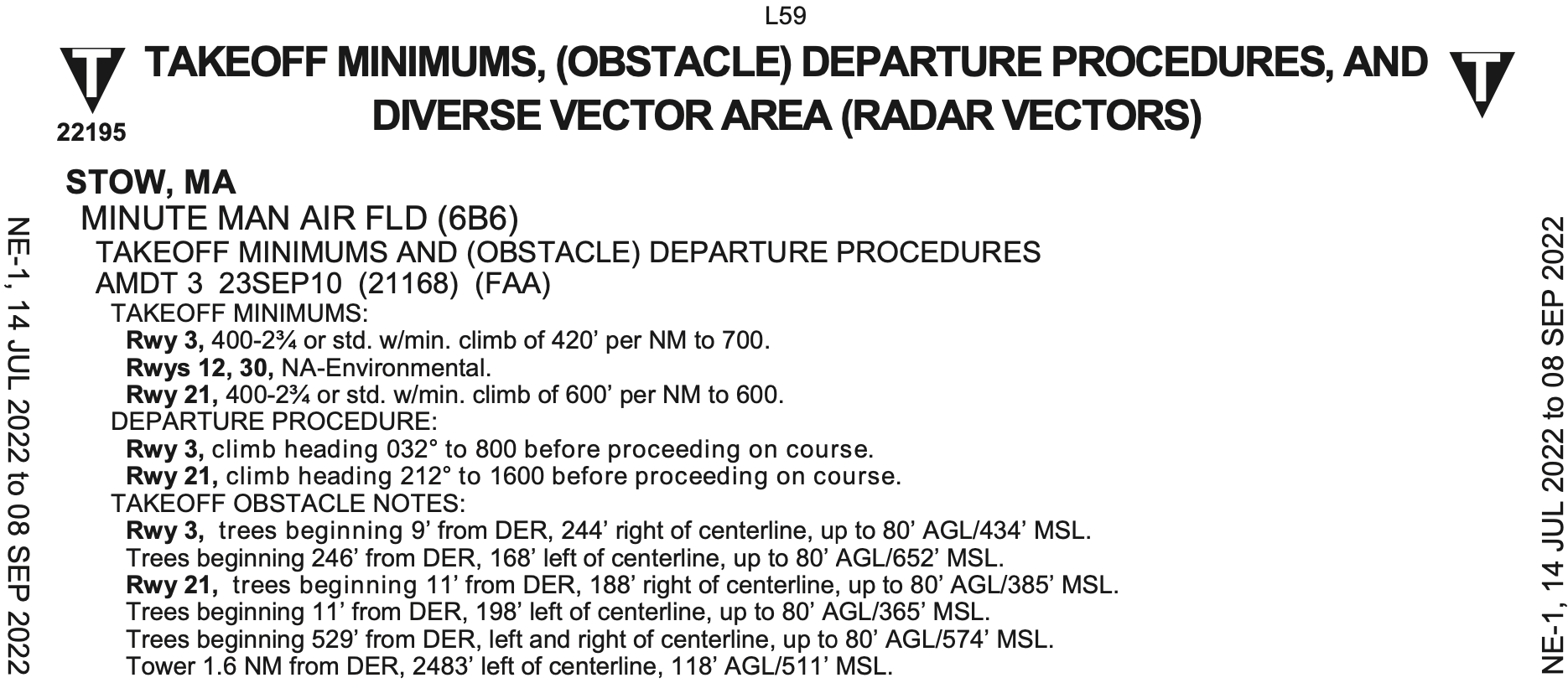
Tin upside down triangle on approach plate for non-standard takeoff minimums or ODP - Textual ODPs
- Those listed in text format in the Takeoff Minimums and Obstacle Departure Procedures section of the Terminal Procedures Publication
- They are usually fairly simple – turn to a heading, intercept a radial, etc.
- Graphical ODPs
- Charted when it would be too complicated to describe them textually
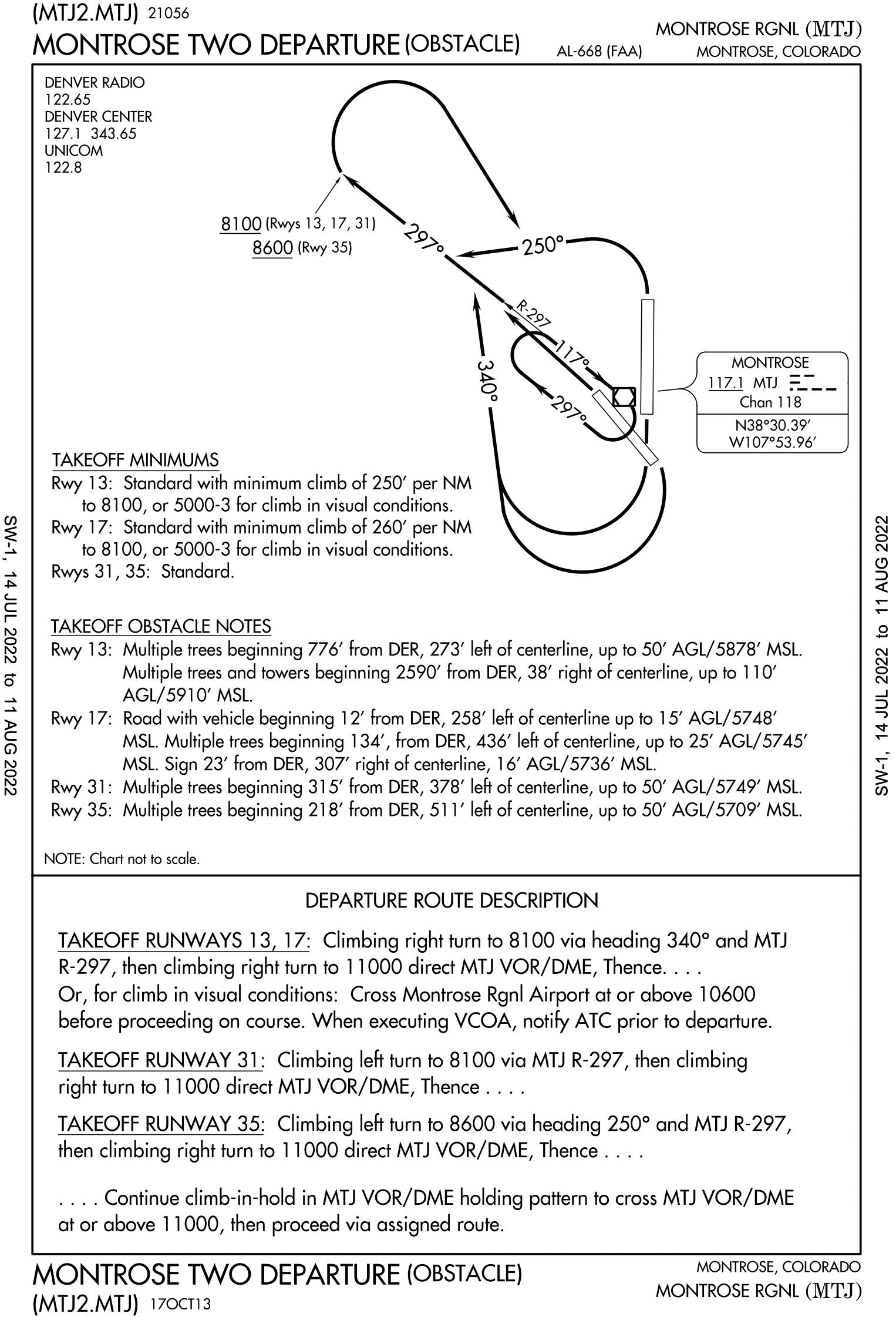
- They include the word (OBSTACLE) in the name, such as the
MONTROSE DEPARTURE (OBSTACLE)out ofKMTJ. - Note the rather tortured routing of the
MONTROSE DEPARTURE (OBSTACLE)designed so that low performance airplanes can hopefully still meet the obstacle clearance requirements.
- Don't need to even fly ODPs, but ATC assumes you will and there's no reason not to
- Climb to 400' AGL before turning
- Must climb at 200' per nm unless otherwise stated
Standard Instrument Departures (SID)
- Exist predominantly for ATC reasons
- Reduces radio traffic and eases traffic flow
- They provide obstacle clearance as well
- Always graphical
- ATC clearance must be received prior to flying a SID
- Given a name, such as the
ARSENAL FIVE DEPARTUREout ofKHEF- This departure is
ARSNL5. - The particular transition is appended to the departure, for example the Martinsburg Transition would be
ARSNL5.MRB.
- This departure is
- The design is based primarily on what is convenient for ATC traffic flow, not whether all airplanes can perform the procedure or not.
- Note they can have some pretty steep climb gradients as well as certain equipment requirements too.
- Climb to 400' AGL before turning
- Must climb at 200' per nm unless otherwise stated
General Departure Notes
- Can decline DP
- If no departure procedure
- Climb to 400' AGL and turn on course
- Must climb at least 200' per nm
- Must be at least 35' AGL at departure end of runway
Takeoff Minimums
- Under Part 91 there are no takeoff minimums except there are performance minimums for the departure you are assigned that you must meet.
- If ATC assigns a departure with performance requirements you cannot meet, you must decline.
- FAA-designated standard minimums for Part 121 and 135
- 1 statute mile (SM) visibility for single- and twin-engine aircraft
- 1⁄2 SM for helicopters and aircraft with more than two engines
- Just because there are no takeoff minimums for Part 91, doesn't mean it's a good idea to take off in zero-zero weather
PIC Emergency Authority
- 14 CFR §91.3 - Responsibility and authority of the pilot in command
- The pilot in command is directly responsible for, and is the final authority as to, the operation of that aircraft
- Can deviate from the rules to meet an emergency
Communication Failure Under IFR
- If the radio fails while VFR, fly VFR and land as soon as practicable
- Squawk 7600
- Unless you decide to declare an emergency, then squawk 7700
- The following rules determine the route and altitude that should be be flown should a radio failure happen in flight and the flight is continued
- If flight needs to be continued IFR after losing communications, the following route should be flown (AVEF)
- A - Assigned
- In last ATC clearance
- V - Vectored
- E - Expected
- From last ATC communication
- F - Filed
- In flight plan
- A - Assigned
- If flight needs to be continued IFR after losing communications, the highest of the following altitude should be flown (MEA) for each route segment
- M - Minimum altitude for IFR operations
- E - Expected
- From last ATC communication
- A - Assigned
- In last ATC clearance
- See 14 CFR §91.185 IFR operations: Two-way radio communications failure
- If radio failure happens and clearance limit is the fix from which approach begins, start descent and approach as close as possible to EFC time, or to arrive at estimated arrival time from flight plan (or amended enroute.)
- If clearance limit is not a fix from which approach begins, leave the clearance limit at EFC time or arrival at the fix if no EFC time, and start approach to begin as close as possible to estimated time of arrival from flight plan (or amended enroute.)
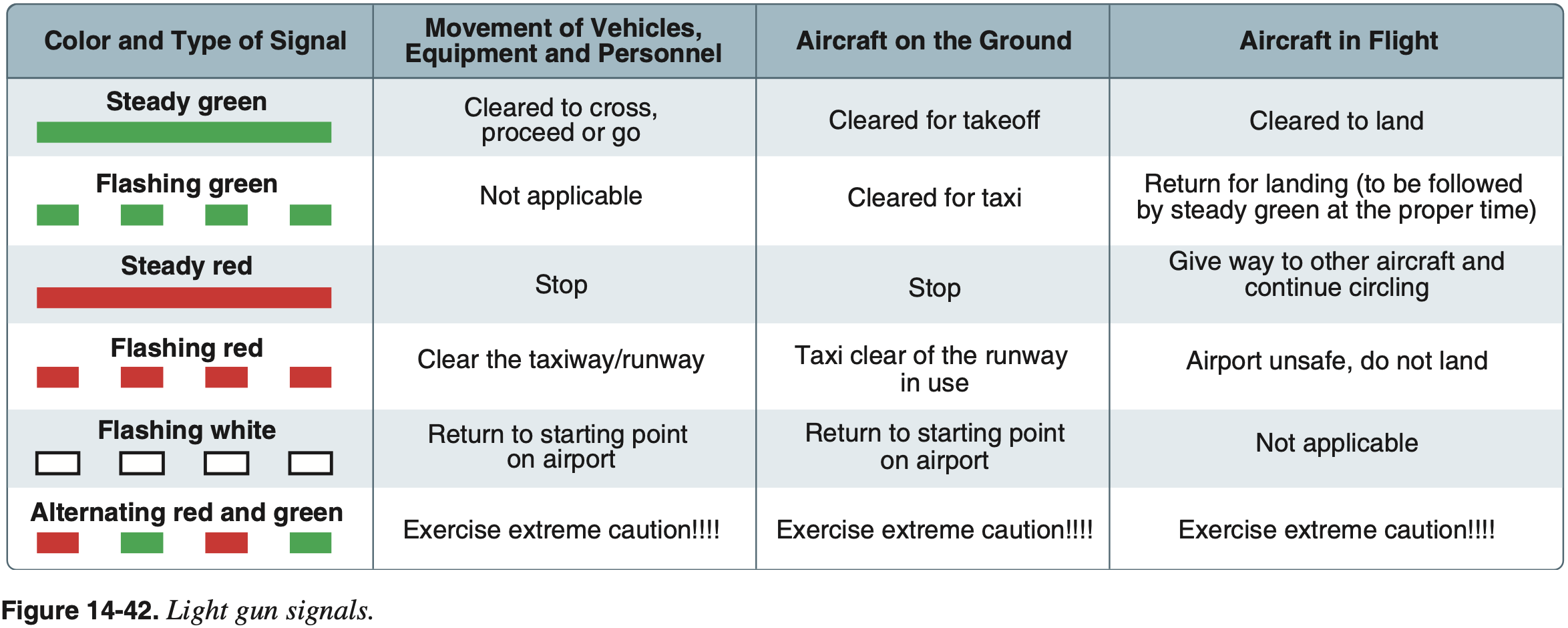
Light Gun Signals
Troubleshooting
- Check frequency
- Check volume
- Try previous frequency
- Try other radio
- Check for TX/RX
- Try other headphone jacks
- Try other PTT
- Try handheld mic
- Try overhead speaker
- Try EMG
- Try other headset
- Otherwise go 7600
References
- FAA-H-8083-15B Instrument Flying Handbook
- Chapter 11: Emergency Operations
- Page 11-8: Communication/Navigation System Malfunction
- Chapter 11: Emergency Operations
Completion Standards