Pilot Qualifications
This page covers Task A. Pilot Qualifications from the FAA-S-ACS-8C Instrument Rating Airplane Airman Certification Standards.
Objective
To determine the applicant exhibits satisfactory knowledge, risk management, and skills associated with requirements to act as pilot-in-command under instrument flight rules.
Instrument Rating
- 14 CFR §61.65
- Pass knowledge test
Aeronautical Experience
- 14 CFR §61.65 Instrument rating requirements
- 50 hours PIC cross country
- 40 hours actual or simulated instrument time
- 15 hours from an instructor
- Max of 20 hours can be in AATD
- 3 hours within 2 calendar months of checkride
- 250 nm cross country
- Total distance along airways, not straight-line distance between points of landing
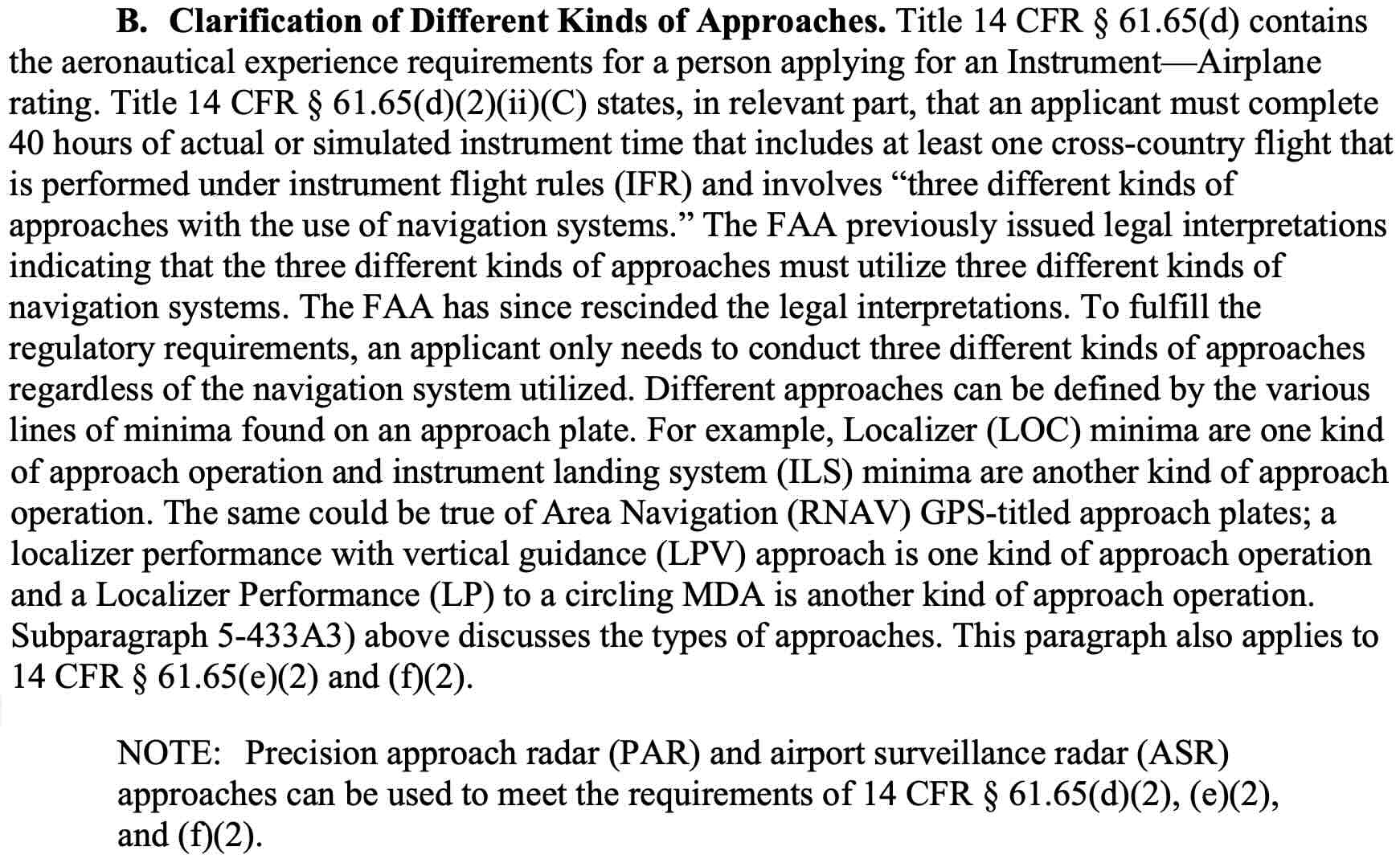
- 3 different types of approaches
- 14 CFR §61.65(d)(2)(ii)
- 14 CFR Par 141 Appendix C Instrument Rating Course
- No minimum PIC cross country
- 35 hours actual or simulated instrument time
- 15 hours from an instructor
- 40% of the time (14 hours) can be in AATD
- The first 2 of 4 stages are well suited to be done in AATD
- 3 hours within 2 calendar months of checkride
- 250 nm cross country
- Total distance along airways, not straight-line distance between points of landing
- 3 different types of approaches
- 100 nm straight line distance
Aside: Different Approaches
In order to satisfy the requirements of the 250 nm cross country flight above, 14 CFR §61.65(d)(2)(ii)(C) specifies the flight must involve three different types of approaches. Order 8900.1A, which provides additional guidance and is available in the Dynamic Regulatory System (DRS) here provides clarity as to what is meant by different in this context in 5-434 B.
Privileges and Limitations
- Flight under IFR or in weather less than VFR
- 14 CFR §61.3(e) Instrument rating
- "No person may act as pilot in command of a civil aircraft under IFR or in weather conditions less than the minimums prescribed for VFR flight unless that person holds ... instrument rating on that person's pilot certificate."
- Goodish 2008 letter states that even filing an IFR flight plan, even without planning to actually accept an IFR clearance in association with the flight plan, is intent to violate 14 CFR §61.3(e)
- 14 CFR §61.3(e) Instrument rating
- Flight in Class A airspace
- 14 CFR §91.135 Operations in Class A airspace
- "Each person operating an aircraft in Class A airspace must conduct that operation under instrument flight rules (IFR)."
- 14 CFR §91.135 Operations in Class A airspace
- Special VFR at night
- Technically it is between sunset and sunrise
- 14 CFR §91.157(b)(4)
- "The person being granted the ATC clearance meets the applicable requirements for instrument flight under part 61 of this chapter."
Adding Instrument Rating to Commercial Pilot Certificate
- Passengers for hire on cross countries longer than 50 nm or at night
- 14 CFR §61.133(b)(1) Commercial pilot privileges and limitations
- "The carriage of passengers for hire in airplanes on cross-country flights in excess of 50 nautical miles or at night is prohibited."
- 14 CFR §61.133(b)(1) Commercial pilot privileges and limitations
14 CFR §91.173
- 14 CFR §61.3(e) states that a pilot needs an instrument rating to operate in weather conditions less than VFR.
- 14 CFR §91.173 says that (and let's assume the pilot is instrument rated and therefor satisfies 14 CFR §61.3(e)) that the pilot only needs to be on an IFR flight plan and receive clearance in controlled airspace.
- Operations in uncontrolled airspace under IMC without a clearance or instrument rating may violate 14 CFR §91.13 Careless or reckless operation
- See FAA vs Murphy
- See Lamb 2016 letter
Currency Requirements
Basic Currency Requirements
- 14 CFR §61.56 - Flight Review
- 14 CFR §61.57 - Recent flight experience: Pilot in command
- To act as PIC
- Flight review within previous 24 calendar months
- 1 hour flight and 1 hour ground training
- Review of Part 91
- Demonstrate safe exercise of pilot certificate
- 1 hour flight and 1 hour ground training
- Checkride counts as flight review
- Flight review within previous 24 calendar months
- To carry persons
- 3 takeoffs/landings within the preceding 90 days
- Same category, class, and type
- Full stop if in tailwheel
- 3 takeoffs/landings within the preceding 90 days
- To carry persons at night (1 hour after sunset and ending 1 hour before sunrise)
- 3 takeoffs/landings within the preceding 90 days
- Same category, class, and type
- Full stop
- 3 takeoffs/landings within the preceding 90 days
- See Kortokrax 2006 which was later rescinded and the Federal Register here.
- Basically, with this change, a non-current pilot can act as PIC with an instructor on board, only for the purposes of regaining currency.
- The update that brought the change from passengers to persons also brought a change to the definition of passenger to clarify that persons providing or receiving flight training are not passengers.
Instrument Currency Requirements
- To act as PIC under IFR or less than VFR weather minimums
- Use 66 HIT to remember instrument currency requirements
- 6 Approaches within
- 6 months including
- Holding
- Procedures and tasks
- Intercepting
- Tracking
- Courses through the use of navigational electronic systems
- 14 CFR §61.57(c) Instrument experience
- Per aircraft category
- e.g. airplane, helicopter
- After instrument currency lapses there is a 6 month "grace period" during which you are not instrument current, but can still complete the above to become curent.
- After that need to complete an IPC
- 14 CFR §61.57(d) Instrument proficiency check
- Note: can file IFR flight plan, but cannot accept the clearance and go IFR even if weather is VMC
- If instrument currency lapses, need IPC
- Use 66 HIT to remember instrument currency requirements
Logging Instrument Experience
Logging Instrument Time
- Logging instrument time
- 14 CFR 61.51(g)
- CFII can log time in IMC as instrument time
- CFII logs any time they are giving instruction as PIC
- Safety pilot
- Needs to be rated in same category and class
- Instrument Proficiency Check
Logging approaches
- When can a pilot log an instrument approach in IMC? When under foggles?
- Actual IMC in an airplane past FAF
- Simulated IMC all the way down to minimums
- When can a CFII log an instrument approach?
- A flight instructor may log an IAP conducted by the student in actual IMC
- INFO 15012 - Logging Instrument Approach Procedures (IAP)
Logging Simulator Time
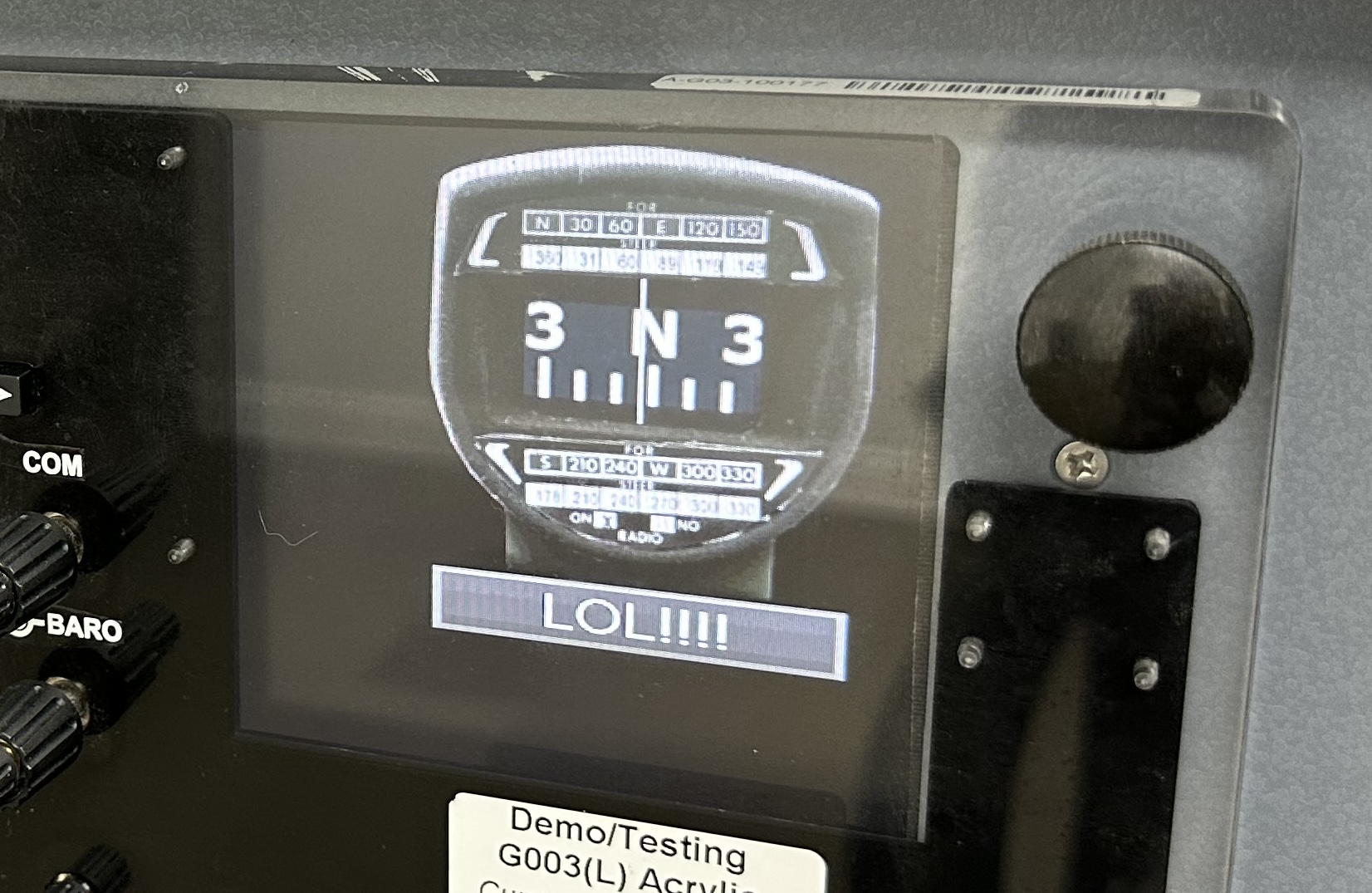
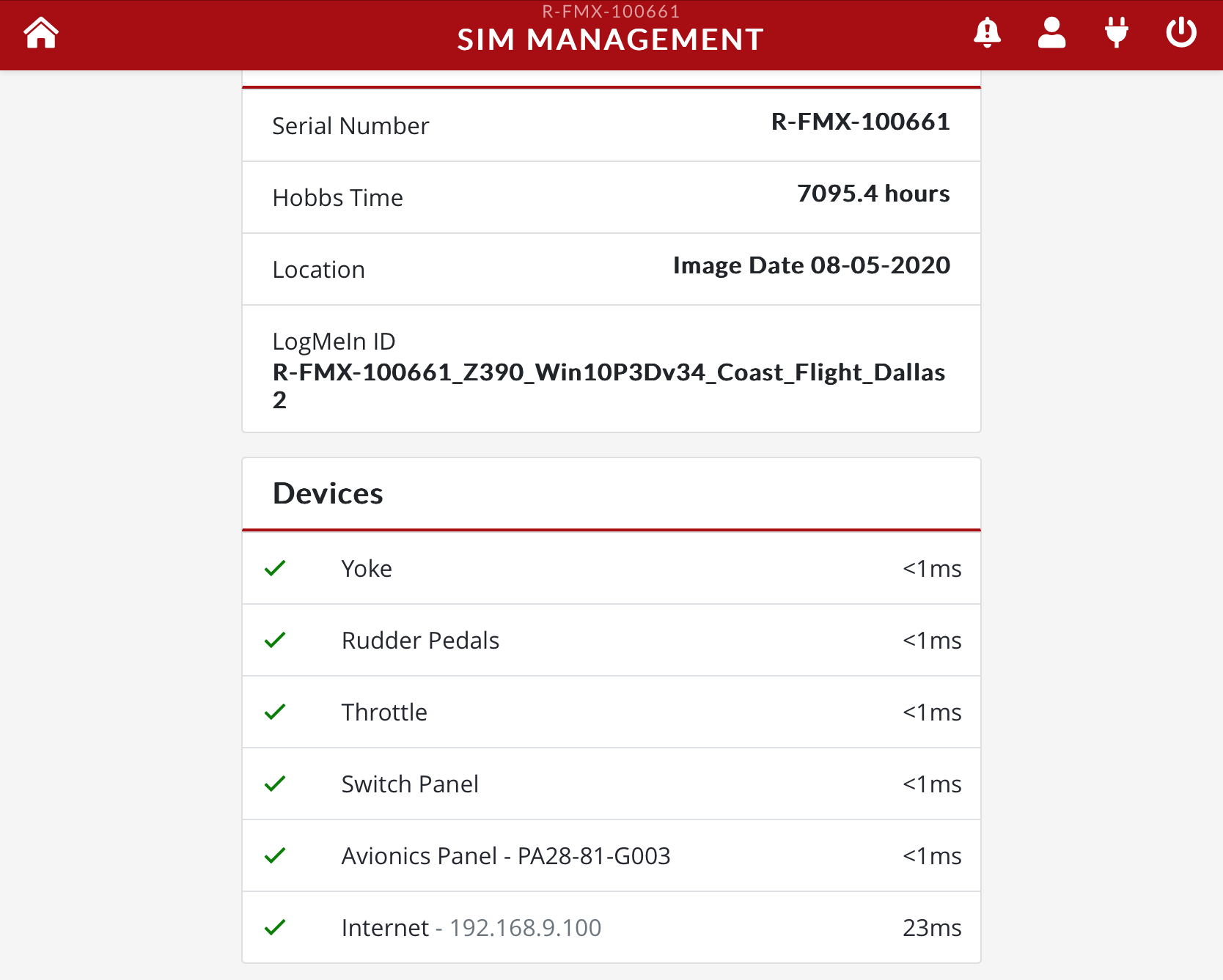
- To satisfy logging the "type and identification" requirement when logging simulator time in Redbird AATD, the tail number does not satisfy the identification requirement as it is a user-configurable field that can be changed
- Use the serial number
- Log the type of aircraft the simulator represents
- Consider logging the avionics package used as well
- 14 CFR §61.51(b)(1)(iv)
BasicMed
- Limitations
- 14 CFR §61.113(i)
- For Private Pilot only
- Airplane authorized to carry not more than 7 people or with max takeoff weight not more than 12,500 lb
- Carry no more than 6 passengers
- Fly no higher than 18,000 ft
- Fly no faster than 250 KIAS
- Cannot fly for compensation or hire
- These limitations were updated in November 2024
- Requirements
- 14 CFR §61.23(c)(3)
- Have held a medical at some point after 14-July-2006
- The most recent medical cannot have been suspended or revoked
- Completed medical education course in previous 24 calendar months
- Received physical exam in previous 48 calendar months
- Bring BasicMed checklist to any licensed physician
- Comply with any medical requirements or restrictions associated with their U.S. driver's license
- FAA-AC-68-1A BasicMed
- FAA Updates BasicMed Program
- FAA BasicMed