Regulations and Publications
This page covers Task C. Regulations and Publications Related to IFR Operations from the FAA-S-8081-9E Flight Instructor Instrument Practical Test Standards.
14 CFR: Aeronautics and Space
Code of Federal Regulations (CFR), which is the codification of the general and permanent rules published by the executive departments and agencies of the United States Government.
The regulations are divided into 50 different codes, called Titles, that represent broad areas subject to Federal regulation.
Title 14 of the Code of Federal Regulations is a collection of regulatory laws that govern aeronatics and space.
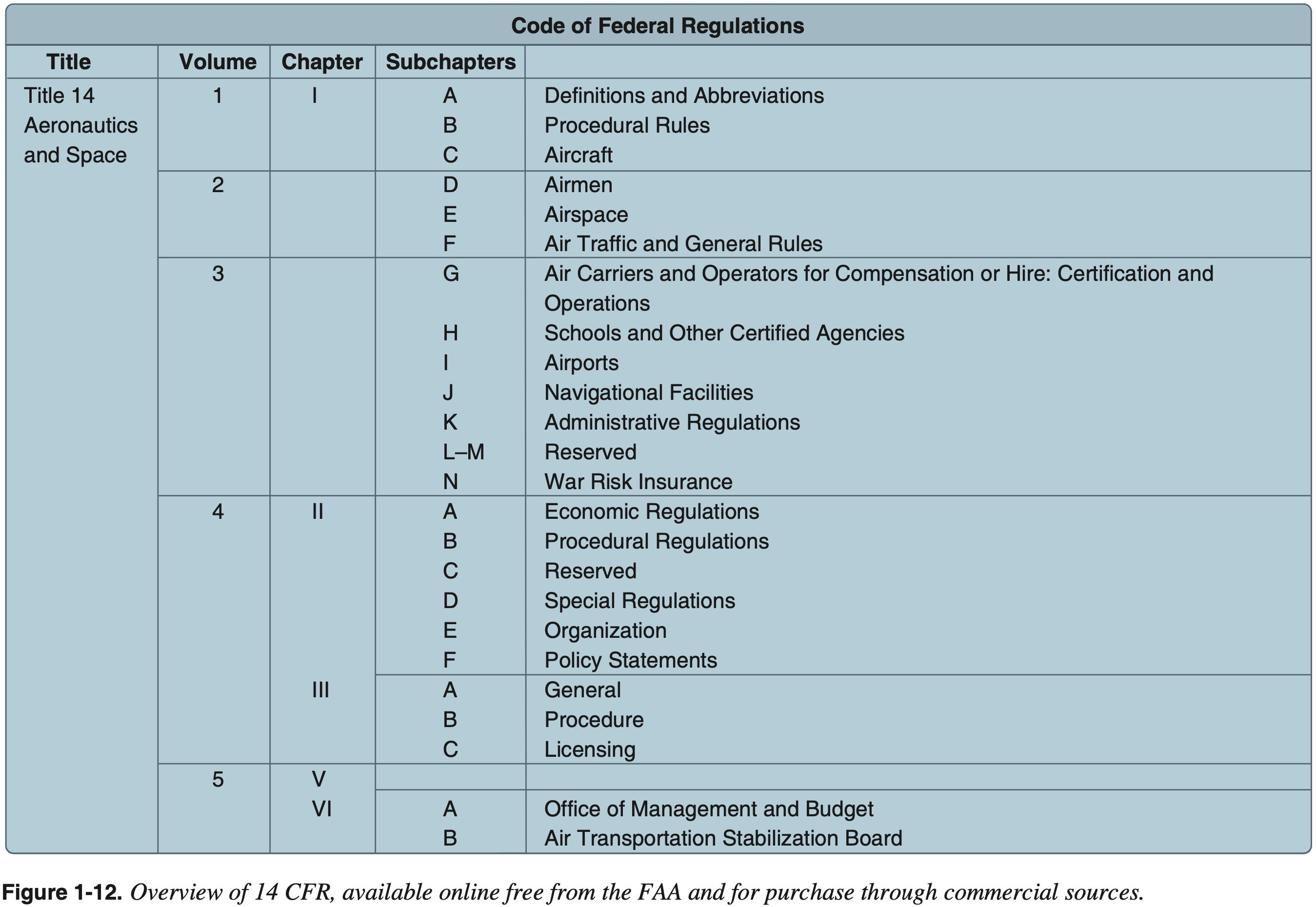
The heirarchy of Title 14 that is relevant to pilots is shown below.
While the parts listed below are some important parts for pilots to know, there are other parts which are relevant as well.
Title 14: Aeronautics and Space
- Chapter I: Federal Aviation Administration, Department of Transportation
- Subchapter A: Definitions and General Requirements
- Part 1: Definitions and Abbreviations / Section 1: General definitions
- Subchapter A: Definitions and General Requirements
- Chapter I: Federal Aviation Administration, Department of Transportation
Select Regulations
Part 43
- 14 CFR §43.3(g)
- Says that a private pilot or higher can perform preventative maintenance on an aircraft they own or operate that is not being used for part 121, 129, or 135 operations
- Appendix A to Part 43(c)
- Long list of items considered preventive maintenance
- 14 CFR §43.3(k)
- Says a pilot can update GPS databases
Part 91
- 14 CFR §91.3 - Responsibility and authority of the pilot in command
- The pilot in command is directly responsible for, and is the final authority as to, the operation of that aircraft
- Can deviate from the rules to meet an emergency
- 14 CFR §91.13 - Careless or reckless operation
- 91.205 IFR Equipment
- 91.167 Fuel Requirements
- 91.179 IFR Cruising Altitudes
- 91.173 IFR ATC Clearance and Flight Plan
- 91.187 Malfunction Reports
49 CFR: Transportation
Title 49 governs transportation.
Heirarchy for 49 CFR is different.
Select Regulations
- 49 CFR §830.2 - Definitions
- Serious injury is defined by the following
- Requires hospitalization for more than 48 hours, commencing within 7 days from the date of the injury was received
- Results in a fracture of any bone (except simple fractures of fingers, toes, or nose)
- Causes severe hemorrhages, nerve, muscle, or tendon damage
- Involves any internal organ
- Involves second- or third-degree burns, or any burns affecting more than 5 percent of the body surface
- Serious injury is defined by the following
- 49 CFR §830.5 - Immediate notification
- The aircraft operator should notify the NTSB immediately when an aircraft accident or serious incident occurs, or an aircraft is overdue and is believed to have been involved in an accident.
- The list of serious incidents is
- Flight control system malfunction or failure
- Inability of any required flight crewmember to perform normal flight duties as a result of injury or illness
- In-flight fire
- Aircraft collision in flight
- Damage to property, other than the aircraft, estimated to exceed $25,000
- Release of all or a portion of a propeller blade from an aircraft, excluding release caused solely by ground contact
- A complete loss of information, excluding flickering, from more than 50 percent of an aircraft's cockpit electronic displays
- If a landing or departure occured on a taxiway, incorrect runway, or other area not designed as a runway
- Experiences a runway incursion that requires the operator or the crew of another aircraft or vehicle to take immediate corrective action to avoid a collision.
- Failure of any internal turbine engine component that results in the escape of debris other than out the exhaust path
- Responding to an Airborne Collision and Avoidance System (ACAS) resolution advisories on an IFR flight plan to avoid a collision
- Damage to helicopter tail or main rotor blades, including ground damage, that requires major repair or replacement of the blade(s)
- For large multiengine aircraft (more than 12,500 pounds maximum certificated takeoff weight) several failures including electrical, hydraulic, multiple engine failure, or evacuation
- 49 CFR §830.15 - Reports and statements to be filed says
- The aircraft operator must file a report within 10 days after an accident, or after 7 days if an overdue aircraft is still missing
- A report on an incident for which immediate notification is required by 49 CFR §830.5(a) shall be filed only if requested by the NTSB
- Reporting requirements are also provided in AIM 7-7-2. Aircraft Accident and Incident Reporting
Instrument Rating
- 14 CFR §61.65
- Pass knowledge test
Aeronautical Experience
- 14 CFR §61.65 Instrument rating requirements
- 50 hours PIC cross country
- 40 hours actual or simulated instrument time
- 15 hours from an instructor
- Max of 20 hours can be in AATD
- 3 hours within 2 calendar months of checkride
- 250 nm cross country
- Total distance along airways, not straight-line distance between points of landing
- 3 different types of approaches
- 14 CFR §61.65(d)(2)(ii)
- 14 CFR Par 141 Appendix C Instrument Rating Course
- No minimum PIC cross country
- 35 hours actual or simulated instrument time
- 15 hours from an instructor
- 40% of the time (14 hours) can be in AATD
- The first 2 of 4 stages are well suited to be done in AATD
- 3 hours within 2 calendar months of checkride
- 250 nm cross country
- Total distance along airways, not straight-line distance between points of landing
- 3 different types of approaches
- 100 nm straight line distance
Aside: Different Approaches
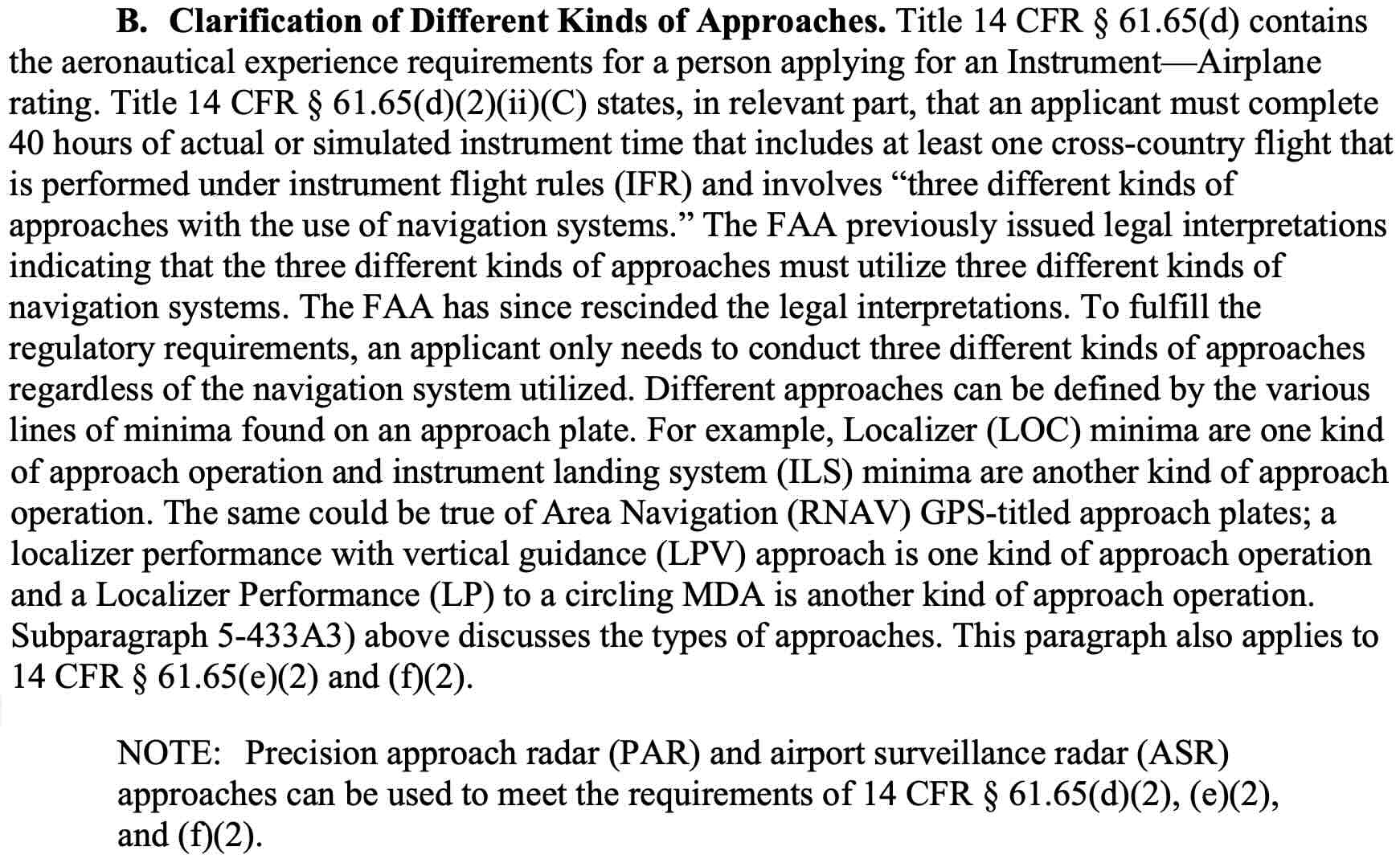
In order to satisfy the requirements of the 250 nm cross country flight above, 14 CFR §61.65(d)(2)(ii)(C) specifies the flight must involve three different types of approaches. Order 8900.1A, which provides additional guidance and is available in the Dynamic Regulatory System (DRS) here provides clarity as to what is meant by different in this context in 5-434 B.
Privileges and Limitations
- Flight under IFR or in weather less than VFR
- 14 CFR §61.3(e) Instrument rating
- "No person may act as pilot in command of a civil aircraft under IFR or in weather conditions less than the minimums prescribed for VFR flight unless that person holds ... instrument rating on that person's pilot certificate."
- Goodish 2008 letter states that even filing an IFR flight plan, even without planning to actually accept an IFR clearance in association with the flight plan, is intent to violate 14 CFR §61.3(e)
- 14 CFR §61.3(e) Instrument rating
- Flight in Class A airspace
- 14 CFR §91.135 Operations in Class A airspace
- "Each person operating an aircraft in Class A airspace must conduct that operation under instrument flight rules (IFR)."
- 14 CFR §91.135 Operations in Class A airspace
- Special VFR at night
- Technically it is between sunset and sunrise
- 14 CFR §91.157(b)(4)
- "The person being granted the ATC clearance meets the applicable requirements for instrument flight under part 61 of this chapter."
Adding Instrument Rating to Commercial Pilot Certificate
- Passengers for hire on cross countries longer than 50 nm or at night
- 14 CFR §61.133(b)(1) Commercial pilot privileges and limitations
- "The carriage of passengers for hire in airplanes on cross-country flights in excess of 50 nautical miles or at night is prohibited."
- 14 CFR §61.133(b)(1) Commercial pilot privileges and limitations
14 CFR §91.173
- 14 CFR §61.3(e) states that a pilot needs an instrument rating to operate in weather conditions less than VFR.
- 14 CFR §91.173 says that (and let's assume the pilot is instrument rated and therefor satisfies 14 CFR §61.3(e)) that the pilot only needs to be on an IFR flight plan and receive clearance in controlled airspace.
- Operations in uncontrolled airspace under IMC without a clearance or instrument rating may violate 14 CFR §91.13 Careless or reckless operation
- See FAA vs Murphy
- See Lamb 2016 letter
Currency Requirements
Basic Currency Requirements
- 14 CFR §61.56 - Flight Review
- 14 CFR §61.57 - Recent flight experience: Pilot in command
- To act as PIC
- Flight review within previous 24 calendar months
- 1 hour flight and 1 hour ground training
- Review of Part 91
- Demonstrate safe exercise of pilot certificate
- 1 hour flight and 1 hour ground training
- Checkride counts as flight review
- Flight review within previous 24 calendar months
- To carry persons
- 3 takeoffs/landings within the preceding 90 days
- Same category, class, and type
- Full stop if in tailwheel
- 3 takeoffs/landings within the preceding 90 days
- To carry persons at night (1 hour after sunset and ending 1 hour before sunrise)
- 3 takeoffs/landings within the preceding 90 days
- Same category, class, and type
- Full stop
- 3 takeoffs/landings within the preceding 90 days
- See Kortokrax 2006 which was later rescinded and the Federal Register here.
- Basically, with this change, a non-current pilot can act as PIC with an instructor on board, only for the purposes of regaining currency.
- The update that brought the change from passengers to persons also brought a change to the definition of passenger to clarify that persons providing or receiving flight training are not passengers.
Instrument Currency Requirements
- To act as PIC under IFR or less than VFR weather minimums
- Use 66 HIT to remember instrument currency requirements
- 6 Approaches within
- 6 months including
- Holding
- Procedures and tasks
- Intercepting
- Tracking
- Courses through the use of navigational electronic systems
- 14 CFR §61.57(c) Instrument experience
- Per aircraft category
- e.g. airplane, helicopter
- After instrument currency lapses there is a 6 month "grace period" during which you are not instrument current, but can still complete the above to become curent.
- After that need to complete an IPC
- 14 CFR §61.57(d) Instrument proficiency check
- Note: can file IFR flight plan, but cannot accept the clearance and go IFR even if weather is VMC
- If instrument currency lapses, need IPC
- Use 66 HIT to remember instrument currency requirements
Logging Instrument Time
- Logging instrument time
- 14 CFR 61.51(g)
- CFII can log time in IMC as instrument time
- CFII logs any time they are giving instruction as PIC
- Safety pilot
- Needs to be rated in same category and class
- Instrument Proficiency Check
Logging approaches
- When can a pilot log an instrument approach in IMC? When under foggles?
- Actual IMC in an airplane past FAF
- Simulated IMC all the way down to minimums
- When can a CFII log an instrument approach?
- A flight instructor may log an IAP conducted by the student in actual IMC
- INFO 15012 - Logging Instrument Approach Procedures (IAP)
Logging Simulator Time
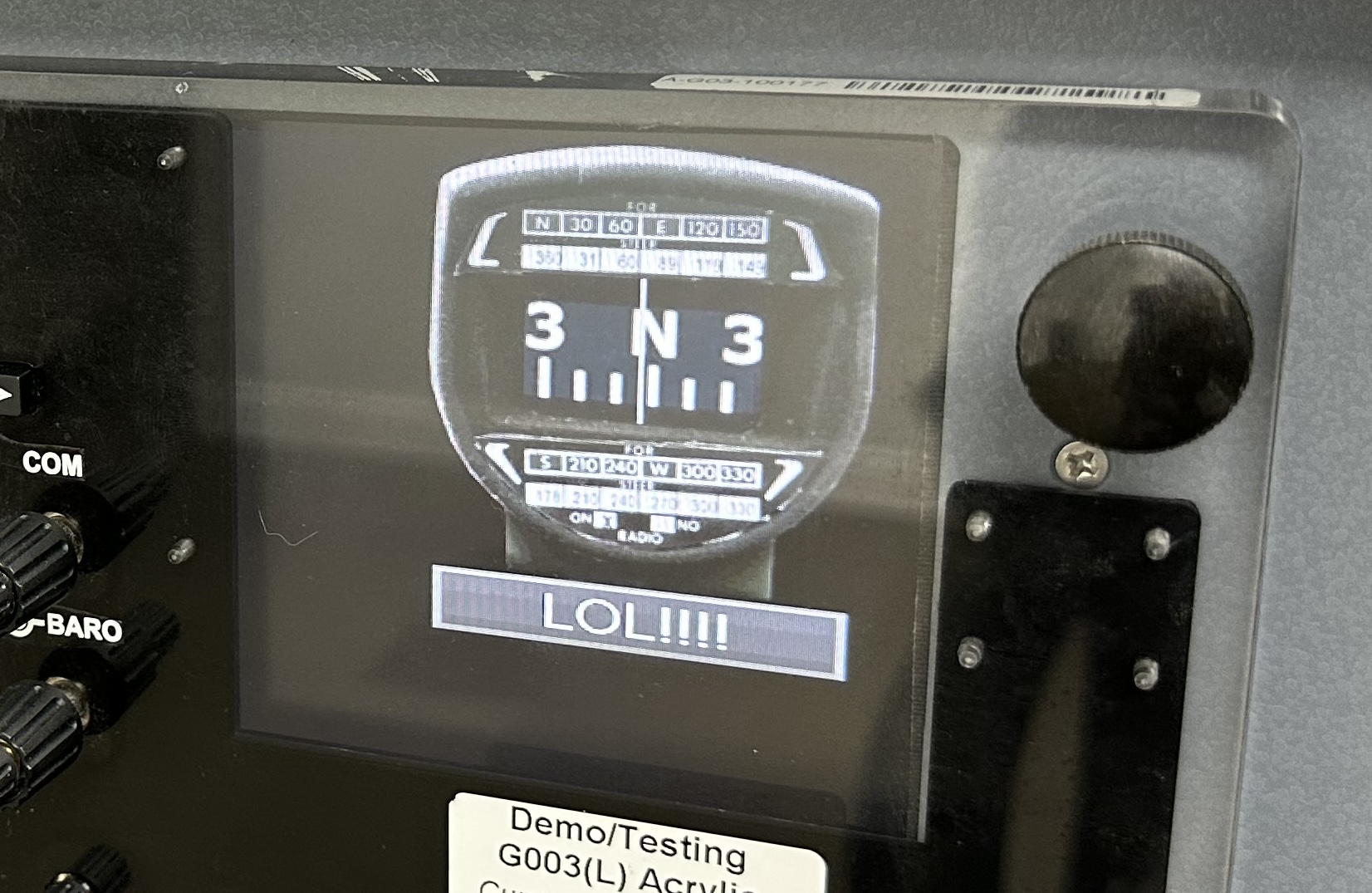
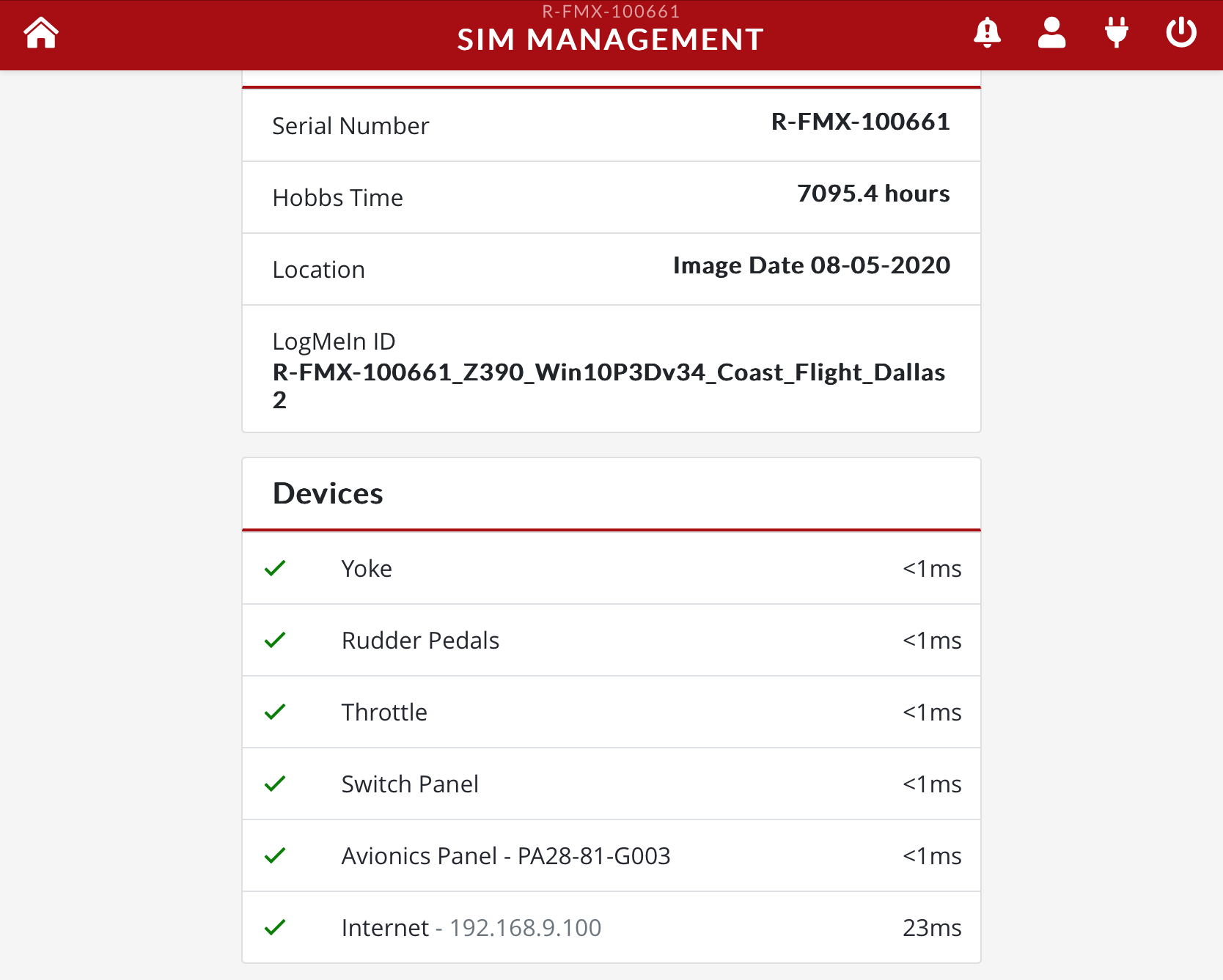
- To satisfy logging the "type and identification" requirement when logging simulator time in Redbird AATD, the tail number does not satisfy the identification requirement as it is a user-configurable field that can be changed
- Use the serial number
- Log the type of aircraft the simulator represents
- Consider logging the avionics package used as well
- 14 CFR §61.51(b)(1)(iv)
Logbook Entries or Training Records for Instrument Flight / Instruction
- 14 CFR §61.51 Pilot logbooks requires pilots to log training time and aeronautical experience used to meet the requirements for an instrument rating and the recent flight experience required by 14 CFR §61.57 Recent flight experience: Pilot in command
- Instrument flight time (simulated or actual) can be logged when the pilot operates aircraft solely by reference to instruments
- CFII can log PIC time regardless of meteorological conditions when acting as as instructor
Safety Pilot Regulations
In the discussion around the use of a safety pilot a key question that must be answered prior to initiating the flight is: who is the acting PIC for the flight. The safety pilot can (under certain conditions) act as the PIC, or the pilot under the foggles may be PIC. In any case, when a safety pilot is used in VMC, they are a required crew member. The following bullets are true regardless of the designation of acting PIC.
- A safety pilot is required when flying under foggles.
- The safety pilot must be at least a private pilot with appropriate category and class rating.
- Regardless whether or not the safety pilot is acting PIC they do need a medical to serve as a required crewmember.
- 14 CFR §61.3(c)(1)
- 14 CFR §61.23(a)(3)(ii)
- BasicMed works
- TODO@dwiese - INSERT CITATION HERE
- The pilot under the foggles gets to log PIC time when they are the sole manipulator of the flight controls.
- 14 CFR §61.51(e)(i)
- This assumes the pilot under the foggles is rated in the aircraft being flow.
There are some additional regulations in 14 CFR §91.109 that are probably less likely, but may be encountered in real life, for example requirements around dual controls.
Sole Manipulator of the Flight Controls
Before moving on to designation of the acting PIC, it's important to be clear on the following:
- The sole manipulator of the flight controls can log PIC time, whether they are instrument rated or not and regardless of weather conditions.
- So this is the only requirement in order to log approaches and other procedures towards currency.
Designating the Acting PIC
Now we look at how requirements change depending on who is the acting PIC.
Safety Pilot is Acting PIC
If the safety pilot is acting PIC then:
- Safety pilot needs a current flight review to act as PIC.
- The safety pilot needs complex / high performance endorsements as appropriate to act as PIC.
- The safety pilot gets to log PIC time when they other pilot is under the foggles or if the safety pilot is manipulating the flight controls.
Pilot Under Foggles is the Acting PIC
- The safety pilot can log SIC time as a required crewmember.
Flight in Actual IMC
- Whoever is the acting PIC must be instrument rated.
- Whoever is the acting PIC must be instrument current.
- Whoever is the sole manipulator of the flight controls can log PIC time.
- Both pilots are not required under IMC, so there is no provision for both pilots to log; only the sole manipulator of the flight controls can log that time as PIC.
Discussion
The question as to whether the safety pilot can legally act as PIC is an important one with real consequences. There may be limitations (e.g. insurance or rental agreements) that prevent the safety pilot from acting as PIC.
14 CFR §1.1 - Pilot in command
Has been designated as pilot in command before or during the flight
So pilot-in-command designation can change during the flight, but this should be briefed so there is zero ambiguity about who is acting PIC at any point in the flight.
While a pilot can log PIC time and approaches in actual IMC with an instrument rated pilot who is acting PIC, this doesn't mean this is a good idea.
- Regardless of the above, if instrument currency is lost and the so-called "grace period" is past, an IPC is required.
More Information
- Glenn 2009
- Gebhart 2009
- Creech 2013
- Hicks 1993
- Rizner 1991
- Beaty 2013
- Walker 2011 Legal Interpretation
- Speranza 2009 Legal Interpretation
IFR Required Equipment
- 14 CFR §91.205(d)
- GRABCARDD
- G - Generator
- Or alternator
- R - Radios
- Comm and navigation suitable for the route to be flown
- A - Altimeter
- Adjustable
- B - Ball
- Inclinometer, slip/skid indicator
- C - Clock
- With seconds
- A - Attitude indicator
- R - Rate of turn indicator
- D - Directional gyro
- Heading indicator
- D - DME or RNAV
- At FL240 and higher if VOR is required
- G - Generator
Relevant Publications
Instrument Flying Handbook
Aeronautical Information Manual
- The Aeronautical Information Manual (AIM) is the official guide to basic flight information and ATC procedures for the aviation community flying in the NAS of the United States.
- Aeronautical Information Manual
Test / Certification Standards
- Practical Test Standards (PTS)
- Older version of testing standards.
- The PTS primarily provides metrics to define acceptable performance of the "flight proficiency" skills listed in 14 CFR part 61 for a given certificate or rating.
- Airman Certification Standards (ACS)
- The ACS is an enhanced version of the Practical Test Standards (PTS) that started replacing the PTS in 2016, and will eventually replace all PTS.
- It adds task-specific knowledge and risk management elements to each PTS Area of Operation and Task.
- The result is a comprehensive presentation that integrates the standards for what an applicant needs to know, consider, and do in order to pass both the knowledge test and the practical test for a certificate or rating.
Airport Facility Directory
- Now the Chart Supplement
- Updated every 56 days
Departure Procedures
- Find Standard Terminal Arrival Routes (STAR) and Departure Procedures (DP) in the Digital Terminal Procedures Publication
- AIM Section 2. Departure Procedures
- Departure Procedures (DP)
- The generic term for any kind of departure procedure
- Then you have two basic types below, with two subtypes (graphical or textual)
- The two basic types are
- Obstacle Departure Procedures (ODP)
- Standard Instrument Departures (SID)
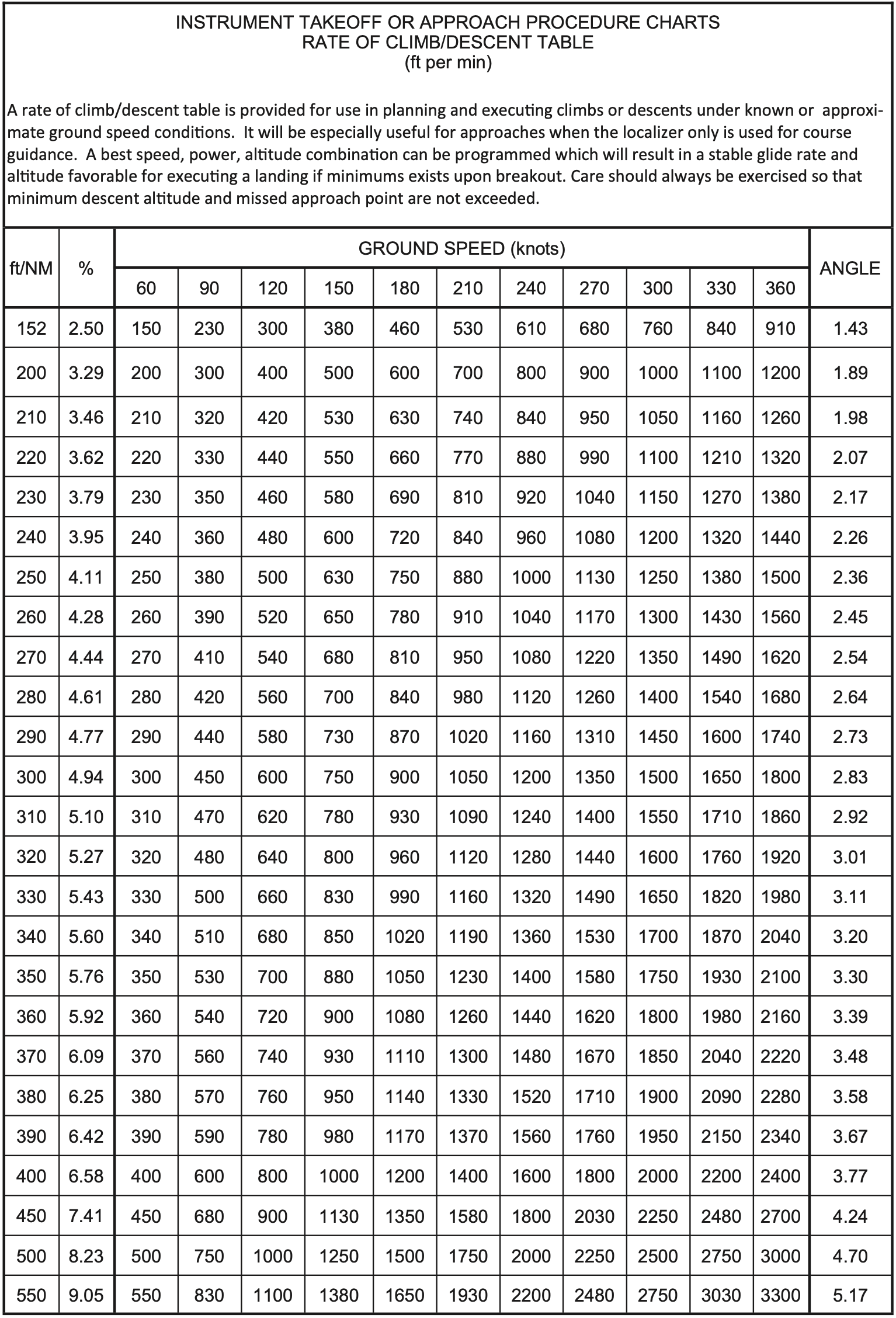
- Departure procedure performance requirements are given in terms of feet per nautical mile.
- To convert those to feet per minute, there is a chart in the back of the Digital Terminal Procedures Publication (d-TPP)/Airport Diagrams
Obstacle Departure Procedures (ODP)
- Purely for obstacle clearance
- Graphical or textual
- ODPs may be flown without clearance
- Generally designed to be available to the largest number of aircraft possible, so they might assume only a VOR receiver and low aircraft performance.
- See
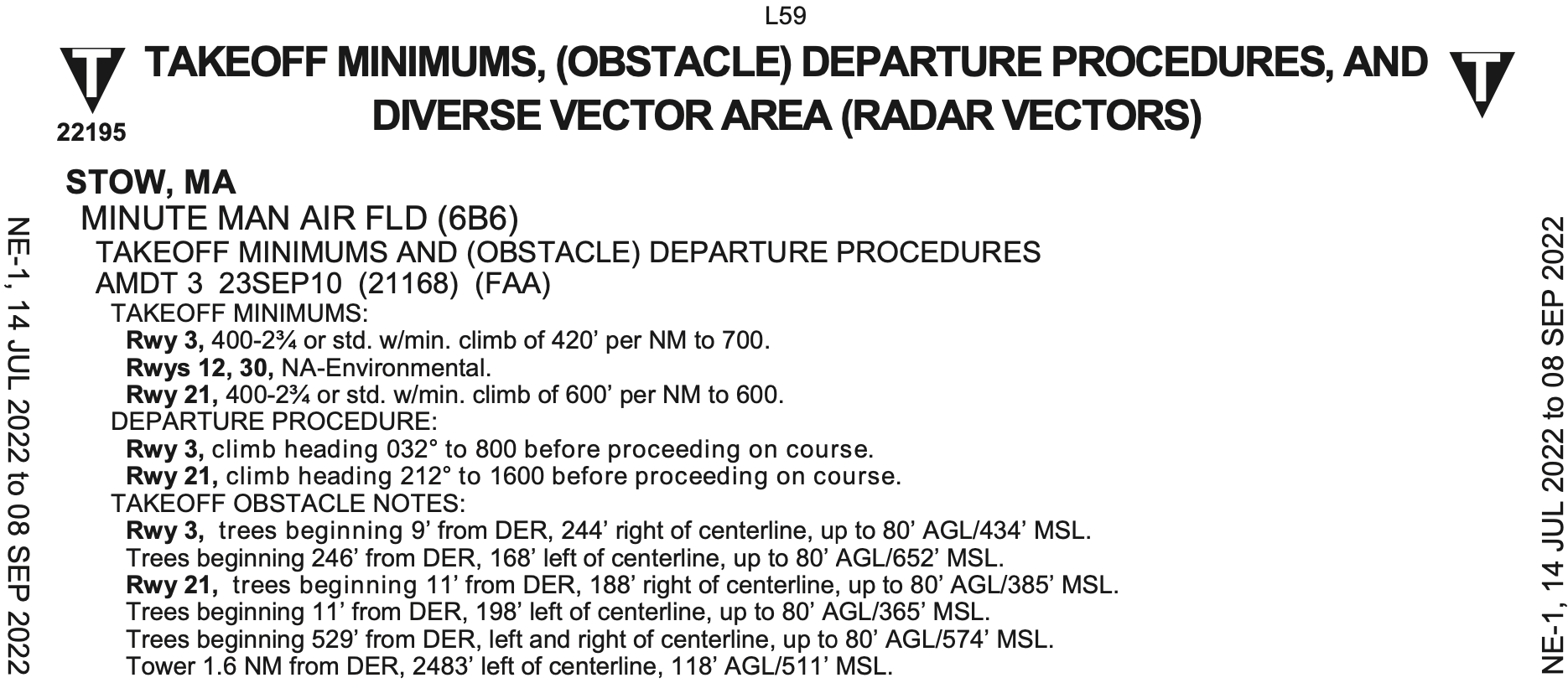
Tin upside down triangle on approach plate for non-standard takeoff minimums or ODP - Textual ODPs
- Those listed in text format in the Takeoff Minimums and Obstacle Departure Procedures section of the Terminal Procedures Publication
- They are usually fairly simple – turn to a heading, intercept a radial, etc.
- Graphical ODPs
- Charted when it would be too complicated to describe them textually
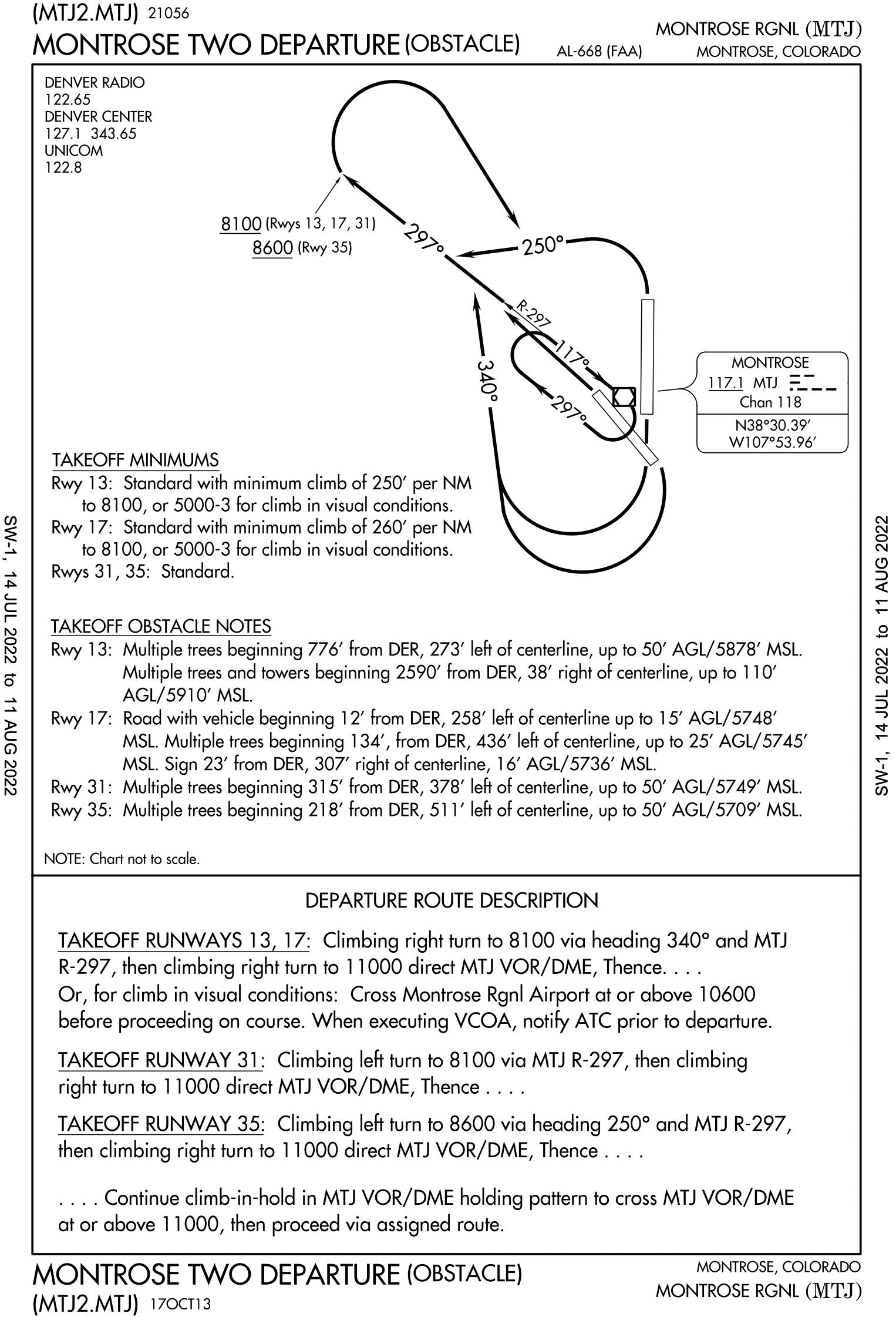
- They include the word (OBSTACLE) in the name, such as the
MONTROSE DEPARTURE (OBSTACLE)out ofKMTJ. - Note the rather tortured routing of the
MONTROSE DEPARTURE (OBSTACLE)designed so that low performance airplanes can hopefully still meet the obstacle clearance requirements.
- Don't need to even fly ODPs, but ATC assumes you will and there's no reason not to
- Climb to 400' AGL before turning
- Must climb at 200' per nm unless otherwise stated
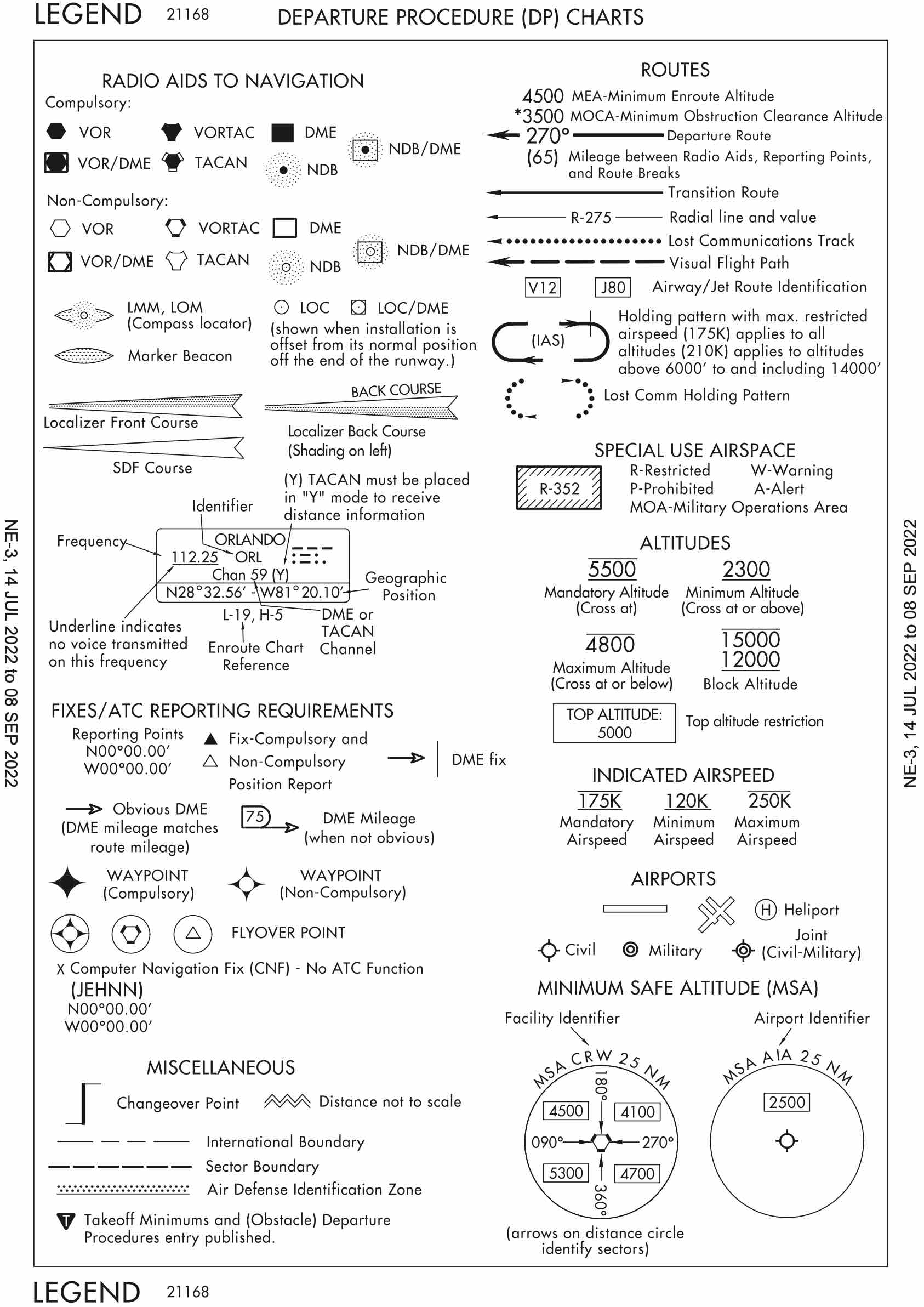
Standard Instrument Departures (SID)
- Exist predominantly for ATC reasons
- Reduces radio traffic and eases traffic flow
- They provide obstacle clearance as well
- Always graphical
- ATC clearance must be received prior to flying a SID
- Given a name, such as the
ARSENAL FIVE DEPARTUREout ofKHEF- This departure is
ARSNL5. - The particular transition is appended to the departure, for example the Martinsburg Transition would be
ARSNL5.MRB.
- This departure is
- The design is based primarily on what is convenient for ATC traffic flow, not whether all airplanes can perform the procedure or not.
- Note they can have some pretty steep climb gradients as well as certain equipment requirements too.
- Climb to 400' AGL before turning
- Must climb at 200' per nm unless otherwise stated
General Departure Notes
- Can decline DP
- If no departure procedure
- Climb to 400' AGL and turn on course
- Must climb at least 200' per nm
- Must be at least 35' AGL at departure end of runway
Takeoff Minimums
- Under Part 91 there are no takeoff minimums except there are performance minimums for the departure you are assigned that you must meet.
- If ATC assigns a departure with performance requirements you cannot meet, you must decline.
- FAA-designated standard minimums for Part 121 and 135
- 1 statute mile (SM) visibility for single- and twin-engine aircraft
- 1⁄2 SM for helicopters and aircraft with more than two engines
- Just because there are no takeoff minimums for Part 91, doesn't mean it's a good idea to take off in zero-zero weather
Arrival Procedures
- Arrival procedures transition the instrument pilot from the en route structure to a fix in the terminal area from which an instrument approach can be conducted
- FAA-H-8083-15B Instrument Flying Handbook
- Chapter 10: IFR Flight
- Page 10-9: Standard Terminal Arrival Routes (STARs)
- Chapter 10: IFR Flight
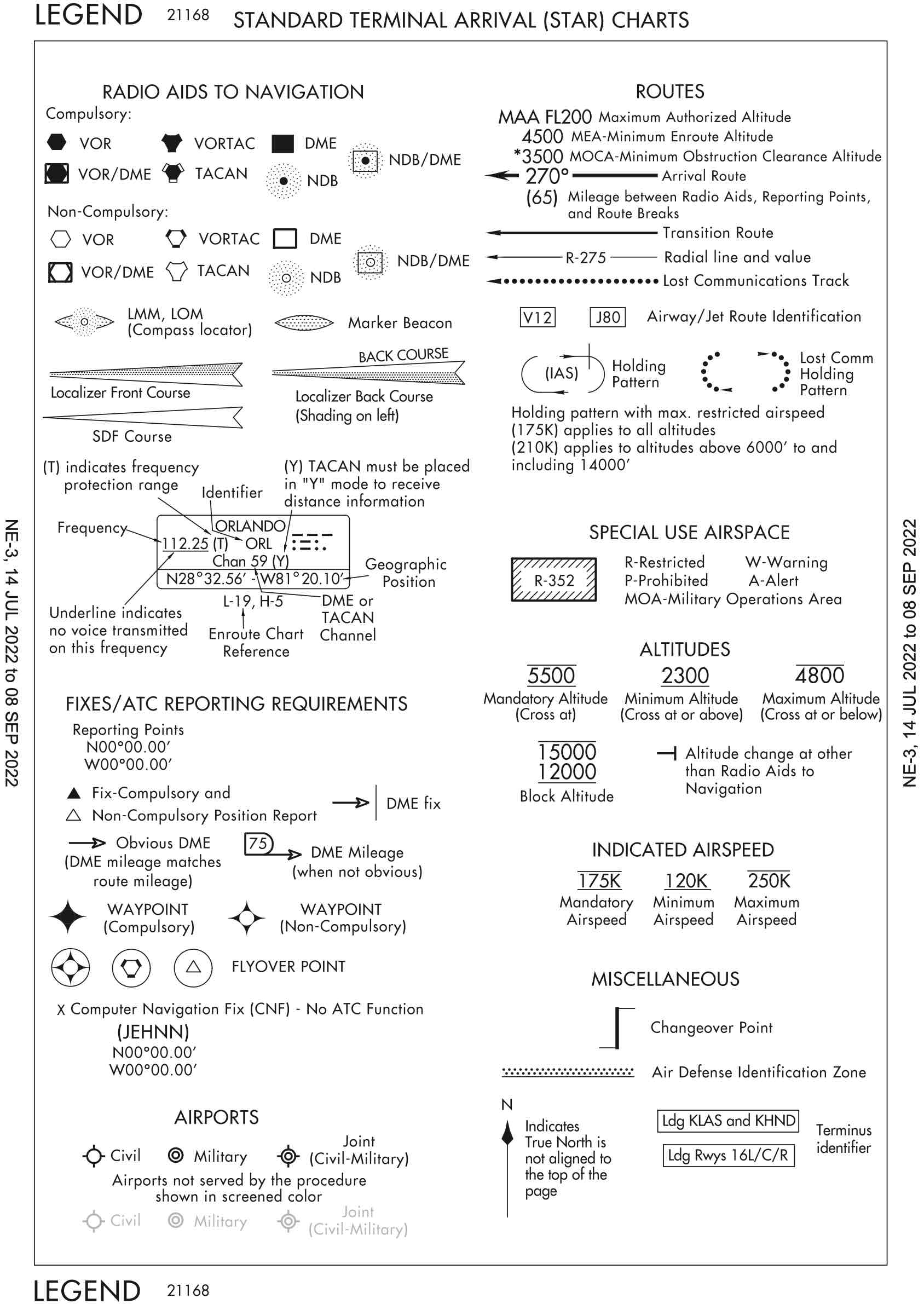
Standard Terminal Arrival (STAR)
- "Fly" vs. "Descend via" the arrival
- FAA Climb Via/Descend Via Speed Clearances Frequently Asked Questions
- Descend via
- Comply with the lateral path of the STAR
- Comply with all published speed restrictions
- Comply with all published altitude restrictions
- "Descend via" means we can descend to the lowest altitude restriction on the STAR
- So if a given waypoint has, for example, a restriction to cross at or above 10,000', then that is the lowest we can descend until cleared lower
- Can only descend lower with clearance to do so, or if cleared for an approach
- Being told to expect a particular runway or approach is not sufficient to descend lower
- Similar rules apply for "Climb Via" with respect to a SID
Terminal Arrival Areas (TAA)
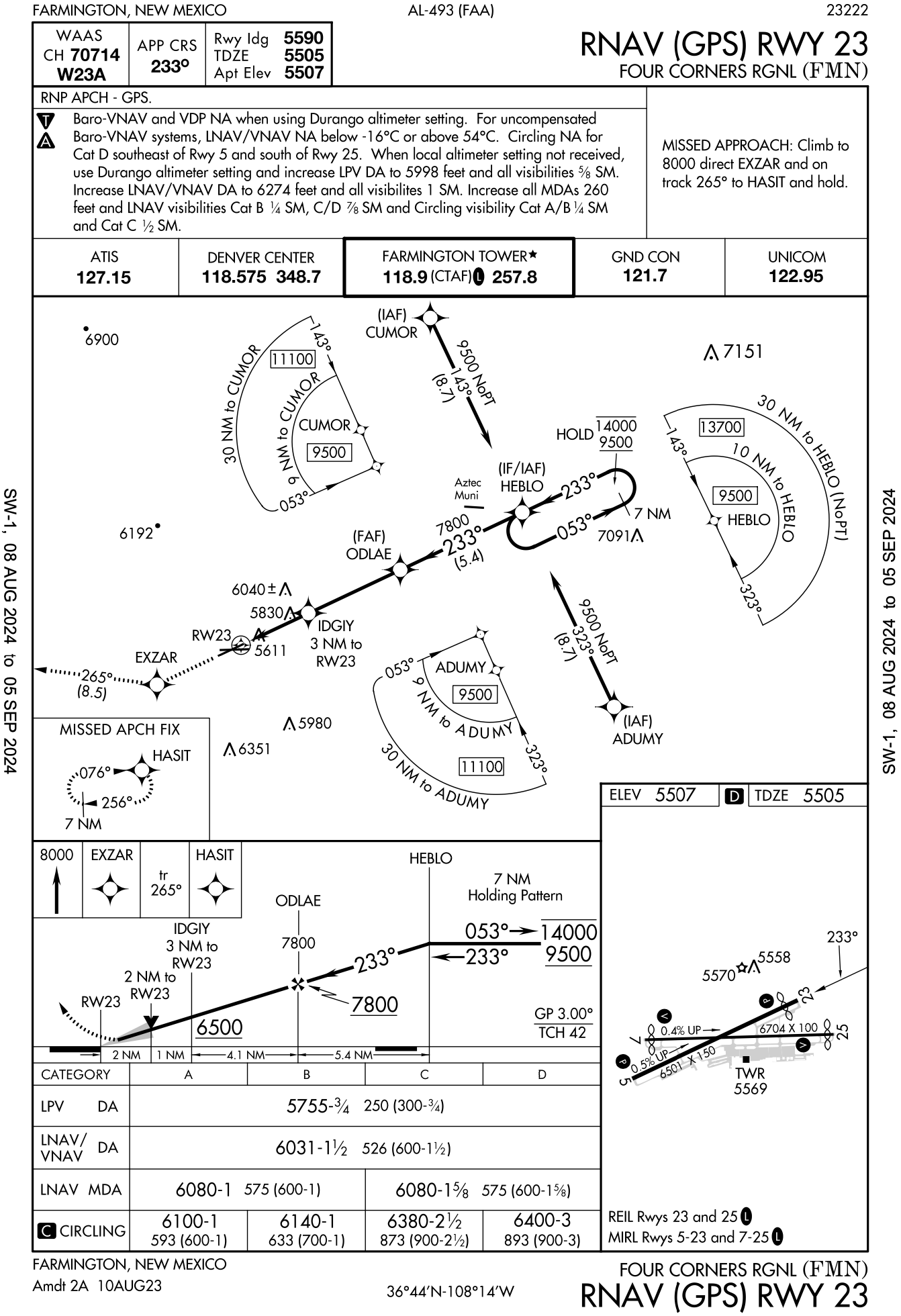
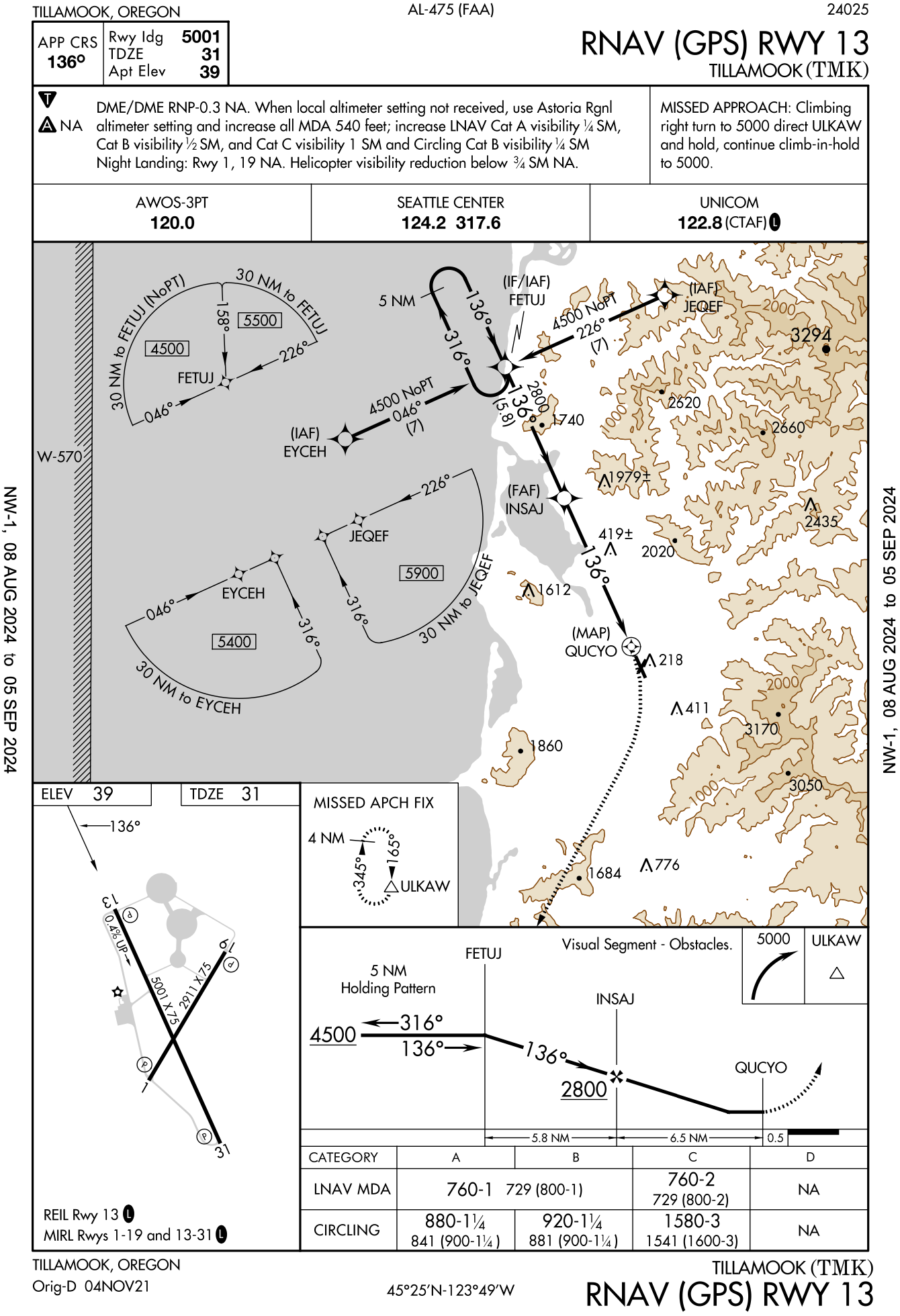
- AIM 5-4-5(d)
- The TAA provides a transition from the en route structure to the terminal environment with little required pilot/air traffic control interface for aircraft equipped with Area Navigation (RNAV) systems.
- Basic RNAV approach procedure underlying TAA is the "T" structure
- 30 nm radius around each of the IAFs
- An aircraft inside a TAA is established on a published segment of an approach
- Obey minimum altitudes when in the TAA and cleared for the approach
- TAAs provide a structure to help understand how the approach will commence, including which IAF it will start from, whether the hold-in-lieu of procedure turn is needed, and what altitude to fly, but this should all be depicted anyhow via e.g. NoPT, and controller communication as to which fix the pilot is cleared to and at what altitude. If in doubt, confirm with ATC.
- BruceAir: Terminal Arrival Areas (TAA)
IFR En Route Charts
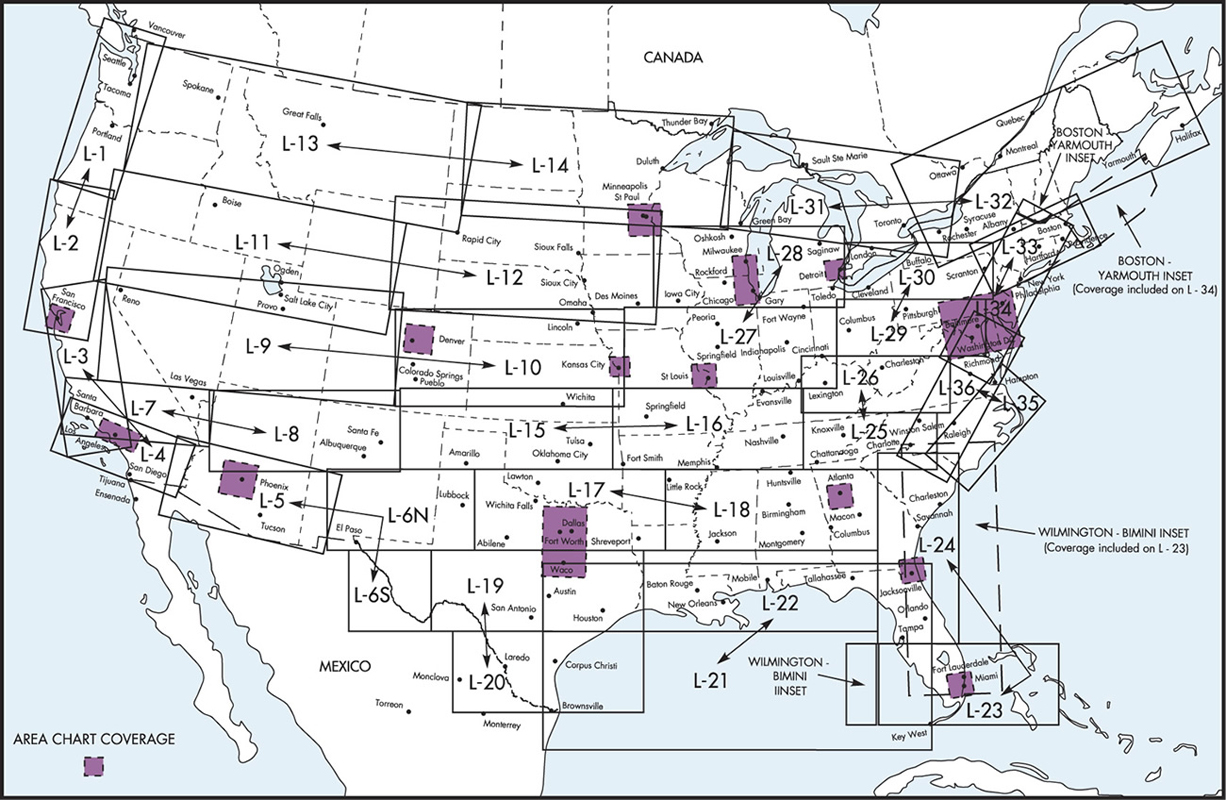
- See the FAA document Aeronautical Chart Users' Guide IFR Enroute Charts for descriptions of terms and symbols used on IFR enroute charts.
- Updated every 56 days
- IFR low chart is used under 18,000 ft.
- Victor airways - from 1200 AGL up to but not including FL 180
- T-Routes - like victor airways but for GPS navigation on IFR low charts
- Can use T-Routes with a suitable GPS
- On IFR high charts these are Q-Routes
- AIP ENR 3.3 Area Navigation (RNAV) Routes
- AIM Chapter 1 Section 2 Performance-Based Navigation (PBN) and Area Navigation (RNAV)
- Magnetic Reference Bearing (MRB)
- Published magnetic bearing between two waypoints on an RNAV/GPS/GNSS route
- Used to enhance situational awareness by associating magnetic course with GPS leg to check against compass
- Blue or green airports on IFR chart have instrument approach procedure (IAP) and/or radar minima, where this is related to ASR or PAR (radar) approaches
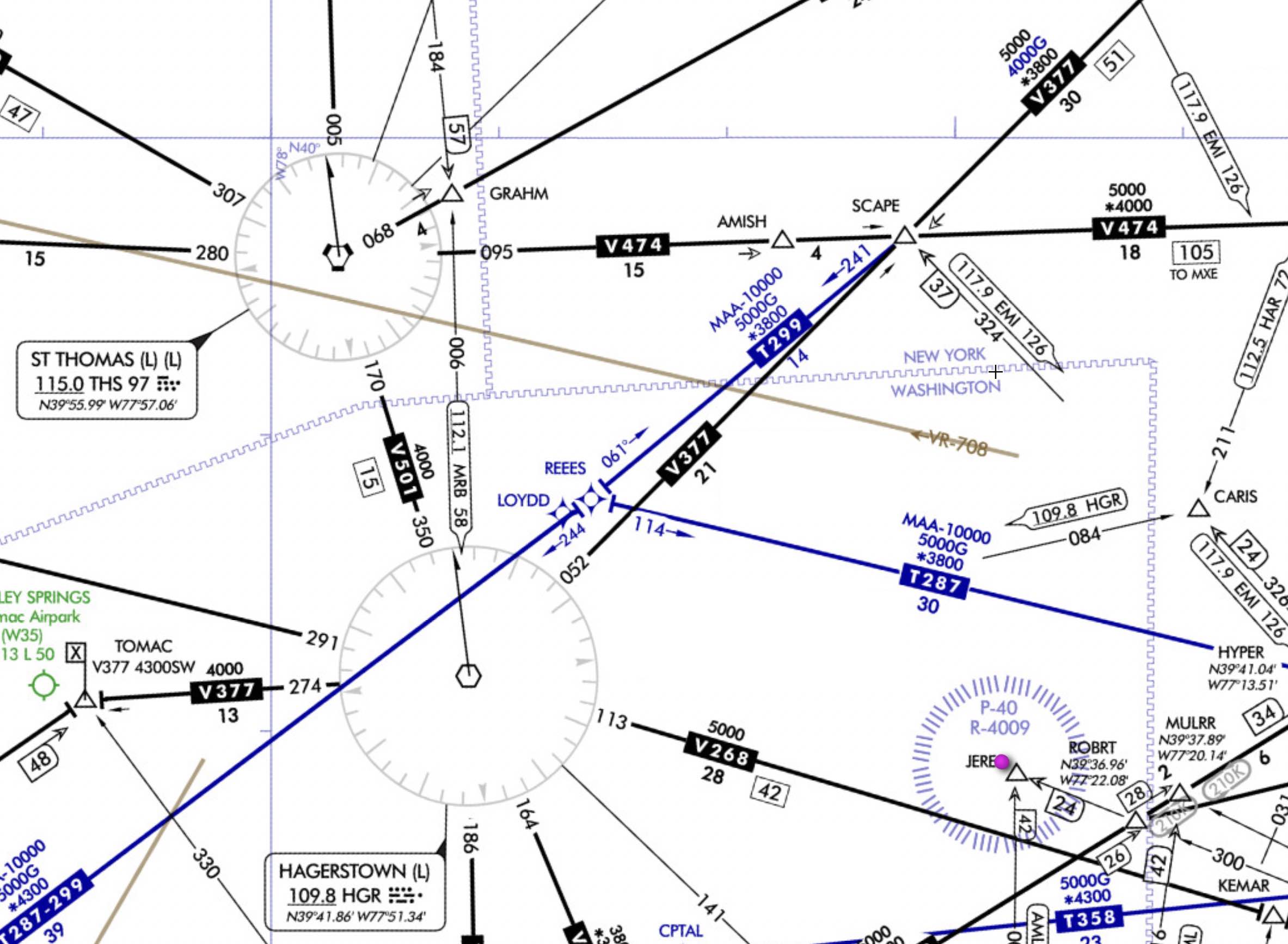
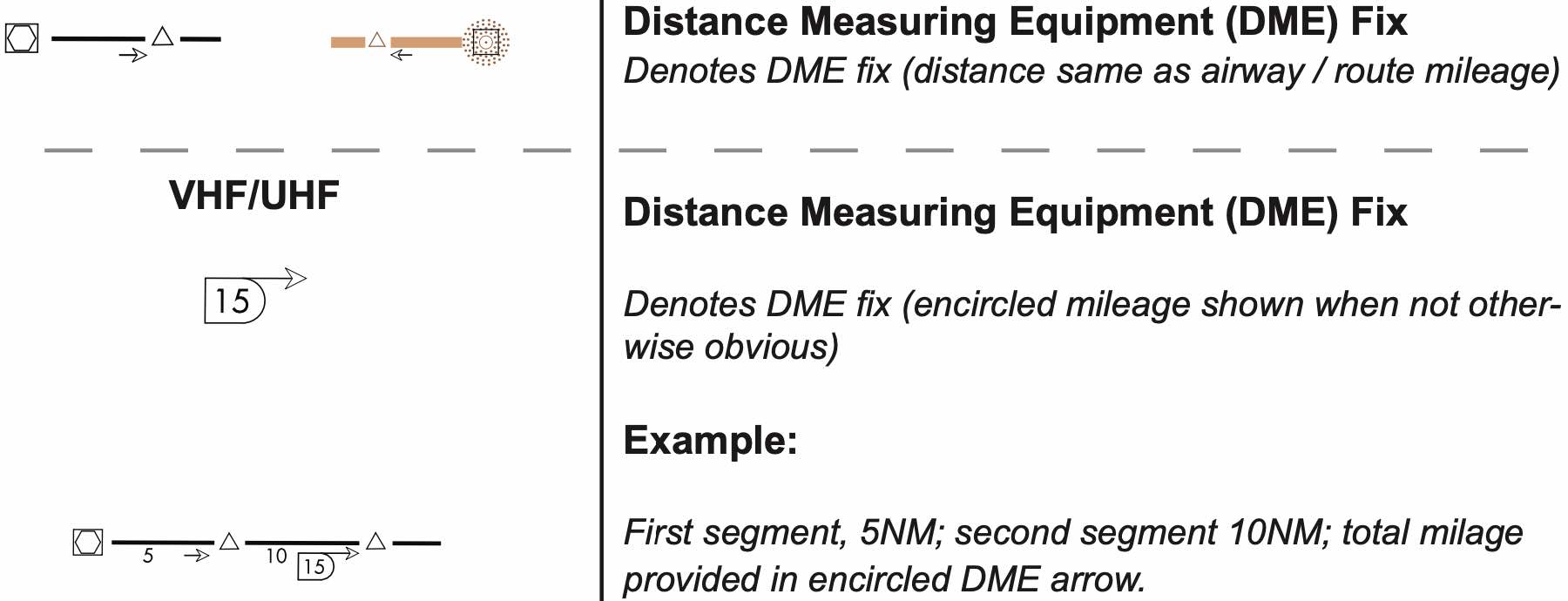
DME Distance Arrows on Low Enroute Chart

IFR Altitudes
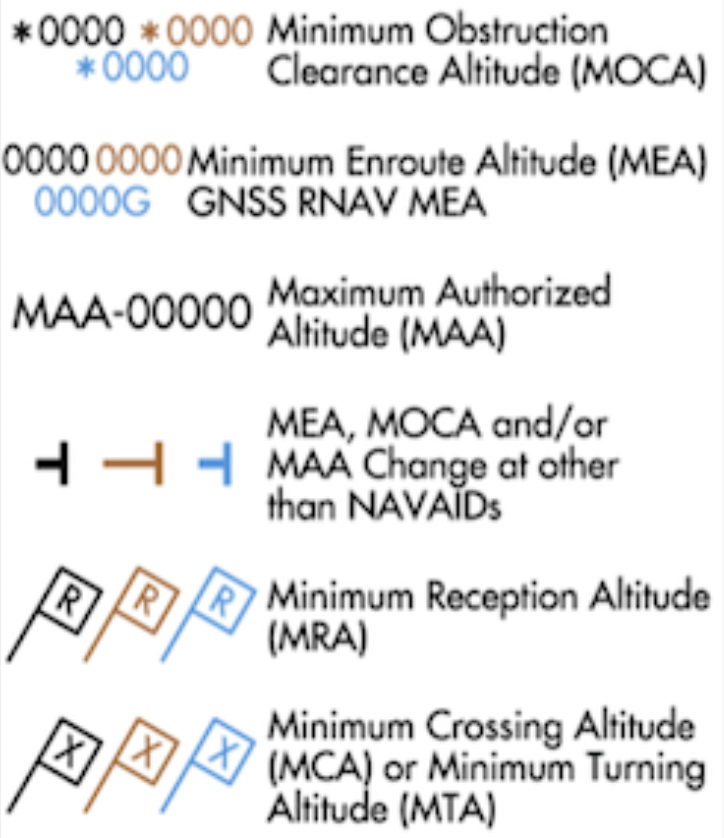
- Minimum Enroute Altitude (MEA)
- Ensures acceptable nav signal coverage and meets obstacle clearance requirements
- 1,000' in non-mountainous areas, 2,000' in mountainous areas
- Ensures radio communication
- Does not guarantee radar coverage
- Ensures acceptable nav signal coverage and meets obstacle clearance requirements
- Minimum Obstruction Clearance Altitude (MOCA)
- Meets obstacle clearance requirements
- Ensure acceptable navigation signal only within 22 nm of VOR
- Only published when it is lower than the MEA
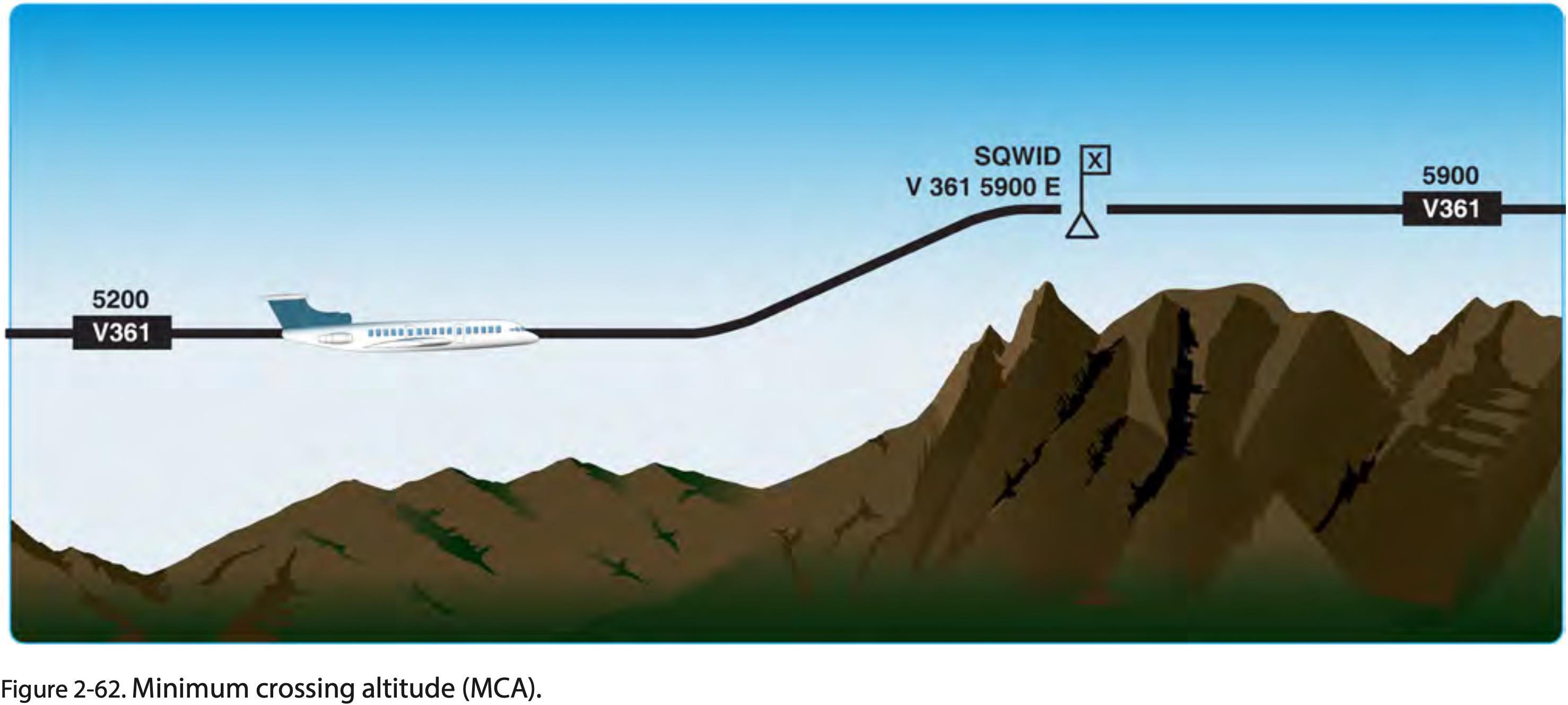
- Minimum Crossing Altitude (MCA)
- Lowest altitude at crossing point when going to a higher MEA, indicated on chart by flag with x.
- Minimum Reception Altitude (MRA)
- Lowest altitude at which an intersection can be determined.
- Maximum Authorized Altitude (MAA)
- Maximum altitude that ensures adequate reception of navigation aid signals.
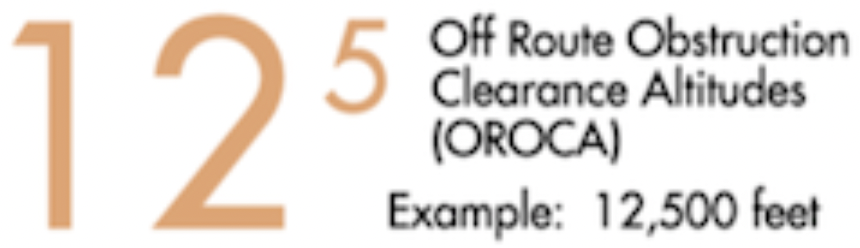
- Off-Route Obstruction Clearance Altitude (OROCA)
- OROCA is computed just as the Maximum Elevation Figure (MEF) found on Visual Flight Rule (VFR) Charts except that it provides an additional vertical buffer of 1,000 feet in designated non-mountainous areas and a 2,000 foot vertical buffer in designated mountainous areas within the United States.
- Does not guarantee nav aid or radio reception.
- Minimum Turning Altitude (MTA)
- Minimum turning altitude (MTA) is a charted altitude providing vertical and lateral obstruction clearance based on turn criteria over certain fixes, NAVAIDs, waypoints, and on charted route segments.
- Minimum Vectoring Altitude (MVA)
- This altitude is not published, but something ATC has (and can be requested if you want to know)
- Lowest altitude a controller can issue a clearance for
- For example, if would like vectors for a visual approach, this is the lowest altitude they can clear you too, so if it's not below the ceiling won't work for visual approach
- Provides 1,000 feet of clearance above the highest obstacle in non-mountainous areas and 2,000 feet above the highest obstacle in designated mountainous areas
- Maximum Elevation Figure (MEF)
- On VFR charts.
- Minimum IFR Altitude (MIA)
- In designated mountainous areas, 2,000 feet above the highest obstacle within a horizontal distance of 4 NM from the course to be flown
- Other than mountainous areas, 1,000 feet above the highest obstacle within a horizontal distance of 4 NM from the course to be flown
- Or as otherwise authorized by the Administrator or assigned by ATC
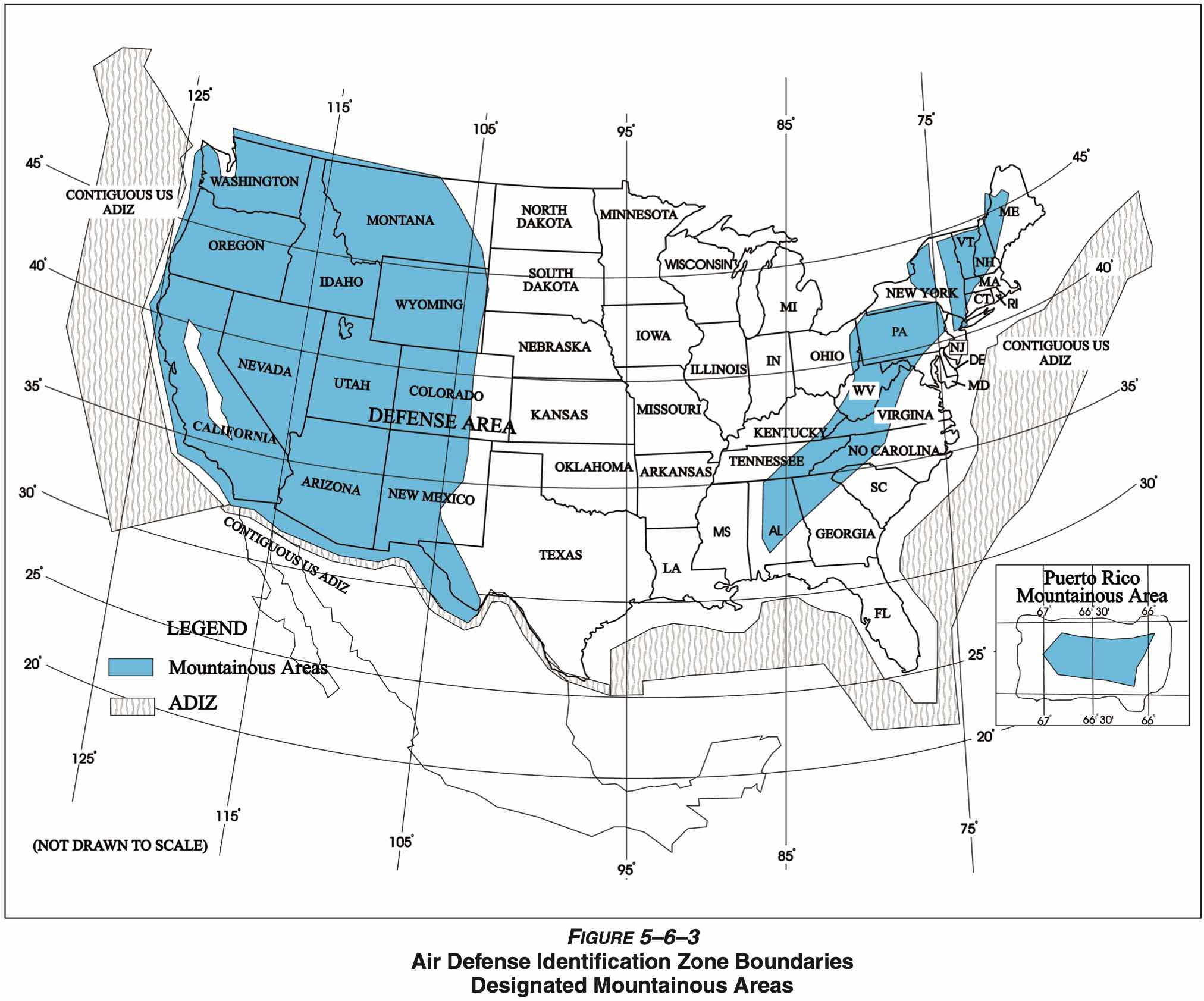
- Mountainous areas are defined in 14 §CFR 95.13 Eastern United States Mountainous Area and other parts within 14 §CFR 95 Subpart B Designated Mountainous Areas
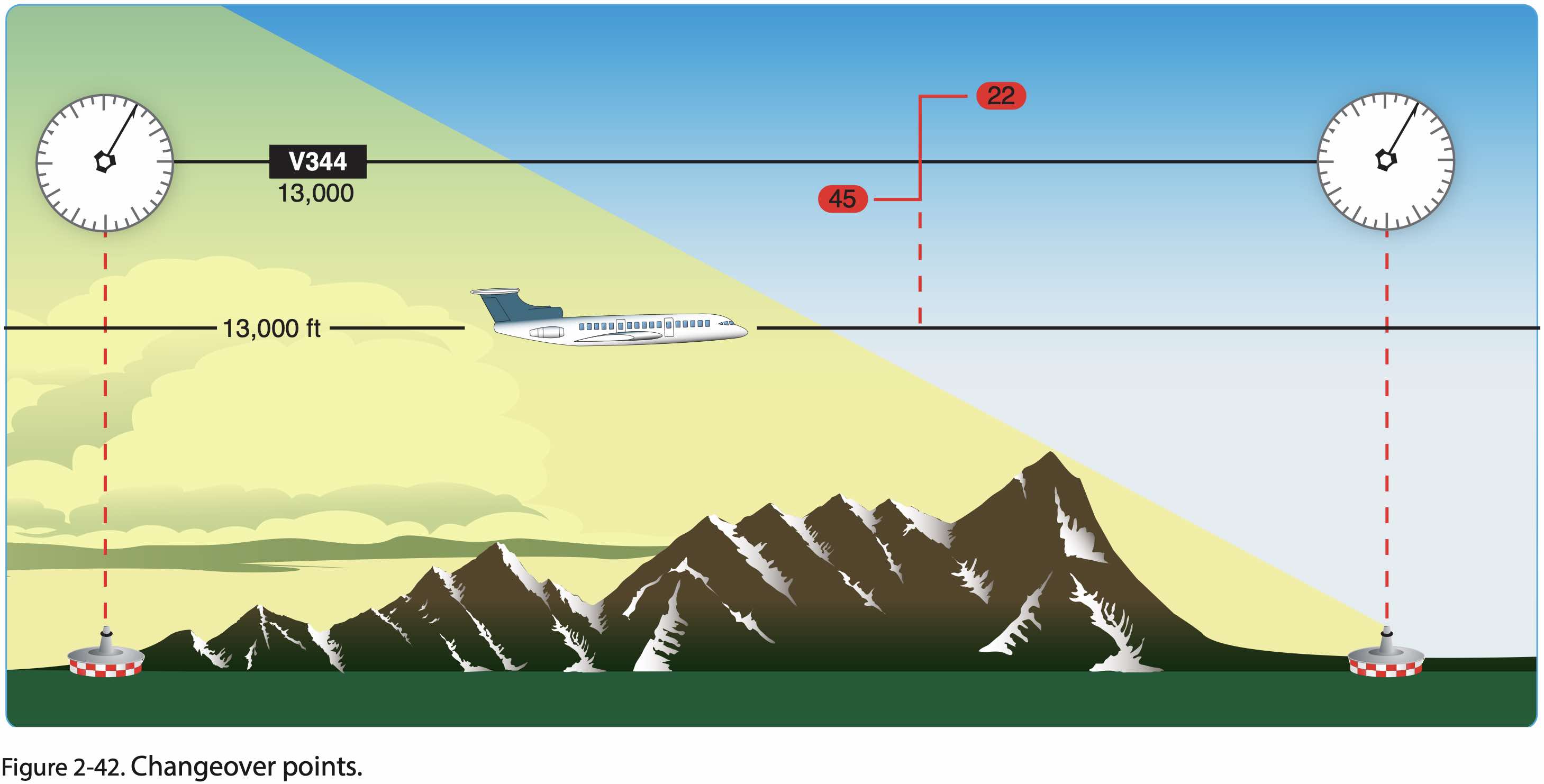
- Changeover point
- When to change from one navaid to another
Mandatory Reporting Points
- Required reports (MARVELOUS VFR C500)
- M - Missed approach
- A - Airspeed
- +/- 10 kts or 5% of filed TAS (whichever greater)
- ATC basically wants to know if we are making a deliberate power change
- R - Reaching a holding fix
- Time and altitude
- Crossing the holding fix outbound as part of our entry procedure
- V - VFR on-top altitude changes
- E - ETA change
- Of more than +/- 2 minutes
- In non-radar environment
- L - Leaving a holding fix
- O - Outer marker inbound
- In non-radar environment
- Outer marker indicates final approach fix for non-precision approach
- U - Unforecast weather
- Especially icing, turbulence, wind
- S - Safety of flight
- V - Vacating an altitude or flight level
- F - FAF inbound
- In non-radar environment
- R - Radio or navigation failure
- Report loss of any equipment which may impair safety and/or ability to operate under IFR
- AIM 5-3-3 a.1 (h)
- 14 CFR §91.187
- C - Compulsory reporting points
- In non-radar environment
- 500 - Failure to maintain at least 500 FPM climb or descent
Waypoints
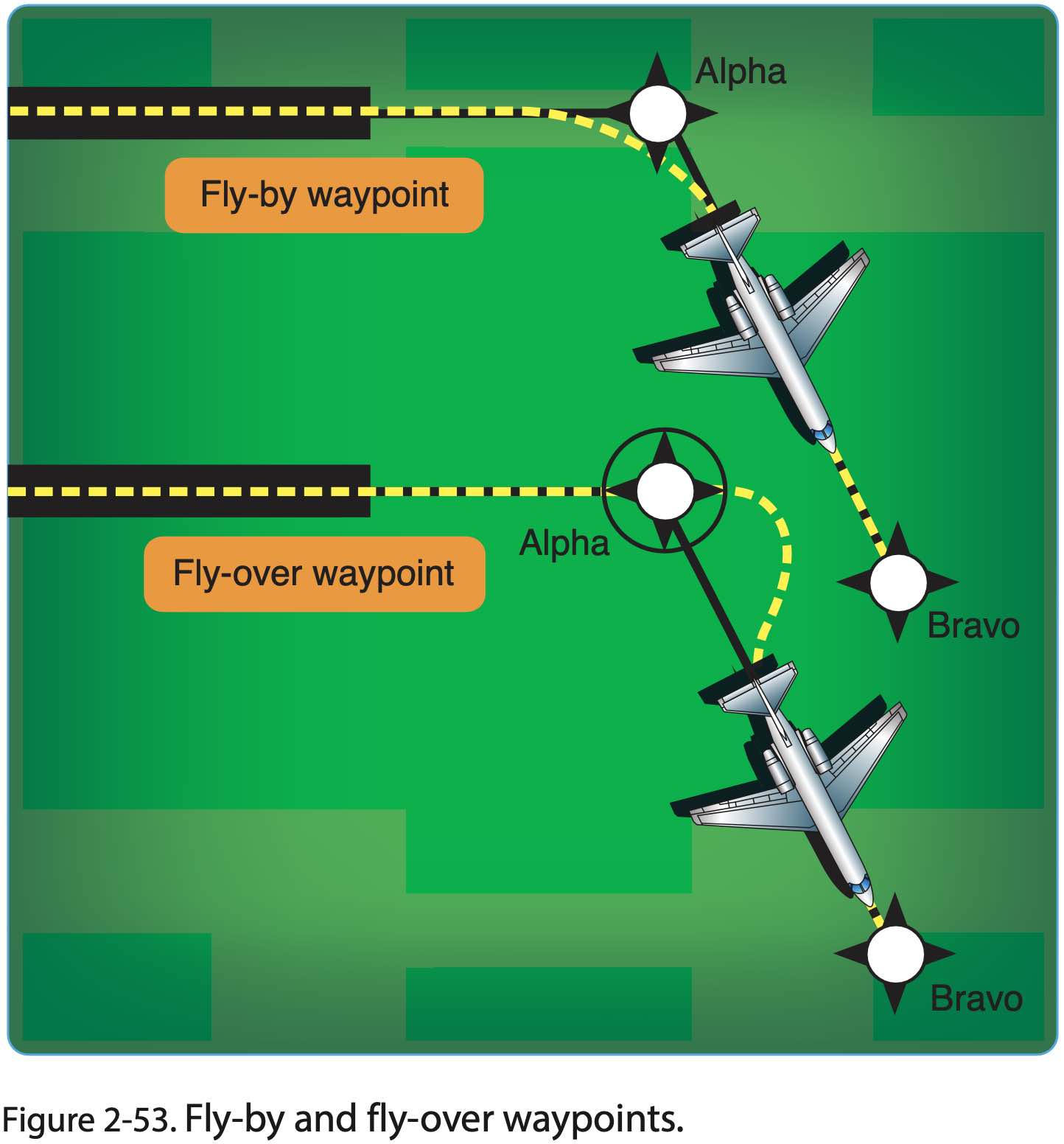
- This is applicable to other portions of IFR flight too, e.g. departure, arrival, and approach
- Flyover vs. flyby waypoints
Standard Instrument Approach Procedure Charts
See Instrument Approach Procedures
References
- FAA-H-8083-15B Instrument Flying Handbook
- Chapter 10: IFR Flight
- Page 10-5: Departure Procedures (DPs)
- Chapter 10: IFR Flight
- 14 CFR §91.175(c) Operation below DA/DH or MDA
- Aeronautical Chart Users' Guide IFR Enroute Charts
- AIM 5–3–8 Holding
- FAA-H-8083-16B Instrument Procedures Handbook
- FAA-AC-61-98E Currency Requirements and Guidance for the Flight Review and Instrument Proficiency Check
- 14 CFR §61.57(d) Instrument proficiency check