Compliance with Clearances
This page covers Task B: Compliance with Departure, En Route, and Arrival Procedures and Clearances from the FAA-S-8081-9E Flight Instructor Instrument Practical Test Standards.
Selection and use of current and appropriate navigation publications
- This is made easier by modern electronic flight bags and apps like Foreflight
- Make sure to always use current publications
- Have access to publications you may need during flight
- Know in which publications to find legends and other information you might need
Pilot and controller responsibilities with regard to DPs, En Route Low and High Altitude Charts, and STARs
See Standard Instrument Departures/Terminal Arrivals
Selection and use of appropriate communications frequencies
- Departure frequency given with CRAFT clearance
- Check frequencies before takeoff
- "No dead frequencies"
Selection and identification of the navigation aids
- Have morse code chart handy if your avionics does not automatically ID the navaid
Accomplishment of the appropriate checklist items
- Follow checklist according to aircraft manufacturer
Pilot's responsibility for compliance with vectors and also altitude, airspeed, climb, descent, and airspace restrictions
- Vectors are headings not course
- Need at least 500 fpm climb
- Level of from descent 100 feet above target altitude to avoid going below
Pilot's responsibility for the interception of courses, radials, and bearings appropriate to the procedure, route, or clearance
- If there is a delay getting FMS set up to adhere to ATC instructions, ask for vectors to buy time
Communication Failure Under IFR
- If the radio fails while VFR, fly VFR and land as soon as practicable
- Squawk 7600
- Unless you decide to declare an emergency, then squawk 7700
- The following rules determine the route and altitude that should be be flown should a radio failure happen in flight and the flight is continued
- If flight needs to be continued IFR after losing communications, the following route should be flown (AVEF)
- A - Assigned
- In last ATC clearance
- V - Vectored
- E - Expected
- From last ATC communication
- F - Filed
- In flight plan
- A - Assigned
- If flight needs to be continued IFR after losing communications, the highest of the following altitude should be flown (MEA) for each route segment
- M - Minimum altitude for IFR operations
- E - Expected
- From last ATC communication
- A - Assigned
- In last ATC clearance
- See 14 CFR §91.185 IFR operations: Two-way radio communications failure
- If radio failure happens and clearance limit is the fix from which approach begins, start descent and approach as close as possible to EFC time, or to arrive at estimated arrival time from flight plan (or amended enroute.)
- If clearance limit is not a fix from which approach begins, leave the clearance limit at EFC time or arrival at the fix if no EFC time, and start approach to begin as close as possible to estimated time of arrival from flight plan (or amended enroute.)
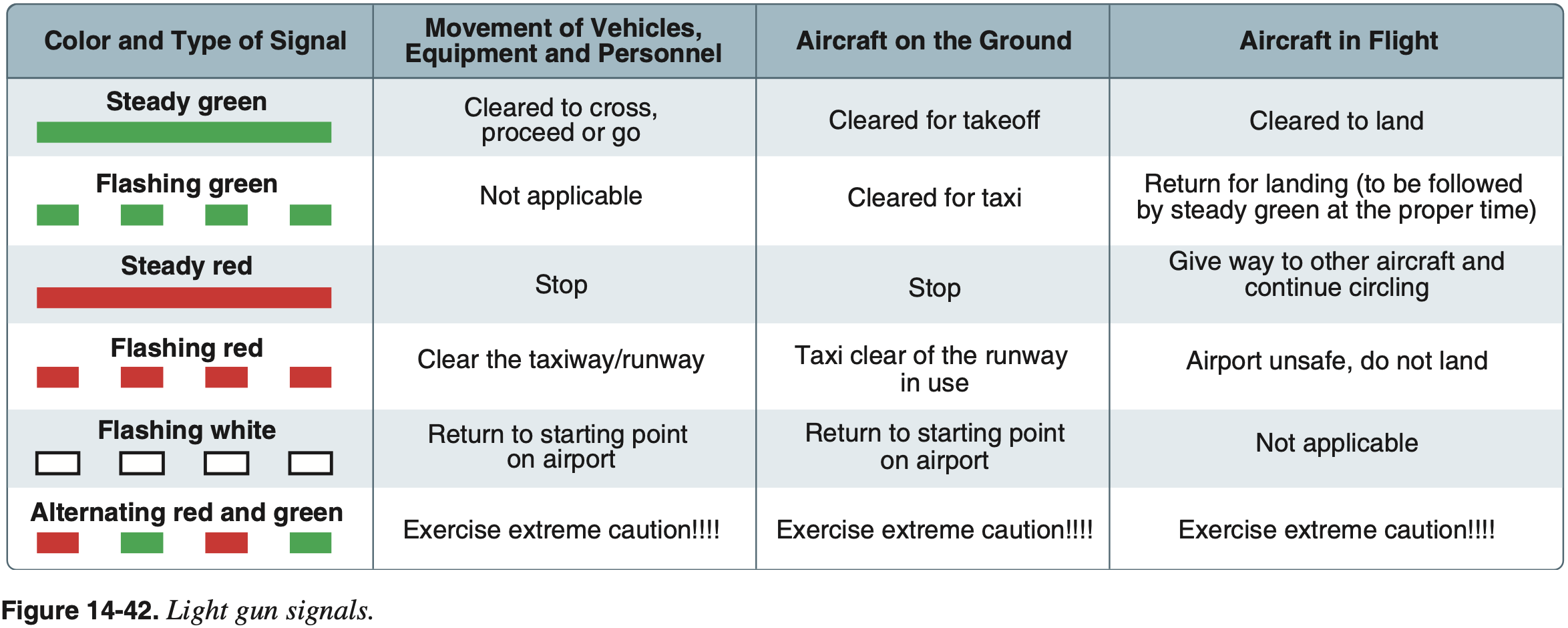
Light Gun Signals
Troubleshooting
- Check frequency
- Check volume
- Try previous frequency
- Try other radio
- Check for TX/RX
- Try other headphone jacks
- Try other PTT
- Try handheld mic
- Try overhead speaker
- Try EMG
- Try other headset
- Otherwise go 7600
References
- FAA-H-8083-15B Instrument Flying Handbook
- Chapter 11: Emergency Operations
- Page 11-8: Communication/Navigation System Malfunction
- Chapter 11: Emergency Operations
The uses of the multifunction display and other graphical navigational displays, if installed, to monitor position track, wind drift, and other parameters to maintain situational awareness and desired flightpath
- Use the MFD and moving map for situational awareness
- In the event of loss of flight instruments, can zoom in on the moving map and magenta line and use that for course guidance