Instrument Cockpit Check
This page covers Task C. Instrument Cockpit Check from the FAA-S-8081-9E Flight Instructor Instrument Practical Test Standards.
Flight Deck Check Overview
- During preflight check all antennas and pitot tube and static ports for blockage
- Check aircraft records
- 24-month pitot-static inspection
- 30-day VOR inspection
- Check NOTAMs for conditions of NAVAIDs to be used in flight
- When turning on the Master switch during preflight, listen to electric gyros as they spin up
- Check pitot heat
- Check lights
Communications Equipment Preflight Check
- Check integrity of antennas during preflight
- Antennas can become damaged due to ice
- Can hear clearly over COM1 and COM2
- Observe TX when depressing PTT
Navigation Equipment Preflight Check
- Two primary systems to check
- GPS
- VOR
- Check system status indication as applicable
- No annunciators
- GPS correctly shows location
- Check databases
- See table in AIM Table 1-1-6
- Databases need not be current, but during enroute you must check each point in the aircraft GPS against a source that is current, e.g. Foreflight and make sure none of the points have changed
- Same with using GPS for approach - need to make sure approach hasn't changed or been amended since your database date, even if your database is out-of-date
- "Verification of correctness"
- Check RAIM
- Will we have adequate satellite coverage
- Check databases
- Review VOR test sheet is within 30 days and in spec
- Date
- Place
- Bearing error
- Signature
Magnetic Compass Preflight Check
- Compass should
- Float freely and turn freely in turns
- Indicate correctly on known headings (e.g. when aligned with runway)
Heading Indicator / Horizontal Situation Indicator / Radio Magnetic Indicator
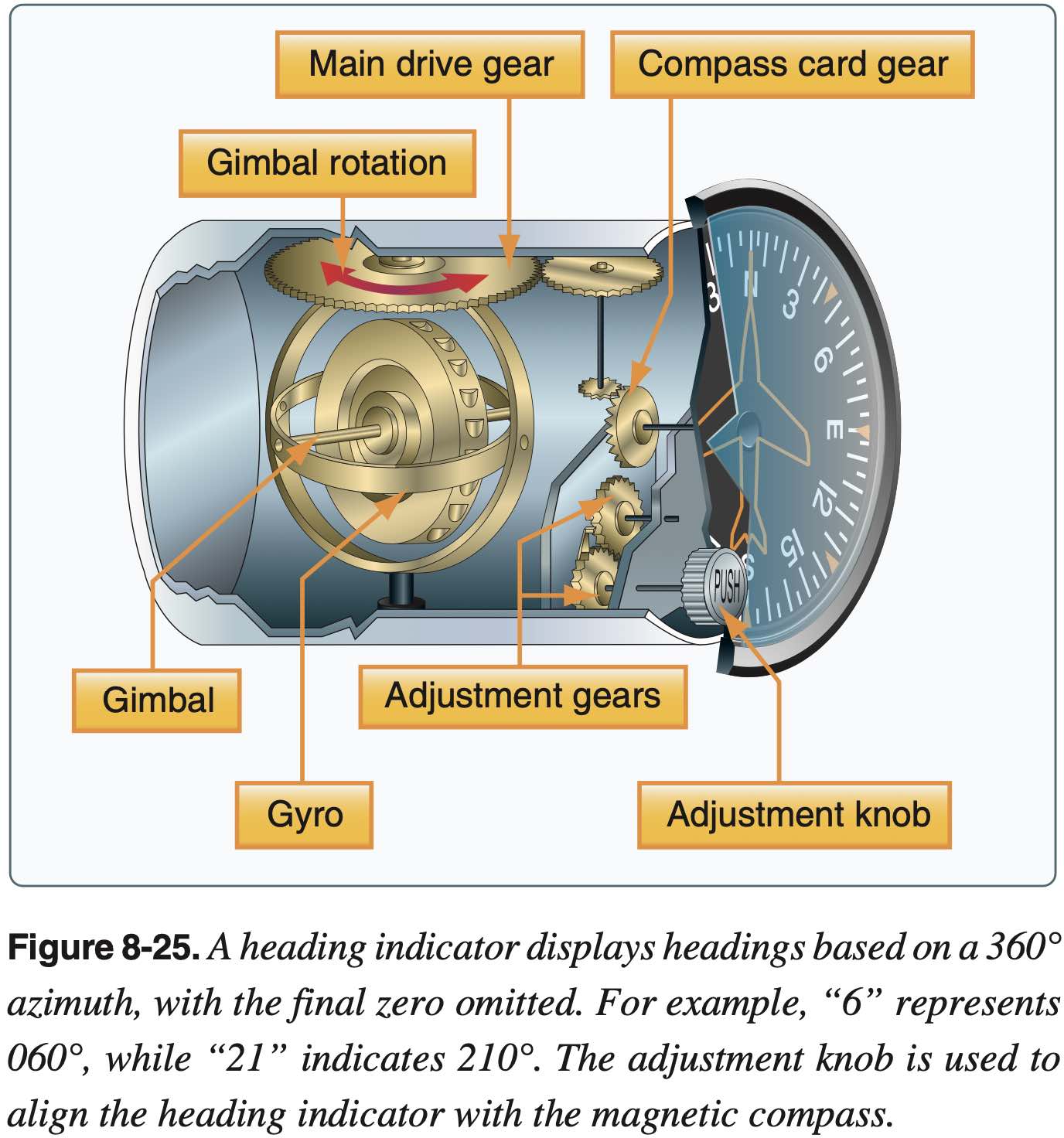
- Heading indicator
- Also known as directional gyro
- Usually powered by the aircraft vacuum system
- Gyroscopic rigidity keeps them fixed in space, but need to be periodically set to the compass
- Errors in compass make it hard to use to turn to specific headings, especially in turbulent air - heading indicator helps with this
- Some heading indicators referred to as horizontal situation indicators (HSI) receive a magnetic north reference from a magnetic slaving transmitter and generally need no adjustment.
- See also: remote indicating compass
- Radio magnetic indicator (RMI)
- Modern systems use an Altitude Heading Reference System (AHRS) to determine the aircrafts heading that incorporate a magnetometer in them
Attitude Indicator
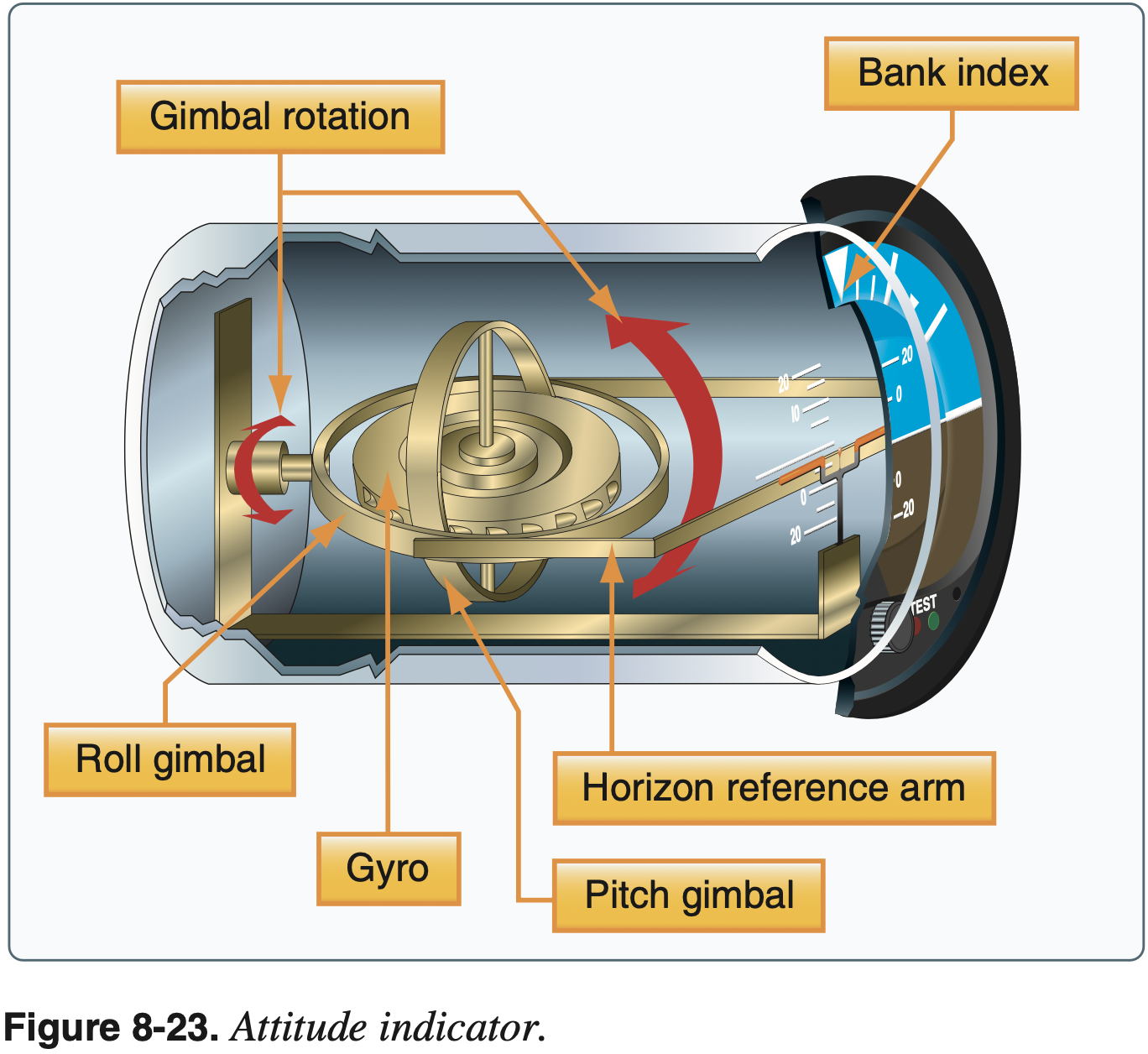
- Also known as artificial horizon
- Principles
- Rigidity in space
- Precession
- Electrically or vacuum powered
- What is in POH might have changed and need to consult supplements
- For example, the Garmin G5 attitude indicator uses solid state (electrically powered) gyro instead of vacuum powered.
- Due to friction, gyroscopic instruments can drift and need to be reset periodically (for example heading indicator to compass)
- For example, check and reset every 15 minutes
- Certain gyroscopic instruments have specific pitch and bank limits that induce a tumble of the gyro.
- Modern systems such as G5 or G1000 use solid-state devices instead of spinning gyros to determine the aircraft attitude
Preflight Check
- During taxi check
- Erect
- Less than 5 degree lean
Altimeter
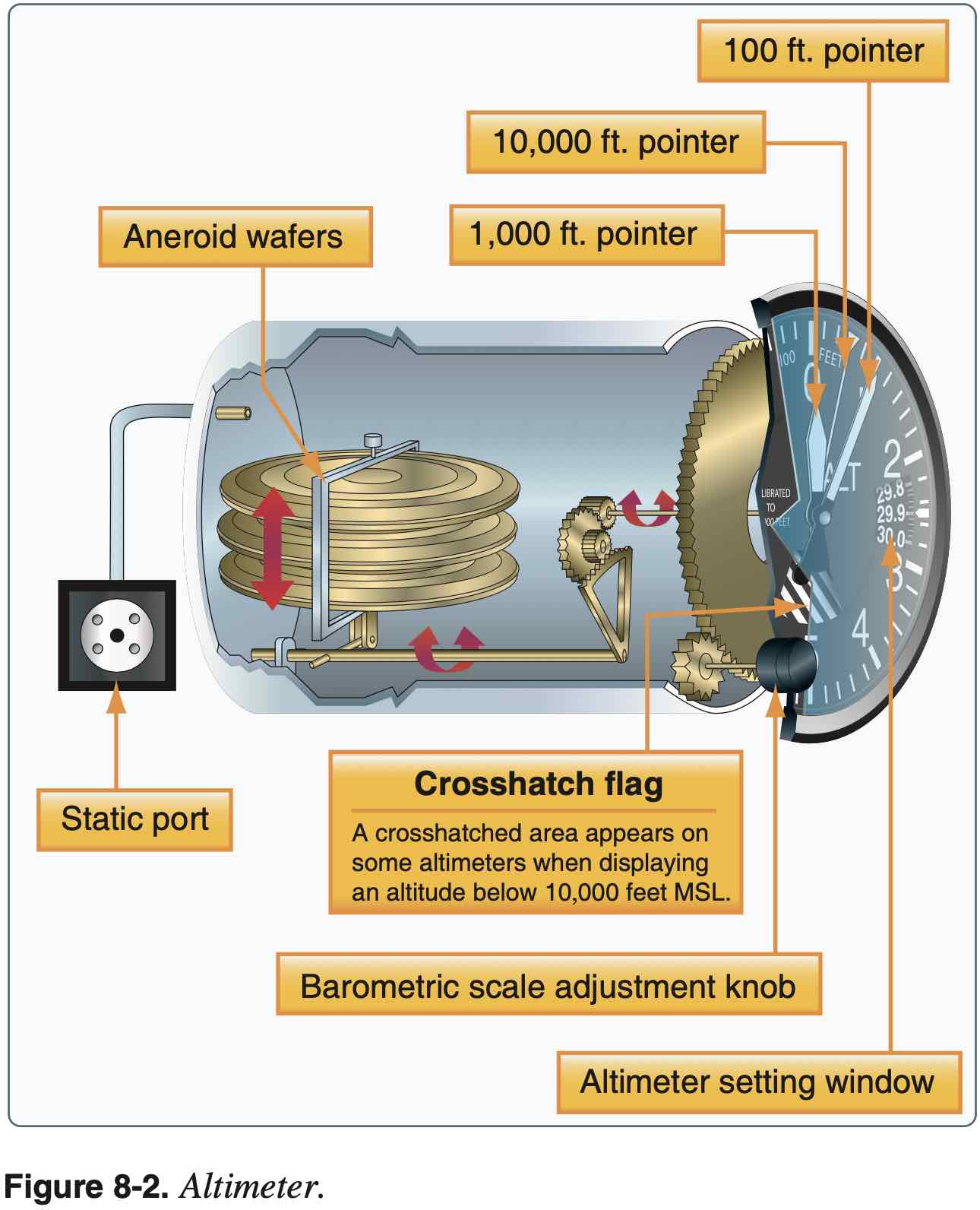
- The indicated altitude is correct, however, only when the sea level barometric pressure is standard (29.92 inHg), the sea level free air temperature is standard (15 °C or 59 °F), and the pressure and temperature decrease at a standard rate with an increase in altitude.
- Can adjust the altimeter for nonstandard pressure but not temperature
- True altitude thus varies with temperature
- Higher temps means true altitude is higher than indicated and lower temps means true altitude is lower than indicated
- Recall "hot-to-cold look out below"
- Beware obstacle clearance especially when flying in colder temps
- Mental model: altimeter setting provides true datum at ground level of the reporting station. Then consider the pressure gradient (which decreases with altitude). Compared to the standard pressure gradient, the pressure gradient in colder more dense air will decrease more quickly, and in hot air the pressure gradient will decrease less quickly.
Preflight Check
- Reads within 75 feet of field elevation when set to local altimeter setting
Turn-and-Slip Indicator / Turn Coordinator
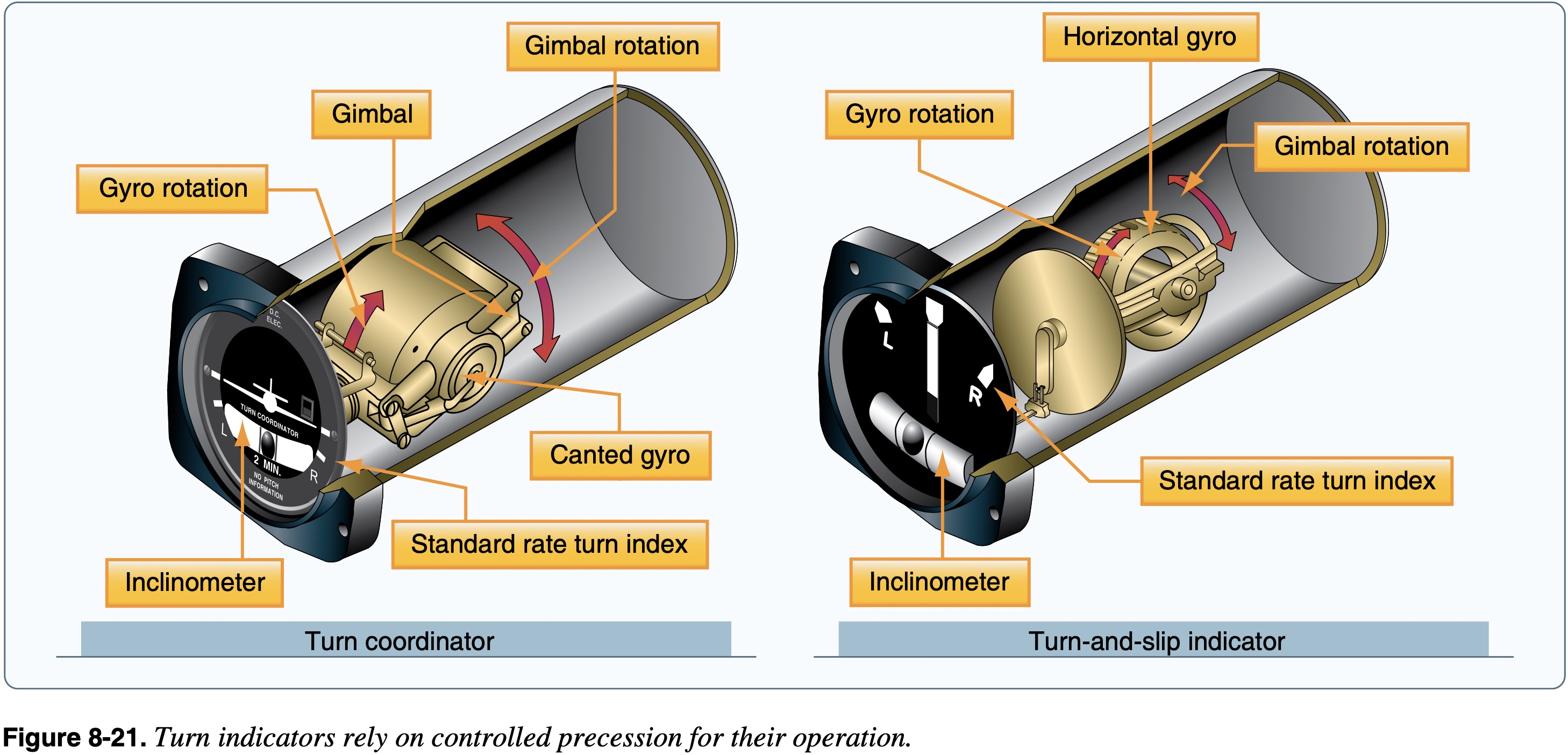
- Turn coordinator
- Roll rate (initially)
- Rate of turn (after it stabilizes)
- Quality of turn
- Contains inclinometer
- The ball
- "step on the ball" to coordinate flight
- Turn and slip indicator
- Rate of turn
- Quality of turn
- Turing taxi should indicate direction of turn and ball should go to outside of turn
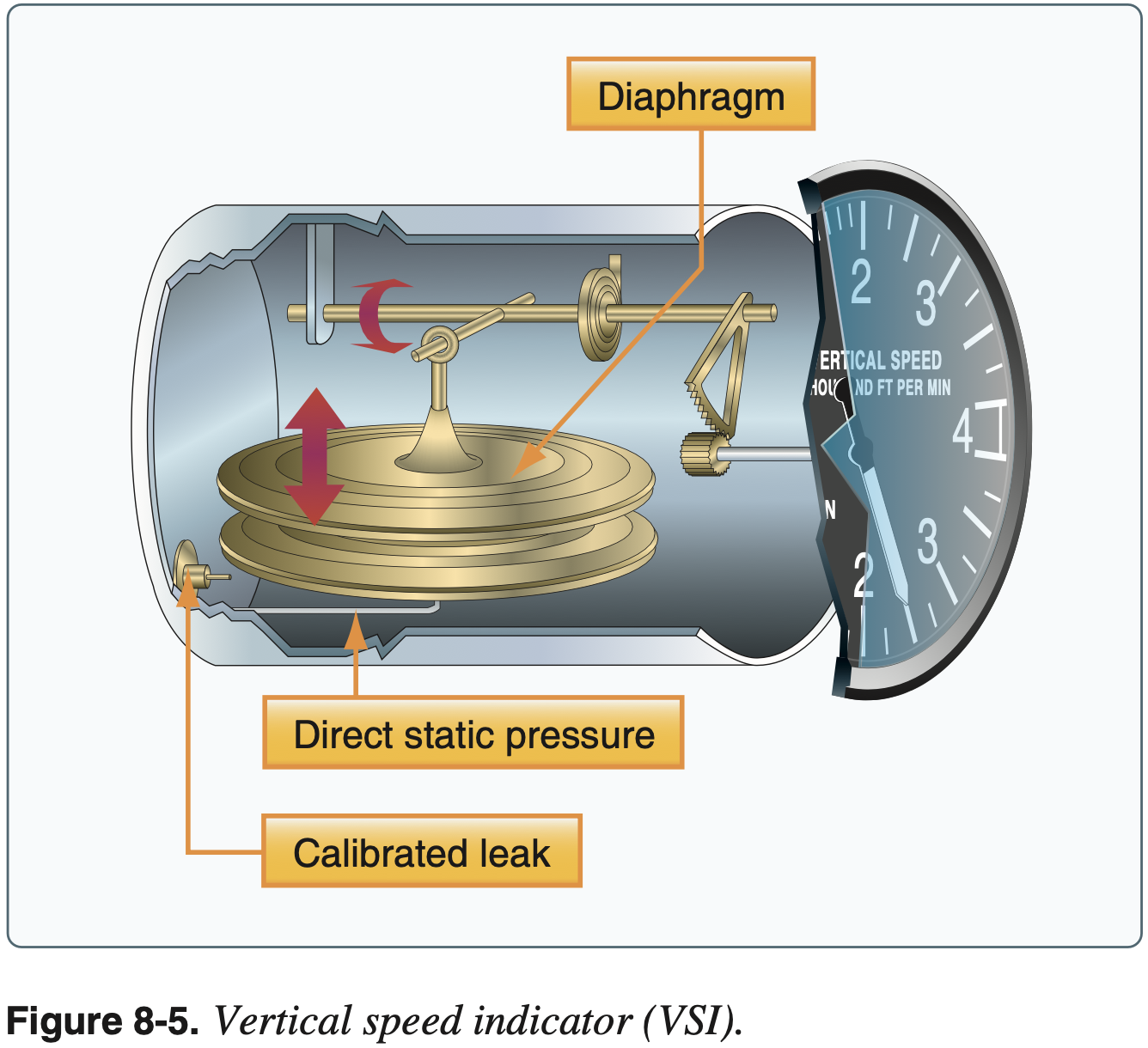
Vertical Speed Indicator (VSI)
- Not required equipment for VFR or IFR flight
- Uses static pressure only
Preflight Check
- Should indicate 0 when on the ground
- If it indicates something other than 0, this value can be used as 0 and then interpret changes from that value
- Should see a small momentary deviation from 0 when changing to alternate static source
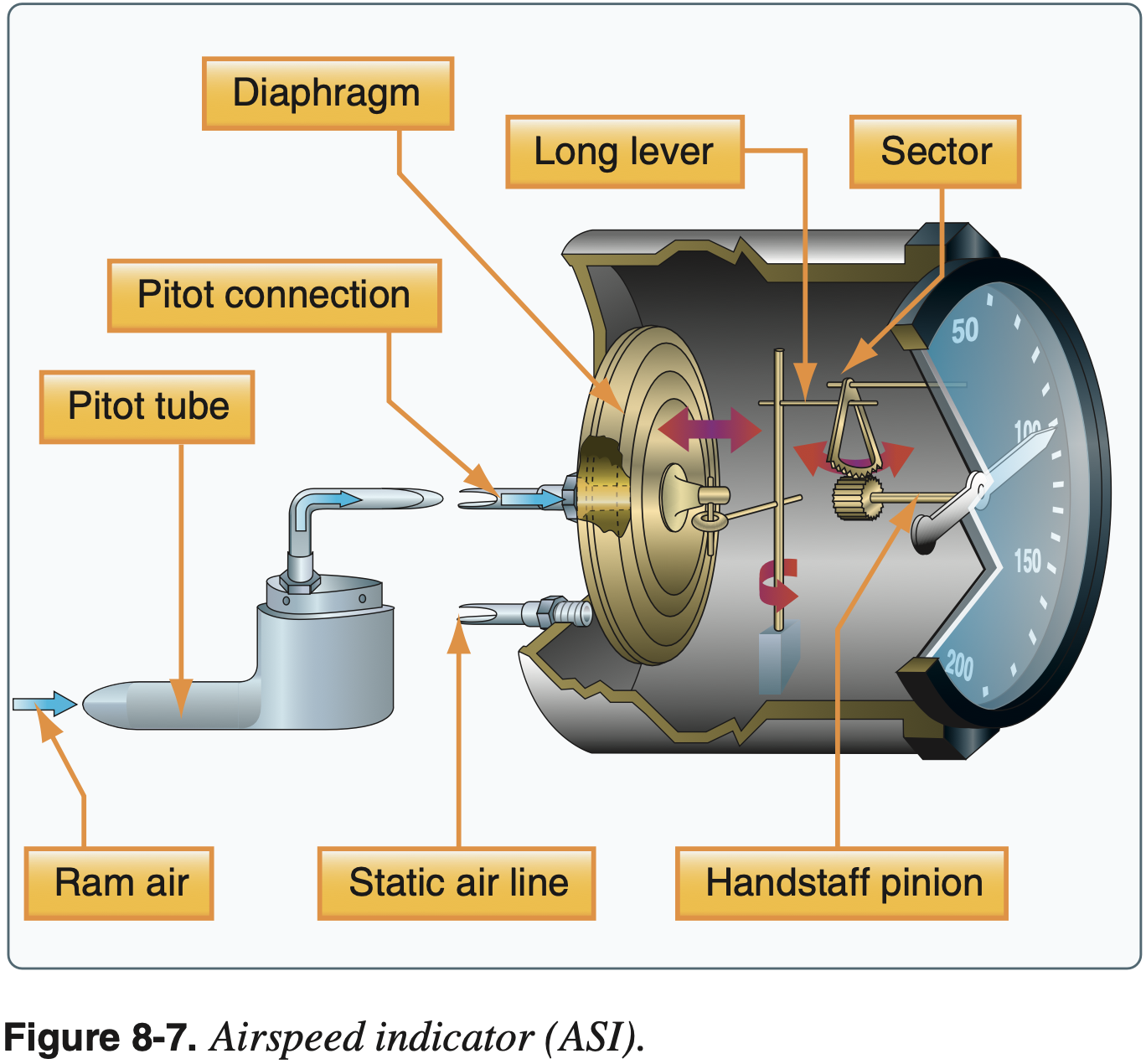
Airspeed Indicator (ASI)
- Requires pitot and static pressure
- Required for day VFR operation
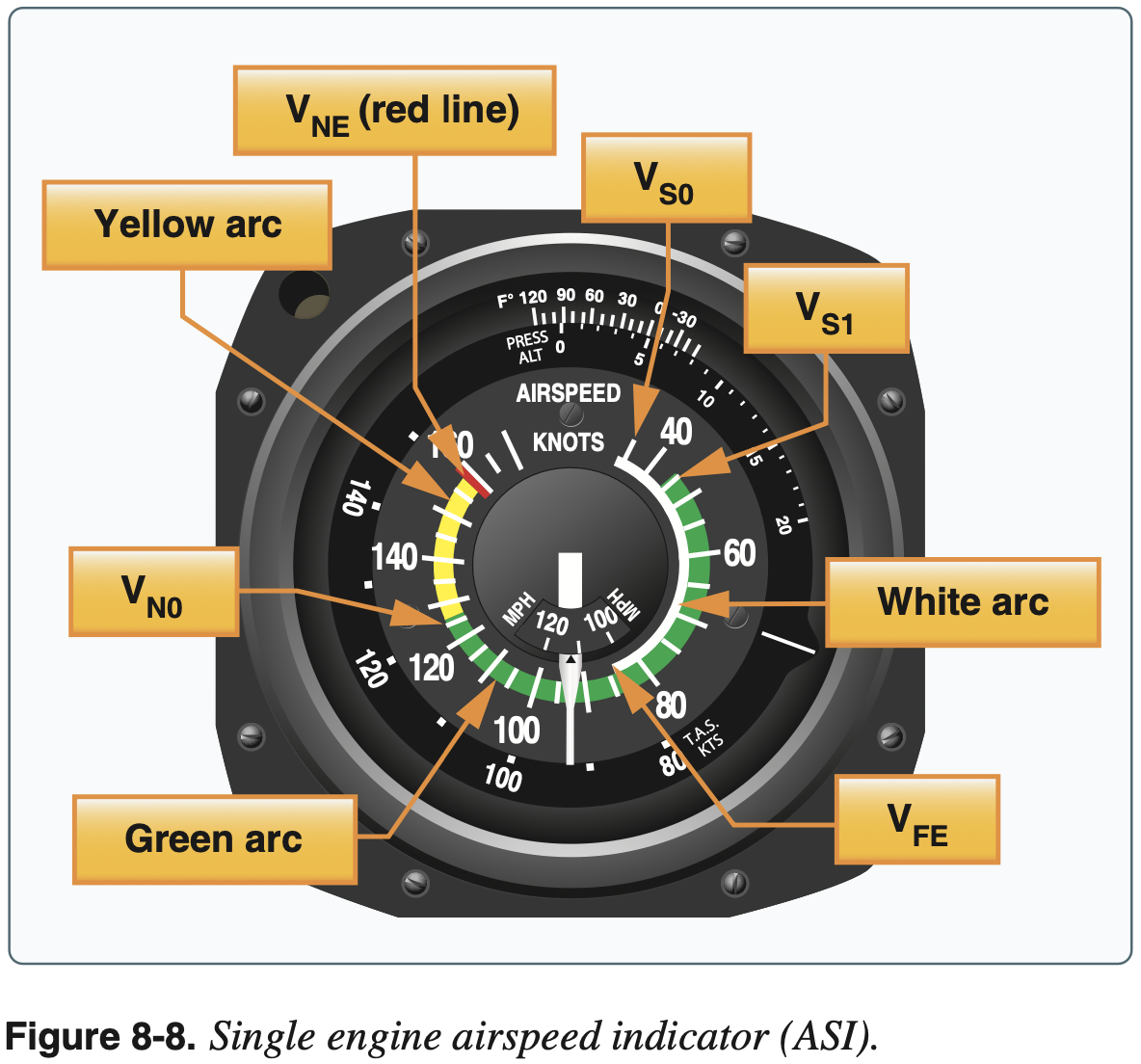
- Lower limits of green and white arc are power-off stall speeds
- Other speeds not here are, for example,
, , and - The same behavior described by "hot-to-cold look out below" for the altimeter applies to the airspeed indicator as well - when flying to a warmer area, for example, true airspeed will increase (given a constant power setting and true altitude)
Preflight Check
- Should read 0 when stationary and while taxiing
Outside Air Temperature Preflight Check
- Should read ambient air temperature
Clock Preflight Check
- Check correct time and running
Cabin Heat
- In most aircraft, can pull a knob to turn on cabin heat
- Cabin heat captures waste heat from the exhaust by passing intake air through a shroud around the exhaust and then into the cabin
- Need to be especially mindful of CO poisoning when using cabin heat
PFD Preflight Check
- No annunciators
- No red X's
Autopilot Preflight Check
- Do preflight check of autopilot according to POH
- Know where the autopilot fuse is
References
- FAA-H-8083-15B Instrument Flying Handbook
- Chapter 5: Flight Instruments
- Page 5-10
- Page 5-26
- Page 5-34: Terrain Alerting Systems
- Chapter 5: Flight Instruments
- FAA-H-8083-15B Instrument Flying Handbook
- Chapter 9: Navigation Systems
- Page 9-44
- Chapter 9: Navigation Systems