Intercepting, Tracking, and DME Arcs
This page covers Task A. Intercepting and Tracking Navigational Systems and DME Arcs from the FAA-S-8081-9E Flight Instructor Instrument Practical Test Standards.
Purpose
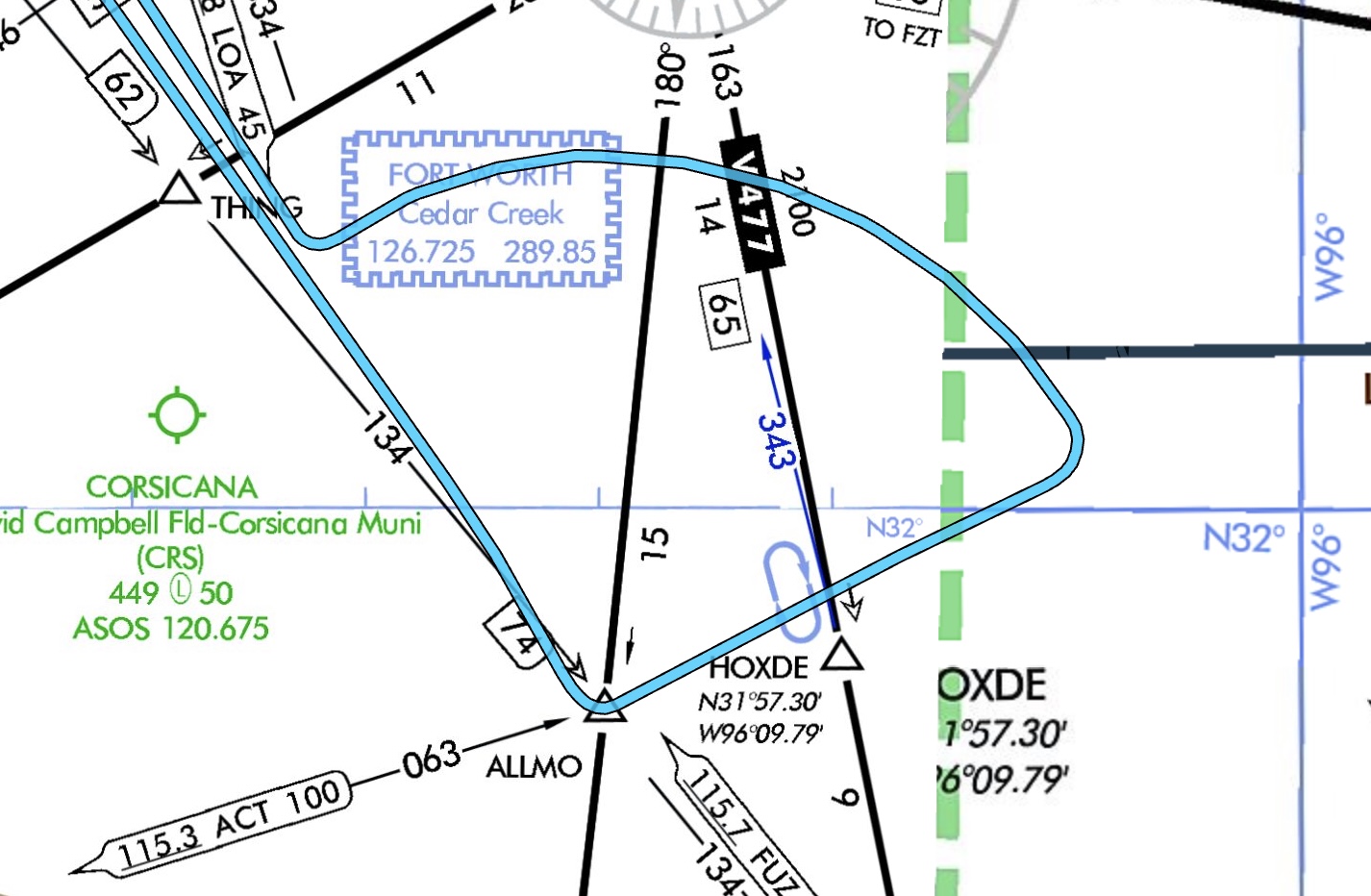
Use ground-based navigation systems to perform en-route navigation, and perform proper procedure to fly a DME arc.
DME Arcs
Introduction
- A series of straight lines to approximate a circle
- Begin turn to join 0.7 nm prior to desired DME distance
- Turn 110° if approaching from inside the arc and 70° if approaching from outside the arc
- When DME hits proper arc distance turn 20° toward VOR
- Repeat until crossing the lead radial
- If no lead radial, begin turn to exit arc 5° prior to desired radial
Elements
- Normal VOR is 10° full-scale deflection from center to either side
- When setting course using OBS, it should match the intended course to be flown rather than the reciprocal
- If plane has HSI, keep the top of CDI needle on the lubber line to intercept
- On planes without HSI
- Full needle deflection use 45° intercept angle
- Partial needle deflection use 30° intercept angle
On 20° Turns
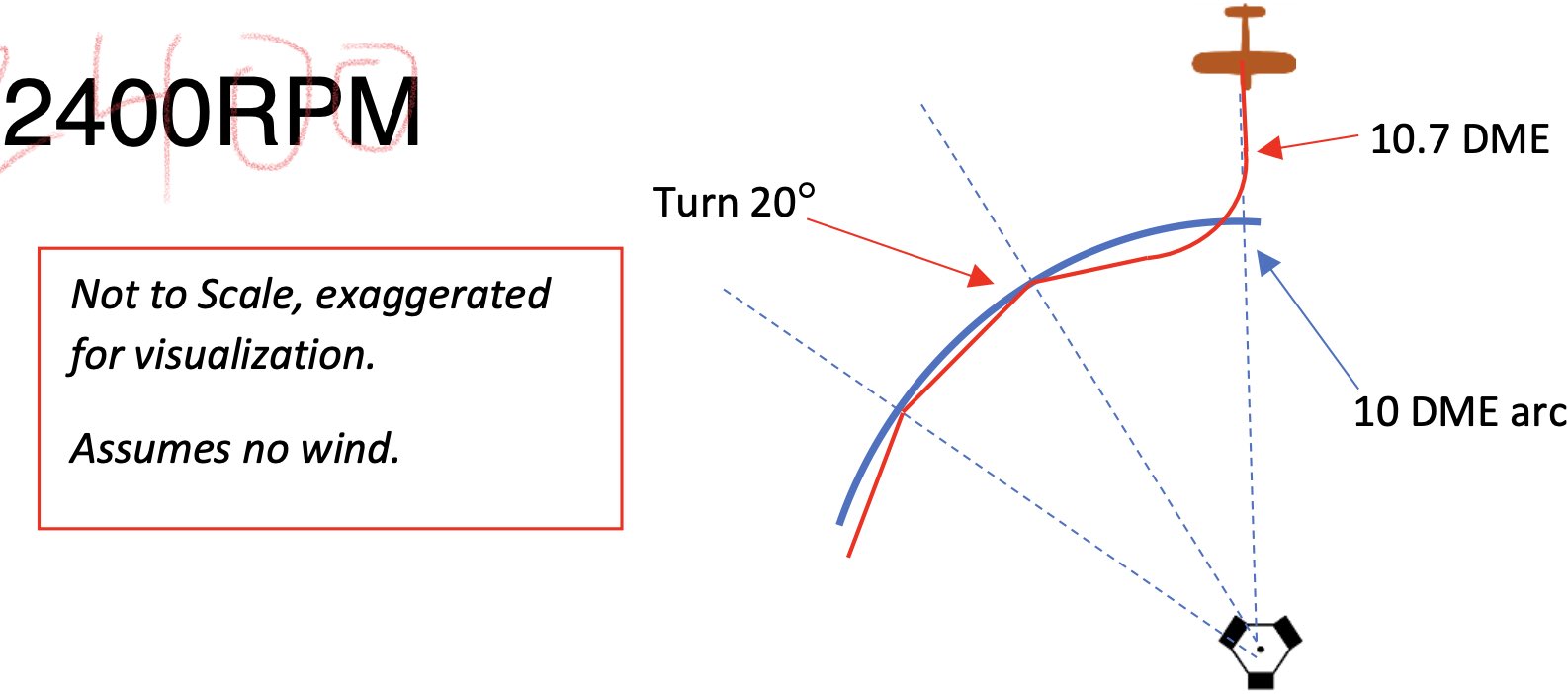

- Real DME arcs "in the wild" exist with radii between 7 and 30 nm, inclusive
- Regardless of the specifics of the procedure, flying a DME arc involves a series of turns to fixed headings, "cutting the corners" of the arc
- Answering the question of how large each heading change should be is a balance between how accurately we wish to fly the arc, and the level of workload required while flying the arc
- More frequent turns mean a bit more work but a more accurate arc
- The ACS standards require DME arcs be flown +/- 1 nm
- Using 20° turns throughout a DME arc will nominally allow this procedure to be applied on arcs up to 16.6 nm before reaching the 1 nm deviation
- To give a more of a buffer, a good rule-of-thumb is using 20° when flying DME arcs up to 10 nm in radius
- While arcs closer to the 7 nm lower limit are tougher to find on real approaches, it is often convenient in training to fly smaller arcs
- Below gives a list of a few approaches which use DME arcs and the radius of the arc
| Approach Name | Distance |
|---|---|
| KMFR VOR-C | 27 nm |
| KMFR LOC BC-B | 24 nm |
| KAST ILS 26 | 19 nm |
| KONP ILS/LOC 16 | 16 nm |
| KCVO VOR 17 | 16 nm |
| KACT VOR/DME 32 | 15 nm |
| KMFR VOR 14 | 15 nm |
| KMTN VOR 15 | 14.7 nm |
| KWRI VOR 6 | 14 nm |
| KWRI VOR 24 | 14 nm |
| KWRI VOR 36 | 14 nm |
| KCVO ILS/LOC 17 | 13.2 nm |
| KWRI VOR 18 | 11 nm |
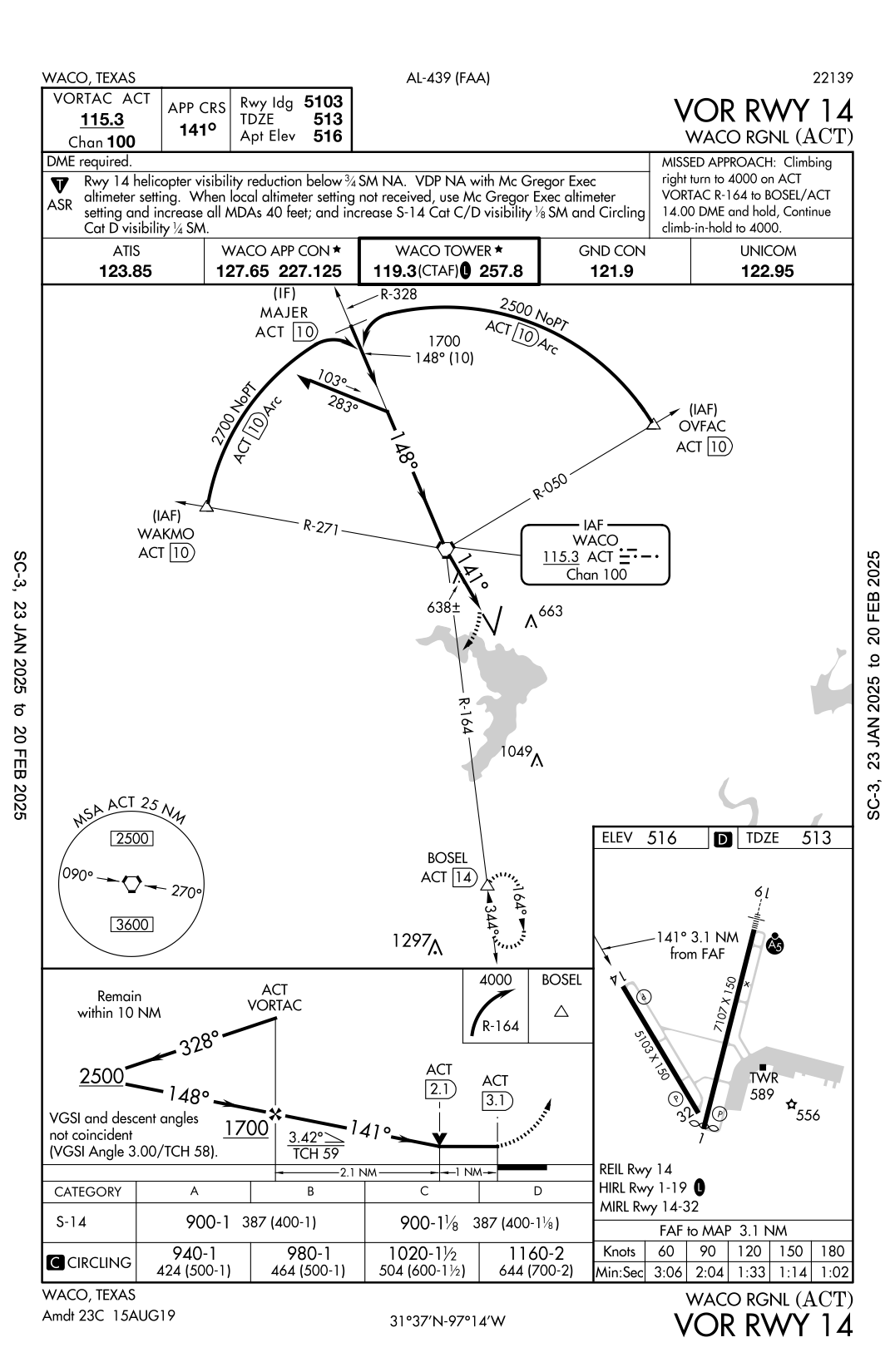
| KACT VOR 14 | 10 nm |
Completion Standards
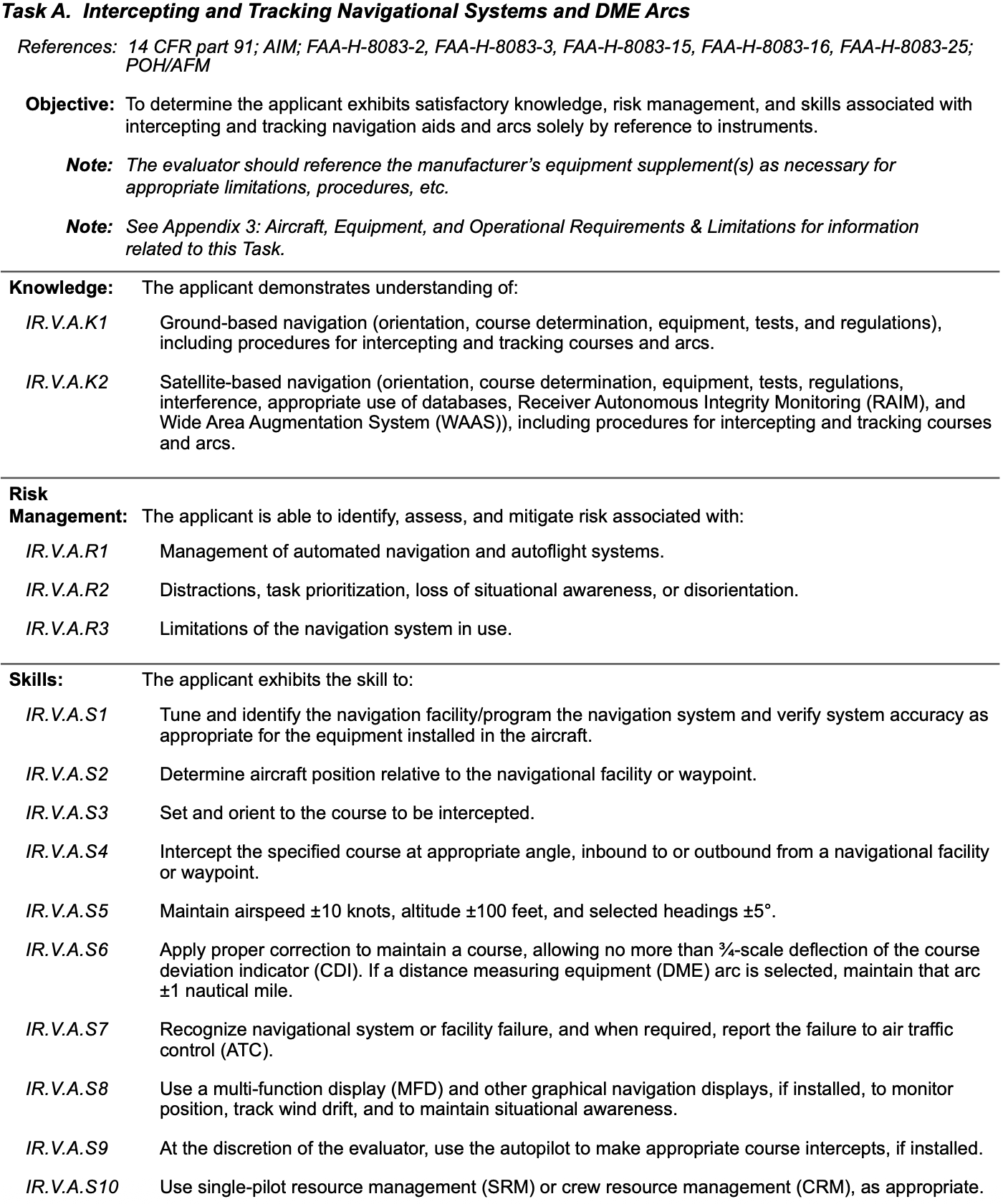
Note from (the older) FAA-S-ACS-8B regarding DME arcs:
While the applicant is expected to be able to fly DME Arcs, they may be selected for testing only if they are charted and available.
The language changed in the more recent FAA-S-ACS-8C:
The evaluator may not select DME arcs, unless charted and available (including use of RNAV substitution techniques, if appropriate).