Aeromedical Factors
This page covers Task B. Aeromedical Factors from the FAA-S-8081-9E Flight Instructor Instrument Practical Test Standards.
Hypoxia
Hypoxia
Not enough oxygen.
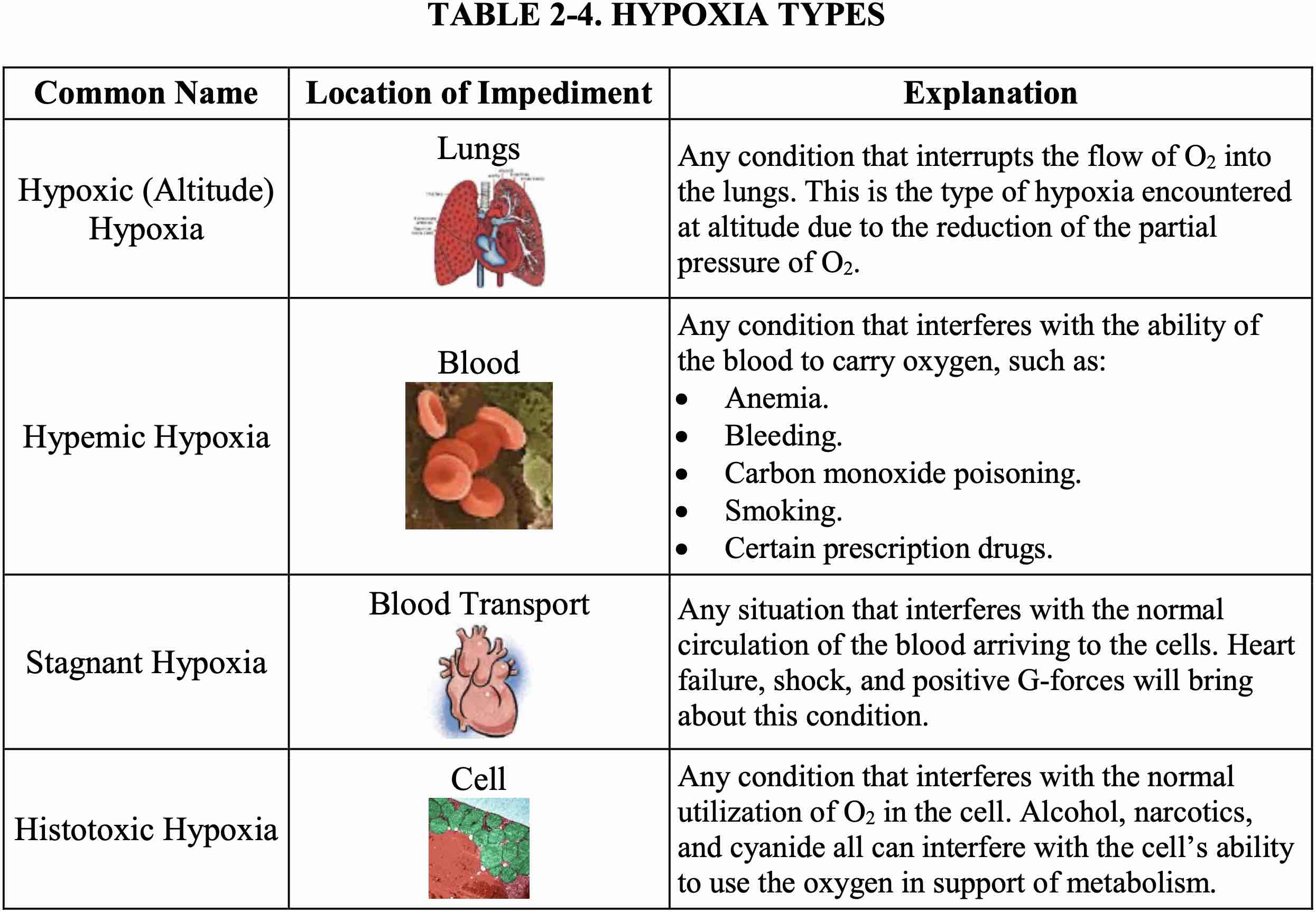
- The forms of hypoxia are based on their causes:
- Hypoxic hypoxia
- Insufficient oxygen available to the body as a whole
- E.g.: blocked airway, drowning
- The "normal" hypoxia we talk about in aviation
- Usually caused by the decreased pressure of oxygen at altitude
- Anemic or Hypemic hypoxia
- Occurs when the blood is not able to take up and transport a sufficient amount of oxygen to the cells in the body
- May be due to low blood supply, low hemoglobin, or CO poisoning
- Same symptoms as hypoxic hypoxia
- Stagnant hypoxia
- Blood not flowing to tissues that need it
- Also known as ischemia
- Can occur with excessive acceleration of gravity (Gs).
- Also from cold temperatures reducing circulation
- Histotoxic hypoxia
- The inability of the cells to effectively use oxygen
- This impairment of cellular respiration can be caused by alcohol and drugs
- Hypoxic hypoxia
- Symptoms of hypoxia
- Belligerence
- Euphoria
- Headache
- Decreased response to stimuli and increased reaction time
- Impaired judgment
- Visual impairment
- Drowsiness
- Lightheaded or dizzy sensation
- Tingling in fingers and toes
- Numbness
- False sense of security
- Blue colored lips and fingernails
- Tunnel vision
- Symptoms can take effect at 5,000 ft. at night
- Immediately reduce altitude, use oxygen, avoid alcohol
Hyperventilation
Hyperventilation
An increase in the rate and depth of breathing that results in insufficient CO2 in the blood stream.
- Can happen when anxious, scared, or nervous
- Symptoms perceived by an aviator who is hyperventilation include
- Dizziness
- Lightheadedness
- Tingling
- Numbness
- Visual disturbances
- Loss of coordination
- Visual impairment
- Unconsciousness
- Hot and cold sensations
- Muscle spasms
- The treatment of hyperventilation requires a voluntary reduction in the rate and depth of ventilation.
- Treatment by slowing breathing rate or breathing into a bag
- The signs and symptoms of hyperventilation can be easily confused with those of hypoxic hypoxia.
- Rapid or deep breathing while using supplemental oxygen can cause hyperventilation
- Because hypoxia and hyperventilation are so similar and both can incapacitate so quickly, the recommended treatment procedures for aviators is to correct both problems simultaneously
- Administer 100 percent oxygen under pressure
- Reduce the rate and depth of breathing
- Check the oxygen equipment to ensure proper functioning
- Descend to a lower altitude where hypoxia is unlikely to occur
Middle Ear and Sinus Problems
- Free gas in body expands due to pressure difference during climb/descent
- Middle ear pressure, Eustachain tube (back of throat) allows pressure balance, normally closed except when chewing, swallowing, yawning
- Sinus problems can also affect pressure equalization
- Constantly equalize
Spatial Disorientation
Spatial Orientation
Defines our natural ability to maintain our body orientation and/or posture in relation to the surrounding environment.
- Vestibular System (inner ear/balance) + Somatosensory System (nerves/gravity) + Visual System
- Sensory mismatch can cause illusions leading to spatial disorientation.
- Vestibular system = fluid in inner-ear makes contact with hairs, deflect
- Basically all vestibular illusions below are caused by a steady-state condition being reached in the inner ear that is not straight-and-level flight
- Return to straight-and-level flight from this condition then feels wrong causing the pilot to react incorrectly
- Posture considerations
- ICEFLAGS is an acronym that can be used to help memorize a mix of some of the more common vestibular and visual illusions below.
Vestibular Illusions
- Inversion Illusion
- An abrupt change from climb to straight-and-level flight can stimulate the otolith organs enough to create the illusion of tumbling backwards
- Pilot may compensate by pushing the aircraft nose towards the ground
- Coriolis Illusion
- Inner ear getting used to turning equilibrium
- Turning head perturbs this equilibrium and can give pilot sense of different motion
- Elevator Illusion
- An abrupt upward vertical acceleration, as can occur in an updraft, can stimulate the otolith organs to create the illusion of being in a climb.
- The Leans
- Sudden return to level flight following a gradual and prolonged turn
- When gradual turn rate is below the detection threshold of the semicircular canals
- Graveyard Spiral
- As in other illusions, a pilot in a prolonged coordinated, constant-rate turn may experience the illusion of not turning
- In recovery from the turn the pilot feels a turn the other way, so compensates back the original direction
- The turn can result in altitude loss, requiring more backpressure, which increases the rate of turn, and results in a spiral to the ground
- Somatogravic Illusion
- A rapid acceleration, such as experienced during takeoff, stimulates the otolith organs in the same way as tilting the head backwards.
- Pilot may compensate by pushing the aircraft nose towards the ground
Visual Illusions
- False Horizon
- A sloping cloud formation, an obscured horizon, an aurora borealis, a dark scene spread with ground lights and stars, and certain geometric patterns of ground lights can provide inaccurate visual information, or "false horizon," when attempting to align the aircraft with the actual horizon.
- Autokinesis
- Staring at a single point of light against a dark background for more than a few seconds the light appears to move.
- During flight a pilot may attempt to align the aircraft with this moving light and cause them to lose control.
- Reversible Perspective Illusion
- At night, an aircraft may appear to be moving away from a second aircraft when it is, in fact, approaching a second aircraft. This illusion often occurs when an aircraft is flying parallel to another's course.
- To determine the direction of flight, pilots should observe aircraft lights and their relative position to the horizon. If the intensity of the lights increases, the aircraft is approaching; if the lights dim, the aircraft is moving away.
- Size-Distance Illusion
- This illusion results from viewing a source of light that is increasing or decreasing in brightness. Pilots may interpret the light as approaching or retreating.
- Flicker Vertigo
- A light flickering at a rate between 4 and 20 cycles per second can produce unpleasant and dangerous reactions. Such conditions as nausea, vomiting, and vertigo may occur. On rare occasions, convulsions and unconsciousness may also occur.
- Proper scanning techniques at night can prevent pilots from getting flicker vertigo.
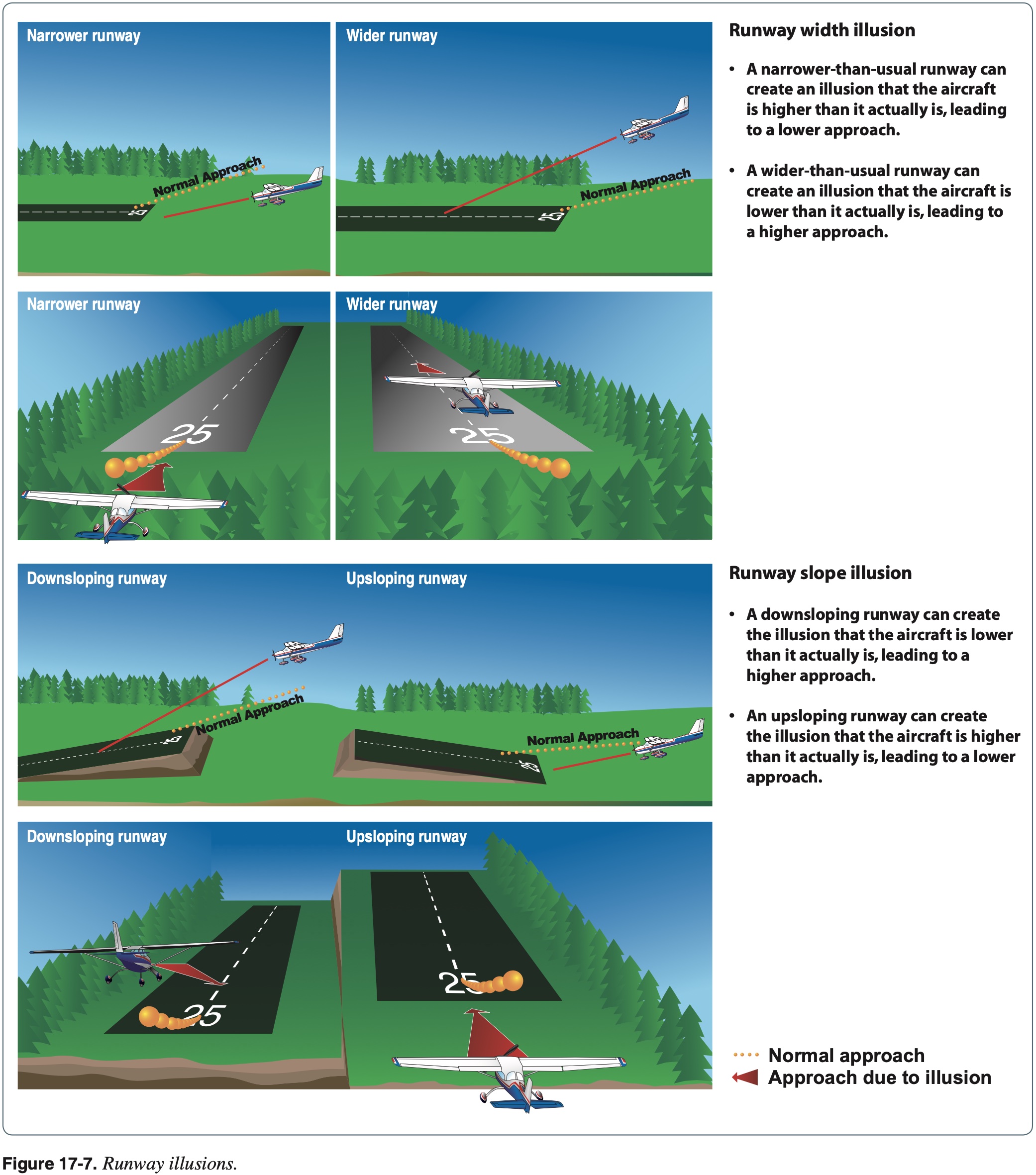
- Runway Width Illusion
- A narrower-than-usual runway can create an illusion that the aircraft is at a higher altitude than it actually is, especially when runway length-to-width relationships are comparable.
- The pilot who does not recognize this illusion will fly a lower approach
- Runway and Terrain Slopes Illusion
- An upsloping runway, upsloping terrain, or both can create an illusion that the aircraft is at a higher altitude than it actually is.
- Featureless Terrain Illusion
- An absence of surrounding ground features, as in an overwater approach over darkened areas or terrain made featureless by snow, can create an illusion that the aircraft is at a higher altitude than it actually is.
- Water Refraction
- Rain on the windscreen can create an illusion of being at a higher altitude due to the horizon appearing lower than it is.
- This can result in the pilot flying a lower approach.
- Haze
- Atmospheric haze can create an illusion of being at a greater distance and height from the runway.
- As a result, the pilot has a tendency to be low on the approach.
- Fog
- Flying into fog can create an illusion of pitching up. Pilots who do not recognize this illusion often steepen the approach abruptly.
- Ground Lighting Illusions
- Lights along a straight path, such as a road or lights on moving trains, can be mistaken for runway and approach lights.
- Bright runway and approach lighting systems, especially where few lights illuminate the surrounding terrain, may create the illusion of less distance to the runway.
- The pilot who does not recognize this illusion will often fly a higher approach.
Preventing Visual Illusions
TIP
When experiencing spatial disorientation make sure to rely on flight instruments.
- Stay proficient
- Avoid flying in conditions for which you are not rated and/or not proficient
- Rely on instruments
- Learn ahead about airport you will be landing at for information on runway slope, terrain, and lighting.
- Reference altimeter
- Overfly the field
- Use approach lighting (VASI or PAPI)
Motion Sickness
- Caused by continuous stimulation of the inner ear that controls sense of balance
- Brain receiving conflicting signals
- To allieviate
- Fix eyes on point outside the aircraft
- Use cabin airflow
- Avoid sudden head movements
- Breathe slowly
TIP
To alleviate symptoms of motion sickness, look forward at a fixed point outside the aircraft, loosen your clothing, and use cabin airflow to get cool airflow across your body.
Alcohol and Drugs
Regulations
- See 14 CFR §91.17 - Alcohol or drugs
- Alcohol
- "8-Hour Bottle to Throttle"
- Limit .04% (0% if under 21)
- Do not fly if "under the influence" - hangovers count
- FAA Civil Aviation Security Division within 60 days after conviction of
- DUI
- Or offense involving alcohol or drugs (e.g. drugs in vehicle, even if not under the influence)
- Drug trafficking offense may result in pilot certificate being suspended or revoked
- One drink can be detected up to 3 hours after consumption
- Alcohol renders a pilot more susceptible to hypoxia
- Drugs
- "Do drugs or fly planes."
- If taking any prescription drugs, must consult with AME first
- OTC counts => when in doubt, don't fly.
Effects
- Altitude will multiply effects of alcohol
CO Poisoning
- Colorless, odorless
- Attaches to hemoglobin easier, intercepts oxygen
- Heater element, if broken exhaust pipe
Evolved Gases From Scuba Diving
- SCUBA Considerations (Induced Decompression Sickness)
- Experience low barometric pressures => Nitrogen comes out of physical solution and forms bubbles
- SCUBA, wait 24 hours if flying above 8,000'. Below 8,000 ft., 12 hours
- After diving where a controlled ascent was not required wait at least 12 hours before flying to flight altitudes (not cabin altituddes) of 8,000 ft. MSL or less
- After diving where a controlled ascent was required wait at least 24 hours before flying to 8,000 ft. MSL or less
Stress and Fatigue
Stress
Stress
Stress is the body's response to demands placed upon it.
- Acute (normal, part of life)
- Chronic (needs to be dealt with prior to flight)
Fatigue
Fatigue
Acute fatigue, a normal occurrence of everyday living, is the tiredness felt after long periods of physical and mental strain.
- Fatigue results in loss of focus, attention, ability to communicate, decision making process
- Chronic fatigue is not enough time to recover from repeated acute fatigue, and may have deeper points or origin e.g. financial stress
- Deal with acute fatigue before it becomes chronic
Dehydration
- Limit intake of diuretic drinks
References
- FAA-H-8083-15B Instrument Flying Handbook
- Chapter 3: Human Factors
- Page 3-5: Illusions Leading to Spatial Disorientation
- Chapter 3: Human Factors
- FAA-H-8083-3C Airplane Flying Handbook
- FAA-H-8083-25B Pilot's Handbook of Aeronautical Knowledge
- Aeronautical Information Manual
- 14 CFR §91.17 Alcohol or drugs