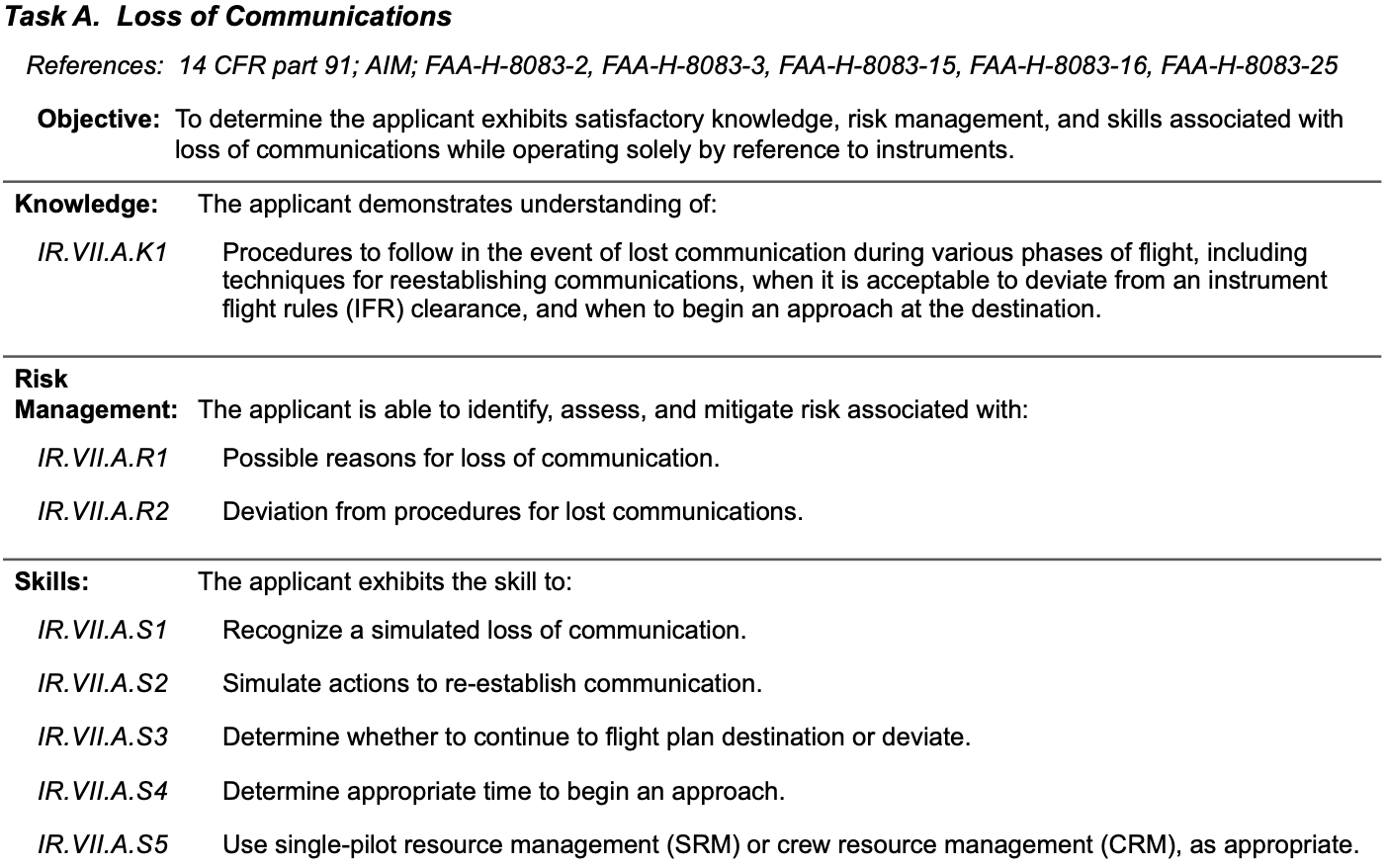
Loss of Communications
This page covers Task A. Loss of Communications from the FAA-S-8081-9E Flight Instructor Instrument Practical Test Standards.
Purpose
Know what to do in the event of a communication failure while flying IFR.
Communication Failure Under IFR
- If the radio fails while VFR, fly VFR and land as soon as practicable
- Squawk 7600
- Unless you decide to declare an emergency, then squawk 7700
- The following rules determine the route and altitude that should be be flown should a radio failure happen in flight and the flight is continued
- If flight needs to be continued IFR after losing communications, the following route should be flown (AVEF)
- A - Assigned
- In last ATC clearance
- V - Vectored
- E - Expected
- From last ATC communication
- F - Filed
- In flight plan
- A - Assigned
- If flight needs to be continued IFR after losing communications, the highest of the following altitude should be flown (MEA) for each route segment
- M - Minimum altitude for IFR operations
- E - Expected
- From last ATC communication
- A - Assigned
- In last ATC clearance
- See 14 CFR §91.185 IFR operations: Two-way radio communications failure
- If radio failure happens and clearance limit is the fix from which approach begins, start descent and approach as close as possible to EFC time, or to arrive at estimated arrival time from flight plan (or amended enroute.)
- If clearance limit is not a fix from which approach begins, leave the clearance limit at EFC time or arrival at the fix if no EFC time, and start approach to begin as close as possible to estimated time of arrival from flight plan (or amended enroute.)
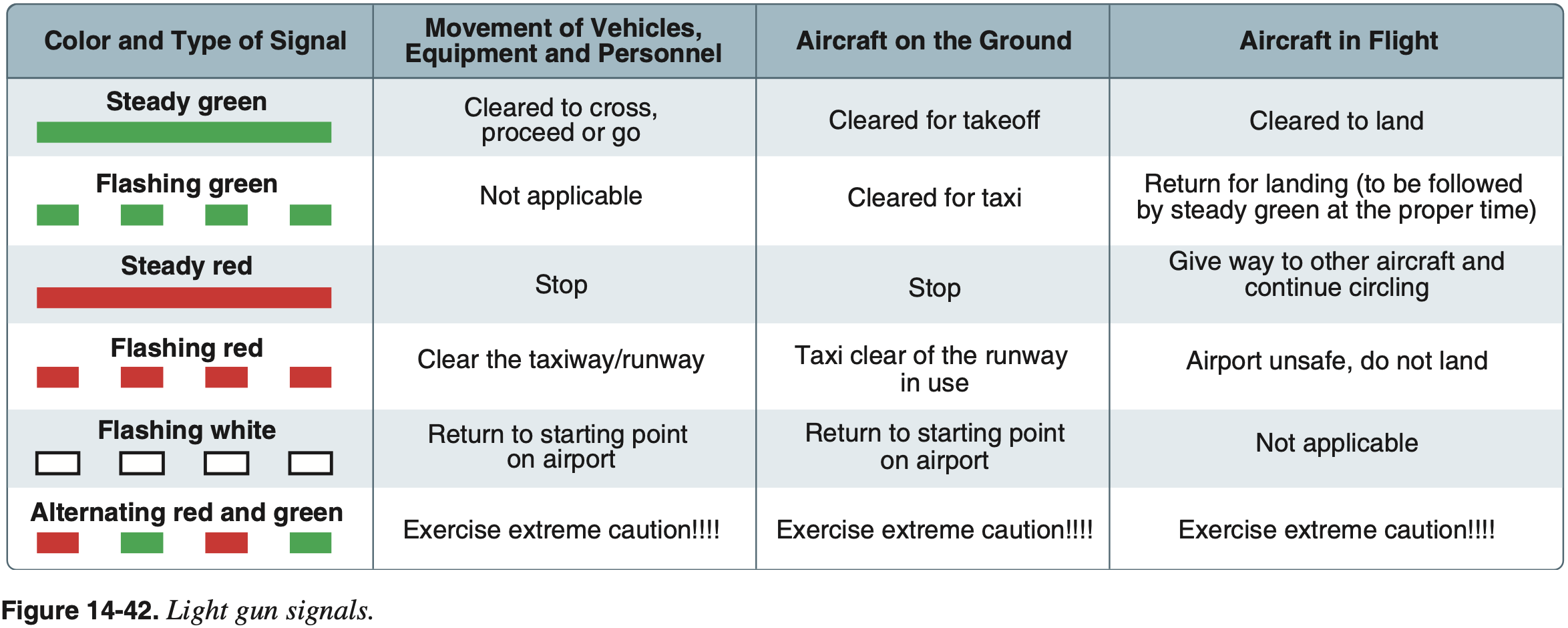
Light Gun Signals
Troubleshooting
- Check frequency
- Check volume
- Try previous frequency
- Try other radio
- Check for TX/RX
- Try other headphone jacks
- Try other PTT
- Try handheld mic
- Try overhead speaker
- Try EMG
- Try other headset
- Otherwise go 7600
References
- FAA-H-8083-15B Instrument Flying Handbook
- Chapter 11: Emergency Operations
- Page 11-8: Communication/Navigation System Malfunction
- Chapter 11: Emergency Operations
Completion Standards