Maneuvers
- Generally 180 KIAS is good airspeed to fly that is above minimum maneuvering speeds
Speeds Notes
- Following speeds are what we bug
- Takeoff v-speeds
- V1 = takeoff decision speed
- VR = rotation speed
- V2 = Takeoff safety speed / second segment climb speed
- Speed at which plane safely climbs with one engine inoperative
- Landing v-speeds
- VR = Landing reference speed
- VREF for flaps 40 or VLNDX for flaps < 40
- Use VLND20 for single engine landing
- V2 = Approach Climb speed (VAPP)
- This is single engine, flaps 8 go-around speed
- This we get from the VLND8 chart?
- VR = Landing reference speed
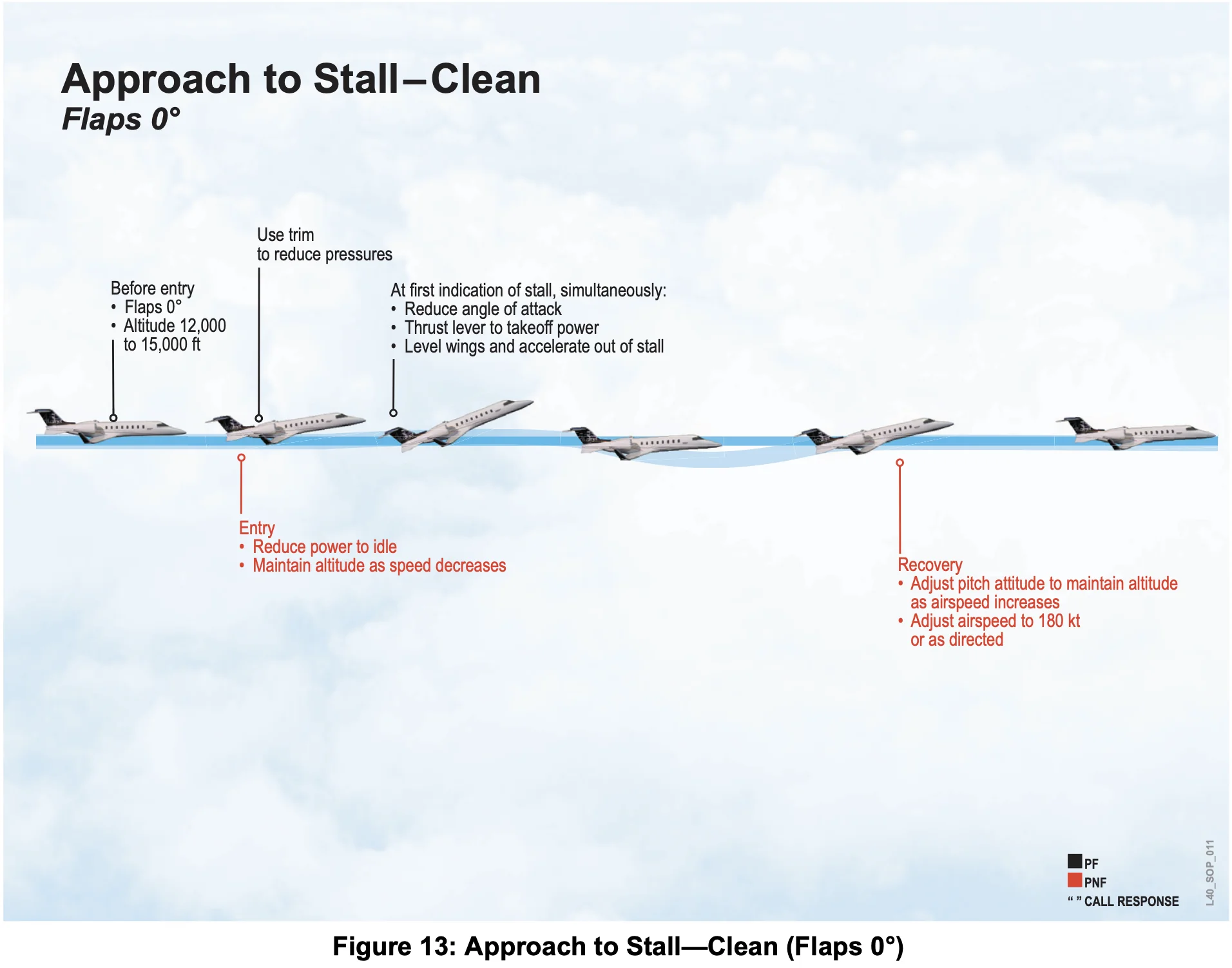
Takeoff
Normal Takeoff
- Before callout = see green T/O AND make sure N1 needle comes up to the bug
- "Takeoff Thrust set"
- "Airpseed alive" / "80 knots" -- "cross check" / "V1" / "Rotate"
- Pitch 12-15°
- PM calls "Positive Rate"
- Call "Gear up"
- When putting the gear up, also turn landing and taxi lights off and spoiler lever RET
- At 400' and V2 + 25 PM should call "flap safety speed" or "flap retraction speed" or "V2 + 25"
- Call "flaps up"
- PM should confirm "flaps set up ... indicating up"
- This speed, VFS, should be set in the speed bug prior to takeoff, so all PM has to do is check when airspeed exceeds the bug and over 400' AGL
- At 500' AGL PM should call "autopilot available"
- Source should already be set, so call the MODE to put in the autopilot
- e.g. "nav mode, AP on"
- This alone puts the AP vertical mode in pitch -- set to desired vertical mode
- e.g. FLC if on departure that requires 250 KIAS, or speed mode and set 250 KIAS
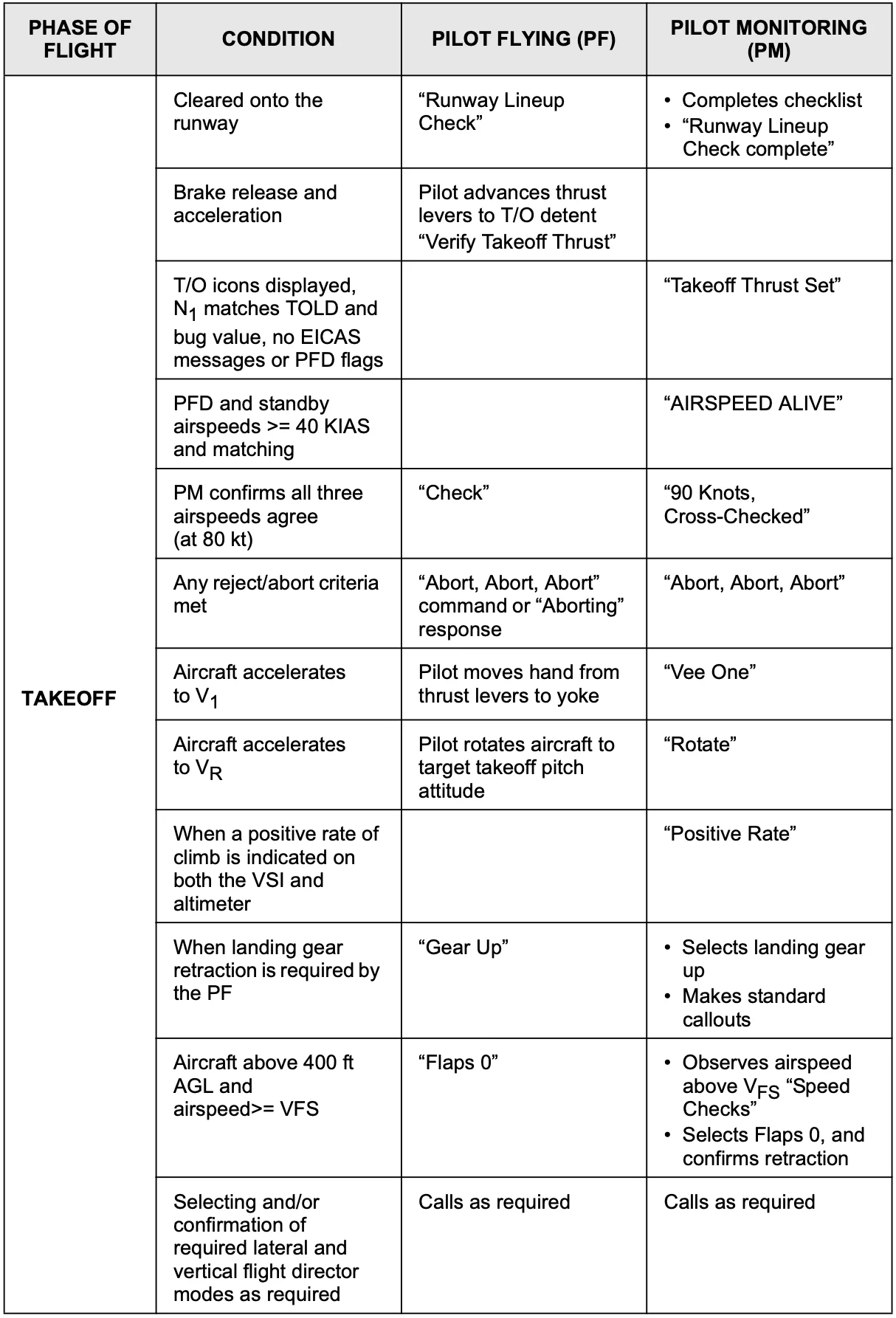
Engine Out Above V1
- Directional control with rudder
- Rotate at 3°/sec to target pitch attitude
- This has been calculated on the card
- Often 11-12°
- PM calls "positive rate"
- Call "Gear up"
- Then command
- "Speed mode"
- "Bug V2"
- "HDG / NAV mode"
- Depending on if assigned runway heading or a published procedure
- Call for "AP on"
- When obstacle clearance assured (1500' AGL), accelerate to V2 + 25
- Passing V2 + 25 PM calls "flap retraction speed"
- Call for "flaps up"
- Note radar altimeter to get 1500' AGL
- Call for engine failure above V1 checklist
- Reduce thrust to get level flight at 180 KIAS
- Consider half bank?
- Press
BNKon flight guidance controller - Limits to 14°
- Press
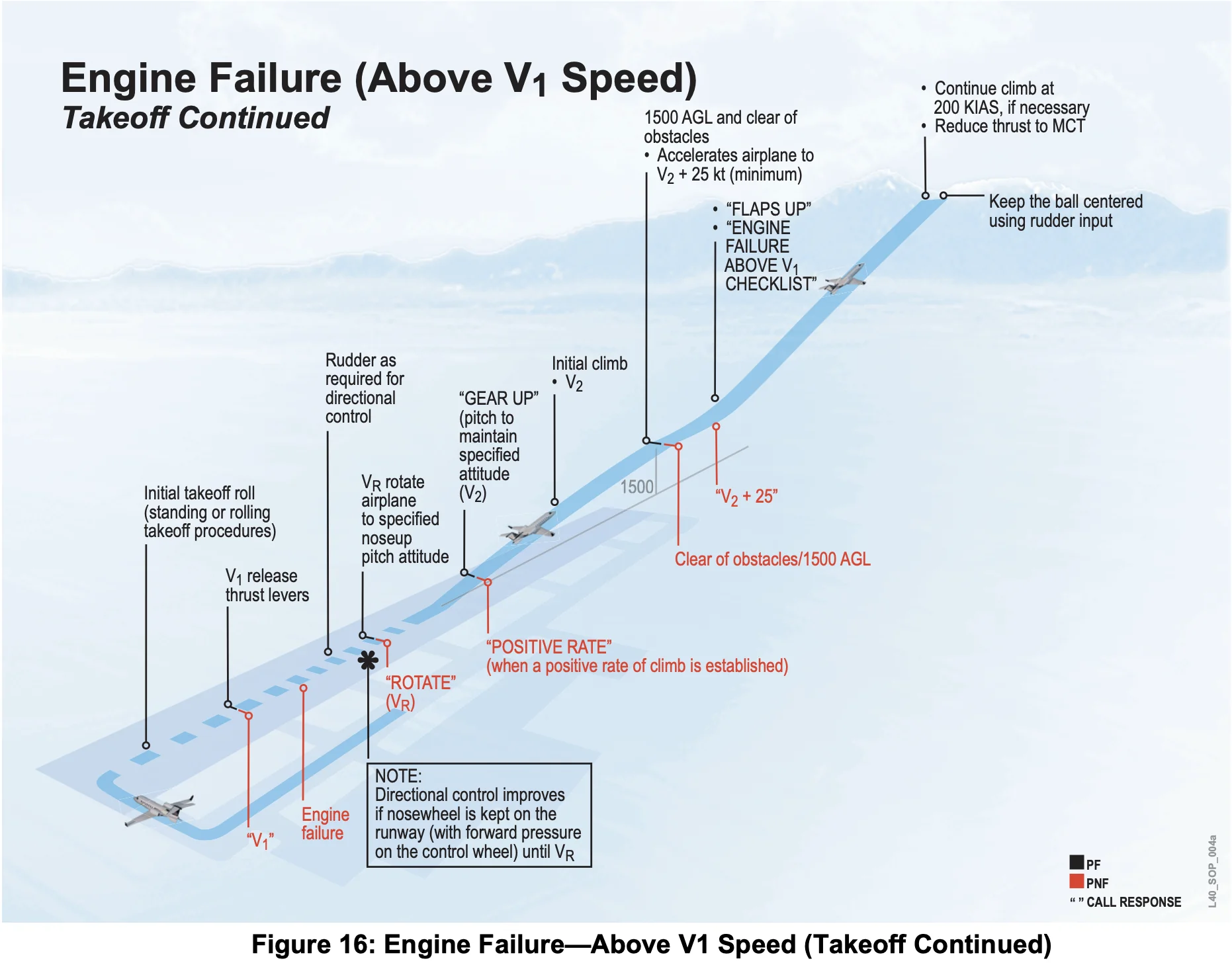
Steep Turns
- Minimum 5,000' AGL
- Select crosspointer flight director command bar
- Use
CUEbutton on display controller
- Use
- Ensure N1 sync on
- Start at 245 KIAS
- Approximately 71% N1
- Bump power 4% N1
- Call for PM to turn autopilot off
- Use AP button on flight guidance controller
- Leave YD on
- Roll to 45° bank
- 3-4 seconds of nose up trim
- Do 180° turns
- Lead roll-in/out by about 5° to 10° of heading
- Heading bug is 8° either side
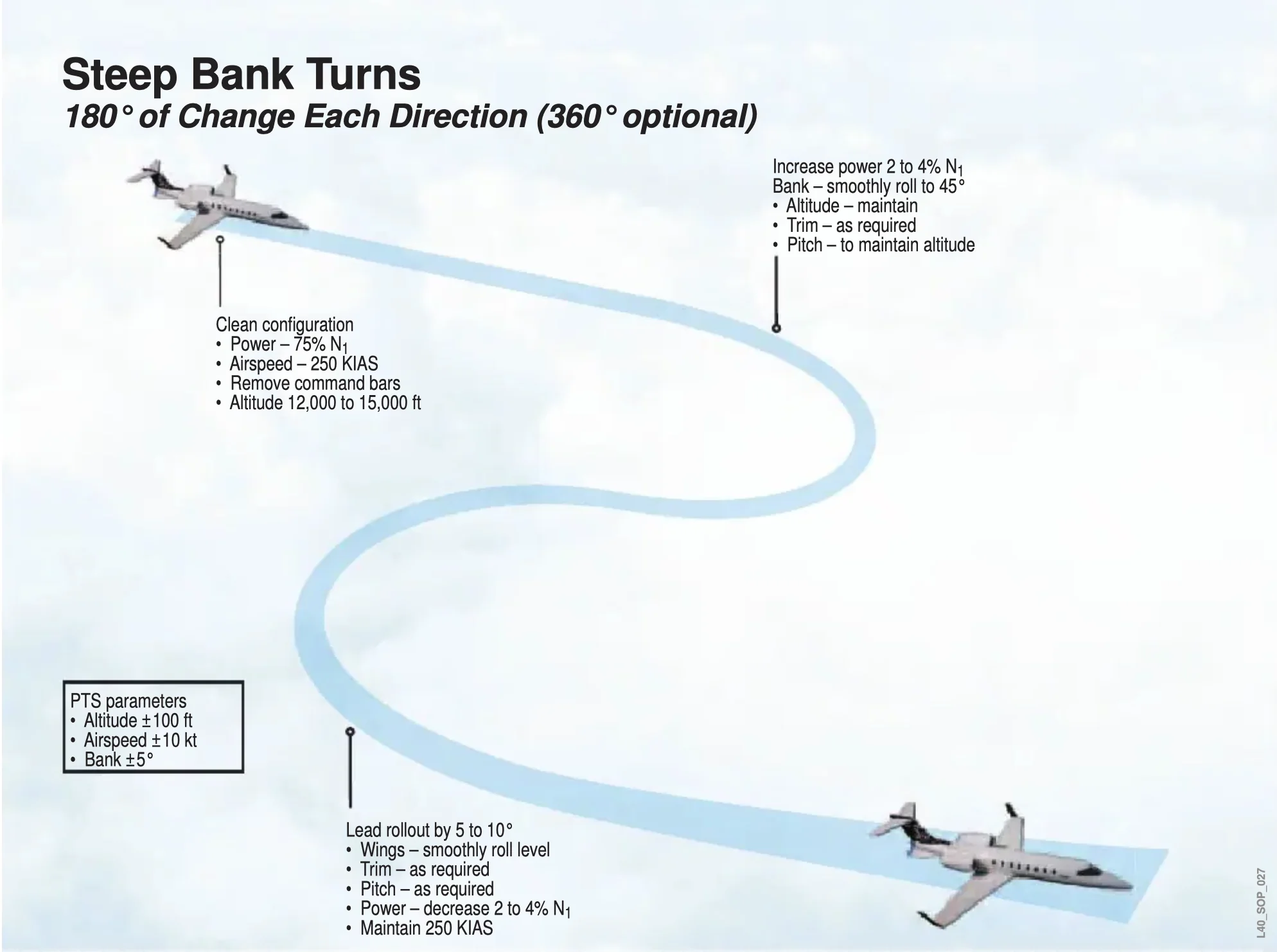
Stalls
- General Recovery Procedure
- Stall recovery -- lower nose = nose on horizon
- At higher altitude might have to go a few degrees below the horizon
- Only graded on recovery from stall
- Three chimes is autopilot disconnect -- silence with control wheel MSW when the autopilot disconnects and you start the stall recovery procedure.
- Lower the pitch attitude to reduce angle of attack.
- Thrust Levers T/O (manual APR, if required)
- Level the wings.
- Accelerate out of stall condition.
Clean Stall
- Thrust levers IDLE
- Spoilers until decelerating through 150 KIAS
- Maintain altitude
- Recover at first indication
- Recovery
- Lower the nose
- To the horizon
- T/O thrust
- Level wings
- Accelerate
- Lower the nose
- Press MSW for 2 seconds to silence audible alert
- At 130 KIAS start pitching up to return to starting altitude
- Make sure to bring power out and pitch down to return to starting altitude and 180 KIAS
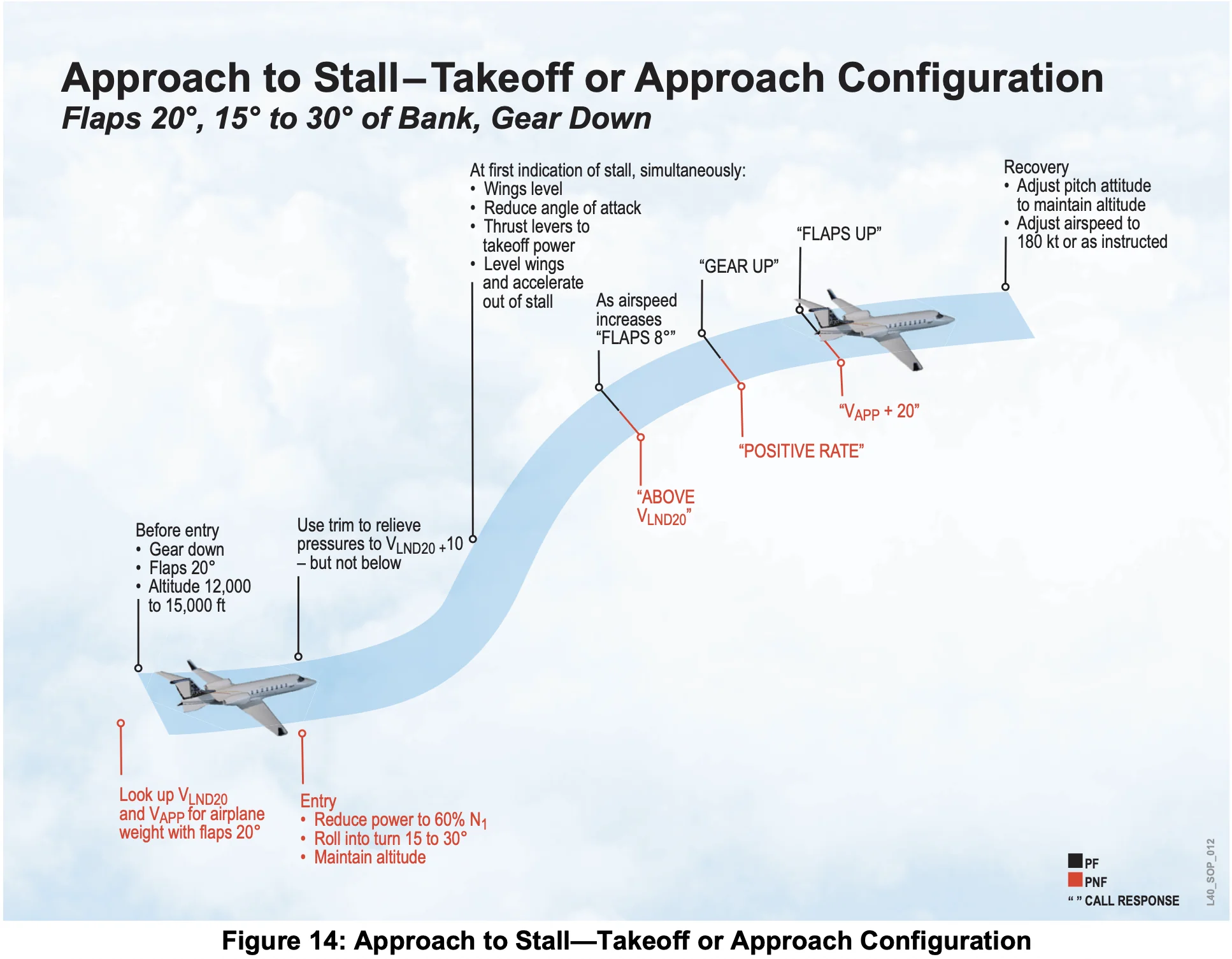
Takeoff / Approach Stall
- Configure
- Flaps 20°
- Bug VREF and VAPP
- Entry
- On departure will
- Set pitch mode and heading mode in AP
- Command a 90 degree heading change with AP as we are climbing
- Bring thrust levers to idle
- On departure will
- Recover at first indication
- Tip of chevron right to horizon
- Do not change configuration when airspeed is below VREF
- As the airplane accelerates above VREF
- PM should call out "VREF"
- Call "flaps 8°"
- When a positive rate of climb and increase in airspeed is indicated
- PM calls "positive rate"
- Call "gear up"
- When airspeed increases above VAPP + 20 KIAS
- PM calls "flap safety speed"
- Call "flaps up"
- VAPP is called Approach Climb Speed
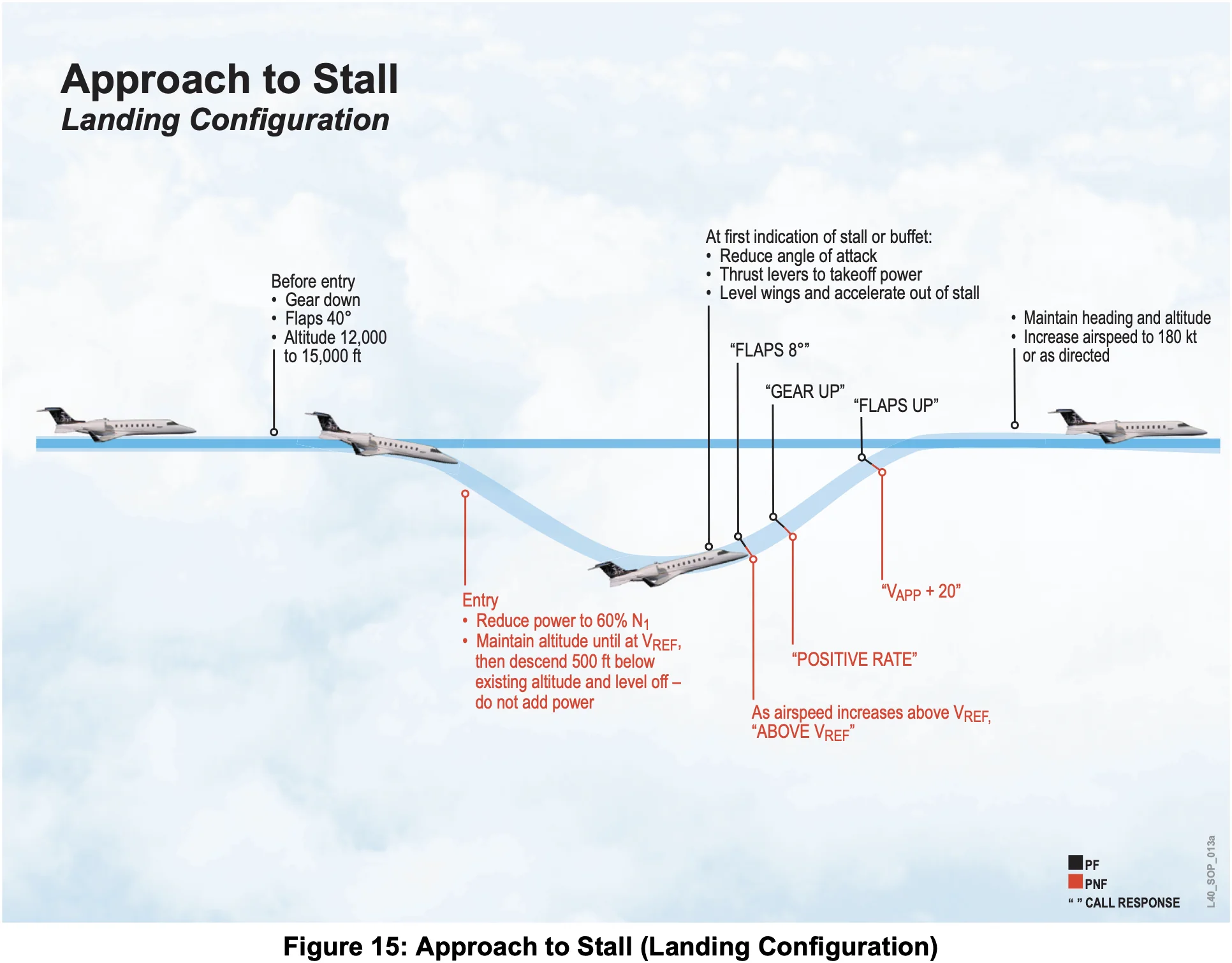
Landing Stall
- Configure
- Flaps 40°
- Gear down
- VSPDS set
- VREF = 122
- VAPP = 132
- Recovery
- Lower the nose
- Tip of chevron on horizon
- T/O thrust
- Wings level and accelerate
- Lower the nose
- Upon accelerating through VREF (as called by PM) the procedure becomes a normal two-engine go-around
- TOGA, power, pitch
- Press GA button
- (T/O thrust is already set)
- Pitch to 12-15° nose up
- Call for flaps 8°
- Wait for PM to call positive rate
- Call "gear up"
- PM should call flap safety speed (i.e. VAPP + 20)
- Call "flaps up"
- Call for HDG/NAV mode?
- Need to call for FMS source first?
- Call for speed mode
- "speed mode, bug VAPP + 20"
- Call for autopilot on
- Reduce thrust as needed to level off according to missed approach procedure / instructions
- TOGA, power, pitch
- Make sure to bring power out and pitch down to return to level flight at entry altitude and 180 KIAS
Unusual attitudes
- Minimum 5,000' AGL
- Look at all 3: both PFD and standby attitude indicator
- The pilot with the reliable attitude information assumes control and flies the recovery.
Nose High Recovery
- T/O thrust
- "In the sky power high"
- Call "Nose High Recovery, Verify Takeoff Thrust."
- Make sure spoilers down
- Leave the bank in OR increase to up to 60° until 10-15° degrees nose up pitch and start leveling wings
- Let that help reduce altitude
- Do NOT push forward due to negative G limits
- Back to straight-and-level
Nose Low Recovery
- IDLE thrust
- "In the brown, power down"
- Call "Nose Low Recovery, Verify Idle Thrust."
- Spoilers if needed
- Wings level
- Raise the nose
- Put power back in
- Lower spoilers
- Back to straight-and-level at original altitude
EGPWS Escape Maneuver
The following procedure should be employed for EGPWS recoveries:
- Disengage autopilot.
- Advance thrust levers to T/O or greater, verify spoilers retracted.
- Roll wings level.
- Smoothly apply back pressure on the yoke to raise the nose.
- Maintain an airspeed at least 10 kt above the low speed awareness cue.
- Configure flaps and gear for minimum drag.
- Once clear of obstacles or terrain establish level flight.
- Check airspeed and adjust thrust as required.
Engine Failure In Flight
- TODO@dwiese -- review drift-down
- Have copilot add rudder trim so you can keep flying
- Be very specific about what rudder trim you want, e.g. 3 units of right trim
- Make sure bus tie closed, and NON-ESS busses go off (step 6 of engine shutdown)
- TA only mode broadcasts to other aircraft we can't do RA (since single engine)
- When NOT to attempt engine restart
- Fire
- FOD
- Frozen
- Need ~60% N2 to do restart
Holding
- Recall holding airspeeds
- Up to 6,000' MSL = 200 KIAS
- 6,000' MSL to 14,000' MSL = 230 KIAS
- Above 14,000' MSL = 265 KIAS
Approaches
- Call for descent and approach checklists.
- Use acronym ABBBC when setting up for the approach
- A -- ATIS (PM)
- B -- Build - in FMS (PM)
- B -- Bug - depends ILS/LOC/VOR or RNAV (PM)
- Make sure for green-needle approaches "bug" is
- Localizer frequency
- Set course
- BARO mins
- For RNAV just set BARO mins
- Make sure for green-needle approaches "bug" is
- B -- Brief (PF)
- C -- Checklist
- When cleared for the approach
- Arm the approach
- Unless white needles and not yet in approach level of service then need to wait
- Taxi lights on
- Arm spoilers?
- Arm the approach
- Generally 180 KIAS is good airspeed to fly in the pattern or prior to the FAF
- About 54% N1?
- No power changes needed until past the FAF
- Precision
- Glideslope showing 2 dots above = flaps 20°, gear down
- Glideslope showing 1 dot above = flaps 40°
- Add a few percent N1 to hold VREF + 5 KIAS descending on GS
- Non-precision
- 2 miles before?
- 1 mile before?
- When putting in approach speeds (instead of takeoff speeds)
- VR = VREF
- V2 = VAPP
- Techniques for configuring
- Do not extend flaps until below 200 kts -- because after flaps 8 you can't use spoilers -- below 200 cant use spoilers but can use flaps 20 and gear to slow down
- As soon as you go to flaps 8 is good time to arm spoilers (since can't use them anymore anyway)
- Callout: AUX HYD ON -- GEAR DOWN
- Turning on the aux hydraulic pump before gear down is not prescribed in the checklist but is good practice
- Flaps 40° => call for before landing checklist
- Techniques for landing
- Don't flare just round out
- 50 feet power idle
- 20 feet a little back pressure to get mains to touch first
- Fully configured BY FAF (flaps 40°, gear down)
Circling
- We circle fully configured (flaps 40°, gear down)
- When on LOC and captured, set heading bug in anticipated direction of turn 45°
- Cleared to circle = heading mode
- Once wings level start timer for about 25 seconds
- At 25 seconds turn base
- When to descend below MDA on circling approach
- Once abeam 18L -- take right side of chevron and put it on horizon
- Kick off autopilot with nose down trim
- Min speed until final is VREF + 10 (while maneuvering, MINIMUM)
No-flap Approach
- No flare on no-flap approaches
- Centerline between mains and touching down in touchdown zone
Single Engine Approach
- Technique when being vectored flaps 8° and 180 KIAS
- Once you see GS starting to move -- flaps 20° and reduce power about 15%
- Will slow us to 132 KIAS
- GS half a dot high put gear down
- For NPA
- 3 miles out flaps 8° 180 KIAS
- 2 miles out flaps 20°
- 1 mile out gear down
Go-Around
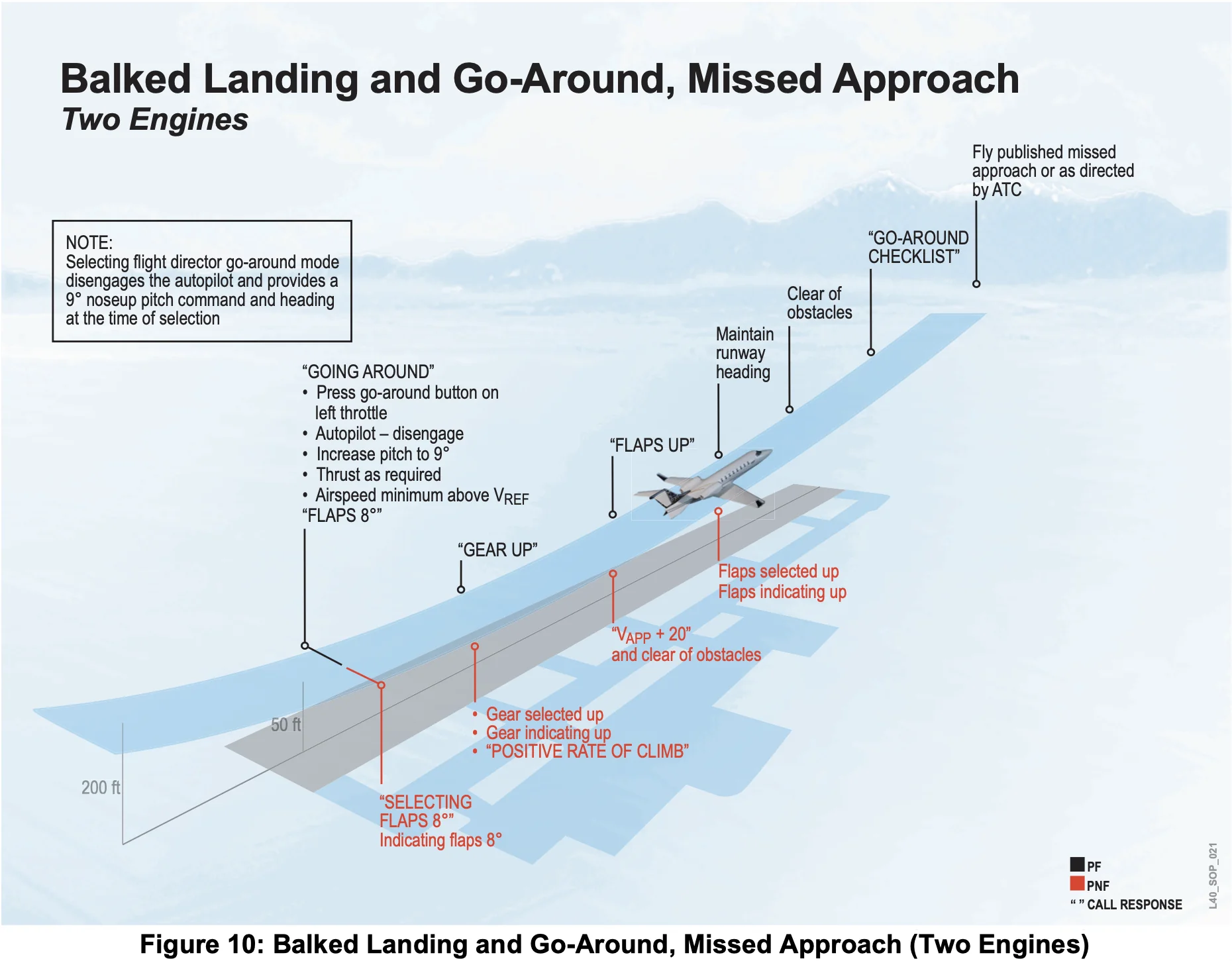
Two Engine Go-Around
- TOGA, power, pitch
- Press GA button
- T/O thrust
- Pitch to 12-15° nose up
- Call "go around"
- Call "flaps 8°"
- Wait for PM to call positive rate
- Call "gear up"
- Call for speed mode
- "speed mode, bug V2 + 20"
- Recall, V2 bug indicates VAPP (approach climb speed)
- Call for HDG/NAV mode?
- Need to call for FMS source first?
- PM should call flap safety speed (i.e. VAPP + 20)
- Call "flaps up"
- Call for autopilot on
- Reduce thrust as needed to level off according to missed approach procedure / instructions
- Call for go-around checklist
Single Engine Go-Around
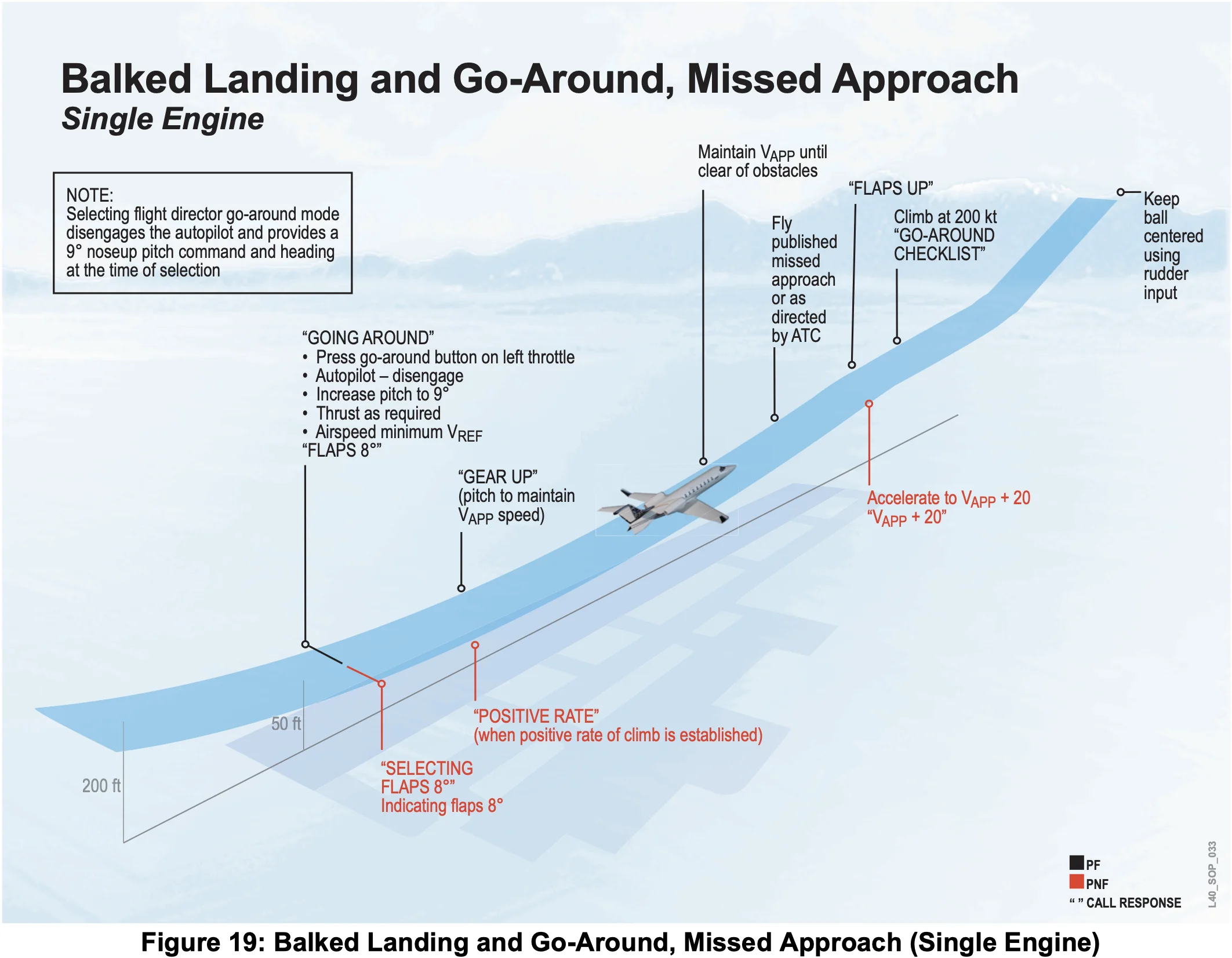
- Memorize: VAPP (Approach Climb Speed) is single engine, flaps 8 go-around speed that we set in V2 bug.
- Procedurally single engine go-around is same as two-engine go around
- TOGA, power, pitch
- GA button
- T/O thrust
- Pitch to 9° minimum
- FD is single engine go-around at max gross weight
- Call "go around"
- Call "flaps 8°"
- Wait for PM to call "positive rate"
- Call "gear up"
- Call "speed mode, bug V2"
- Which is set to contain VAPP (approach climb speed)
- Call "HDG/NAV mode"
- Whichever is appropriate
- Obstacle clearance altitude, accelerate to V2 + 20
- Call "flaps up"
- Call for go-around checklist
Landing
- Note: "Landing" checklist in title of checklist indicates it's the final and only checklist we need to run
After Landing / Clearing Runway
- Done by PM
- 2 unlocked, 2 deployed -- wrt to the TRs so can indicate to PF if only one deploys
- Most airports want transponder in ALT mode until at ramp spot
- Step 11. Thrust Lever -- CUTOFF
- Only if doing single engine taxi
Shutdown
- Done by PF (read-and-do, PM reads, PF does)
- Don't turn mains off BEFORE EMER or will deploy oxygen masks!!!!
- Just follow ordering: step 14 is EMER BAT Switch -- OFF, step 15 is L and R BATT switches -- OFF
- When shutting down the APU it's not powering anything
- But not bad idea to turn off APU GEN
- See page 35 ... ?
- Wait 30 seconds before APU master off
- When R STBY fuel pump turns off that indicates 30 seconds
Emergency Procedures
LR GEN FAIL
- Checklist
- FLOOD Light -- the knob is on pilot side crew light panel
- Standby Pitot Heat -- it is controlled from the "R PROBES" button
Engine Failure
No specific red CAS message for engine failure, see e.g. L OIL PRESS LOW red CAS
- During takeoff -- memory items then checklist
- During flight -- checklist
Abnormal Procedures
Hydraulic Failure
- Checklist