E55 Baron (Late) Maneuvers
This document provides maneuvers guidelines developed for Baron N322ET.
Notes
- Always reach over the bar to access e.g. flaps and gear handle
- This keeps hand closer to throttles in case an engine quits and we need to run "The Drill"
- Use more complete grip on throttle levers, not just fingers
- "The Drill": Flaps up first then gear up
- Engine failure below 3,000' AGL, secure the engine come back and land
- Above 3,000' AGL, can attempt a restart
- CGUMPS
- Cowl flaps: closed
- Gas: fuel selectors on
- Undercarriage: gear down
- Mixture: full rich
- Props: leave at 2500 RPM
- Switches and seatbelts
- Landing light on
- Buckled in
- Hands on throttles during critical phases and maneuvers e.g. VMC demo
- When scissoring from one engine high power and the other one idle or simulated feather, bring the high power engine back to 15" first, then the low power engine up to 15" second.
- When making power changes from or to OEI, the amount of right aileron to counter rolling tendencies was larger than expected, and needs to be well coordinated (along with rudder) with these power changes
- The climbs/descents combined with heading changes that we used were 30° and 200 ft
- When starting the right engine make sure the door isn't propped open
The Drill
- When encountering the "feather" step, also make sure to pull mixture to idle-cutoff
- Say: simulated (left or right) feather
- Say: simulated (left or right) mixture idle cutoff
- Can go props full forward during "The Drill" but in every other maneuver, including landings, just leave them at 2500 RPM
Engine failure during takeoff before VR
is 80 KIAS and is 84 KIAS, so an engine failure before we are still on the ground - Guidance in AFM is to simulate the failure at a speed of no more than 50 percent
so 40 KIAS - Throttles to idle
- Maintain centerline
- Brake as needed
Normal takeoff
- Flaps up
- Hold brakes
- Throttles full
- Gauges green
- Rotate
84 KIAS - Positive rate, gear up
- Climb
102 KIAS - By 500 AGL
- Throttle 25"
- Prop 2500 RPM
- 1000 AGL
- Run the climb checklist
- Disregard the airspeed target of 115 KIAS on the checklist that need not exist between initial
climb and transitioning to "cruise climb" at 130 KIAS
- Disregard the airspeed target of 115 KIAS on the checklist that need not exist between initial
- Pitch for 130 KIAS
- Run the climb checklist
- Expect under normal training scenarios a ground roll of around 1,400'
- 95 °F, 2,000' pressure altitude, full fuel with 420 lb of occupants and baggage, no headwind
- Notes
- Lots of right rudder needed
- Due to rudder being on springs, it is initially a ton, then able to relax slightly
- KHQZ field elevation: 447' so 500 AGL = 950
- KADS field elevation: 645' so 500 AGL = 1150
- At KHQZ turn crosswind at 1200'
- Until alternator annunciator is fixed, leave landing lights on
- This draws a bit more current so it doesn't falsely trigger the alternator annunciator
- Initial altitude bug to 3,500' until clear of the 4,000' Bravo ceiling, then bug 4,500'
- It is OK to fly level at 25" and 2500 RPM so power is already set for subsequent climb from 3,500' to 4,500'
Short-field takeoff
- Like normal takeoff but pitch for
(87 KIAS) +/-5 KIAS initially - Rotate
84 KIAS - Climb
87 KIAS - Notes
- Because
is 84 KIAS and is 87 KIAS and climb performance is so good, the pitch and holding of 87 KIAS until we call out "obstacle cleared" at 100' AGL will not be a long time - At 100' AGL call out "obstacle clear" and pitch for
102 KIAS
- Because
Pre-Maneuver Checks
- Climb to 4,500' for initial maneuvers
- CHAPS
Steep turns
- Prop: 2500 RPM
- Start at 20"
- 145 KIAS
- Turning left
- Throttle: 22"
- Pitch: 2° below the horizon
- Right turn
- Throttle: 23"
- Pitch: level with the horizon
- The additional power in right turns is to fight against left turning tendencies
- 50° bank
- Notes
- Use 4,500' MSL to start maneuver
- Recommend against using trim, it's more difficult to dial in the correct amount of trim than it's worth
- Start roll out 10° before target heading
- Tolerances
- Altitude: +/-100 ft
- Airspeed: +/-10 kts
- Bank: +/-5°
- Heading: +/-10° on rollout
Slow flight
- Throttle: 15"
- Prop: 2500 RPM
- Below 152 KIAS
- Gear down
- Flaps 15°
- Below 121 KIAS
- Flaps full
- Throttle: 19"
- Target 90 KIAS
- Climb: full power
- Descent: 15"
- Bank: 5°
- Recovery
- Full power
- Flaps 15°
- Above 102 KIAS, flaps up, gear up
- Notes
- Minimum altitude 3,000' AGL (to complete maneuver, per AFH)
- Use 4,500' MSL to start maneuver
- Pitch for airspeed, power for altitude
- Tolerances
- Altitude: +/- 50 ft
- Heading: +/- 10°
- Airspeed: +5/-0 kts
- Bank: +/-5°
- Minimum altitude 3,000' AGL (to complete maneuver, per AFH)
Power-off stall
- Throttle: 15"
- Prop: 2500 RPM
- Below 152 KIAS
- Gear down
- Flaps 15°
- Below 121 KIAS
- Flaps full
- Establish descent at 95 KIAS
- Power to idle
- Maintain altitude
- At first indication recover
- Lower nose (pitch -5° to -10°)
- Full power
- Level wings
- Flaps 15°
- This is part of the expeditious flow above, there is no checking of airspeed or trend
- After flaps 15° put your hand right back on the throttle and wait patiently
- Pitch for 87 KIAS (
) - As 87 KIAS approaches smoothly pull up, but not too briskly
- Pitch for 102 KIAS (
) - Look for positive rate on altimeter
- Flaps up
- Gear up
- Recover to level cruise flight
- Notes
- Minimum altitude 3,000' AGL (to complete maneuver, per AFH)
- Use 4,500' MSL to start maneuver
- Tolerances
- Heading: +/- 10°
- Minimum altitude 3,000' AGL (to complete maneuver, per AFH)
Power-on stall
- Throttle: 12"
- Prop: 2500 RPM
- At 102 KIAS Throttle: 16"
- Slowly pitch up
- Recover
- Lower nose (pitch -2.5°)
- Full power
- Pitch for 87 KIAS (
) - As 87 KIAS approaches smoothly pull up, but not too briskly
- Pitch for 102 KIAS (
) - Recover to level cruise flight
- Notes
- Minimum altitude 3,000' AGL (to complete maneuver, per AFH)
- Use 4,500' MSL to start maneuver
- Minimum altitude 3,000' AGL (to complete maneuver, per AFH)
Accelerated stall
- Throttle: 16"
- Prop: 2500 RPM
- 115 KIAS
- Bank: 45°
- Recovery
- Reduce angle of attack
- Then roll wings level
- Throttles full
- Climb at
102 KIAS - Throttle: 15"
- Notes
- Roll smoothly into 45° and get established, being mindful of overbanking tendencies
- Once established, the brisk pull back requires quite a bit of force
- Reduction of angle of attack in recovery should just be a relaxing of back pressure, not a push down
- Should not lose altitude in the maneuver in recovery
- Minimum altitude 3,000' AGL (to complete maneuver, per AFH)
- Use 4,500' MSL to start maneuver
VMC demo
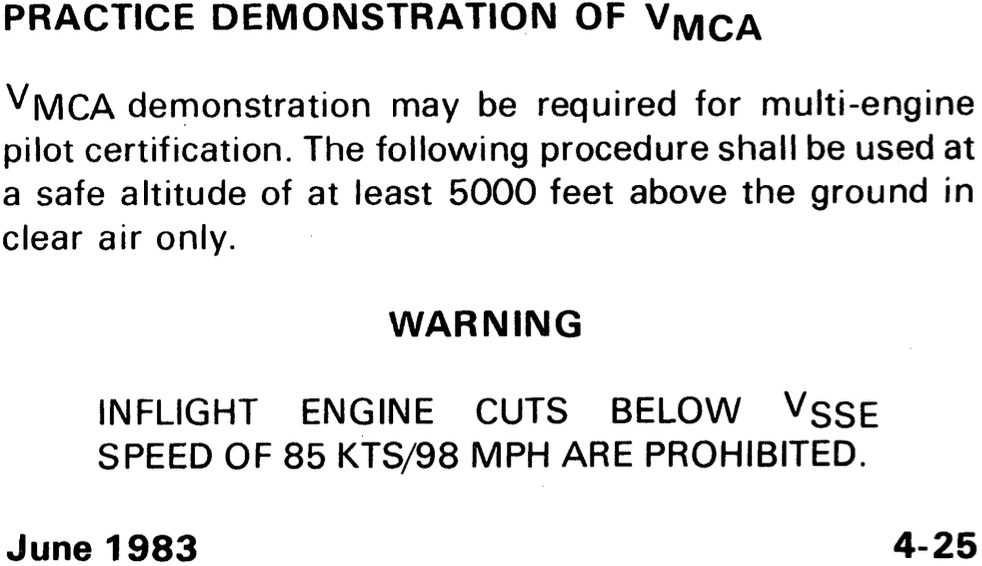
- Throttle: 14"
- Prop: 2500 RPM
- Airspeed: 110 KIAS
- Left throttle: slowly close
- Right throttle: slowly full
- Right rudder and right aileron simultaneously with added power to maintain directional control with wings level
- Pitch up to decelerate no faster than 1 KIAS per second
- Recover at first indication of loss of directional control, stall warning, or buffet (including red line)
- Recover
- Right throttle close
- Pitch below horizon (pitch -10°)
- Do this simultaneously with closing throttle
- Above 85 KIAS (
) right throttle full - Airspeed: 99 KIAS (
) - After established in a
climb recover to level flight and scissor the throttles together 15" - When scissoring it's easiest to bring the right throttle from full back to 15" first, and then the left throttle from idle to 15"
- Notes
- Minimum altitude 5,000' AGL (per POH)
- Use 7,500' MSL to start maneuver
- On recovery, when pulling power back on operative engine, do so promptly (ACS wording) but not doing it abruptly will make coordination with rudder easier.
- On recovery, wait patiently for
and add power smoothly to catch and maintain airspeed - After establishing a
climb, do not wait to be told to recover, just recover - Tolerances
- Airspeed: +/- 5 kts
- Heading: 20° on recovery
- Minimum altitude 5,000' AGL (per POH)
Drag demo
- Want to show how the drag associated with configuration changes affects the OEI climb rate at
- Start maneuver like
demo but will pitch not to continue to bleed of airspeed, but to hold (99 KIAS) - Throttle: 14"
- Prop: 2500 RPM
- Airspeed: 110 KIAS
- Left throttle: slowly close
- Right throttle: slowly full
- Right rudder to maintain directional control
- Airspeed 99 KIAS (
), note VSI for each of the following - Failed engine cowl flaps closed
- This is to protect that engine from being overcooled
- Gear - down
- Flaps – 15°
- Flaps - full
- Failed engine – simulate feather
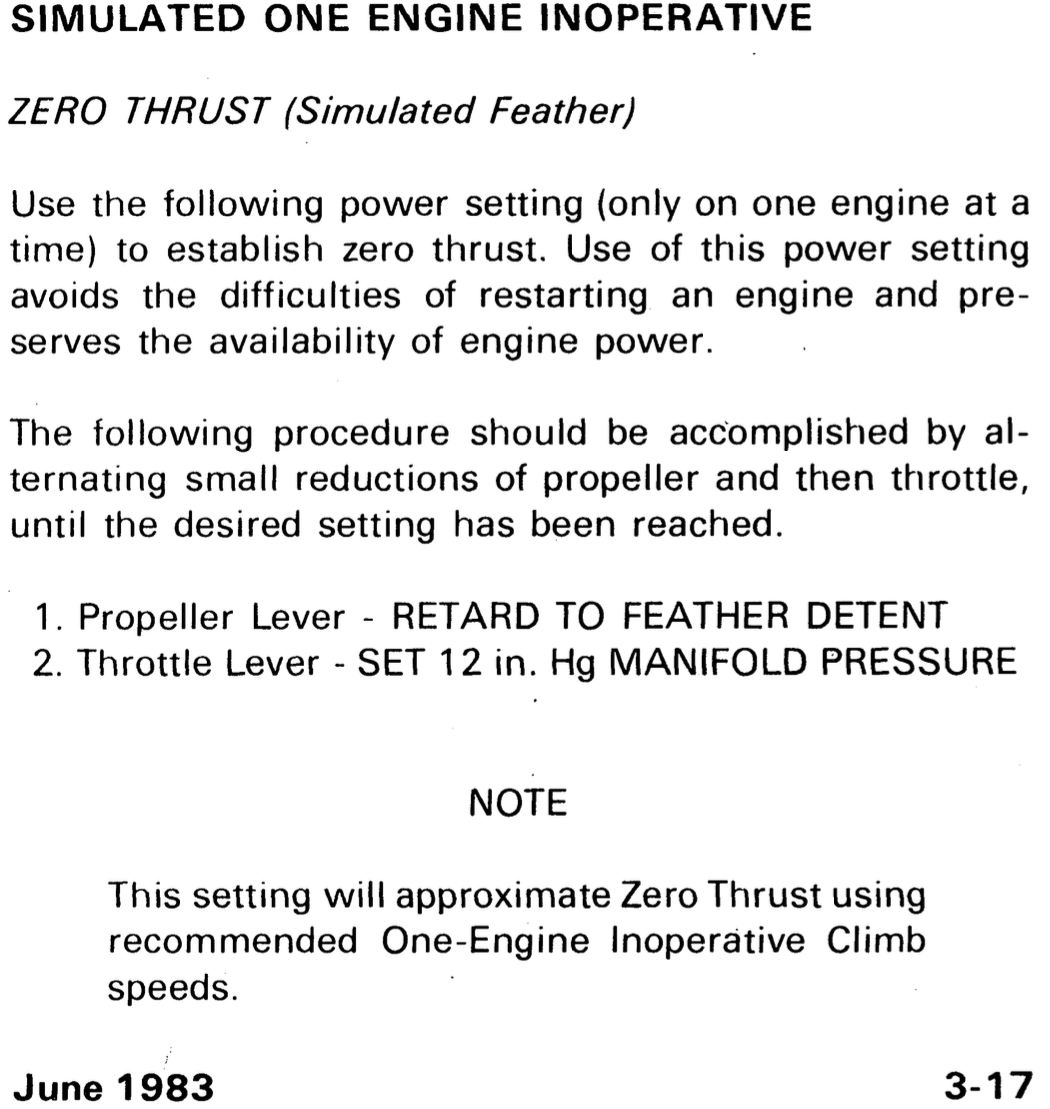
Prop lever to feather detent- Throttle: 12"
- POH page 3-17
- Flaps – 15°
- Flaps – up
- Gear up
- 93 KIAS
- 105 KIAS
- Cowl flaps open
- Failed engine cowl flaps closed
- Recover
- Straight and level flight with both engines
- When scissoring it's easiest to bring the right throttle from full back to 15" first, and then the left throttle from idle to 15"
- Warm up "dead" engine
- Throttle: 15"
- Prop: 2000 RPM
- Reopen cowl flap on failed engine as needed
- Let CHTs get over 200 °F
- Notes
- Can start a bit faster than 110 KIAS, all we need to do in the end is establish
- Can start a bit faster than 110 KIAS, all we need to do in the end is establish
Engine Shutdown
- Can be performed by turning a fuel selector off
Maneuvering OEI
- Notes
- When turning towards the dead engine, can use two approaches
- Just turn wings level and relax rudder pressure to allow the yaw to help turn
- Can reduce power on the operative engine and accept sacrificing some altitude to help turn towards the the dead engine
- When reducing power, use 15"
- Tolerances
- Altitude: +/-100 ft
- Airspeed: +/-10 kts
- Heading: +/-10°
- When turning towards the dead engine, can use two approaches
Engine Restart
- Follow the checklist
Emergency Descent
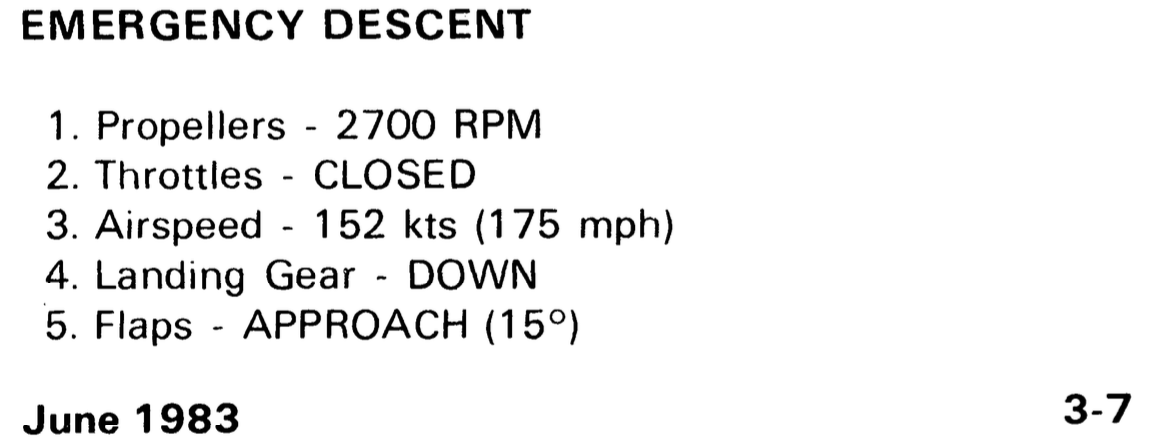
- "Chop -- Drop --
Prop" - Throttle: idle
- Gear down
- When below 152 KIAS
- Prop: 2500 RPM
- Bank 30° away from burning or dead engine
- Pitch 15-20° nose down
- Airspeed: 140 KIAS
- Recover
- 400 feet above target altitude roll wings level
- Gear up
- Notes
- POH calls for props full forward, we won't do it to avoid overspeeding the props
- We must no overspeed the gear, so there is hard limit at 152 KIAS, hence the 12 KIAS buffer
- The POH calls for flaps 15°, but it doesn't increase the descent rate substantially so we don't do it
- Don't forget to put the gear up
OEI instrument approach
Precision Approach
- Precision approaches (after the FAF) are done at 99 KIAS (blue line)
- 115 KIAS before the FAF
- About 20" for level flight
- One dot above glideslope/glidepath run GUMPS
- Gear down, and flaps 15° comes with it
- This works well so that right at glideslope intercept we are at 99 KIAS (Blue Line)
- Reduce power to 16-18" and descend on glideslope
- OEI approach, full flaps when landing is assured (that is key phrase)
- If low minimums, we might break out at 200' AGL, in which case do not plan on using full flaps (unless making a configuration change so low and the risk of destabilizing the approach outweighs the need of e.g. a very short runway)
- Page 3-3 of POH says minimum 99 KIAS approach and on final minimum 90 KIAS
- 12" on inoperative engine to give zero thrust
- The POH page 3-17 says to retard the prop to the feather detent, but we leave at 2500 RPM
Normal landing
- Throttle: 16" entering downwind clean
- Prop: 2500 RPM
- 115 KIAS in pattern
- Midfield downwind
- Run CGUMPSS
- Any time gear comes down, also bring flaps 15°
- Ideally get configured by the time we reach abeam touchdown point 1000' markers
- By the time abeam touchdown point or 4 mile final
- Gear down, flaps 15°
- Throttle: 18"
- 115 KIAS
- Should give about 500 fpm descent
- Start the turn to base a bit before the 45° so pattern does not get too long
- Base or 2 mile final
- Flaps full
- 110 KIAS
- Throttle: 15"
- Final
- Throttle: 13 - 15"
- 99 KIAS
- 95 KIAS Short final
- Power to idle over the threshold
- Power idle by the 500 foot markers to touch down on 1000 foot markers
Short-field landing
- Same approach as normal landing
- Need to hit touchdown point within 100 ft
- Call out "simulated flaps up" and "simulated maximum braking"
- Notes
- ACS requires not more than 1.3
which is 95 KIAS in N322ET with of 73 KIAS - Tolerances
- +100 / -0 ft of touchdown point
- +/- 5 kts
- ACS requires not more than 1.3
Engine failure after VR, no runway remaining
- Run the drill
- This becomes OEI pattern
- Fly pattern at normal airspeeds
- 115 KIAS downwind
- 110 KIAS base
- 105 KIAS final
- Configuration before abeam touchdown point the same as normal landing
- When abeam touchdown point gear down only
- When on base, flaps 15°
- When on final, flaps 30°, only if landing is assured
Engine failure after liftoff
- 400' AGL minimum for training
- If gear is up
- Pitch 99 KIAS (
) - Or 96 KIAS (
) as needed
- Or 96 KIAS (
- Execute memory items
- Pitch 99 KIAS (
- In real-life, if gear is down
- Throttles to idle
- Land straight ahead
Go-around
- Full power
- Pitch 102 KIAS (
) - Positive rate, flaps up to 15°
- Positive rate, flaps up
- Gear up
- 500' AGL
- 25"
- 2500 RPM
- 1000' AGL
- 115 KIAS