CFI Study Guide
Fundamentals of Instruction
I.A. Human Behavior and Effective Communication
- What is Human Behavior? Why is important to instructors?
- Human behavior - product of factors that cause people to act in predictable ways.
- And is the the result of attempts to satisfy certain needs
- By observing human behavior, an instructor can gain the knowledge needed to better understand him or herself as an instructor as well as the learning needs of learners.
- Understanding human behavior leads to successful instruction.
- Understand
- Motivation for flying
- Fatigue / anxiety in personal life
- What learning style works best
- Communication style
- Understand
- Human behavior - product of factors that cause people to act in predictable ways.
- Your student began his training very well, but recently seemed very distracted. You find out that his wife's medical treatments are not progressing well and are stretching the budget. What might you suggest?
- Such deep and prolonged stress is going to cause chronic fatigue, and impair the student's ability to learn, and compromise safety.
- Given this, the student should focus on his family's health and making sure their financial needs are met before returning to flight instruction.
- What are 3 defense mechanisms you might see from a student?
- DR CPR DR F
- Denial
- Refusal to accept external reality because it is too threatening
- A form of repression
- Ignores the problem
- "My landings are fine, landing half way down the runway is no big deal."
- Repression
- When a person places uncomfortable thoughts into inaccessible areas of the unconscious mind.
- For example, after the CFI recovers the airplane from an inadvertent spin, the student might not be able to recall any memory of the event.
- Compensation
- Psychologically counterbalancing perceived weaknesses by emphasizing strength in other areas
- "Maybe I was off course, but I held altitude like a pro and you know it!"
- Projection
- Relegating blame for personal shortcomings, mistakes, and transgressions to others
- "My landing was bad because my instructor had me land on a runway I've never landed on before"
- Reaction Formation
- Faking of a belief opposite to the true belief because the true belief causes anxiety
- "I don't care what people think of me..." when really they are lonely and long for acceptance.
- Displacement
- Unconscious shift of emotion, affect, or desire from the original object to a more acceptable, less threatening substitute
- For example get mad at something else instead of instructor
- Rationalization
- Subconscious technique for justifying actions that otherwise would be unacceptable
- Making excuses
- Learner cannot accept real reasons for their behavior
- "I am a very safe pilot, it's the examiner's fault that he doesn't see that."
- Might be the first defense mechanism we will see as CFI
- Fantasy (Daydreaming)
- When a learner engages in daydreams about how things should be rather than doing anything about how things are
- A mental escape from frustrating situations
- For example dreaming of being a successful airline pilot rather than actually committing to the hard work required to reach that goal.
- What is the difference between stress and anxiety?
- Stress is the body's response to demands placed upon it.
- A certain amount of stress is good since it keeps a person alert and prevents complacency.
- However, the effects of stress are cumulative and, if not coped with adequately, they eventually add up to an intolerable burden.
- Anxiety is a feeling of worry, nervousness, or unease, often about something that is going to happen
- Counter anxiety by emphasizing enjoyment of flying
- Teach students to cope with their fears
- Stress is the body's response to demands placed upon it.
- How can you develop your instructional communication skills?
- RILQI
- Role Playing
- Learner is provided with a general description of a situation and then applies a new skill or knowledge to perform the role
- e.g. CFI learner flies with another CFI who plays role of student pilot
- Need to think it terms of SBT
- Instructional Communication
- Instructors perform better when speaking of something they know very well and for which they have a high level of confidence
- The instructor should not be afraid to use examples of past experiences to illustrate particular points
- The aviation learner should know how and why something should be done before doing it
- Listening
- Listening is "hearing with comprehension."
- Certain emotions interfere with how learners listen
- A listener should always ask, what is the purpose of what I am listening to? By doing this, the listener can relate the words to the overall concept.
- Learner can take notes
- Know your students before teaching them. Listening goes both ways, both instructor and student need to want to listen to each other.
- Questioning
- Good questioning can determine how well the learner understands what is being taught
- Focused questions allow the instructor to concentrate on desired areas
- Open-ended and closed-ended questions can both be used
- Effective questions are adapted to the learner
- Instructional Enhancement
- CFI should continue develop their skills well above the level of material they are teaching.
- As an instructor: never stop learning
I.B. The Learning Process
- What is the definition of Learning?
- Learning - the change in behavior that results from experience and practice.
- What is an example of a behaviorism skill that you will teach your student?
- Use of checklists
- Not much deep understanding required to acknowledge their importance, and then to use them.
- For example remembering to use the checklist after landing and rewarding them with praise.
- What is an example of a cognitive skill that you will teach your student?
- Higher order thinking of cognitive theory goes beyond what I'd consider simply a skill, but rather changing how they think, understand, and feel.
- For example, would teach them to have a positive attitude towards safety, and develop good risk management skills.
- Also teach through the use of scenarios good aeronautical decision making.
- What is a learning plateau? How can you help your student overcome it?
- A temporarily decreased or stalled rate of learning
- Let learner know it's normal, only temporary, and not to get discouraged
- Move to another portion of the curriculum
- Most likely to occur pre-solo
- Pre-solo this can happen with making radio calls and/or landings
- Also be sure to set expectations ahead of time, and let them know that plateau at this stage is common, and then after solo the rest of private pilot training goes quickly
- What are the principles (or laws) of learning?
- REEPIR
- Readiness
- The basic needs of the learner need to be satisfied before he or she is ready or capable of learning
- Learners make more progress if they have a clear objective
- Effect
- Behaviors that lead to satisfying outcomes are likely to be repeated
- Based on the emotional reaction of the learner
- Exercise
- Practice / "use it or lose it"
- Primacy
- What is learned first is most sticky
- Creates strong unshakable impression
- Important to teach things right the first time
- Intensity
- More vivid learning experience more likely to be remembered
- The less intense experiences e.g. classroom learning still very important
- Recency
- What is learned most recently is also sticky
- Readiness
- REEPIR
- When do you think Scenario Based Training (SBT) is most useful in primary flight training?
- For teaching higher-order thinking skills / aeronautical decision making. (HOTS/ADM)
- Where the student needs to be placed in a unique situation with many possible solutions.
- For example, a low fuel emergency scenario during a cross-country flight might provide a good example scenario to have the student talk through their ADM, and provide opportunities to understand, critique, and improve their thought process.
- What is the difference between a slip and a mistake?
- Slip - Knew what to do and just accidentally did something else
- Planned to do the correct thing and inadvertantly did the wrong thing
- e.g. briefed an airspeed, power setting, altitude, or other configuration properly for a maneuver and then just did the wrong thing
- Mistake - A judgment or action that is misguided
- Planned to do the wrong thing and succeeded
- Just did not know or do the correct thing, like flying into a thunderstorm because they didn't check the weather.
- Slip - Knew what to do and just accidentally did something else
I.C. The Teaching Process
- What are 5 advantages of Computer-Assisted Learning (CAL) over classroom instruction?
- Reduces cost
- Allows flexible schedule
- Accessible anywhere
- It's self paced
- Interactive and can respond to learner inputs
- Less time can be spent on traditional ground school and can spend more time on integration and correlation of learning
- Allows instructor to follow student progress
I.D. Assessment and Critique
- What are 3 methods of critiquing a student's performance?
- Instructor critique
- Written or oral
- Self-critique
- Good for seeing if students perceptions are correct
- Avoids triggering defense mechanisms
- Individual critique by another learner
- Another learner to presents the entire assessment
- Small group critique
- The class is divided into small groups, each assigned a specific area to analyze
- Instructor/learner critique
- Instructor leads
- Members of the class are invited to offer criticism of a performance
- Learner-Led Critique
- A learner leads the class through the assessment
- Instructor critique
I.E. Instructor Responsibilities and Professionalism
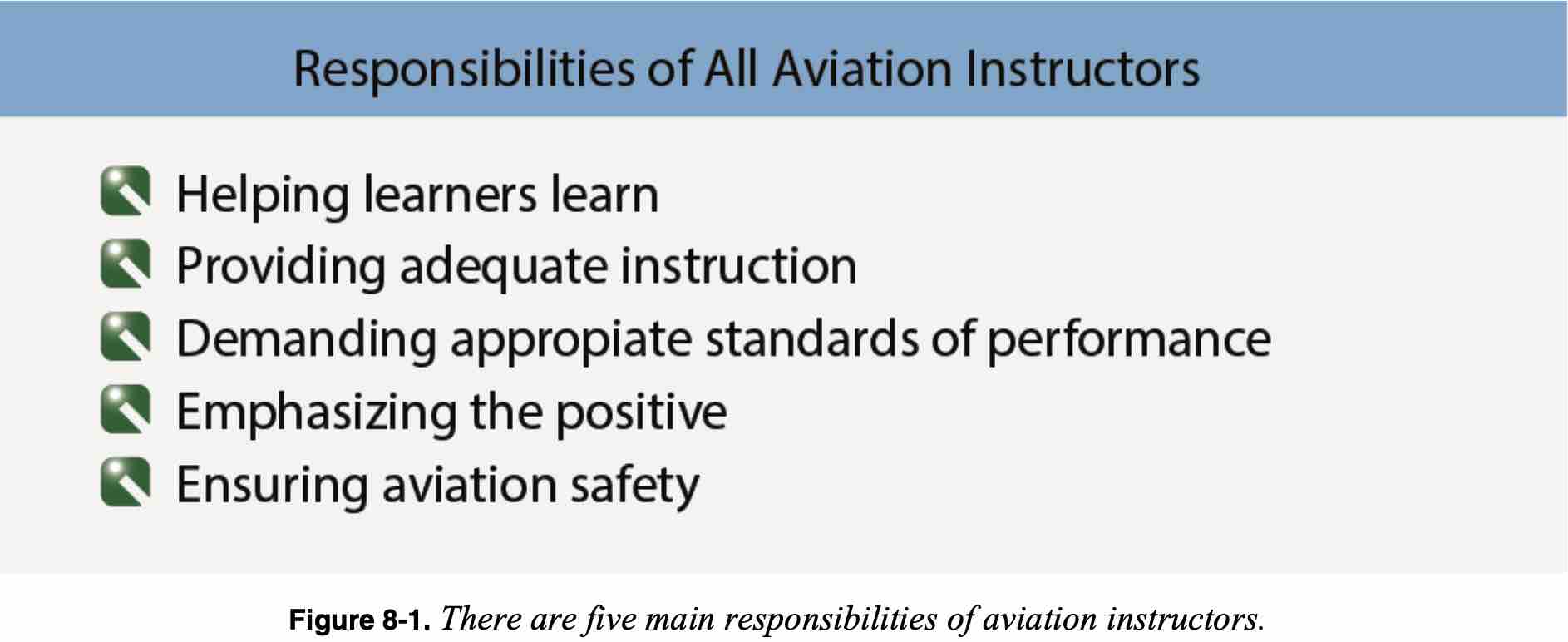
- What are the 5 main responsibilities of CFIs regarding the learning process?
- LISES
- L - Helping students learn
- I - Provide adequate instruction
- S - Demanding adequate standards of performance
- E - Emphasizing the positive
- S - Ensuring aviation safety
- How can you ensure that adequate instruction is provided to your student?
- CNMFSPQ
- Proper design and use of curriculum starting with overall learning objective, blocks, to lesson plans
- Ensure their basic needs are met first before instruction
- Need to understand students so you can communicate with them well and motivate them
- Explain the purpose for why we are doing different things throughout instruction
- Make learning fun, and remind them of the enjoys of flying
- Give them safe environment in which to learn
- Come prepared, on time, well informed, and be confident
- Ask good questions to see if they are learning and adjust teaching style if needed
- Present problems and opportunities to apply what they have learned
- When should ACS/PTS standards be introduced in flight training?
- FAA says introduce 3 hours before checkride
- This was from a previous edition of Aviation Instructor's Handbook, but doesn't seem to be in the latest
- There is ambiguity in FAA docs about how the ACS/PTS should be used
- AIH page 5-26: "Another example of enhanced, instructor-oriented material for pilot training is a maneuvers guide or handbook which includes the ACS as an integral part of the description of maneuvers and procedures."
- Or: "How did your performance compare to the standards in the ACS?"
- Some FAA written exam sample questions (e.g. King schools) also stated that the ACS/PTS should be used in training
- Other references say that ACS/PTS should not be used for training
- AIH page 8-2: "It should be emphasized that the ACS/PTS book is a testing document, not a teaching document."
- AIH page 9-1: "The ACS/PTS is not a teaching tool. It is a testing tool."
- Introducing the standards prematurely could create unhelpful stress on a new pilot
- It could also create complacency in a good pilot who can fly within the standards early, and then you'd have to tighten up the standards and hold them to a higher standard
- Introducing the standards too late could increase the amount of time the student is putting in reps flying the maneuvers outside of standards
- A good time to introduce them is once the student is able to generally perform the maneuver correctly, but not within the standards, and then use the standards to raise the bar
- FAA says introduce 3 hours before checkride
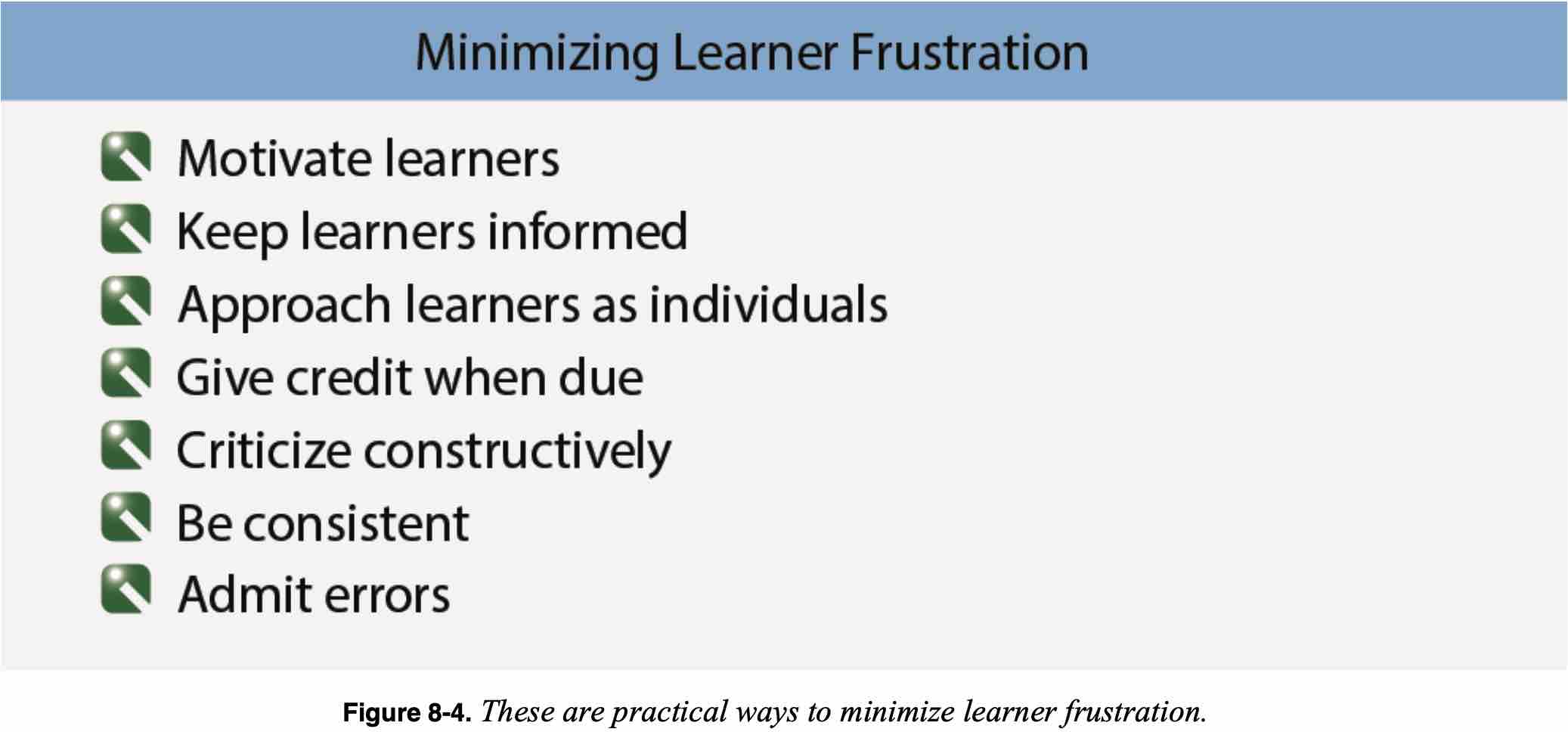
- What are 5 things that you can do to minimize student frustrations?
- MIICCCA
- M - Motivate students
- I - Keep students informed
- I - Approach students as individuals
- C - Give credit when due
- C - Criticize constructively
- C - Be consistent
- A - Admit errors
- What are some of the physiological considerations that you need to ensure new students are aware of, and are addressed, prior to flight?
- Check that student is well rested, hydrated, well fed, use restroom
- During flight training, students may react to unfamiliar noises or vibrations, experience unfamiliar sensations due to G-force, or have an uncomfortable feeling in their stomach.
- It will be hot, bring water bottle
- A sick student does not learn well.
- Before medical is issued
- Does student require glasses to see - make sure they have them for instruction
- Is student colorblind, for example
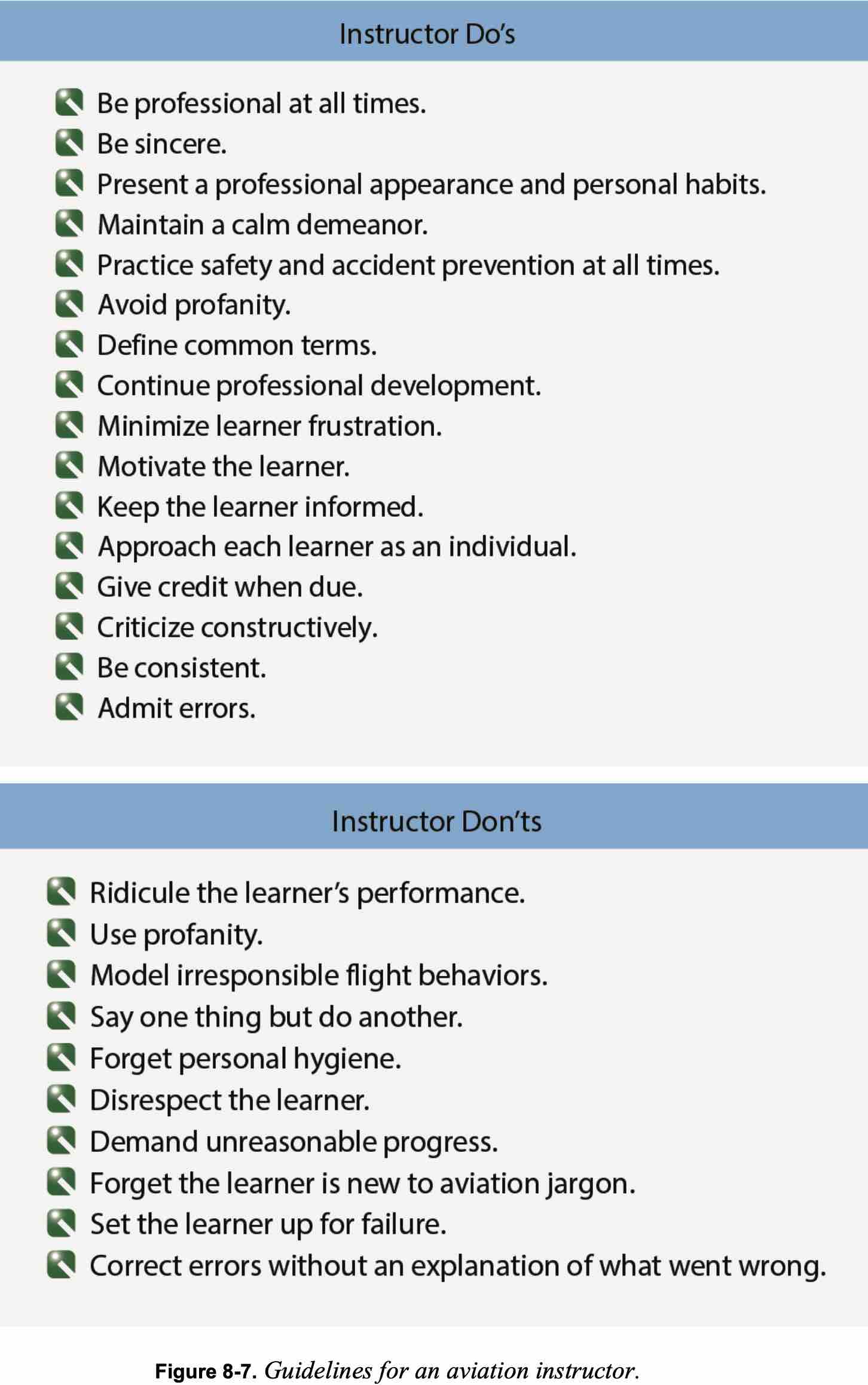
- What traits demonstrate your level of professionalism to your students?
- Speak, look, and act professional
- Be an ambassador for general aviation
- Keep students motivated and progressing
- Ensure students flying safely
- Be humble
- Strive to improve yourself
- Remember: students are more likely to follow our example, than our advice
- Be sincere
- Accept students as they are
- Proper language, demeanor, appearance, habits
What guidelines should you follow when evaluating your students' ability?
- ASP1
- ACS / PTS
- Syllabus
- Where we are in syllabus holds students to different standards
- Procedure guide
- 141 ops manual
- Focus should be on strengthening areas of weakness / how to improve
- ASP1
How will you know when your student is ready to solo safely?
- The student needs to have taken and passed a pre-solo knowledge test
- 14 CFR §61.87(b)
- Want to see that they knew the things required of them, including
- Knowledge of airspace rules and procedures
- Flight characteristics and limitations of make and model of aircraft to be solo'd
- The student also needs to receive a solo endorsement
- 14 CFR §61.87(c)
- CFI must have judged student to be safe
- Student needs to have received and logged training in maneuvers specified in 14 CFR §61.87(d)
- Proper flight preparation procedures, including preflight planning and preparation, powerplant operation, and aircraft systems
- Taxiing or surface operations, including runups
- Takeoffs and landings, including normal and crosswind
- Straight and level flight, and turns in both directions
- Climbs and climbing turns
- Airport traffic patterns, including entry and departure procedures
- Collision avoidance, windshear avoidance, and wake turbulence avoidance
- Descents, with and without turns, using high and low drag configurations
- Flight at various airspeeds from cruise to slow flight
- Stall entries from various flight attitudes and power combinations with recovery initiated at the first indication of a stall, and recovery from a full stall
- Emergency procedures and equipment malfunctions
- Ground reference maneuvers
- Approaches to a landing area with simulated engine malfunctions
- Slips to a landing
- Go-arounds
- Generally, a student is ready for the first solo flight when the instructor observes the student from preflight to engine start to engine shutdown, and the student performs consistently, without the need for instructor assistance.
- The student needs to have taken and passed a pre-solo knowledge test
What are some things you are looking for a pilot to demonstrate before providing them with an endorsement?
- Look to the requirements of the endorsement but also the spirit of the endorsement
- Safety and proficiency to perform the privileges granted by the endorsement
What are you planning to do to continue your development as a flight instructor?
- Practice - continue flying personally and maintain and develop flying skills
- Continue to read, learn, fly, youtube videos, podcasts, stay active in aviation community
- Publish notes and guides
- Attend AVAD CFI University and CFI Standardization course
- Join professional organization
- NAFI (National Association of Flight Instructors), SAFE (Society of Aviation and Flight Educators), AOPA
I.F. Techniques of Flight Instruction
- Evaluated on the flight portion of the check
I.G. As it pertains to evaluating and managing risk
- What is PAVE? IMSAFE? 5Ps? Personal Minimums?
- PAVE checklist
- Use the PAVE checklist to perceive hazards
- Identify hazards and personal minimums
- Divides risk into four fundamental risk elements or categories
- P ilot
- A ircraft
- en V ironment
- E xternal pressures (mission)
- IMSAFE checklist
- Personal checklist to check pilot risk element
- Illness
- Medication
- Stress
- Alcohol
- Fatigue
- Eating
- Personal checklist to check pilot risk element
- 5 Ps
- Evaluate the pilot's current situation at key decision points during the flight or when an emergency arises.
- Proactive approach to SRM instead of reactive
- The 5P concept relies on the pilot to adopt a "scheduled" review of the critical variables at points in the flight where decisions are most likely to be effective.
- P lan
- P lane
- P ilot
- P assengers
- P rogramming
- Decision points include
- Preflight
- Pretakeoff
- Hourly or at the midpoint of the flight
- Pre-descent
- Just prior to the final approach fix or entering the traffic pattern
- Personal minimums
- Limits unique to that individual pilot's current level of experience and proficiency
- Criteria more restrictive than minimum legal requirements a pilot sets for themselves to ensure safety
- It's critical to understand that just because something is legal doesn't mean it's safe or a good idea
- Know the criteria that goes into setting personal minimums (PAVE)
- There are also other criteria not necessarily listed or captured by PAVE that should be considered
- e.g. does your aircraft have a squawk for scratchy comms that you haven't observed before, but if it ends up manifesting during your flight it will increase pilot workload - consider increasing minimums
- Mountainous and/or unfamiliar terrain should increase minimums
- Runway width (e.g.
KHEF100 ft vsKEDUor7W450 ft)
- Less important to have rigidly defined personal minimums committed to memory, and more important to exercise good ADM to weigh the various factors and make safe go/no-go decisions
- See FAA personal minimums worksheet
- FAA-H-8083-9B Aviation Instructor's Handbook Appendix D: Personal Minimums Checklist
- It is long (3 pages) and has a lot of fields to fill out
- Emphasizes spending quiet time thinking about each item
- Also to be reviewed and update periodically
- Also FAA Developing Personal Minimums
- PAVE checklist
Technical Subject Areas
II.A. Aeromedical Factors
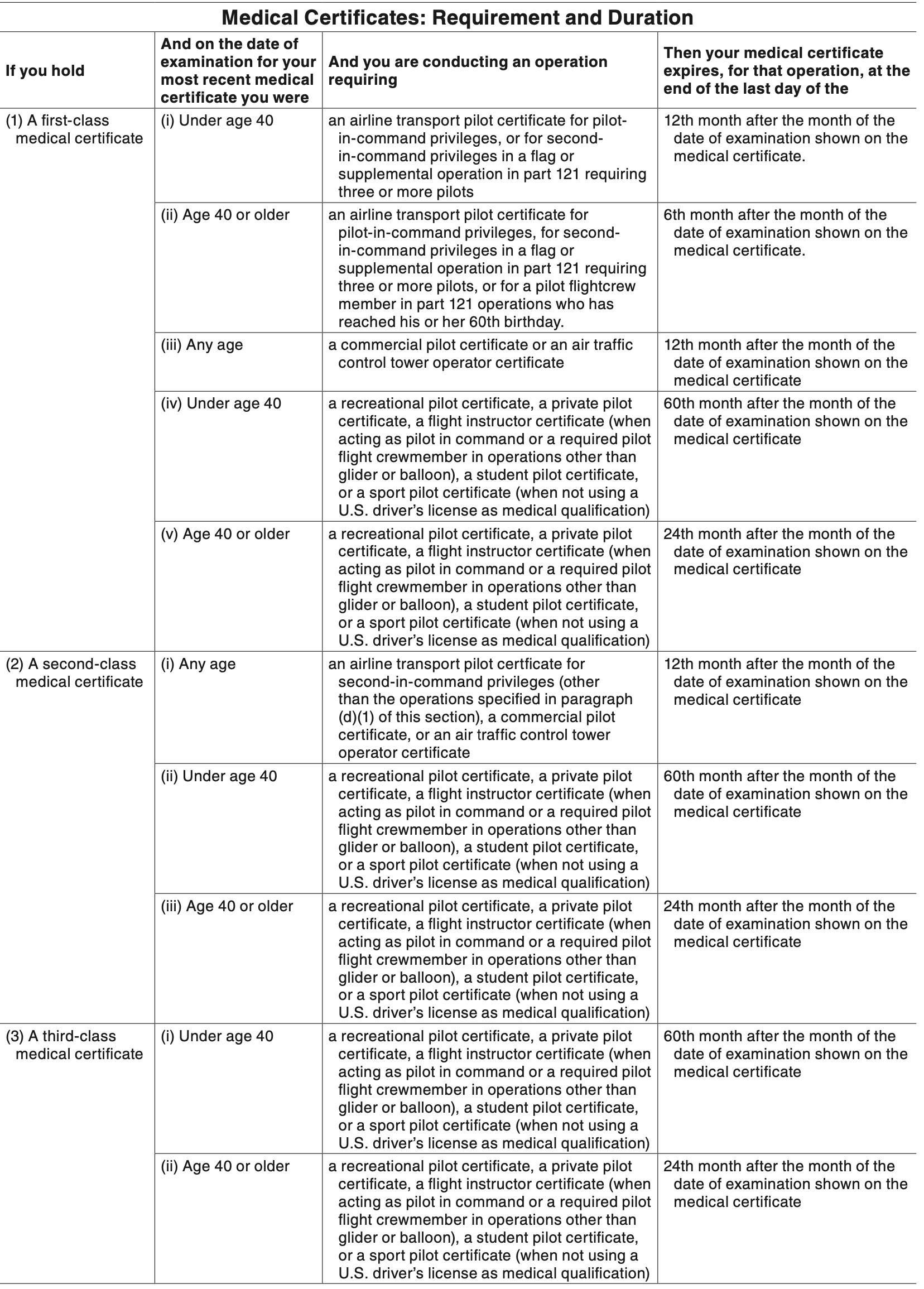
- What are the classes of medical certificate, and how long are they valid?
- First Class
- Required to PIC with an ATP
- Required to be required pilot flightcrew member if 60 years old
- Under 40 valid 12 months
- 40 or over valid 6 months
- Second Class
- Required for commercial PIC privilages
- Valid 12 Months at any age
- Third Class
- Sufficient for the sport, recreational, student, private, and flight instructor ratings
- Under 40 valid 60 months
- 40 or older valid 24 months
- Basic Med
- For exercising priveleges of Private Pilot 14 CFR §61.113(i), CFI, or safety pilot as PIC
- Have held a medical at some point after 14-July-2006
- Completed medical education course in previous 24 calendar months
- Received physical exam in previous 48 calendar months (bring BasicMed checklist)
- Restrictions
- Max Airplane 6 persons, 6000lbs
- No more than 5 pax
- VFR/IFR up to 18,000ft
- 250kts maximum
- No compensation or hire
- Cannot fly internationally (except in the Bahamas)
- Need to carry valid driver's license
- See 14 CFR §61.23(c)(3)
- For example, the most recent medical cannot have been denied and the airman try to use an earlier medical
- FAA-AC-68-1A BasicMed
- 14 CFR §61.23 - Medical certificates: Requirement and duration
- First Class
- What class Medical Certificate do you need to flight instruct?
- None - as long as not PIC or required crewmember (e.g. safety pilot)
- BasicMed
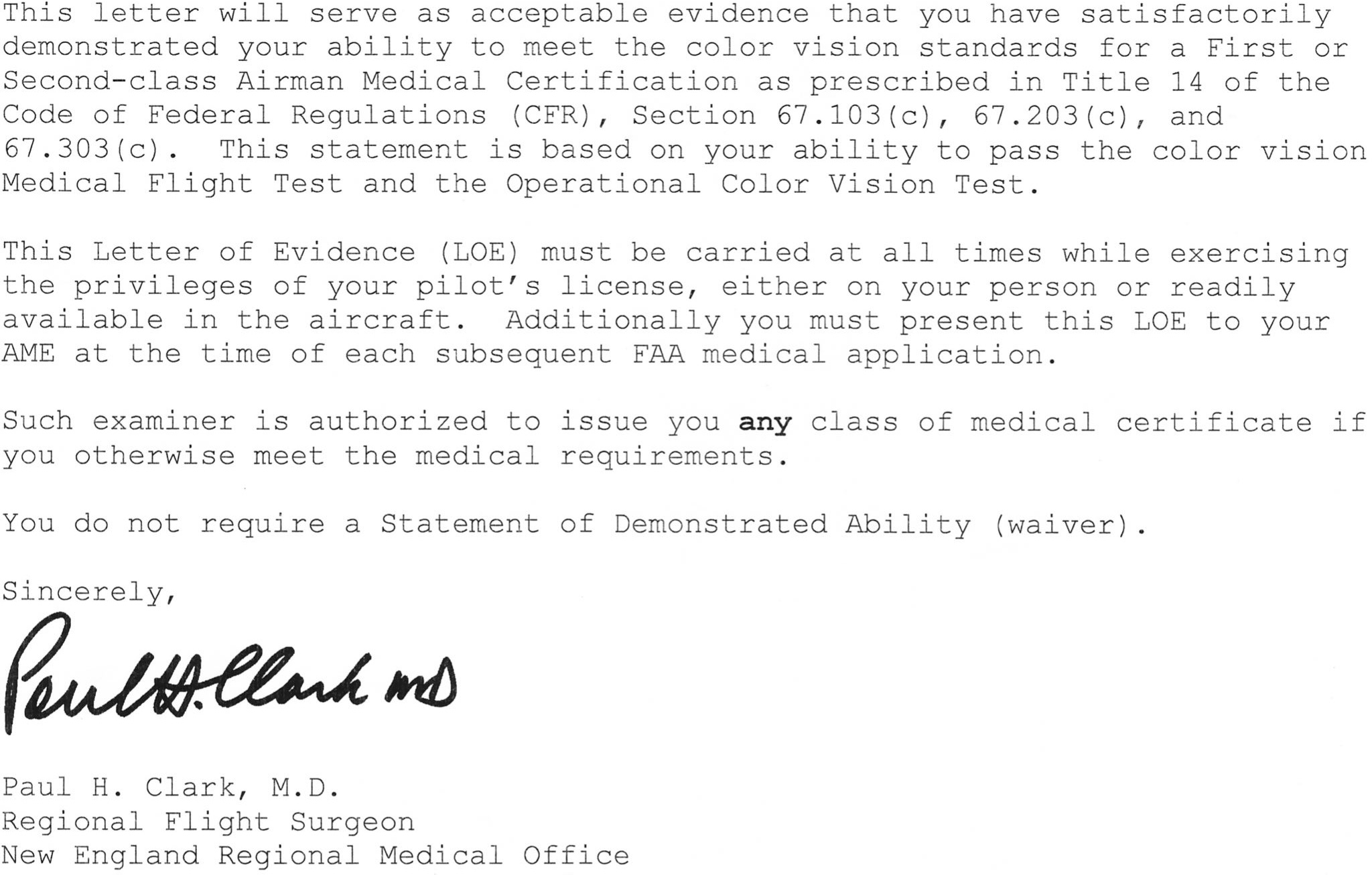
- You student advises you that they are colorblind. Can they eventually get a Pilot Certificate? What can you advise them to do to handle this?
- If an applicant fails to meet the color vision standard as interpreted above but is otherwise qualified, the Examiner must issue a medical certificate bearing the limitation
- "Not valid for night flying or by color signal control"
- Guide for Aviation Medical Examiners Application Process for Medical Certification
- Guide for Aviation Medical Examiners Aerospace Medical Dispositions Item 52. Color Vision
- Statement of Demonstrated Ability (SODA) is a statement authorizing medical certification of, at the discretion of the Federal Air Surgeon, applicants whose disqualifying condition is static or non-progressive.
- May be issued Letter of Evidence (LOE) that needs to be carried along with medical
- May involve different levels of tests
- e.g. Operational Color Vision Test (OCVT), Medical Flight Test (MFT)
- If you have any concern about potential medical deficiency, good idea to get medical certificate in the early stages of flight training
- Remember, medical (and student pilot) certificate is required to solo
- No age limit to log dual received, so potentially could be paying for and receiving a lot of flight training before even being eligible to solo, only to later find out you can't get medical (or it has limitation)
- See also 14 CFR §67.401 - Special issuance of medical certificates
- If an applicant fails to meet the color vision standard as interpreted above but is otherwise qualified, the Examiner must issue a medical certificate bearing the limitation
II.B. Runway Incursion Avoidance
- Applicant taught lesson - see TSA document
II.C. Visual Scanning and Collision Avoidance
- Checked in flight
II.D. Principles of Flight
- Applicant taught lesson - see TSA document
II.E. Airplane Flight Controls
- What are the secondary controls on the airplane we are using today? What is the purpose of trim controls?
- Flaps and elevator trim tab
- Balance moments on aircraft during flight while reducing pilot input
II.F. Airplane Weight and Balance
- Review weight and balance calculation from data previously provided.
II.G. Navigation and Flight Planning
- How will you teach your students to find themselves if lost?
- Start with situational awareness before getting lost
- Recall Situational awareness is the accurate perception of operational and environmental factors that affect the flight.
- It is knowing what is going on and what is coming next
- Use nav log
- Be looking at landmarks outside during flight (pilotage)
- Monitoring progress
- Looking for airports along the way as potentials to divert to
- Use tools available during flight
- Monitor with GPS
- Check VORs along the way (can be fun on long cross country)
- Recall Situational awareness is the accurate perception of operational and environmental factors that affect the flight.
- If they do get lost, recall 5 C's
- Circle: Stay in one spot
- Climb: Better visibility, better signal and communication strength
- Communicate: Ask for vectors to a known location
- Confess: Admit you are lost
- Calculate: Figure out fuel remaining, where to go, groundspeed, distance covered
- In addition to some of the items above
- Double check maps and look for landmarks
- Use secondary navigation systems (GPS, VOR)
- GPS nearest or direct-to
- 2x VORs to identify location
- Use iPad / phone / Stratus / Sentry as backup GPS if airplane GPS fails
- Check town water towers or airfield names
- Compare the heading indicator to the magnetic compass, and note the direction of error before resetting
- Can help determine if you are left or right of course
- Use ATC (report who you are last known location, heading, airspeed, altitude)
- Is your GPS destination correct, or did you make a typo that went unnoticed?
KPHLvsKPHF - See also
KAUGvsKAGS- Augusta Maine vs Augusta Georgia
- Both a few hundred nautical mile cross country from
KHEF - This example from the FAA guide to flight review
- Start with situational awareness before getting lost
- What is the difference between a course and a heading?
- Heading
- Direction the airplane is pointed
- Course
- Planned direction of flight as a line drawn over the ground
- Track
- Actual direction plane is flying
- Above can be magnetic or true
- Heading
II.H. Night Operations
- Why does our vision need time to adapt from daytime conditions to nighttime conditions?
- Dark adaptation is the time taken for a (primarily) biochemical reaction to take place
- Pupil dialation happens in a few seconds up to a minute
- Both cones and rods participate in dark adaptation, slowly increasing their sensitivity to light in a dim environment.
- Cones adapt faster, so the first few minutes of adaptation reflect cone-mediated vision.
- Rods work slower, but since they can perform at much lower levels of illumination, they take over after the initial cone-mediated adaptation period.
- Takes about 30 minutes for eyes to fully adjust to darkness
- When landing at night is it better to fly a long low approach or a normal approach with normal speeds? Why?
- There are several night vision illusions discussed in the Airplane Flying Handbook
- Some of these illusions cause tendency to fly higher than normal approach, others lower
- Some important things can do
- If VASI/PAPI is there, use it
- Can calculate and use a sort of VDP for longer finals
- GS Kts * 5 = descent rate in FPM
- Use instruments
- If in doubt, go around
- Nevertheless, in doubt flying too high of an approach is preferably because you can always go-around, whereas flying too low of an approach increases the risk of hitting terrain or obstacles on the ground
- If you see a green steady light and a flashing red light in front of you while flying, which direction is the aircraft going relative to you?
- Green light is on right wing
- Aircraft is traveling left to right in front of us
II.I. High Altitude Operations
- At what cabin altitudes are pilots and flight crew required to use supplemental oxygen?
- Note altitudes are cabin pressure altitudes
- 12,500 - 14,000 ft MSL: flight crew uses supplemental oxygen for that part of the flight at those altitudes that is of more than 30 minutes duration
- Above 14,000 ft MSL: flight crew must use oxygen
- Above 15,000 ft MSL: each occupant is provided oxygen
- What are some of the early onset symptoms of hypoxia?
- Belligerence
- Euphoria
- Headache
- Decreased response to stimuli and increased reaction time
- Impaired judgment
- Visual impairment
- Drowsiness
- Lightheaded or dizzy sensation
- Tingling in fingers and toes
- Numbness
- False sense of security
- Blue colored lips and fingernails
- Tunnel vision
II.J. 14 CFR and Publications
- What is the limitation on hours you are able to instruct? What records must you keep as a flight instructor? For how long?
- No more than 8 hours of flight training in any 24-consecutive-hour period
- Instructor needs to keep a record of
- US Citizenship
- Keep for 5 years
- Solo flight endorsements
- Name and date
- Test endorsements (knowledge and practical)
- Name
- Date
- Kind of test
- Results
- Need to keep endorsement records for 3 years
- 14 CFR §61.189 - Flight instructor records
- US Citizenship
- For what certificates and/or ratings must a non-US student have TSA approval prior to beginning flight training?
- Any initial U.S. airman certificate
- Recreational, sport, or private pilot
- Instrument Rating
- Multiengine Rating
- Airships, balloons, and gliders are exempted
- Think new skill = new TSA approval, for example commercial doesn't add new skills unless they are doing commercial and don't already have intrument rating - then the instrument training of commercial would be adding a new skill
- When must a non-US student begin and end their flight training after receiving TSA approval?
- Start within 180 days
- Finish within 365 days
- The 365 day requirement I didn't see anything in 14 CFR, but it is here
- What initial and recurrent TSA Security training do you need to provide flight instruction?
- Within 60 days of getting hired as CFI need to receive initial security awareness training
- Need to receive recurrent training each year the same month as the initial training
- 49 CFR §1552.23 - Security awareness training programs
- What ways can you renew your flight instructor certificate?
- Flight instructor certificate lasts 24 months if not renewed/reinstated
- To renew
- Pass a practical test
- For one of the ratings listed on the current flight instructor certificate
- Or an additional flight instructor rating
- Completed application to FAA showing in previous 24 months the flight instructor has
- At least 5 practical test endorsements for a certificate or rating and at least 80 percent of those students passed on first try
- Be a part 121 (scheduled) or part 135 (charter) flight instructor (including company check pilot, chief flight instructor, company check airman, or in a position involving the regular evaluation of pilots)
- Successfully completed an approved flight instructor refresher course (FIRC) within previous 3 months consisting of ground training or flight training, or a combination of both
- Pass an official U.S. Armed Forces military instructor pilot proficiency check within the preceding 12 months
- Gold seal renews certificate
- Pass a practical test
- If not renewed within 24 months and it expires, must take checkride
- What does your student need to know about the Aviation Safety Reporting Program?
- Aviation Safety Reporting System
- Effort by government, industry, and individuals to maintain and improve aviation safety.
- Collects voluntarily submitted aviation safety incident/situation reports from pilots, controllers, and others.
- Goal is to identify system deficiencies and get the word out to correct them, and reduce risk of aviation accidents
- Data supports policy formulation
- Voluntary, confidential, non-punative
- ASRS has committed itself not to use ASRS information against reporters in enforcement actions
- "Get out of jail free card" - report things here, and if you get asked about them later, you can use a receipt of your anonymous submission to ASRS to relieve punishment of the mistake
- Aviation Safety Reporting System
- IAW NTSB Part 830, who is responsible for submitting the initial report of an accident or incident?
- 49 CFR §830.5 - Immediate notification
- Aircraft operator
- Only definition of "operate" in 14 CFR §1.1
- Seems for GA the operator is the pilot in command "cause to use or authorize to use aircraft, for the purpose of air navigation including the piloting of aircraft"
- If one aircraft is on a right base for runway 22 at Culpeper and another is on a left base, which plane has the right of way?
- Aircraft that is at a lower altitude
- Right-of-way rule for aircraft converging head-on both alter course to the right
- Aircraft that is at a lower altitude
II.K. National Airspace System
What are the requirements to fly VFR in the SFRA?
- Completed SFRA training
- SFRA flight plan
- Mode-C transponder
- ADS-B
- 2-way comms
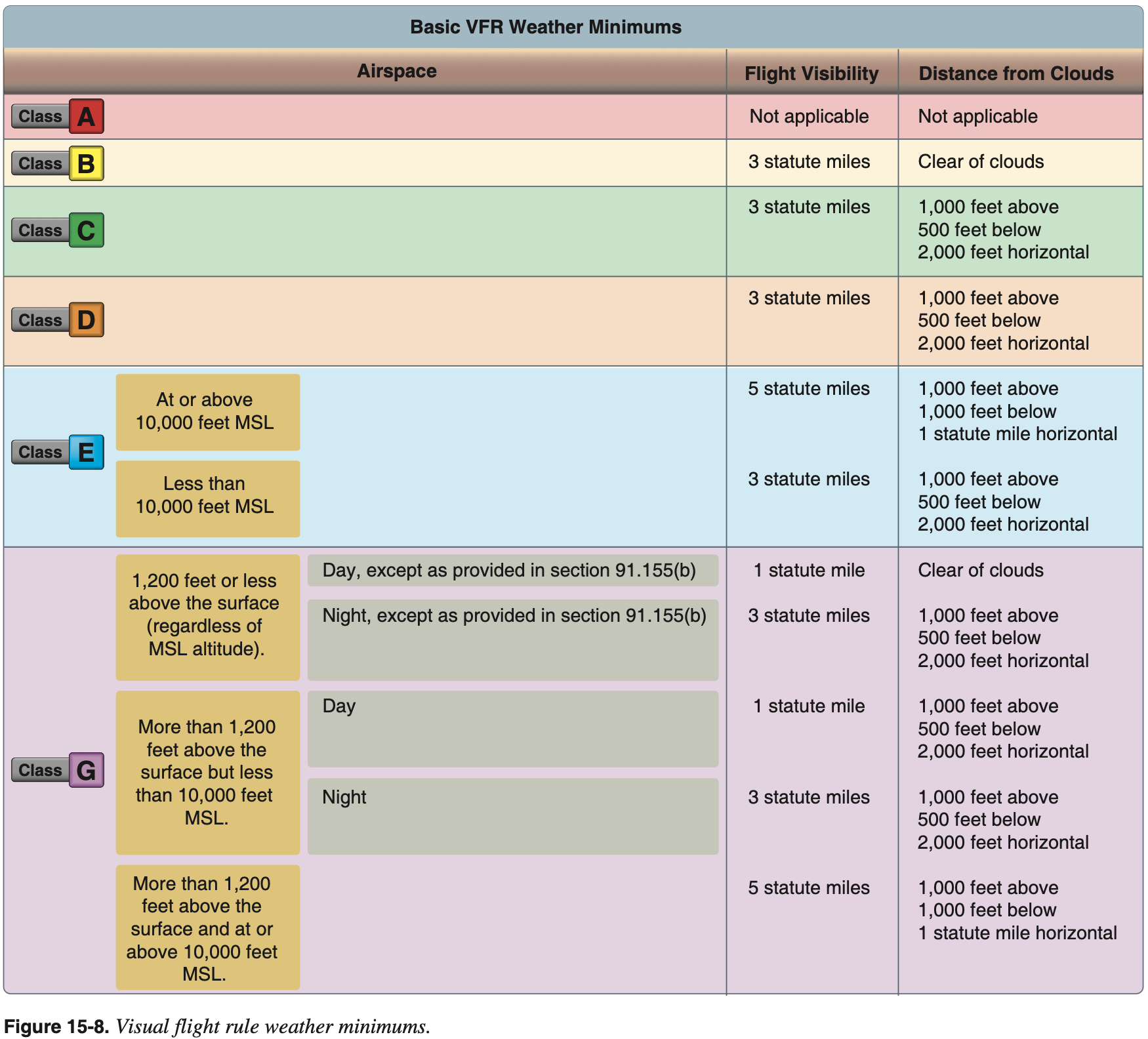
What are the visibility and cloud clearance requirements to fly VFR in Class B, C, D, and E airspace?
- G at night: 3, 1-5-2
- What is a TFR? When do we commonly see them in this area?
- Temporary Flight Restriction
- Established to protect persons and property in the air or on the surface from an existing or imminent hazard
- Examples
- Disaster relief aircraft operations 14 CFR §91.137
- National disasters in Hawaii for humanitarian reasons 14 CFR §91.138
- President, VP, or other public figures 14 CFR §91.141
- Space agency operations 14 CFR §91.143
- Prevent an unsafe congestion of sightseeing aircraft above an incident/event which may generate a high degree of public interest (e.g. sporting event)
- FDC NOTAM issued to designate TFR
- Begins with phrase "FLIGHT RESTRICTION" followed by location, effective time period, area defined in sm, and altitudes affected for temporary restriction.
- Includes FAA coordination facility and telephone number, reason for restriction, and other appropriate information.
- Name, effective time, location
- Can fly through a TFR
- Usually the outer area
- Follow the rules/requirements outlined in the TFR
- In DC area, SFRA and FRZ have TFRs
- Wilmington, DE has TFR often when Biden goes home
- Sporting events
- Wallops launch site in Virginia
II.L. Navigation Systems and Radar Services
- What is ADS-B?
ADS-B
ADS-B
A surveillance technology in which an aircraft determines its position via satellite navigation or other sensors and periodically broadcasts it, enabling it to be tracked.
- ADS-B uses plane's WAAS GPS and broadcasts information to other planes and ground stations.
- Ground stations compile and rebroadcast received information.
- This is known as ADS-B Out.
- ADS-B In is the capability for other planes to receive this information as traffic, as well as weather information.
- Acronym
- Automatic - no pilot input required
- Dependendent - requires positon input, e.g. WAAS GPS
- Surveilance - provides aircrafts location, direction, and climb/descent indication
- Broadcast - broadcasts the surveilance information to be seen by others
- Components of ADS-B In
- Traffic Information Services-Broadcast (TIS-B)
- Provides traffic information to planes with ADS-B receivers.
- The traffic includes that which is not broadcasting its own output via ADS-B, because it's able to use radar data and conventional transponder data to understand where aircraft are.
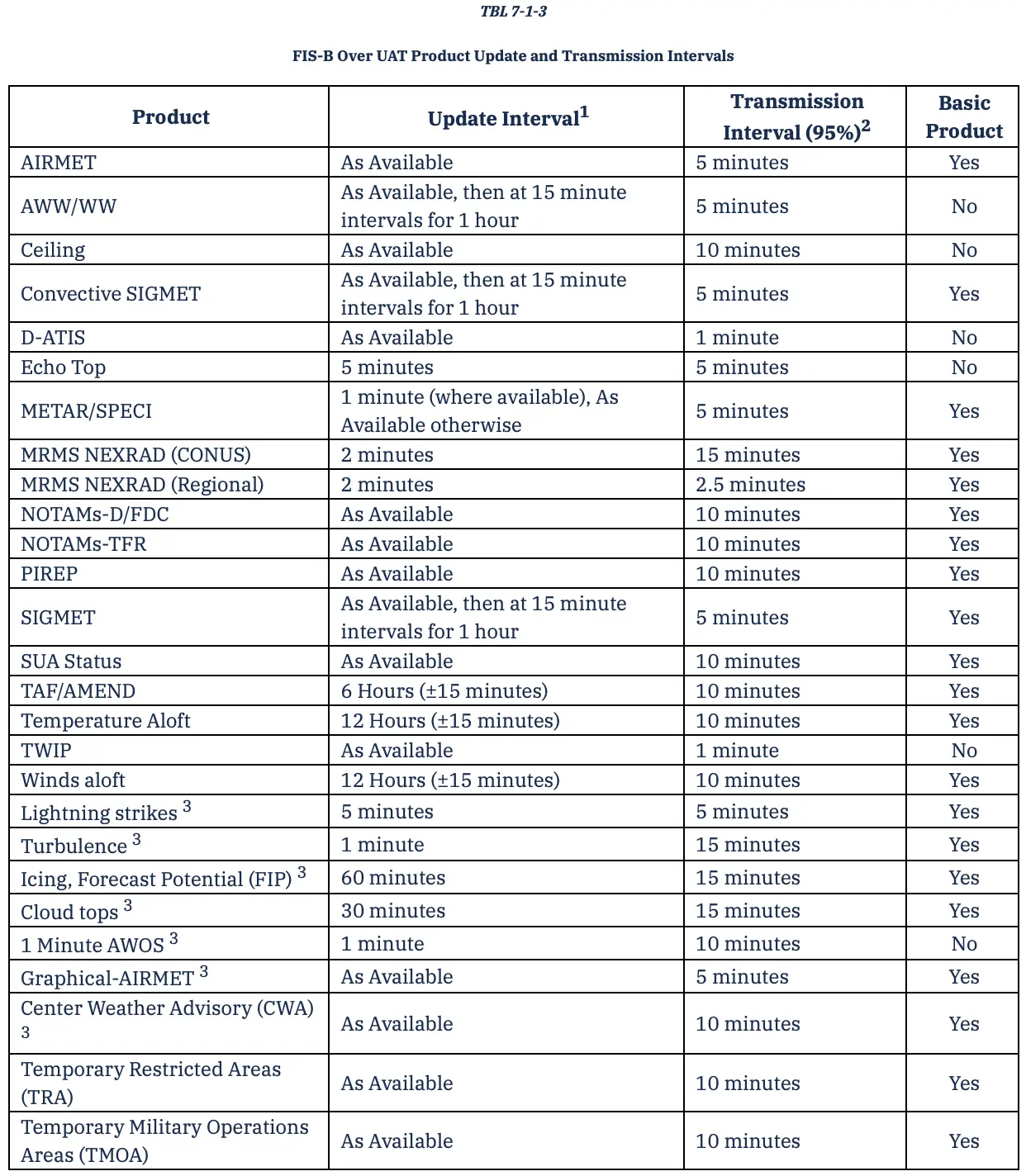
- Flight Information Services-Broadcast (FIS-B)
- Provides NEXRAD graphical weather in (for example in G1000).
- Also provides info on SUA and TFRs.
- Traffic Information Services-Broadcast (TIS-B)
- FAA Automatic Dependent Surveillance-Broadcast (ADS-B)
- FAA Equip ADS-B
- 978 and 1090 MHz
FIS-B
Requirements
- ADS-B is required in:
- Class A, B, and C airspace.
- Class E airspace at or above 10,000 feet MSL.
- Excluding airspace at and below 2,500 feet AGL.
- Within 30 nautical miles of a Class B primary airport (the Mode C veil).
- Above the ceiling and within the lateral boundaries of Class B or Class C airspace up to 10,000 feet.
- Class E airspace over the Gulf of Mexico, at and above 3,000 feet MSL, within 12 nm of the U.S. coast.
- 14 CFR §91.225 - Automatic Dependent Surveillance-Broadcast (ADS-B) Out equipment and use
- 14 CFR §91.227 - Automatic Dependent Surveillance-Broadcast (ADS-B) Out equipment performance requirements
II.M. Logbook Entries and Certificate Endorsements
See FAA-AC-61-65H - Certification: Pilots and Flight and Ground Instructors
What do you need to do to provide a US citizen with an endorsement of US citizenship?
- 49 CFR §1552.3(h)
- Passport (must be valid)
- Birth certificate
- Naturalization certificate
- And more
- CFI / flight school must keep a copy of the documents proving citizenship for 5 years
- 49 CFR §1552.3(h)
What endorsements do you need to provide your student pilot prior to their first solo?
- Citizenship endorsement
- If they are not a US citizen, they need TSA approval, but this doesn't come with an endorsement
- Pre-solo knowledge test
- Pre-solo flight training
- Initial 90-day solo endorsement
- This then follows with continuing endorsements no more than every 90 days
- 61-65H, A.6 61.87(n)
- Citizenship endorsement
What endorsement(s) do you need to provide your student pilot prior to solo flights to an airport beyond 50NM?
- One for cross country flight in make/model
- 14 CFR §61.93(c)(1) and 14 CFR §61.93(c)(2) specify endorsements needed for category and make and model, respectively. But there is only one endorsement needed since specifying make and model necessarily specifies category.
- 61-65H, A.9
- Another specific to the planning to a particular airport(s) including route
- 14 CFR §61.93(c)(3) requires the student's instuctor verify their preflight planning and specifies origin and destination airports, route, and airports of landing along the way.
- This endorsement also dates, so needs to be redone for each cross-country flight
- One for cross country flight in make/model
What other endorsements may you provide your student pilot after their first solo and prior to them becoming a Private Pilot?
- Knowledge test endorsement
- FAA-AC-61-65H A.32
- The below sections just say the CFI has made sure the applicant completed the required ground training and is prepared to take the knowledge test
- Retake of knowledge test (if required)
- Solo at airport within 25nm
- e.g. CJR, HWY
- The CFI has given training from the home airport to the other airport and back, including entering and exiting the traffic pattern
- The purpose of the flight is to practice takeoffs and landings at the other airport
- FAA-AC-61-65H A.8
- 14 CFR §61.93(b)(1)
- Solo within Class B Airspace
- Landing at Class B airport
- Not authorized pursuant to Aviation Adventures operations manual
- FAA-AC-61-65H A.13
- 14 CFR §61.95(b)
- Repeated solo cross country flight within 50 nm
- Solo at Night
- Not authorized pursuant to Aviation Adventures operations manual
- Meet prerequisites for practical test
- This includes
- Received training within 2 months of practical test
- Is prepared for practical test
- Review of deficiencies from knowledge test
- FAA-AC-61-65H A.1
- 14 CFR §61.39(a)(6)
- This includes
- Retake of practical test (if required)
- Note 141 doesn't have practical test failure, so won't have this endorsement
- But would use it for Part 61
- FAA-AC-61-65H A.73
- 14 CFR §61.49
- Knowledge test endorsement
How do you re-endorse your student who failed his or her private pilot practical test?
- Receive necessary training and determine that the student is proficient to pass the test
What additional endorsements can you provide to rated pilots?
- High performance
- Complex
- Commercial written
- (High altitude after I get endorsement)
- A high altitude aircraft is a pressurized plane with max operating altitude or service ceiling above 25k MSL
- There is ambiguity in the regulations as to whether flying an unpressurized plane above 25k ft MSL needs an endorsement.
- A conservative reading of the regulations says that flying any plane above 25k ft MSL needs the endorsement, and this is the wise and safe interpretation.
- Flying a pressurized plane with a max operating altitude or service ceiling 25k MSL or below don't need endorsement
- 14 CFR §61.31(g) - Additional training required for operating pressurized aircraft capable of operating at high altitudes
- AOPA - Other Ratings and Endorsements
- Flying Magazine - How To Earn a High-Altitude Endorsement
- A high altitude aircraft is a pressurized plane with max operating altitude or service ceiling above 25k MSL
- (Tailwheel after I get endorsement)
What guidance should you follow when administering a Flight Review?
- See FAA-AC-61-98E Currency Requirements and Guidance for the Flight Review and Instrument Proficiency Check
- A flight review consists of a minimum of 1 hour of flight training and 1 hour of ground training
- Send student to FAASafety.gov for the free ALC-25 Flight Review Prep Guide course
- Set expectations
- I need to ensure the pilot can safely exercise the privileges of their pilot certificate
- The minimum requirements may not be sufficient
- Ask pilot to complete short cross country planning session
- Weather
- Decision making
- Risk management
- Personal minimums
- GA security (airspace, TFRs, etc.)
- Review results of Flight Review Prep Guide Course
- Flying
- Start cross-country flight
- Diversion
- Airwork
- Debrief
- References
If you have completed a flight with a student who came to you for a flight review and they did not fly well enough that you intend to provide them a Flight Review endorsement, what kind of logbook entry do you make and what do you do from there?
- Log flight as dual given
- Discuss areas to improve
- Offer plan of action (ground and flight training) to return the pilot to proficiency
III.A. Certificates and Documents
- What Certificates and Documents are required to be on board an aircraft?
Required Certificates and Documents
- Use the SPARROW acronym to remember certificates and documents required to be on board an aircraft.
- S - Supplements
- P - Placards
- The placards that should be on the plane are listed in the POH
- 14 CFR §91.9(a)
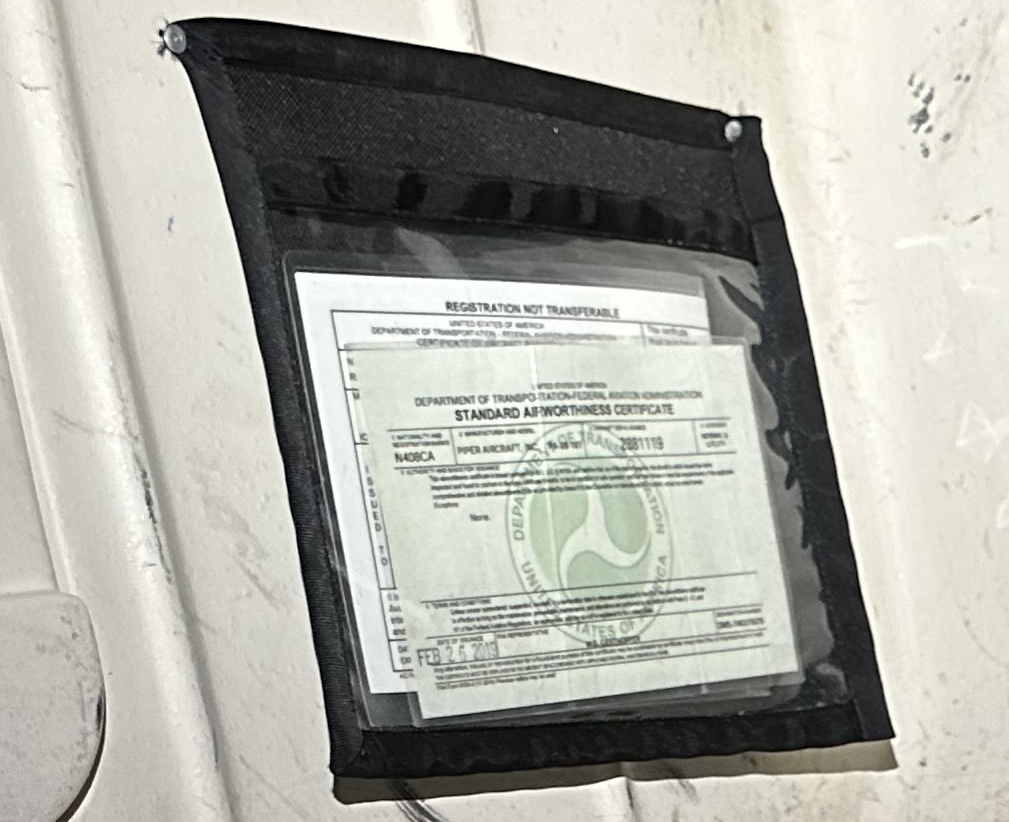
- A - Airworthiness certificate
- Means aircraft is safe for flight
- Remains valid as long as maintenance is done
- 14 CFR §91.203(a)(1)
- R - Registration
- Valid for 3 years (Now 7 years)
- Required to be visible on outside of aircraft
- Paper document required to be onboard
- 14 CFR §91.203(a)(2)
- R - Radio station license
- International only
- Good for 10 years?
- Note: the pilot may also need a radiotelephone operator permit, but that is a requirement of the pilot, not the plane as the items in this list pertain to.
- TODO@dwiese check this 47 CFR §87.89, and 47 CFR §87.18
- O - Operating limitations
- Includes but not limited to: placards, gauge markings, POH/AFM
- 14 CFR §91.9(b)(1)
- W - Weight and balance
Radio Station License / Radiotelephone Operator Permit
Regarding an additional "R" for radio station license see FCC Commercial Radio Operator License Program, Transport Canada: Flying to Canada: what you need to know - TP 15048, 47 CFR §87.89, and 47 CFR §87.18.
Basically, the plane needs a radio station license and the pilot needs a restricted radiotelephone operator permit.
A commercial operator license does not constitute or imply FCC authorization to transmit radio signals. Before you operate any radio station, make certain that the station is licensed as required by the FCC.
Another excerpt:
You need a commercial radio operator license to operate the following:
- Aircraft radio stations, except those which operate only on very high frequencies (VHF) and do not make foreign flights.
AFM vs POH
Aircraft owner/information manual is not approved by the FAA and is not a substitute for the approved POH/AFM
- The POH is a document developed by the aircraft manufacturer and contains FAA-approved AFM information.
- If "POH" is used in the main title, a statement must be included on the title page indicating that sections of the document are FAA approved as the AFM.
- The POH for most light aircraft built after 1975 is also designated as the FAA-approved flight manual.
Manuals follow standard format
AFM vs POH/PIM
AFM regulated by FAA and specific to airplane
POH/PIM general aircraft info
POH is standardized by the General Aviation Manufacturer's Association
The title [of the document shall be] "Pilot's Operating Handbook and FAA Approved Airplane Flight Manual" for all airplanes except those for which the airplane manufacturer elected to provide a separate FAA Approved Airplane Flight Manual. In the latter case, the title shall be "Pilot's Operating Handbook".
Note: After the effective date of this revision, Pilot's Operating Handbooks for newly manufactured airplanes must be FAA Approved Airplane Flight Manuals.
What certificates and documents must you carry as a flight instructor in flight?
Documents Pilots Must Possess
A pilot is required to have on them or readily accessible in the plane (PPM):
- P - Pilot certificate
- P - Photo ID
- M - Medical certificate
As instructor and not acting as PIC, just need
- Instructor certificate
- Pilot certificate
- Instructor certificate it says not valid unless pilot certificate is also carried
Don't need SFRA course completion certificate, but need to produce it within reasonable time if asked
14 CFR §61.3 - Requirement for certificates, ratings, and authorizations
Student pilots are required to carry their logbook on solo cross-country flights
What class medical certificate must you have to provide flight instruction? Do you always need to have a medical certificate to instruct?
- None if not acting as PIC or required crewmember and the other pilot can act as PIC
- For example, wouldn't be possible if other pilot was a private, but with lapsed flight review then they couldn't act as PIC
- Also wouldn't be possible if instructor was acting as PIC while other pilot was under simulated instrument conditions
- To act as PIC (for example with student pilots) just need BasicMed
- None if not acting as PIC or required crewmember and the other pilot can act as PIC
XIII.B. Systems and Equipment Malfunctions
- If you notice that your oil pressure indicator is indicating zero while in flight, what could be the cause, and what actions will you take?
- Causes
- Bad indication
- Bad pressure transducer
- Bad wiring / connection
- Bad guage
- Low oil pressure
- Bad indication
- Actions
- See checklist in POH
- Check oil temp
- Any evidence of loss of oil?
- Land as soon as practicable
- If oil temp is also increasing, engine failure may be imminent, use minimum power to get to nearest suitable site for emergency landing
- Causes
III.D. Performance and Limitations
- How would you expect your aircraft's performance will be affected by being over its maximum weight allowance? With a CG forward of the limit? With a CG aft of the limit?
- CG too far forward
- Longer takeoff distance
- Higher stalling speed
- Reduced elevator effectiveness
- Increased stability
- Reduced fuel economy and speed
- Limit imposed by making sure enough elevator authority to hold the aircraft in normal glide with power off / aircraft's landing characteristics are suitable.
- CG too far rearward
- Worse than too far forward
- Unstable
- Reduced elevator effectiveness
- May not be able to recover from a spin
- Limit imposed by stability (making sure aircraft has correct damping) / stall recovery
- Heavy
- Longer takeoff roll
- Reduced fuel economy and speed
- Higher stalling speed
- CG too far forward
IV. Preflight Lesson
- Applicant taught lesson.
Preflight Preparation
- What class of medical is required to exercise flight instructor privileges?
- None in certain circumstances
- 14 CFR §61.3(c)(2)(viii) says a medical certificate is not required to exercise the privileges of a flight instructor certificate, provided the person is not acting as pilot in command or as a required pilot flight crewmember.
- This is repeated in 14 CFR §61.23(b)(7)
- So as long as the person being taught is legally able to act as PIC, and the instructor is not acting as a safety pilot (which would make them a required crewmember) then the instructor does not need to hold a medical.
- If the instructor does need to act as PIC or a required crewmember, then they need to hold at least a third class medical or BasicMed.
- 14 CFR §61.23(a)(3)(ii)
- There is an exception that says a third-class medical is not required if operating under the conditions required for BasicMed described in 14 CFR §61.113(i)
- Prior to 2022 a pilot could not use BasicMed when not acting as PIC.
- None in certain circumstances