High Altitude Operations
Introduction
- A high altitude aircraft is a pressurized plane with max operating altitude or service ceiling above 25k MSL
- There is ambiguity in the regulations as to whether flying an unpressurized plane above 25k ft MSL needs an endorsement.
- A conservative reading of the regulations says that flying any plane above 25k ft MSL needs the endorsement, and this is the wise and safe interpretation.
- Pressurized plane with a max operating altitude or service ceiling 25k MSL or below don't need endorsement
- See 14 CFR §61.31(g) - Additional training required for operating pressurized aircraft capable of operating at high altitudes
- The following document covers each of the required ground training areas specified in 14 CFR §61.31(g)(1)
14 CFR §61.31(g)(1) Required Ground Training
I. High-altitude Aerodynamics and Meteorology
Aerodynamics
- At high altitudes are generally operating closer to critical angle of attack and closer to overspeed.
- Air density decreases with altitude, so for a given airspeed a higher angle of attack is required to generate the same lift
- Recall
where - This means that during flight at high altitudes the aircraft may be spending more time closer to the critical angle of attack and easier to inadvertantly stall
- At high altitudes use shallower banks
- King Air, for example, has a
1/2 BANKbutton to limit bank angle to 1/2 maximum (15°) - Common to limit bank to 10-15° in cruise flight
- King Air, for example, has a
- Be cautious of using too much additional backpressure to maintain altitude during turbulence
- Coffin corner or Q corner
- At high altitude flight the region tightly bounded by stall speed and overspeed, aka Maximum Mach Number (MMO)
- Maximum altitude
- Aerodynamic factors such as buffet onset are one factor in determining an aircraft's maximum altitude
- Buffet can be low speed (stall) or high speed (critical Mach)
- Another is structural considerations - how the aircraft was certified depending on it's pressurization load limits
- Another is thrust or power to actually allow the aircraft to continue to climb (at least 100 fpm)
- Aerodynamic factors such as buffet onset are one factor in determining an aircraft's maximum altitude
- As flow over wing becomes supersonic, the center of pressure moves from quarter-chord to half-chord
- Speed of sound decreases with altitude
- Avoid flying at speeds less than
due to instability and tendency towards stall - Crossover altitude
- Altitude at which a specified CAS and Mach value represent the same TAS
- Above this altitude the Mach number is used to reference speeds
- At high altitudes there is less aerodynamic damping
- The reduced weight of air moving over control surfaces at high altitudes decreases their effectiveness.
- As the airplane approaches its absolute altitude, the controls feel sluggish, making altitude and heading difficult to maintain.
- For this reason, most airplanes that fly at above 25,000 ft MSL are equipped with an autopilot.
The Atmosphere
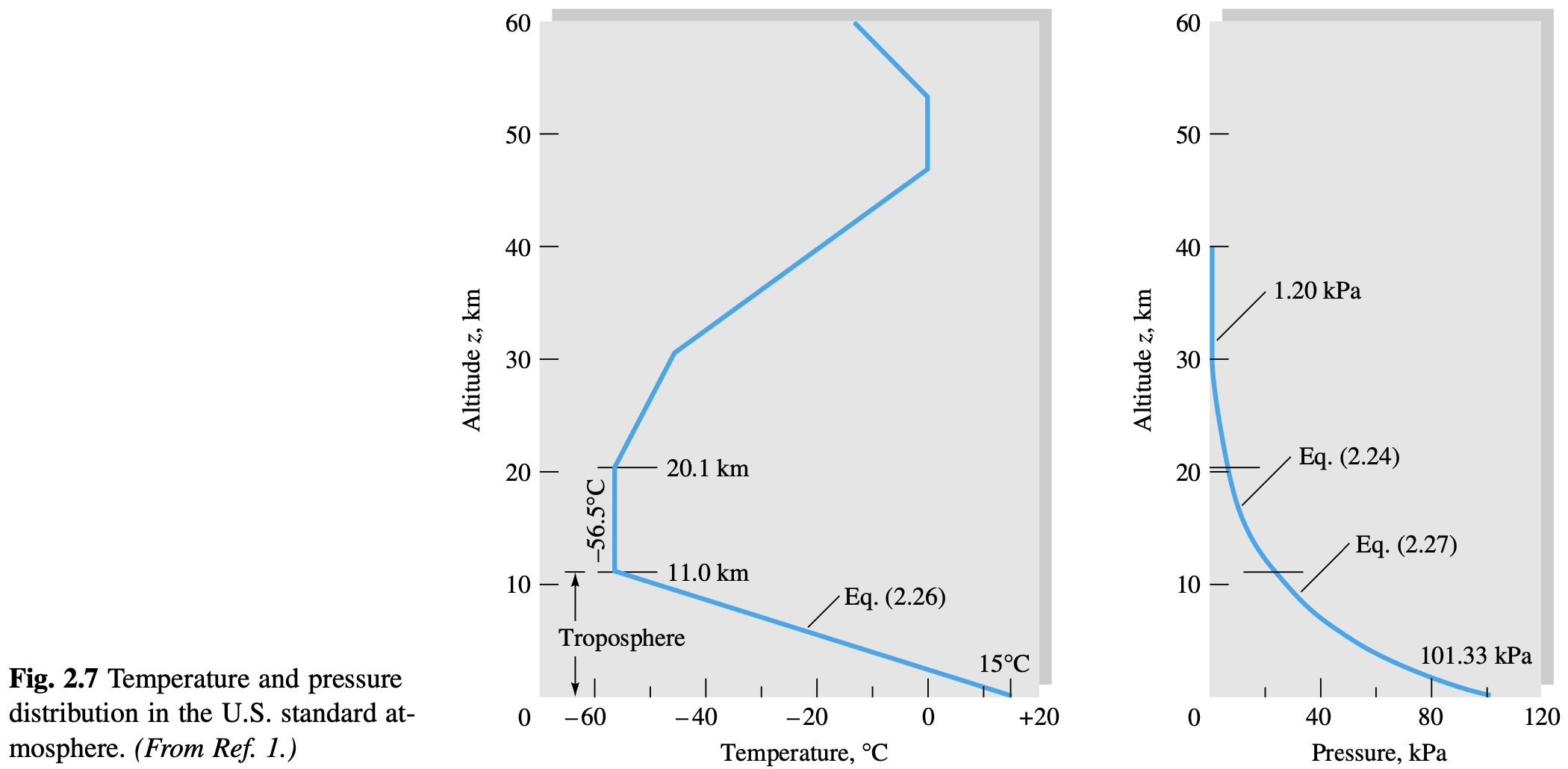
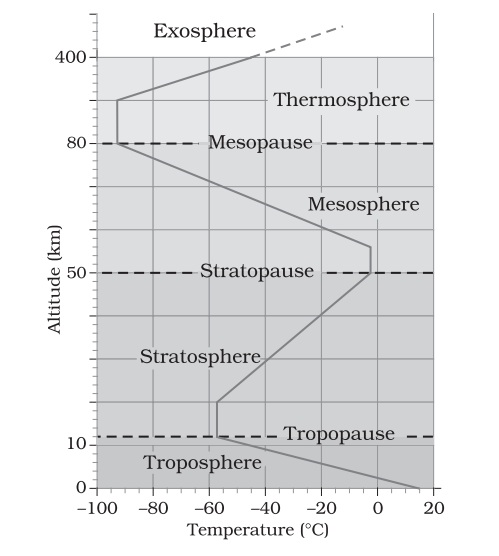
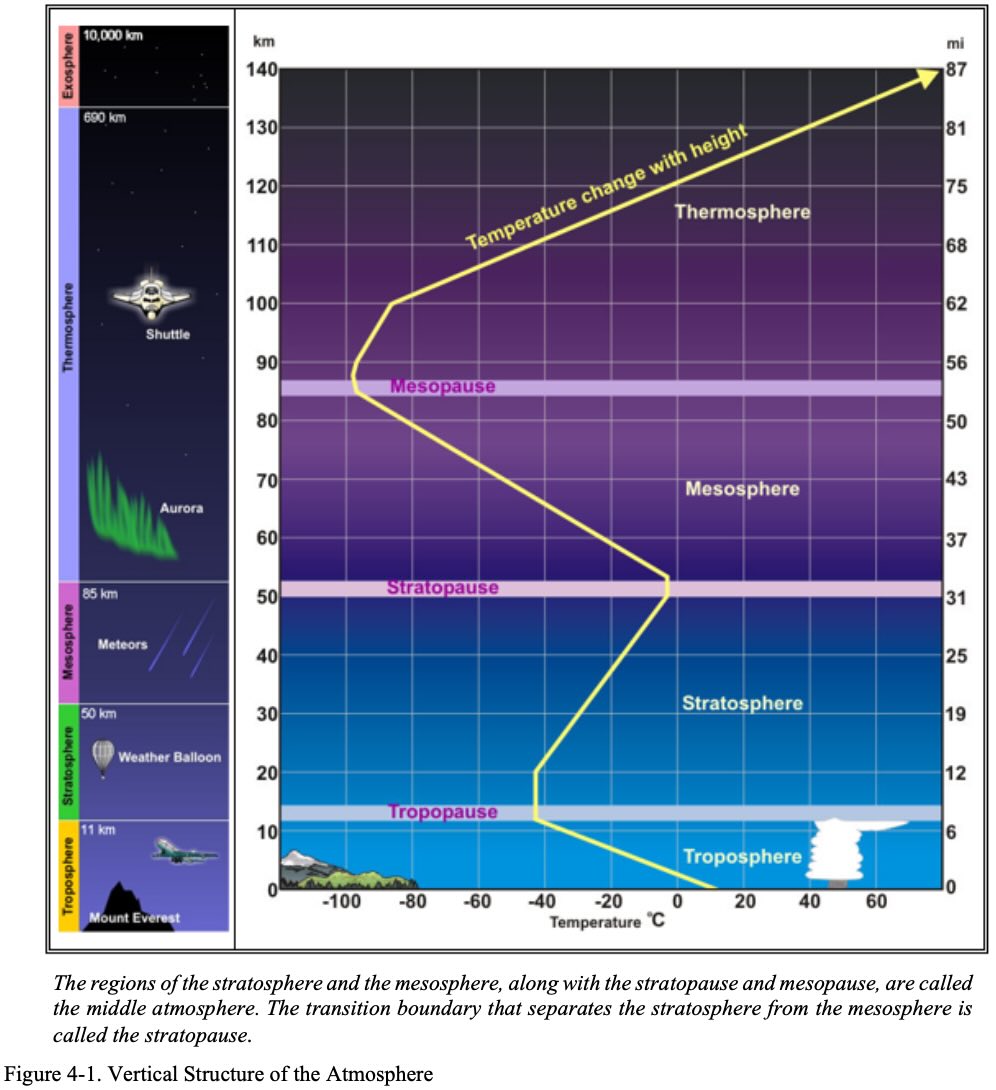
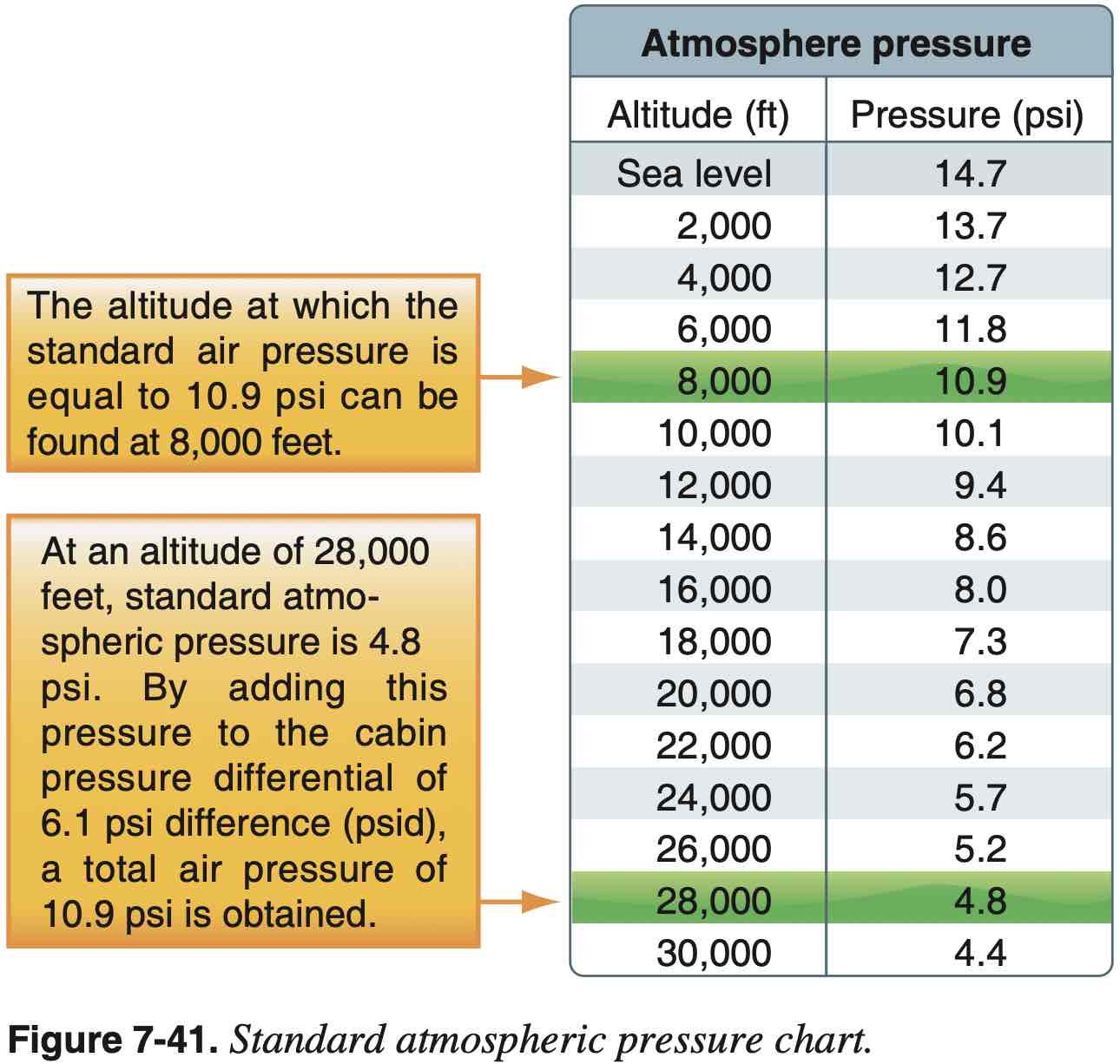
- There are three levels of the atmosphere where high-altitude flight may occur.
- Troposphere
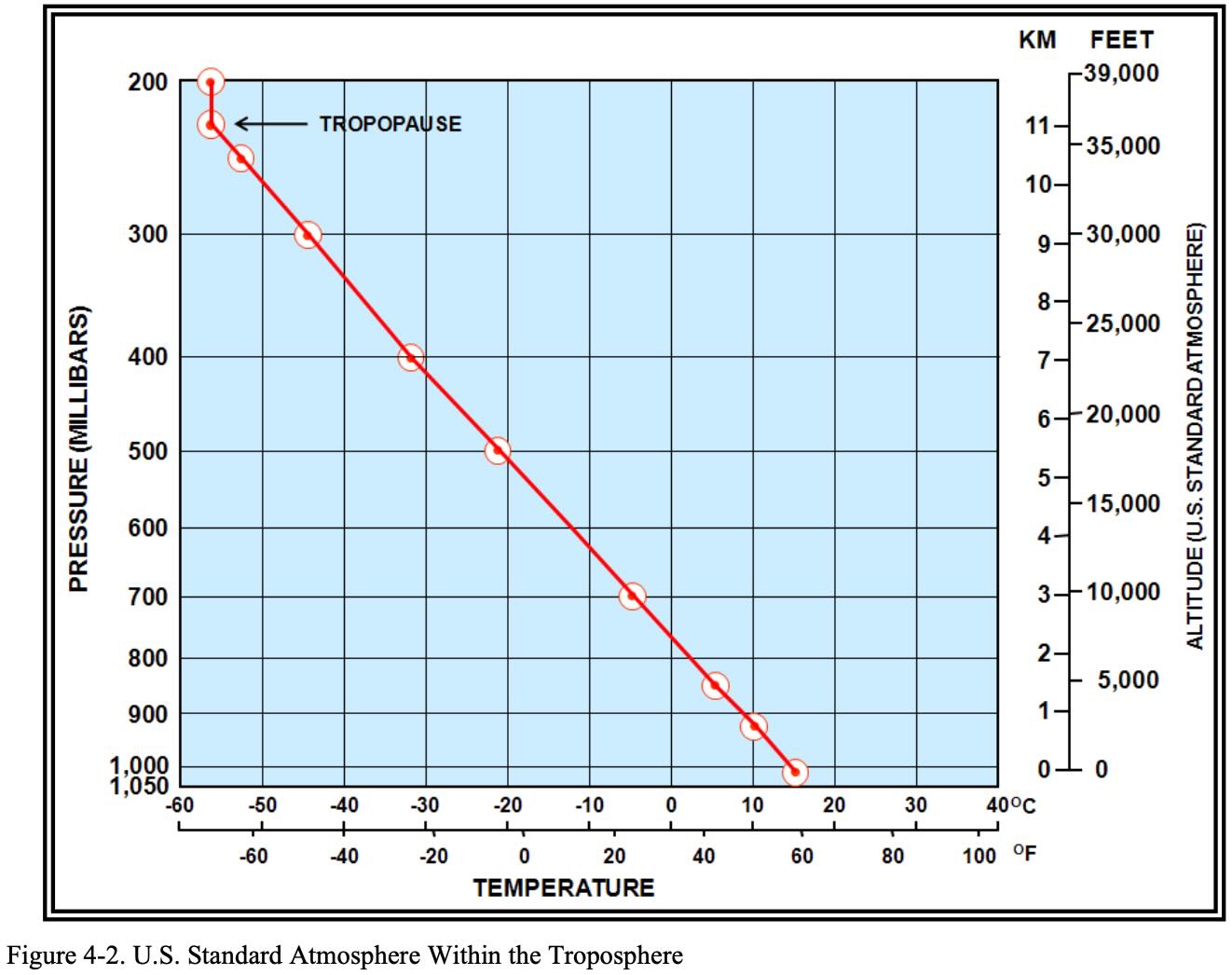
- Extends from sea level to approximately FL 350 around the poles and up to FL 650 around the equator.
- Tropopause
- Thin layer at the top of the troposphere that traps water vapor in the lower level.
- The location of the tropopause is important because it is commonly associated with the location of the jet stream and possible clear air turbulence.
- Stratosphere
- Extends from the tropopause to approximately 22 miles (mi).
- The stratosphere is characterized by lack of moisture and a constant temperature of -55 °C, while the temperature in the troposphere decreases at a rate of 2 °C per 1,000 ft.
- Troposphere
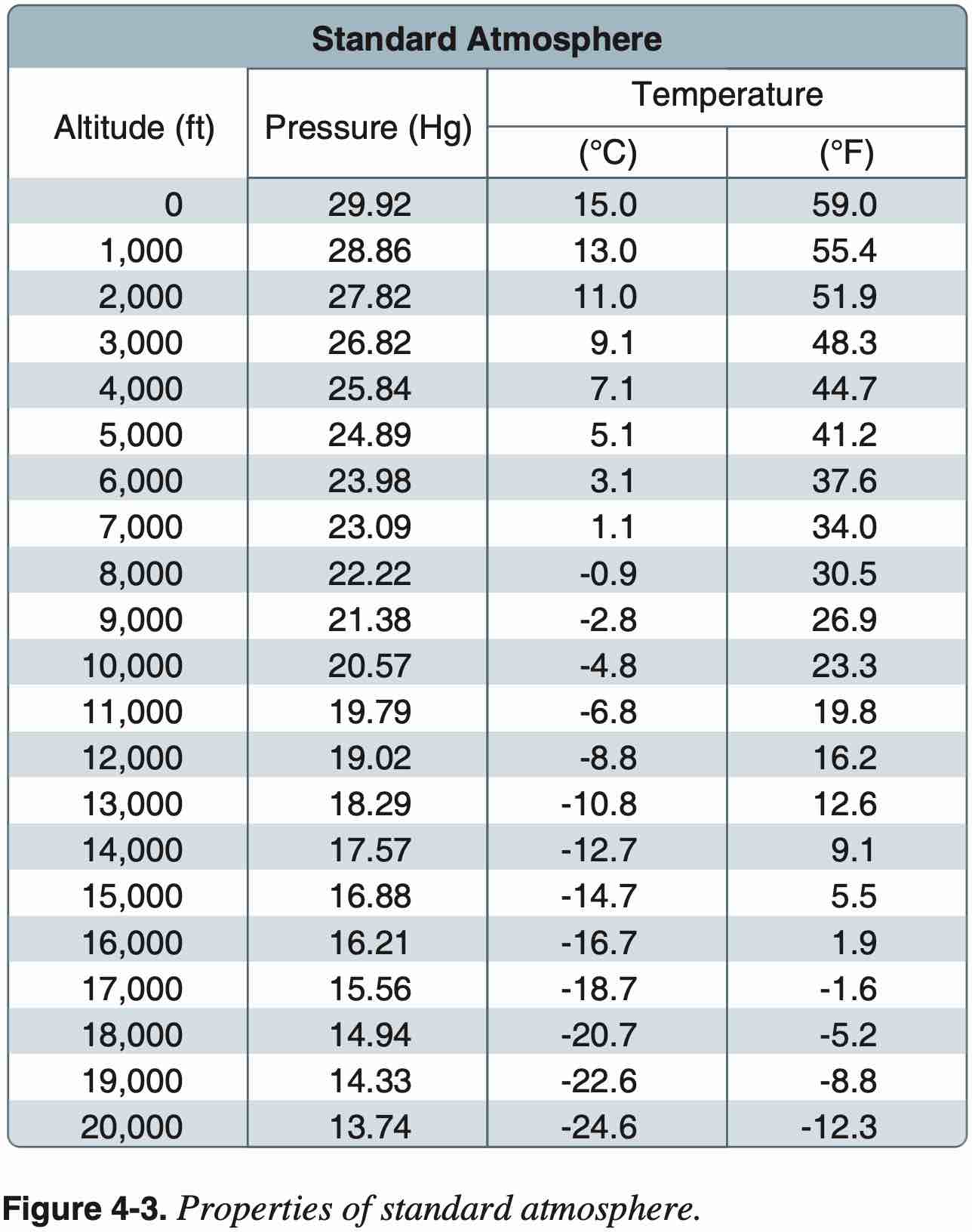
Jet Stream
- The jet stream travels from west to east at speeds up to 250 mph, but average speeds about 110 mph.
- The jet stream is stronger and further south in the winter.
- Horizontal wind shear and turbulence are frequently found on the northern side of the jet stream.
- Horizontal wind changes of 40 kts within 150 NM or vertical wind shear of 6 kts or greater per 1,000 ft usually indicate moderate to severe turbulence and should be avoided.
Clear Air Turbulence
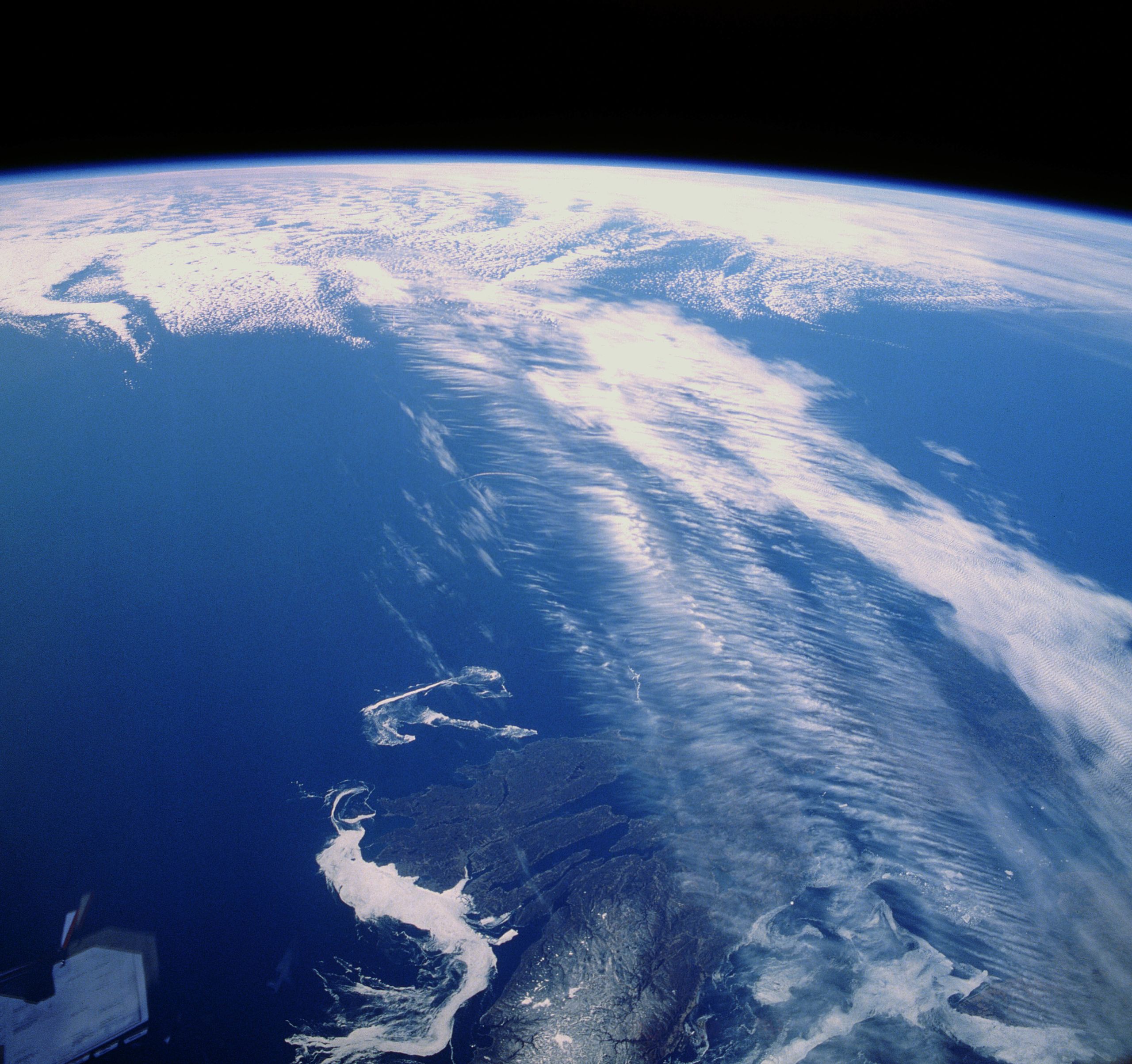
- Associated with jet streams is a phenomenon known as clear-air turbulence (CAT), caused by vertical and horizontal wind shear caused by jet streams.
- The CAT is strongest on the cold air side of the jet, next to and just under the axis of the jet.
- Can take place at any altitude (normally higher than 15,000 ft above ground level (AGL))
- Usually develops in or near the jet stream where there is a rapid change in temperature.
- CAT is generally stronger on the polar side of the jet and greatest during the winter months.
- Causes of CAT are wind shear, convection currents, mountain waves, strong low pressures aloft, or other obstructions to normal wind flow.
- CAT is difficult to forecast because it gives no visual warning of its presence and winds can carry it far from its point of origin.
- PIREPs are one of the best methods of receiving timely and accurate reports on icing and turbulence at high altitudes.
Clouds and Thunderstorms
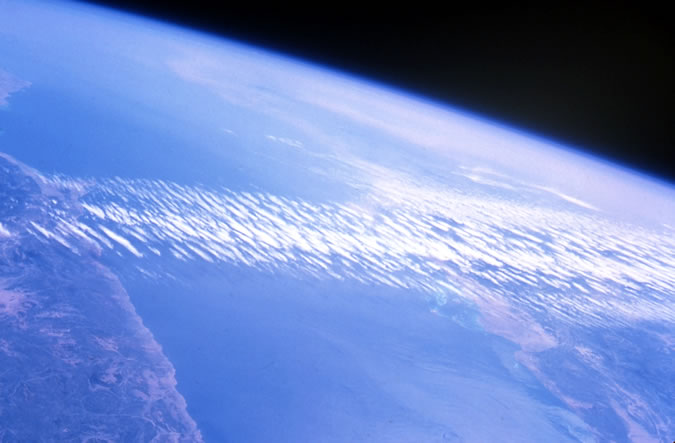
- Cirrus and cirriform clouds are high-altitude clouds composed of ice crystals.
- Cirrus clouds are found in stable air above 30,000 ft MSL in patches or narrow bands.
- Cirriform clouds, such as the white clouds in long bands against a blue background known as cirrostratus clouds, generally indicate some type of system below.
- The tops of cumulonimbus clouds can extend up to 60,000 ft MSL or more.
Icing
- Icing at high altitudes is not as common or extreme as it can be at low altitudes.
- When it does occur, the rate of accumulation at high altitudes is generally slower than at low altitudes.
- Rime ice is generally more common at high altitudes
II. Respiration
- Respiration involves the inhalation of a constant volume of gas per breath
- At altitude, the partial pressure of each constituent of atmospheric air is less
- This results in lower pressure gradient between oxygen in the lungs and across the alveoli to the red blood cells
- This results in decreased transport of oxygen to the red blood cells and decreased arterial oxygen saturation
- As an example, hospitalized patients will typically be administered oxygen when their SpO2 drops below 88%
Hyperventilation
Hyperventilation
An increase in the rate and depth of breathing that results in insufficient CO2 in the blood stream.
- Can happen when anxious, scared, or nervous
- Symptoms perceived by an aviator who is hyperventilation include
- Dizziness
- Lightheadedness
- Tingling
- Numbness
- Visual disturbances
- Loss of coordination
- Visual impairment
- Unconsciousness
- Hot and cold sensations
- Muscle spasms
- The treatment of hyperventilation requires a voluntary reduction in the rate and depth of ventilation.
- Treatment by slowing breathing rate or breathing into a bag
- The signs and symptoms of hyperventilation can be easily confused with those of hypoxic hypoxia.
- Rapid or deep breathing while using supplemental oxygen can cause hyperventilation
- Because hypoxia and hyperventilation are so similar and both can incapacitate so quickly, the recommended treatment procedures for aviators is to correct both problems simultaneously
- Administer 100 percent oxygen under pressure
- Reduce the rate and depth of breathing
- Check the oxygen equipment to ensure proper functioning
- Descend to a lower altitude where hypoxia is unlikely to occur
III. Effects, symptoms, and causes of hypoxia and any other high-altitude sickness
Hypoxia
Hypoxia
Not enough oxygen.
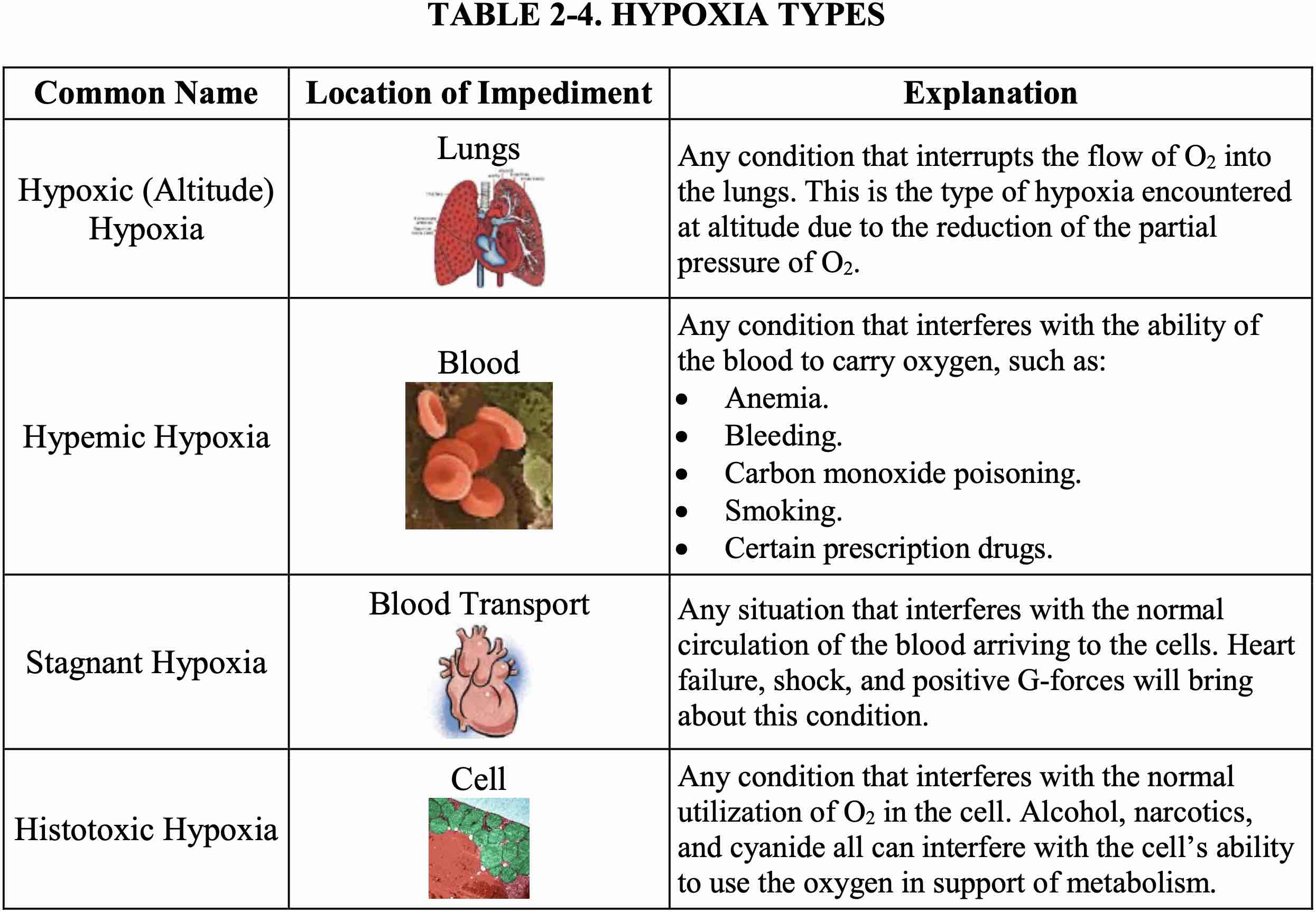
- The forms of hypoxia are based on their causes:
- Hypoxic hypoxia
- Insufficient oxygen available to the body as a whole
- E.g.: blocked airway, drowning
- The "normal" hypoxia we talk about in aviation
- Usually caused by the decreased pressure of oxygen at altitude
- Anemic or Hypemic hypoxia
- Occurs when the blood is not able to take up and transport a sufficient amount of oxygen to the cells in the body
- May be due to low blood supply, low hemoglobin, or CO poisoning
- Same symptoms as hypoxic hypoxia
- Stagnant hypoxia
- Blood not flowing to tissues that need it
- Also known as ischemia
- Can occur with excessive acceleration of gravity (Gs).
- Also from cold temperatures reducing circulation
- Histotoxic hypoxia
- The inability of the cells to effectively use oxygen
- This impairment of cellular respiration can be caused by alcohol and drugs
- Hypoxic hypoxia
- Symptoms of hypoxia
- Belligerence
- Euphoria
- Headache
- Decreased response to stimuli and increased reaction time
- Impaired judgment
- Visual impairment
- Drowsiness
- Lightheaded or dizzy sensation
- Tingling in fingers and toes
- Numbness
- False sense of security
- Blue colored lips and fingernails
- Tunnel vision
- Symptoms can take effect at 5,000 ft. at night
- Immediately reduce altitude, use oxygen, avoid alcohol
Vision
- Vision becomes impaired with lack of oxygen, especially at night
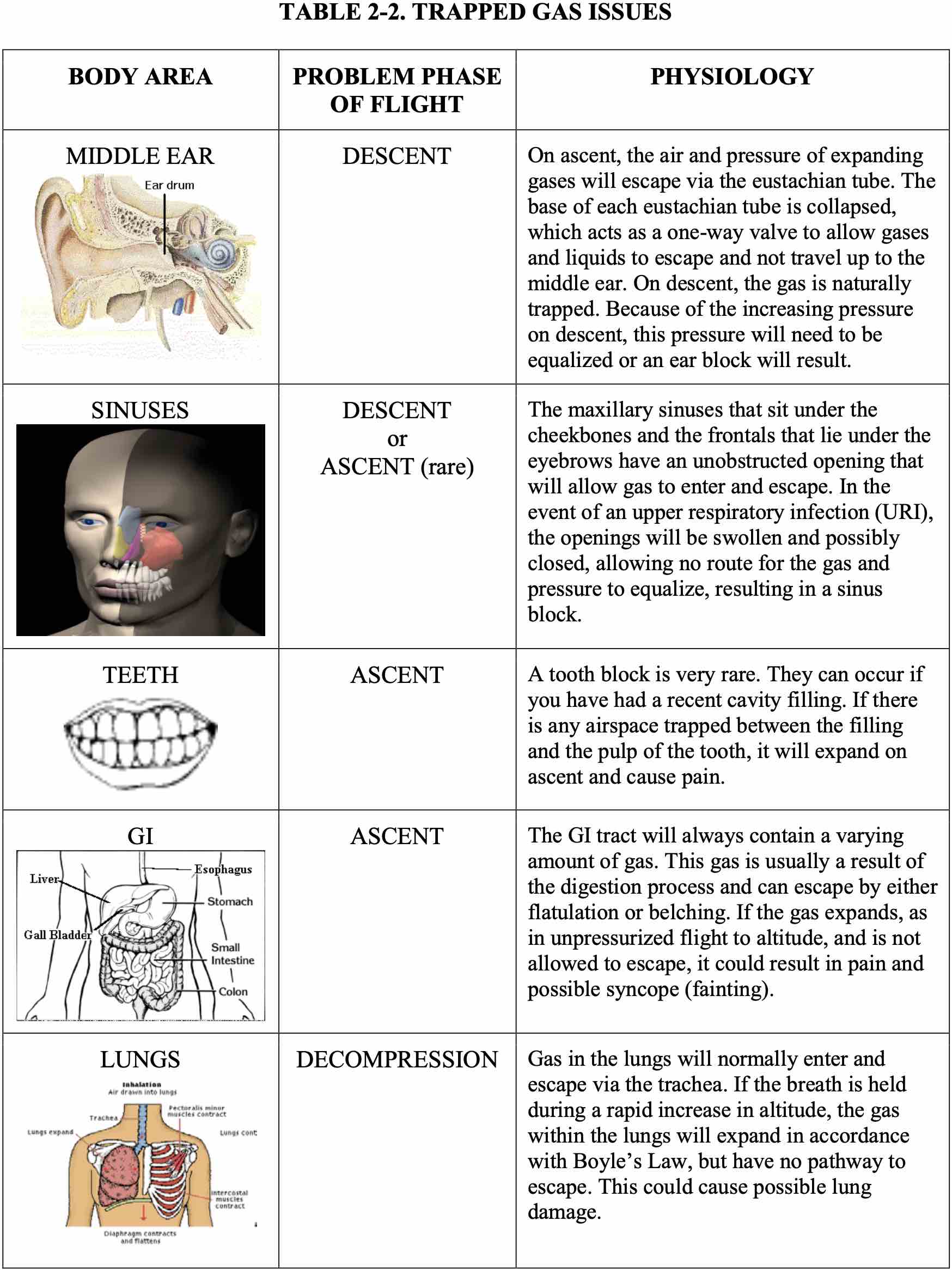
Trapped Gas
- When gas is trapped in cavities in the human body, decreased external pressure at altitude causes increased external pressure to be exerted from within the cavity, potentially causing pain
- See the table below
- Treatment generally involves
- Leveling off
- Attempt to clear the trapped gas (e.g. valsalva, yawn, sinus-clearing, burping)
- If cannot relieve the symptoms then land
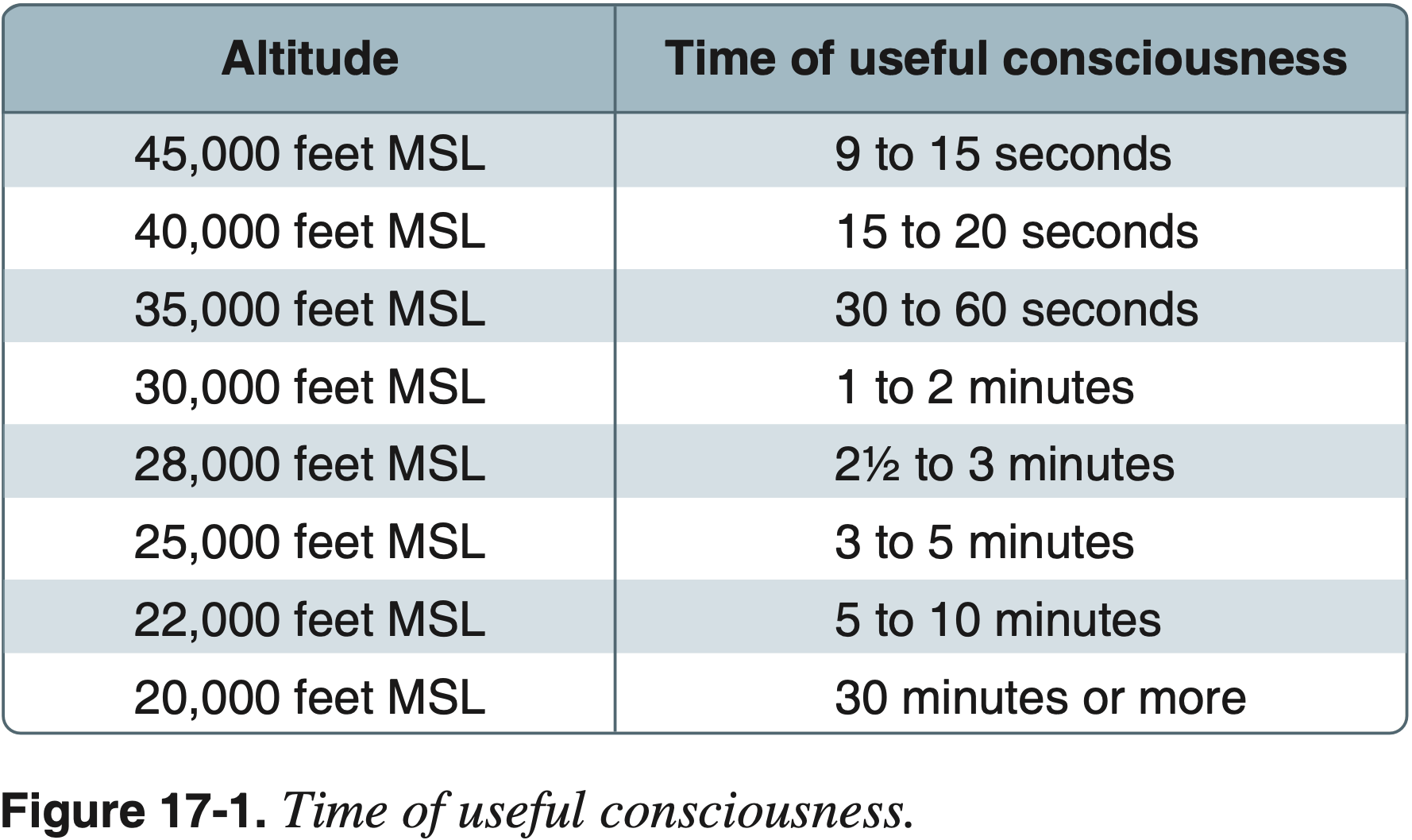
IV. Duration of consciousness without supplemental oxygen
V. Effects of prolonged usage of supplemental oxygen
- Take oxygen gradually to build up in small doses
- The sudden supply of pure oxygen following decompression can aggravate hypoxia.
- Prolonged oxygen use can be harmful to health.
- 100% aviation oxygen can create toxic symptoms such as the following if used for too long
- Bronchial cough
- Fever
- Vomiting
- Nervousness
- Irregular heartbeat
- Lowered energy
VI. Causes and effects of gas expansion and gas bubble formation
Nitrogen
- Decompression sickness
- Evolving and expanding gases in the body.
- Trapped gas-expanding/contracting gas in cavities during altitude changes can result in abdominal pain, toothache, or pain in ears and sinuses if the pressure change isn't equalized.
- Evolved gas
- With a sufficient pressure drop, nitrogen forms bubbles which can have adverse effects on some body issues.
- Scuba diving compounds this problem.
- SCUBA Considerations (Induced Decompression Sickness)
- Experience low barometric pressures => Nitrogen comes out of physical solution and forms bubbles
- SCUBA, wait 24 hours if flying above 8,000'. Below 8'000 feet, 12 hours
- After diving where a controlled ascent was not required wait at least 12 hours before flying to flight altitudes (not cabin altituddes) of 8,000 ft. MSL or less
- After diving where a controlled ascent was required wait at least 24 hours before flying to 8,000 ft. MSL or less
VII. Preventive measures for eliminating gas expansion, gas bubble formation, and high-altitude sickness
- To monitor for hypoxia can use a pulse oximeter
VIII. Physical phenomena and incidents of decompression
Rapid Decompression and Solutions
- Decompression
- The inability of the pressurization system to maintain its designated differential pressure.
- May be caused by a malfunction in the pressurization system or structural damage to the plane.
- Explosive decompression
- Change in cabin pressure faster than the lungs can decompress
- Less than 0.5 seconds
- Rapid decompression
- Change in cabin pressure where lungs can decompress faster than the cabin
- No likelihood of lung damage
- During explosive decompression, there may be noise, and one may feel dazed for a second
- During most decompressions, the cabin will fill with
- Fog (the result of the rapid change in temperature and change of relative humidity)
- Dust
- Flying debris
- Air will rush from the mouth and nose due to the escape from the lungs
- Differential air pressure on either side of the eardrum should clear automatically
- Exposure to wind blast and extremely cold temperatures may occur
- Primary danger of decompression is hypoxia.
- If proper use of oxygen equipment is not accomplished quickly, could quickly result in unconsciousness.
- Effective performance time-reduced to one third or one fourth of its normal time.
- Recovery
- Don oxygen masks
- Emergency descent
- Top priority: reaching safe altitude. Be aware that rapid descent from high altitude could result in cold shock in piston engines, and cylinder cracking.
- For explosive decompression, the time to make a recovery before loss of useful consciousness is even less.
- Slow decompressions are the most dangerous, and the aviator must always be on guard against this insidious threat.
IX. Any other physiological aspects of high-altitude flight
- TBD
Additional High Altitude Ground Training Topics
Pressurized Airplanes and Oxygen Systems
Oxygen Requirements
- 14 CFR §91.211 - Supplemental oxygen
- Oxygen requirements at various cabin pressure altitudes
- 12,500 - 14,000 ft MSL: flight crew uses supplemental oxygen for that part of the flight at those altitudes that is of more than 30 minutes duration
- Above 14,000 ft MSL: flight crew must use oxygen
- Above 15,000 ft MSL: each occupant is provided oxygen
- Pressurized cabin requirements at various flight altitudes
- Above FL250 need at least 10 minutes oxygen supply for each occupant
- Above FL350 one pilot needs to wear oxygen mask that provides oxygen continuously or automatically whenever the cabin pressure altitude of the airplane exceeds 14,000 feet (MSL)
- Exception: below FL410 if there are two pilots at the controls and each pilot has a quick-donning type of oxygen mask that can be placed on the face with one hand from the ready position within 5 seconds, supplying oxygen and properly secured and sealed.
Oxygen Systems
- In a mixture of gases, each constituent gas has a partial pressure which is the notional pressure of that constituent gas as if it alone occupied the entire volume of the original mixture at the same temperature.
- Components
- Mask/cannula
- Supply (bottle/air bleed)
- Regulator
- For optimum protection, pilots are encouraged to use supplemental oxygen above 10,000 feet cabin altitude during the day and above 5,000 feet at night.
- Most regulators provide 100% cabin air at around 8,000 ft, and 100% oxygen at 34,000 ft, with the ratio changing in between.
- Be aware of the danger of fire when using oxygen
- Masks
- Face worn mask or cannula
- Most masks are the oronasal type that covers only the mouth and nose
- Cannula only goes in nose. More comfortable, but is not as reliable at providing adequate oxygen.
- Current regulations require aircraft with oxygen systems installed and certified for operations above 18,000 feet to be equipped with oxygen masks instead of cannulas.
- Oxygen delivery systems
- Diluter-Demand
- Supply oxygen only when the user inhales through the mask
- Used up to 40,000 ft
- Pressure-Demand
- Supply oxygen to mask at positive pressure above 34,000 ft
- Used above 40,000 ft
- Continuous-Flow
- Most common kind in general aviation aircraft
- Usually provided for passengers
- Electrical Pulse-Demand
- provide oxygen flow during the initial portion of inhalation
- do not waste oxygen during the breathing cycle
- reduce oxygen 50-85 percent compared to continuous-flow
- Diluter-Demand
Pressurization
Aircraft more efficient at altitude
Can help avoid bad weather
Cabin pressure typically maintained at 8,000 feet
Differential pressure puts stress on airframe
Decompression
- Rapid / explosive
- Dangers
- Hypoxia
- Gas decompression sickness (nitrogen bubbles out of blood)
Relief valve
Gauges to monitor pressure
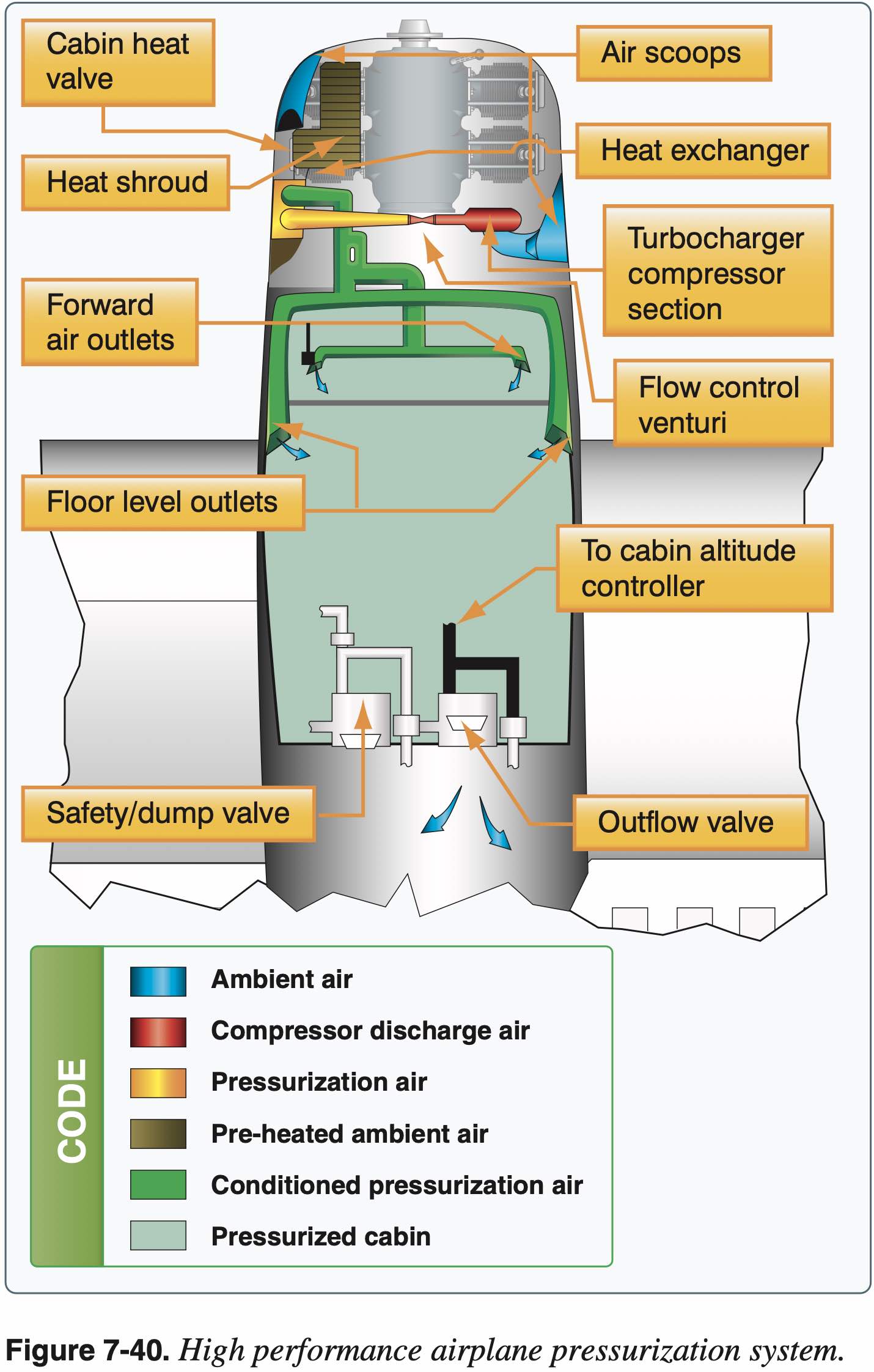
Cabin, flight, and baggage compartments are incorporated into a sealed unit capable of containing air under a differential pressure.
- Maximum differential pressure varies by airplane - be familiar with limitations
- Turbine-powered aircraft-bleed air from engine compressor section used to pressurized
- Light aircraft-turbocharger's compressor/engine-driven pneumatic pump used to pressurize. Compression heats the air, so it's routed through a heat exchange unit before entering the cabin.
Provides pressure regulation, pressure relief, and vacuum relief, as well as the means for selecting the desired cabin altitude.
Uses a cabin pressure regulator, an outflow valve, and a safety valve.
- Cabin pressure regulator (CPR)-controls cabin pressure.
- If we reach the maximum difference, an increase in outside altitude will result in an increase inside.
- Outflow valve-keeps pressure constant by regulating flow of compressed air.
- Safety valve-combination of a pressure relief, vacuum relief, and a dump valve.
Pressure relief-prevents cabin pressure from exceeding a predetermined differential pressure above ambient pressure. Vacuum relief-prevents ambient pressure from exceeding cabin pressure by allowing external air to enter when ambient pressure exceeds cabin pressure.
Dump valve-dumps cabin air to atmosphere.
- Cockpit switch.
Cabin differential pressure gauge-indicates the difference between inside and outside pressure.
Cabin altimeter-shows altitude inside the airplane. Differential pressure gauge and cabin altimeter could be combined into one instrument.
Cabin rate of climb/descent.
Importance of Aviator's Breathing Oxygen
- Specified at 99.5% pure oxygen.
- Not more than 0.005mg of water per liter.
- Medical oxygen-has too much water, which can collect in various parts of the system and freeze, reducing or stopping the flow of oxygen.
- Industrial oxygen-not intended for breathing, may have impurities in it.
Care and Storage of Oxygen Bottles
- Portable oxygen equipment must be accessible in flight if the airplane does not have a fixed installation.
- Oxygen usually stored at 1,800-2,200 psi. When the ambient temperature surrounding the cylinder decreases, the pressure within the cylinder will decrease-no reason to suspect supply depletion if you notice a drop in indicated pressure.
- Fire danger-materials that are nearly fire proof in ordinary air may be susceptible to burning in pure oxygen.
- Oils and greases may catch fire if exposed to pure oxygen and cannot be in oxygen systems.
- Smoking is prohibited during any kind of oxygen equipment use.
- Thoroughly inspect and test all oxygen equipment before each flight.
- Available supply, operational check, assure it is readily available.
- Do periodic inspections and servicing.
- PRICE checklist to inspect oxygen equipment
- Pressure - is there enough oxygen pressure and quantity to complete the flight
- Regulator
- Indicator - check to assure steady flow of oxygen
- Connections - all secured
- Emergency - have equipment readily available, brief passengers
Fundamental Concept of Cabin Pressurization
- Pressurized air from turbine compressor or turbocharger used to pressurize aircraft
- Cabin and baggage compartments pressurized
- Maintains cabin pressure about 8,000 ft MSL
Airspace Speed Limits
- Defined in 14 CFR §91.117 - Aircraft speed.
- Below 10,000' MSL: 250 KIAS.
- For C and D airspace, within 4 nm and within 2,500 AGL of the primary airport: 200 KIAS.
- Under or through (VFR cooridor) B airspace: 200 KIAS.
- These limits can be exceeded if safety requires it.
- Speed limits are in indicated airspeed.
- In addition 14 CFR §91.817 - Civil aircraft sonic boom prohibits the operation of a civil aircraft in the United States at a true flight Mach number greater than 1.
VOR Service Volumes
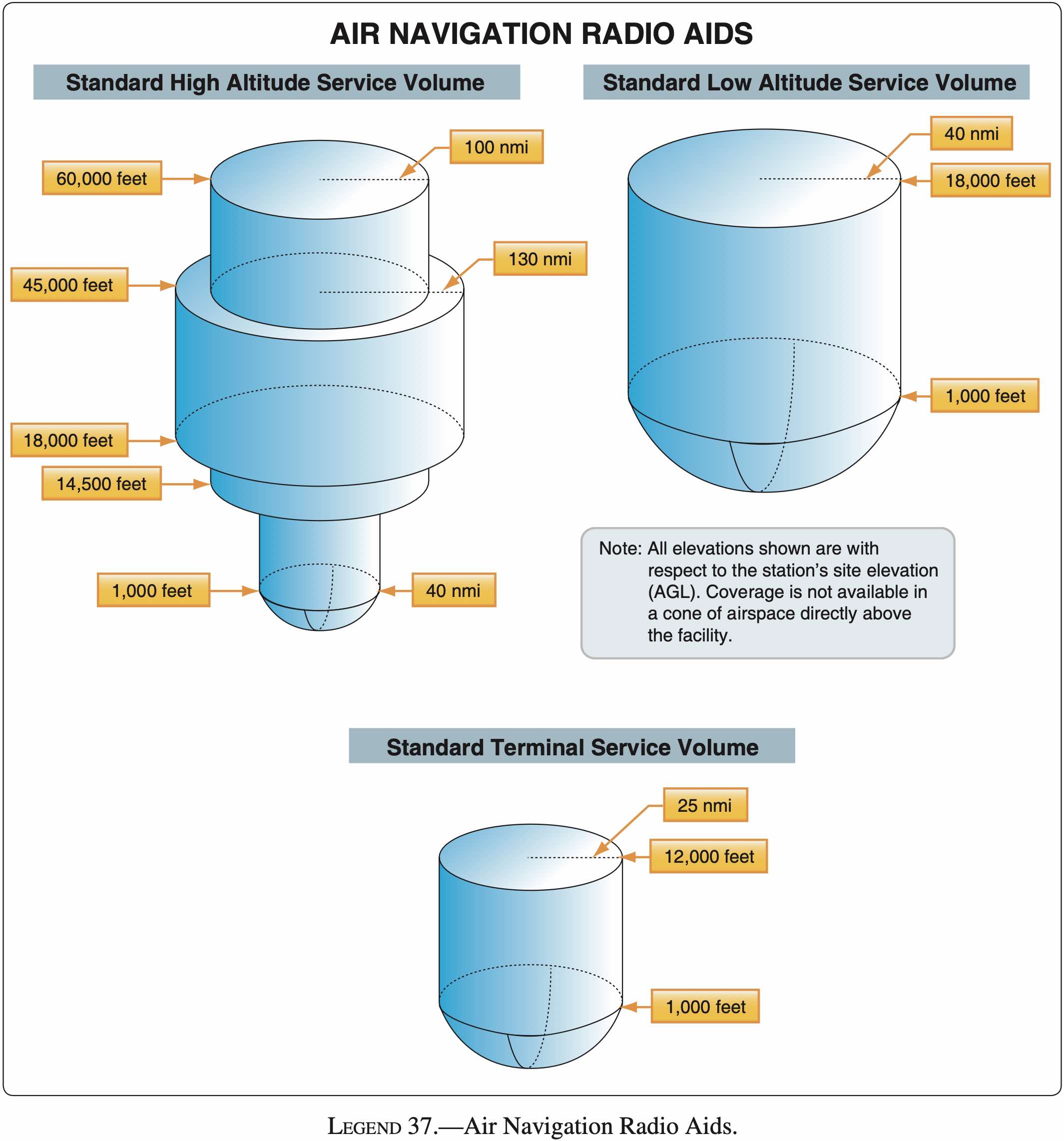
VOR, distance measuring equipment (DME), and Tactical Air Navigation Aids (TACAN) depicted on high-altitude charts are designated as Class H NAVAIDs
Also in AIM:
1-1-8. NAVAID SERVICE VOLUMES
a. Most air navigation radio aids which provide positive course guidance have a designated standard service volume (SSV).
- To find the service volume class of a given VOR
- Can find the service volume in the Chart Supplement.
- For example see
BOSTON (H) VOR/DMEindicating it is a high class(H)
- For example see
- See also: Aviation StackExchange How do you know if a VOR is High, Low, or Terminal?
- Can also check low and high altitude IFR charts to see which appear on each.
- Here it is implicit, but Low Class
(L)VORs will not appear on the IFR High Chart as their service volume tops out at 18,000 ft. AGL, and IFR charts are for use at or above 18,000 ft. MSL. - Note the difference between AGL and MSL. I don't know at what altitude the IFR high charts top out at, but there are Maximum Authorized Altitudes (MAA) so conceivably a Low Class
(L)VOR located at 10,000 ft. MSL, for example, would provide 40 nm radius of service up to 28,000 ft. MSL and be used on a high chart. - In any case, following what is on the IFR charts for VOR navigation ensures a pilot need not worry too much about the various service volumes.
- Here it is implicit, but Low Class
- Can find the service volume in the Chart Supplement.
Flight Training
I. Normal cruise flight operations while operating above 25,000 feet MSL
- Set altimeter to 29.92 when passing through FL 180
- Use high-altitude charts at and above 18,000'
- Follow manufacturers recommended procedures and checklists
II. Proper emergency procedures for simulated rapid decompression without actually depressurizing the aircraft
- Simulate the decompression by donning the oxygen masks, turning on the oxygen controls, configuring the airplane for an emergency descent, and performing the emergency descent as soon as possible.
III. Emergency descent procedures
- TBD